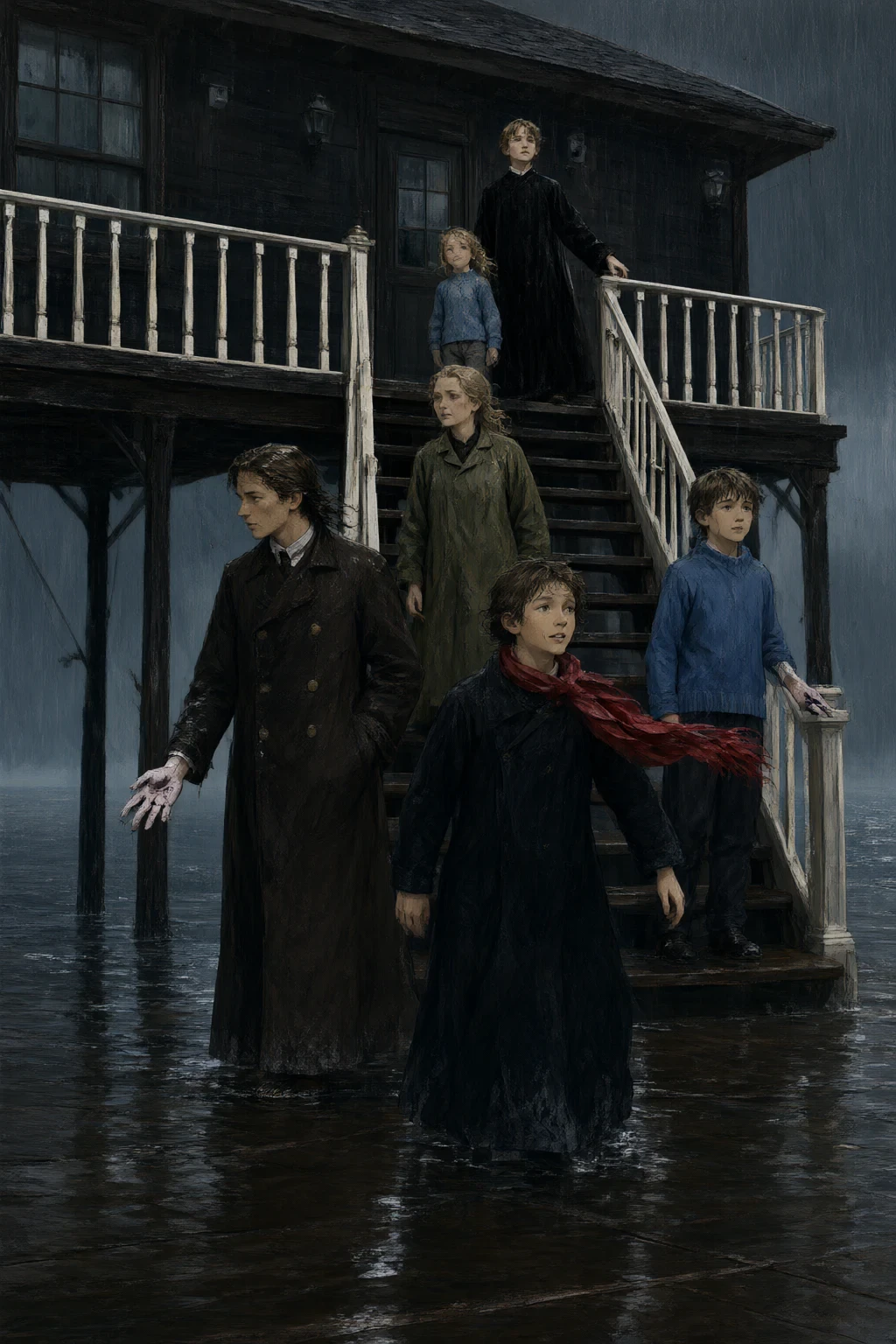
The boy came into the Servery at two in the morning on the seventh night with a rope in his hands and a book he could not put down, and he put it down on the scarred amber table, and it shut itself on a page, and the sound it made was the sound of a door in another county. “Amleth Curnow,” said Niko. “Nineteen. Rope-maker’s apprentice, out of the Greyhaven yards. He has been in the Servery every night since Thursday and he has not read a word.” “He has read four hundred pages,” said Amleth. “I read about the mill at Oransay, and the flood, and the man who cut the sluice, and I know what his mother called the dog. I have read all of that and I cannot tell you one single thing I feel about any of it, and I went to put my hand on the page and there was nothing under my hand.” He had rope-burned palms and he turned them over to show it. “And the book is on the mud Shelf, and I have carried it down here so that somebody will take it up and look at it, and one of you will tell me what is in it.”
“Nothing is in it,” said Anja Roe. “It is in it. That is the whole difficulty and I am not going to be unkind about it at four in the morning. It is in the book and it is yours and it was taken at a turning of a page, and the only two things in this building that ever get a part back are the spindle lamp and a person reading his own watercopy aloud in his own voice, and you are nineteen and you have a fortnight before you are eligible for the second one, and I am not going to spend the first half of a long night explaining to you why the first one is a knife.” “And what is it that has gone?” said Amleth Curnow. “Because you keep saying it as though it were a thing in a bag.”
“I have never once said the word out loud in my life without apologising for it afterwards,” said Anja. “Here it is, then. It is not a likeness. Nobody is copied. What is copied is a weight. A person reads and goes past a page, and the book takes up something and holds it, and what it takes is exactly as big as what was put in. A man loved can lose a man. A woman carried a fear forty years can lose a woman carried a fear forty years, and she will be exactly right about every other thing in her life, and there will be a place where the fear used to be, and nothing whatever in it.” “That is what has happened to me.” “Yes. And there is nothing in that book about the mill at Oransay that I can put back for you, and I am sorry, and I have said that word very few times in thirty-four years, and I am saying it now, and if you can find a better use for it than an apology, take it.”
The seventh night is the night the building grows a Higher Stair. One step appears somewhere in it, a step no harder than any other, and it is gone by morning whether or not anybody takes it. It has been in the Quire, in the Gallery, in the gutter of the Spine, and twice in a doorway that four hundred people walked through daily. Nobody has ever found it the same night twice, and the only thing the keepers agree on, in four hundred years, is that it does not appear where the building is quiet. “So we make the building quiet,” said Anja. “Now then. I am going to say the terms and I am going to say them once, and then nobody is to argue about them for the rest of the night, including me.” She stood at the head of the Servery table with her hood still back and her right hand in its blackened wool glove, and she had a piece of chalk in her left.
“No words. Not a name, not a title, not a date, not aloud and not to yourself, between now and first light. No lamp lit in any Room. No salt, no ash, no spindle, no blade, nothing that is a ward and nothing that is a key. We do this tonight the way a coast does a thing, with our hands and in the dark and slowly, and if the building wants to grow a step it will have to find six people who are not using it, because that is the only thing I know about the seventh night and I have watched it for thirty-four years.” “That is not a plan,” said Wray Imbrie. “That is a superstition with good manners.” “Then you had better bring a plan, borrower, and I shall be glad of it.”
They went down to the Maps Room first, because Perran Hesk was in it with his spectacles on their green string and a long sheet of paper, and because it is the only room in the building where the rain does not sound and the floor stays level. “It is Friday,” he said. “And you are about to be outside on a rising tide in the dark, which is the one condition I have written down twice in nineteen years and never once seen survived.” He put the plan out, weighted flat with two censers. “The Spine is out. It is the lowest corridor in the building and the gutter runs its whole length and the gutter is fed off the flat, so at the turn the Spine is the first room to fill and the last to empty. That is at two hours past five, call it. There is no interior route from the mud Shelf to the Servery that does not use it.” “The Quire,” said Wray.
“The Quire is bolted on the Quire side and has been since the day before the fever,” said Anja, “and the Quire is hot and dry and full of four hundred scraped spines and there is no second door out of it, in this building or in any plan of this building, and that is not a thing I have just gone and checked.” “So the only way is the Verandah.” “The only way is the Verandah,” said Anja. “Out of the low end, along the outside of the low side of the building, in the weather, in the dark, past sixty-one steps and the whole run of them, and in at the top.”
“Anja,” said Wray Imbrie. “Say the term and I’ll sign. But the term is that this is the long way round, and the long way round is not a longer version of the short way. It is a different thing. In there—” he moved his chin at the wall, at the building, at the whole of it “—everything is watched. Every Room, every shelf, every page that turns. Out there nothing is watching anybody, because out there there is no building. And a step does not grow in a place nobody is using, and I would like it noticed that I have given you the only useful thing I know.”
There are six of them, and four of the six are not keepers and were never going to be. Ilse Ranney was fifteen and read aloud to her little brother in Greyhaven every night and had therefore never once in her life been quiet, and she had asked to come, and Anja had said no, and Ilse had stood in the Servery until Anja had said yes. Tam Corrie was twelve and read only in the dark, which is a thing the Servery has always been full of on a winter evening and which is generally taken for atmosphere. It is not atmosphere. It is a boy who has worked out that the light is the price. Hesper Mull was thirty-eight and came up from the fish sheds twice a week to read the Atlas charts, because her husband had sailed in the spring and had not come back, and the charts say where the currents go.
Bree Salkeld was nine, and had been brought by her grandmother, and could not reach the rail, and had been given the only job in the building that a nine-year-old can be trusted with, which was to walk the whole length of the Verandah in daylight that afternoon and say out loud, to Anja Roe, every hook that had no lantern in it. Bree had counted nine. Anja had counted eleven. “Eleven is wrong,” said Bree Salkeld. “There are nine hooks. I have counted them since I was six because it is the only thing anybody has ever let me do properly.” “Then it is nine,” said Anja. “It was eleven on Thursday,” said Bree. “I did not count it wrong. I counted it. I am quite good at it.” Nobody said anything about that. Anja Roe, who had been the senior keeper of this building for thirty-four years and had put four hundred scraped spines onto a line in a single long night with her own hand, wrote the number nine on the inside of her left wrist in chalk where she could not see it, and then rubbed most of it out again, and left the one.
The six of them went down to the low end at twenty past three with no lamps. The rain had gone round to the north and come back as something finer, the kind that does not fall so much as hang, and the Verandah ran the whole length of the low side of the building above the water line with white railings and green bench seats and hooks at intervals for the storm lanterns. Every hook was empty. “Every one,” said Hesper Mull, who was thirty-eight and came up from the fish sheds twice a week to read the Atlas charts and had brought oilskins and a boat-knife she was going to be asked to put down. “I have seen them lit. I have seen them lit on a market morning with the wind coming off the flat. Somebody put them out, all of them, and not one of them has a wick in it, and a wick does not go out on its own.”
“Nobody in this building has ever been able to say who put them out,” said Anja. “That is not the same as nobody knowing,” said Wray. They went out onto the Verandah in the order Anja set, which was the two largest first, and then the rest, and then herself, and the door was left off the latch behind them, which is the one accommodation a coast makes for weather. The deck was wet and it was black and it was the same width as a corridor and it had no roof, and after about two hundred paces Niko understood why no one had ever put a lantern back on those hooks. The light there is not light. It is the black flat to the west, under cloud, and the white of the railings, and the water, and it is enough to see a step by and not enough to see anything else.
Ilse Ranney was fifteen and read aloud to her little brother in Greyhaven every night and had therefore never once been quiet in her life. “I have counted sixty-one steps since the door,” she said, “and I have counted them out loud, and I know I have broken the first term, and I am going to keep counting, because I would rather be useful and in the wrong than silent and in the right.” “That is exactly the right answer,” said Anja, “and I shall be arguing with you about it in about an hour.” The water came up on them in stages. It came first along the flat and made a shape of the building’s own reflection lying underneath it, and then it found the third step at the Porch and stood there, and then, at about ten past four, it came over the edge of the flat and got the underside of the Verandah, and you could hear the building find out.
Hesper Mull said, “That is the stilts talking.” “That is the stilts talking,” said Anja. “Eighty-one of them and they have not spoken since the last flood.” At the bottom of the sixty-one steps, where the Verandah runs out and the flat begins, the deck was under four inches of black water, and Bree Salkeld stopped dead. “Bree,” said Anja. “Up here. Now. You are nine and you go where the tall ones go.” “I am not stopping for me,” said Bree Salkeld. “I am stopping because there is a step in the water.”
Nobody spoke for a moment, and the rain went on hanging in the air, and the water went on coming up the deck between the white railings. “Describe it,” said Anja. “It is a step,” said Bree. “It is like ours. It is out in the water where there is only water. It is going away from the building, not going towards it, and it is not on the bottom, it is on the top, and the water goes over it and it does not go under.” “How far out?” Bree put her arm out and pointed with the whole of it, the way a child does, and her hand was very small at the end of it. “As far as the end of my arm, and then some.” “That is ninety feet,” said Wray Imbrie, “which is out on the flat, in open water, in the dark, on a tide that is coming in.”
“A step is a step is a step,” said Tam Corrie, who was twelve and read only in the dark and had therefore been the only one of the six of them who had not found any of this strange. “If it is out there it is out there and the sea has put it there, and if we go out on the flat tonight we will be going out on the step whether we mean to or not, and that is the whole of the seventh night in one sentence and I have been waiting four days for somebody to say it.” Nobody said it. “Now then,” said Anja Roe. “I did not see a step. I was at the top of those sixty-one steps with my hand on a rail and I was thinking about a boy on the mud Shelf, and that is what I was thinking about, and I will swear to that in any room in this building.” “I did not see a step,” said Wray Imbrie. “I did not,” said Hesper Mull. “I did not,” said Niko. “I did not,” said Ilse Ranney. “I did not,” said Tam Corrie. Bree Salkeld said nothing at all, and looked at the water, and then at Anja, and then at the water.
The mud Shelf opens straight onto the flat through a wooden hatch, and at the lowest tide of the year it is the best room in the Library, and on the seventh night at ten to five it was four inches deep in black water with the racks down and the two hundred volumes of the oldest and wettest books in the world standing up on them in rows like a choir. Amleth Curnow had been four days ago on the second tier, and Niko had his lantern off and his hands shaking, and the racks in the dark are a thing that has to be learned, because a wet book stands up on a rack with its boards open like a shell and every one of them looks like every other one and they are all different. “If you turn a page in here,” said Anja, “it takes something.” “I know what it takes,” said Niko. “I have been having it taken for two years.”
He put his thumb under the edge of a board and lifted it, and the title page was dark and wet and had four words on it in a gold that had gone to a brown, and he read them, because there was no other way to know, and it took him about a second and a half. The ink lifted off the damp paper and hung in the air for a moment and went into him, and he felt it go, and he closed the book, and took it off the rack, and put it inside his jumper against his chest. “That was one page,” he said. “That was one page,” said Anja.
“I know exactly what I have lost and I can name it, and I would like it said now, in front of witnesses, so that nobody has to find out by asking me later.” He was seventeen and he was not crying and his voice did not do anything at all. “It was the first thing I ever read in this building. It was a book about a ship that came apart, in my second winter here, and it was the best thing I had ever read, and I could not tell you one thing about it now, and I can still tell you that I read it, and I can still tell you I was happy, and there is nothing in the two facts joined together.” Nobody said anything, because there was nothing to say to that, and they went out onto the flat in the rain.
The way back was the whole length of the Verandah again, and the water was on the deck. It came over the boards in a sheet and it did not run, it stood, and then it came in a second sheet, and by the time they were at the bottom of the sixty-one steps it was over the top of the lowest bench seat and there was no way across it that a person would call a choice. “We go on them,” said Hesper Mull. “The benches. Four abreast, slow, and nobody lets go of the rail, and the rail is the only thing in this building that is not made of paper.” It took them twenty-two minutes. It is the single most-repeated figure in the oral history of this coast and there is no vote.
Halfway along, at the point where the Verandah runs out over the stilts and there is nothing under you but two feet of black water, the long red scarf came off Wray Imbrie’s neck and went out across the deck and away on the water, and he watched it go and did not go after it, and that was the single most human thing anybody saw all night. The Servery had a fire in it and the fire had been in it for two hours and nobody had put a fresh log on, and Amleth Curnow was sitting at the table with the rope in his lap and his hands open. They put the book down in front of him in the dark and he did not touch it for a long time. “It is not the right book,” said Niko. “It is the right book,” said Anja. “Say the rest of it.”
“It is the right book and it is not the right page, and the right page is in it, and the last thing that happened in that book is a man on a mill in Oransay with his hand in the water, and if I open it there I will find the mill again, and there will be nothing under my hand.” He turned his rope-burned palms over. “I have come down here four nights running to be told to stop. Nobody has told me to stop.” “Open it,” said Anja. He opened it there. There was no spindle lamp in the Servery and there was no salt on the sill and nobody in that room said a word. The page simply came back up off the paper and went into him and Niko watched a nineteen-year-old rope-maker discover in the space of four seconds that he is the most fortunate person alive, and watched him put both hands flat on a wet page and leave them there for a long time, saying nothing, with his shoulders moving.
They were on the Roof at half past six, in the wind, with the whole black flat laid out west of them under a moon that had come out and made the whole of it white. “If a step is out there,” said Ilse Ranney, “then in a month there will be eleven. That is how it works. I have listened to a hundred years of my grandmother and that is how it works.” “It is gone by morning,” said Anja. “It is gone by morning,” said Hesper Mull, “and it is not gone by morning the other thing is, and the other thing is that Perran is going to want a page for the seventh night, and Perran is going to want it written down, and there is not going to be one thing on it.” Which was true.
Perran Hesk had the fair sheet on the oak table in the Atlas Room by seven, with the date and the place at the top and the ruled lines under it, and the first line was the one every sheet in this building starts with, which is a list of who was in the building. “It is the only form I have ever used,” he said. “In nineteen years. Who was in the building, and where, and at what hour. And this is a fair sheet for the seventh night, which is the night I would most like in the whole calendar, and I have got nothing for it at all, because six people were outside on the low side of the building in the dark from three until six, and the building did not see a single one of them.” “Write the word none,” said Anja. “None is not a true entry,” said Perran. “None is what a man writes when he has not been in the room. And in nineteen years I have never once written none on a sheet that mattered, and I am not starting at fifty-one.”
The next part of the fair sheet was harder, and Anja Roe knew it was coming, and had known it was coming since Tuesday. “The witnesses,” said Perran. “The line under the list is who saw it. On a flood night I would write six names. Tonight I have six people who were all in the same place and none of them will say the same thing about it, and I am obliged to enter it as one statement or enter it as six, and if I enter it as six the sheet is nonsense, and if I enter it as one statement I am writing down something I did not see.” “You will enter what you were told.”
“What I was told is that a nine-year-old girl saw a step standing in the water off the Verandah, and I believe her, and if I put that on a fair sheet of this Library it will be in the record for four hundred years, and there is not a keeper in this building who will be able to raise it again without raising the whole of the seventh night with it.” He put his pencil down. “You had better do it yourself, then,” he said. “You were the senior keeper on the flat. Say it, or do not say it, but do not make me write it.”
Anja looked at the sheet for some time. The Servery was across the Spine and the light was on the long table and the kettle was not singing, because Niko had not put it on. He had told Anja, three weeks ago, on the morning after the lowest tide, that he did not know whether he would ever want to hear it again, and had then said that he would want to hear it, and had not put it on. “Rowan Roe,” said Perran, gently, writing nothing. “Your mother. The line under the witness is for the Ridge Road. On a flood night people come down the Ridge Road to watch the water come in, and half of my entries are names of people who were standing up there in the dark, and you have done it every year of your life.”
The tidemark on the wall behind him was a pale line at exactly one height, the same height it had been that morning, the same height it was in the Servery and on the rail and on the sill. “I do not know,” said Anja Roe. “That is not a thing the form takes.” “Then the form will have to be a new one,” she said, “and I shall write the new one, and it will be a bad one, and it will have a line in it that says a keeper may enter that she was not on the Ridge Road and does not remember, and Perran, I am telling you that I have been the senior keeper of this building for thirty-four years and I have got to the end of what a fair sheet can carry.” He wrote it down, in his even hand, with a date and a place and an index.
At seven o’clock, with the sun up and the flat already going off in long grey sheets, they went out on the flat in daylight, which is the one thing about the seventh night that nobody ever enjoys and everybody does. There was no step in the water. There was no step anywhere. The sea was a quarter mile off and the hard sand was ribbed and the six sets of boot-marks were all still there, and the building stood in its own reflection, doubled, upside down. Bree Salkeld went down to where the water had been and stood a long time in the middle of it, looking at nothing, with her grandmother holding her coat. “I did see it,” she said, to the sand. “Did you, love,” said her grandmother, who had not seen anything either, and had not been anywhere near the Verandah, and who said it in exactly the way that people on this coast say things to children at the seventh hour of a morning in the ninth month of a year when the water stood ninety feet off the front of a library and then did not.
Perran Hesk entered the night on the fair sheet for the seventh day, and the entry of the seventh night is a line, and the line is this, and it is the only line in the fair sheets of the Tide Library that has ever been written six times over in six different hands. The seventh night. The Higher Stair. Seen by: did not see. And on the Rail of the Verandah, at the point where the deck runs out over the stilts, where the white paint has been rubbed back to the timber by three hundred years of hands laid on it in weather, there is a place about the width of two fingers where the paint is not rubbed back at all. It is as though a step had stood there. It is the colour of clean salt, and it is exactly the height of the tidemark on every stone and post and boot and cheek in this building, and there is no water within four hundred yards of it.