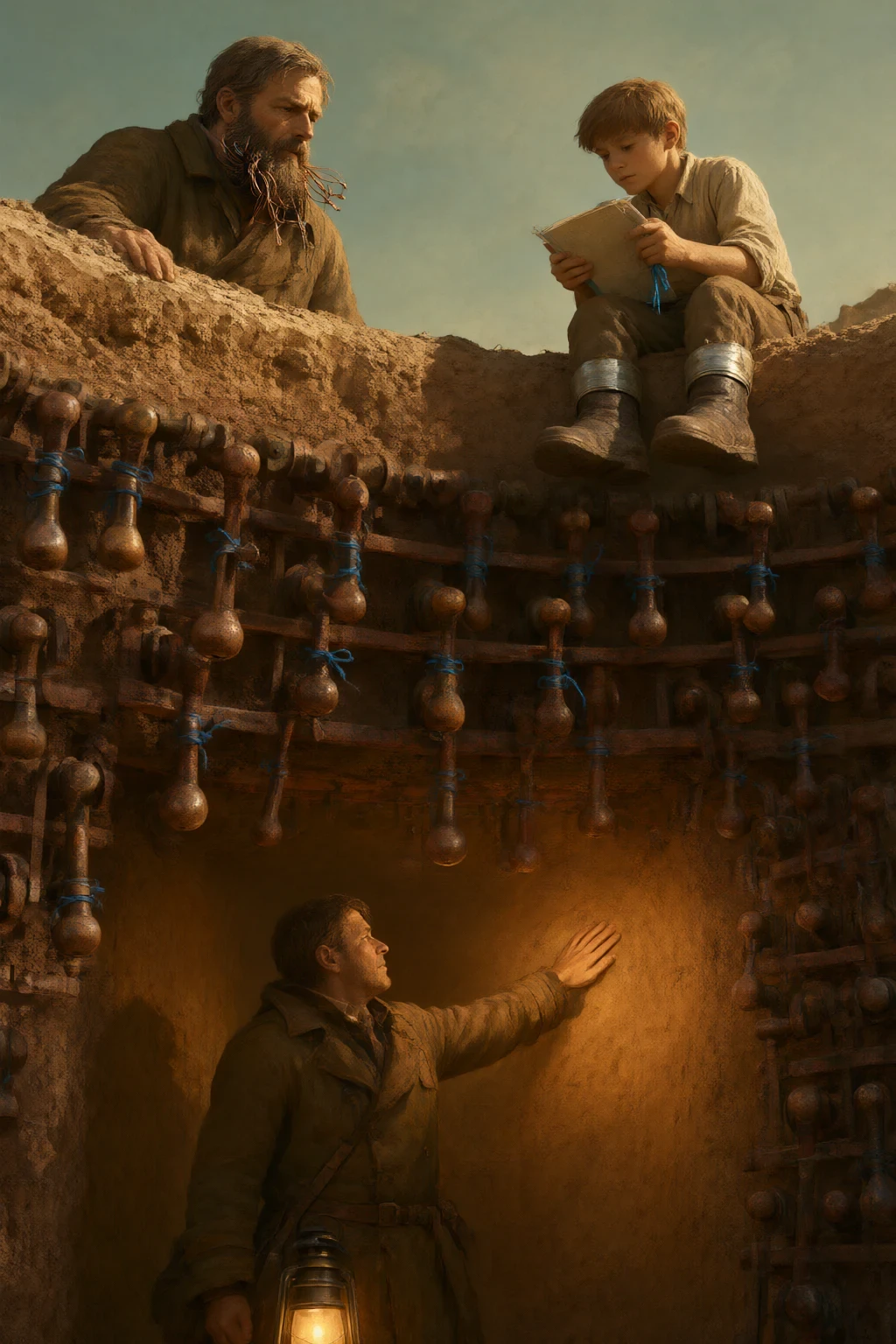
The Hour Yards at Kellvetch held nine hundred and six thousand hours of ballast in the spring, and Captain Rell Ferrite stood at the head of the fourth aisle on the morning of the ninth and did the only thing he had ever wanted to do, which was to find out how long the Line had left. The racks go down into the clay like corkscrews, four hundred jars deep, and the packers work the aisles in shirtsleeves, and every handle in the yard is tied with a loop of blue twine so that a bad one can be spotted from the ridge. He had them read out to him by three separate men on three separate days and he added the three answers together and then he took one of the answers and subtracted it from another, and the two numbers would not agree, and he made them agree by sending his own people back down with a tally stick, and they came back with the same figure twice. Nine hundred and six thousand. He did the sum in the open because he did not trust himself to do it in a room. Nine hundred and six thousand hours, at the burn the Long Noon was making on a full circuit with ninety tons of extra ballast on the sheets, was nine circuits. Nine circuits was a dry season and a little. Nine circuits was until the middle of next winter, and then the Line would have nothing left to burn, and a steam-and-balloon train with nothing left to burn does not stop. It comes apart. The carriages lose the hour that is holding them to each other, one coupling at a time, the way a chain comes apart at the end you are pulling, and it is not a wreck exactly. It is a train that has stopped having ever been a train. “Right. Listen,” he said, to the aisle, to the clay, to nobody. “Nine.”
Sol Brannen had the whole Line’s books by the fifteenth, because he had asked all eleven engines for a total and had been sent eleven totals, and he laid them out on the desk in the Ledger Room in a grid, in green ink, in his own hand, and the grid was a picture of the same number copied eleven times. Every engine’s first register has the same page eight. The founding convention was written once, in the second year, on the Long Noon, and it was copied out to the other ten engines when they were built, because a convention is a convention and a railway is a railway, and the clerks did not copy it because it was true. They copied it because it was on the page. Taken this season, 876,000. Whereof fares 0. Standing 876,000. Carried. Eleven times eight hundred and seventy-six thousand is nine million six hundred and thirty-six thousand hours, and the Line’s own count has no leap years, and nine million six hundred and thirty-six thousand divided by eight thousand seven hundred and sixty is exactly eleven hundred, and so the total debt of the Ochre Basin railway was, in the only sense anybody had ever been able to give it, eleven centuries.
“A hundred years a page,” said Sol. “And a hundred years an engine, and eleven engines, and no arithmetic anywhere that makes it a smaller number or a different one.” “And a hundred years of the ground in every one of them,” said Ivo Tarrow, from the doorway. He had come four hundred miles for the first time in twenty-two years, because there is a bell at Kellvetch as well as a bell at Emberwhistle and both of them are rung by hand and he is the only man left who does it. “I have said this to four people now and four of them have written it down and none of them has done anything with it, and I am sixty-two, and this is the last time I am going to say it, and I would like somebody to do something with it before I stop.” “The debt is not the problem,” said Sol. Ferrite looked up sharply. He was a heavy man with a braided beard through which three fine copper wires were run, singed at the ends from leaning over firebox doors, and he had come down from the yards that morning and had been standing since six. “Nine circuits is the problem.”
“Nine circuits is a fact about the reserve. The debt is a fact about the book, and they are the same fact, and here is how.” Sol turned the grid round. “Every hour that goes into a firebox has to come from somewhere. It comes from a rack, or it comes from a man. If it comes from a rack, it is entered on the spend side, and there is no matching entry on the intake side, and the difference is the debt, and the difference is exactly what is in the racks. The Line has been eating its own capital for forty years. The debt is not a debt to anybody. The debt is the capital, and the capital is going.” “Then it is the same thing.” “It is the same thing, and it is worse than the same thing,” said Sol, “because a capital can be replaced, and there is nothing in the Ochre Basin that makes time. There is the third stratum, and it is worked out to the two hundred and eleventh foot, and under it is ordinary rock, and ordinary rock has never given anybody an hour in its life.” Silence in the room, and the tick under the floor, half a beat behind. “So there are three things we can do,” said Sol. “We can confess. We can discharge. We can stop.” “Confess is a word,” said Ivo. “What is confess in practice.”
“Put the mechanism in the register in full, in the finding column, the way I did it on the Long Noon, and let the Basin read it. It is legal, it is one line of my schedule, and it will be in every register in nine days, because a finding carries. Then eleven hundred years of a ground with no payer against it will be in the book of every railway in the Basin, and every customer will be a customer of a railway that runs on stolen time, and that will be the end of us, and it will be the end of us in about five weeks.” “And discharge.” “One hour of the debt per true name spoken, once, and a year off the Line for whoever speaks it. Once in a lifetime.” Sol took his glove off and looked at the green ground into his thumb. “The whole Line, at the moment, has eleven hundred years in it and approximately four thousand people, and four thousand people at one hour each for one year of exile apiece is four thousand hours, and four thousand hours is one hundred and sixty-seven days of the Line’s existence, out of eleven hundred years. We could clear the whole Basin in the time it takes to boil an egg, and then the Line would have nothing in it and would come apart on the ballast between Kellvetch and Sirocco with two hundred people on it.” “And stop.” “Stop,” said Sol Brannen. “And be honest about it, which is the only one of the three I would recommend and the only one that ends with a railway in the ground instead of a railway in pieces.” “Wrong,” said Captain Ferrite.
Nobody asked him why. He had a braided beard and three singed wires in it and he had been in the engine room since four o’clock, and he had walked up the length of the yard and read nine hundred and six thousand hours into a tally stick and had come down here to be told by a man with a pen that the machine he was responsible for was a criminal. “There is a fourth,” he said. “There is not a fourth.” “There is, and it is in your own grid, Ledger-keeper, and you have been looking at it for six days.” He put one thick finger on the middle column. “Intake. Nine million six hundred and thirty-six thousand taken. Three per cent of it is fares. The other ninety-seven is the standing charge, and the standing charge is billed to eleven districts and it has never once been entered, because there is no schedule anywhere in this railway for entering a charge the customer did not sign for.” He looked around the room. “Enter it.”
The argument took two days and it was not a discussion, because all five of them already knew the answer and were spending the two days finding out what it cost. The standing charge is the annual bill the Line puts on the districts of the Ochre Basin for the privilege of having a railway. It has been levied since the sixth year. It is not a tax and it is not a fare and it is not a tariff; it is an entry in a book that the districts are told to pay, and the payment is in minutes out of the body, the same as a fare, and no one at any point in the chain of it signs anything. That is the whole crime, and Sol Brannen had it in a sentence by the second morning, and the sentence was this: a fare is a thing two people agree to and the standing charge is a thing one person does to four thousand households at nine hundred miles, and the only difference between them is that one of them is written down. “Can they agree to it?” said Ivo. “They can refuse it.” “Have any of them ever been asked?” “No.”
“Right,” said Ferrite. “Then they have not refused it. They have been done to it. And the difference between being done to a thing and refusing a thing is the entire difference between a crime and a contract, and we are going to go and find out which one of those it is, in one day, along nine hundred miles, and we are going to write down what they say.” “You understand what you have just proposed,” said Sol. “Four thousand households will be asked to sign for a century, and a century is nine days and six hours a year, each, out of their own bodies, and the ones who understand what is being asked will refuse, and the ones who do not understand will be frightened, and there is no version of this in which we do not come back nine hundred miles having ruined a good many people for a number that will not change by more than an hour.” “Eleven hundred years is a number that will not change by more than an hour,” said Ferrite, “and the day after we get it changed by an hour, it is the first hour in forty years that anybody in this Basin has ever been able to give back.” They went east on the seventeenth, out of Emberwhistle, with the bell rung by hand at both ends of the platform as it has always been rung, which is a formality at the western end and the first bell the town of Kellvetch has rung in eight years, because the eastern terminus has no Ivo and has never had an Ivo and rings its bell with a length of cable and a boy, and Ivo Tarrow got off the step of the brake van at the head of the Yard and rang it himself, four strokes, by hand, with the rope, and stood there afterwards with his hand still on it.
It took him a while to get up the ladder, and the whole eastern terminus came out to watch a sixty-two-year-old ticket-keeper from the western end try to get his hands on a rope that a boy has been hauling at for eight years with a knot in the wrong place. He got there, put both hands on the rope and pulled, and the bell is a good one, a barrel of riveted brass gone green at the edges, and it made the whole of the Hour Yards go on humming for a minute afterwards in all their aisles at once, four hundred racks deep, and every packer in the pit heard it and stopped working, and a Yard foreman took his hat off and did not put it back on for the rest of the morning. “Eight years,” he said, to the boy holding the other end of the rope. “You are hauling at the fall instead of at the crown, which is why it has been sounding like a bucket all this time, and I have heard it every time I have come in here and I did not think a man could be beaten by his own bell for eight years.” He handed the rope over. “It is not yours because it is the only one. Ring it by hand and the town hears a train. Haul at a cable and the town hears a bucket.” The boy said, “They say it used to be rung by a man who came from the west.” “They say a great many things about that bell,” said Ivo Tarrow, “and about the man, and about his brother, and none of it is the bell’s business, and all of it was true.”
They came into Sirocco at four in the morning and the Underdune Bazaar was already open, because the market opens when the first train releases a jar of stored morning light, and the whole place stands in low amber light under a three-hundred-foot dune whatever the hour, canvas roof and bottled sunrise, thunder flasks and salt and cloth, and at the back behind the curtains, unwrapped only for the buyer, the sealed memories. Nim Ferrous had the fare ledger and Odalys Fenn had the stall ledger and between them they had three days. Odalys Fenn was thirty-three and had sold bottled afternoons out of the fourth aisle for eleven years, and she kept her own book, in pencil, in her own hand, and she was the only person in the Ochre Basin who wrote down what she had taken, and when Captain Ferrite and the Ledger-keeper and a courier came down the aisle at four in the morning and told her what the question was, she did not need it explained twice. “Two hundred and nineteen hours a year,” she said. “Per household. Signed for.” “Yes.” “That is what the charge has been for forty years and I have always known it was a charge and never known what it was a charge for.” She had her pencil out before he had finished the sentence. “How many households.”
“Four thousand one hundred and nine on the Line’s books. We have four hundred and six today in this town and the train.” “Four hundred and six, and I can do about ninety before the market gets busy, because there are ninety stalls in this aisle and every one of them will want to know first.” She wrote 219 at the top of a fresh page. “And I am going to ask them whether it is a choice, and I am going to tell them that it is not, because it is not, and because if I let them think it is then I am doing the same thing the Line has been doing for forty years, and I have a pencil and I am not going to do that.” That is the sentence that made the day possible, and it was said by a woman selling afternoon light in a market under a dune, and not one member of the party heard it as remarkable, at the time, and all of them heard it again for years afterward.
Septimus Vail came east on the seventeenth with the rest of them, because Vail went wherever the Line went and had done for nineteen years, and he took a corner of the third coach with a case of samples and a white panama hat and sunglasses cut from smoked window glass, and for the first four hundred miles he did not know what any of it was about and sold two afternoons out of the case to a Yard runner and was cheerful about it. He was cheerful about it on the fourth hour, and then he read the fare ledger over Nim Ferrous’s shoulder, and the cheerfulness went out of him like a lamp going out of a room, and it did not come back on the ridge, and he was very good company for the rest of the circuit and nobody enjoyed it. “Where do they come from,” he said, at the second mast, to nobody in particular. “I have asked that question of one person in nineteen years and I got a bad answer and I did not think about it again, and I want to ask it properly now, so I am asking it now, at the second mast, to whoever wants to answer it.”
Sol Brannen answered it, at length, standing in the aisle with his glove off, and Vail listened all the way through without once moving, and at the end of it he said: “I knew. I want that on the record, because I am going to want it later, and because I am a man who asks the price out loud before he agrees to anything, and I have never once asked where the thing was. Nineteen years, two hundred and eleven thousand customers, and I have never asked where a jar came from, and the reason I have never asked is that I did not want to know, and I want that in the register too, in my own hand, with the day on it.” He did not shout, and he did not weep, and he went and sat down on the ballast with his back to the engine and looked at his own hands for a long time, and then he came back in and worked out, on the back page of his own grey ledger, what his trade is worth under the new arithmetic, which took him the better part of a night and which nobody had asked him to do.
The answer, when he had it, was this. For nineteen years he had been selling a quantity that belonged to nobody, out of a stock the Line had not counted, and he had done it with a white hat and a fair price and a sincere belief that he was in the afternoon business. From that week he was in the lending business, and the stock had an owner, and the owner had a household, and the thing he sold was a loan against a named debt, dischargeable one hour at a time, once in a lifetime, by anybody with a year they could afford to lose. He had gone into a famine and come out the other side into an ordinary trade, and he did not know whether that was good, and he was not a man who is comfortable not knowing. “What is it worth to me,” he said, to Odalys Fenn, at the pitch in the fourth aisle on the fifth day. “I have been selling a thing that was nobody’s for nineteen years, and now it is going to be somebody’s, and I have not the least idea in the world what to do with that. Same again?”
The fifth household on the list for Sirocco was not a household, and nobody had noticed for four days, and the reason nobody had noticed is that the register is sorted by street, and this one was a line in the Long Noon’s galley book with no street against it, off the standing charge, for seven years, under the heading small mouths, in the steward’s hand. Marmalade is fed by the cooks of the Long Noon. It is an arrangement nobody has ever made and nobody has ever broken, and the steward’s book is the only document in the Ochre Basin that records her, and it records her as a quantity of food and not as a person, and it is signed by four different stewards in seven years, and if you asked any of them who was paying they would have told you that the Line was, and if you asked them what the Line was paying for they would have looked at you.
Nim Ferrous found it on the sixth day because Marmalade was on the list, having gone through the whole of the Sirocco book in one night and put a mark against every name she could not place, and there were nine marks, and one of them was a nine-year-old girl who came out from under the brake van and said, in a confidential whisper, at volume, that the galley had not been doing it, the galley had been covering for the second cook, and the second cook was in the second aisle with a stall of his own and had been for six years. “And he feeds me,” she said, “and he is a liar, and I have known it for two years, and you can put the mark back.” “It is not your household.” “I know it is not.” She put her small boot on the seat of the fare ledger. “You cannot ask me, because there is nobody to ask, and that is not a trick, that is the whole of it, and I have been saying so for two years and nobody will write it down.” Nim Ferrous did not write it down. She carried the line to Kellvetch and Sol Brannen entered it in the intake column, in green ink, in the finding column beside the entry, in the flattest language the medium allowed, and it is nine words long and it is the most consequential line in the register of the Long Noon. Household withheld. Not signed. Not charged. It cost the Line two hundred and thirteen hours of a charge that was not levied, and left the founding page short by that much again, and every Ledger-keeper who will ever work that book will read that line first, because it is the only line in forty years of registers that somebody could have entered and did not, and there is no schedule for entering a charge that has been refused, and no arithmetic anywhere in the Line for what it costs a railway to be owed a thing it has agreed not to take.
They found the ceiling at ten past nine that morning at the second mast on Balloonmast Ridge, and it found them because Sol Brannen entered a district’s total in one line and the Long Noon lifted. Balloons lift by time. A train rises as it spends stored hours, and the more ballast it carries the slower and more honestly it runs, and the Long Noon was carrying ninety tons extra and should have been the most honest engine on the railway. When the intake column went up by a hundred and forty thousand hours in the space of a minute, the engine read it the only way a machine can read anything, which was as fuel, and the six gasbags came up off their rigging like six loaves in an oven, and the train left the ground. It went up ninety feet. Ferrite hit the vent with a bar and the forward bag came down hard enough to crack the sound off the ridge, and the Long Noon sat down on the ballast at the second mast with its couplings intact and its dignity somewhere behind it in the dust, and there was a moment on that ridge when the whole Line was discovered to be, in the most literal available sense, a machine that could be talked out of the ground by a book.
“Right. Listen,” Ferrite said, on the walkway, with the bar in his hand and ninety feet of nothing under the footplate. “No more of that. The intake goes in at the rate the fireboxes can spend it and not one hour faster, and that is the whole of the engineering, and it means the work of this day is a ramp.” “A ramp,” said Nim Ferrous. “Nine hundred miles. Every name we enter, we burn as we go. The rate is the rate of the engine, which is a loaded dray over ballast, and it does not care how many districts want to sign at once.” He was writing on his own arm. “We can do about forty-one thousand hours to Sirocco. Which is a hundred and ninety-two households and change. We had four hundred and six.” “Then we go back for the rest.” “Then we go back for the rest, and it will take three days, and I have nine circuits.” He put the pen behind his ear. “And if any of you enters a total in a lump, I will put the vent in and you can watch the gasbags go. Write it in. Every time. Line by line, name by name, as fast as the fire takes it and no faster. That is the job, and I have never in my life had a job I could describe to the cooks.”
Nim Ferrous had the fare ledger on her knee at the fourth mast, and the rate was forty-one thousand an hour of running, and Sirocco had given her one hundred and ninety-one households in the first two days and had said no eleven times, and the eleven were not refusals of the principle. They were refusals of the arithmetic, and they were all different, and they are worth having. A pit-timer with eleven children would not sign, because two hundred and thirteen hours a year taken from an adult is a fifth of what a man who does not work has, and he said so, and it was true, and Sol entered it as: refused, stated, correct. A woman who sold bottled weather in the seventh aisle signed and then went to her stall and unpitched it and went home to the eastern end, because the stall had been run on the standing charge for nine years and a stall that is entered cannot be resold, and she had a buyer in the second aisle who was not going to be told. A Yard foreman from Kellvetch, on the train, read the figure, laughed, and signed, and then went and sat down by the fire for a long time, because two hundred and thirteen hours a year is very nearly a year, and he had been paying it for twenty years without being asked, and the whole difference between his life so far and his life from today was that somebody had finally said the number out loud in front of him. Eleven refusals, recorded, in the finding column, in green ink, in the Ledger Room of the Long Noon, by a man who had never once refused to sell a ticket.
That was the mechanism, and it took three days and four circuits of the ridge, and it was the slowest and most tedious piece of work any of them had ever done or would ever do. The Long Noon went over the ridge and down the long sand to Kellvetch four times in nine days, every mile converted at the rate of a firebox, name by name, the number going up in the grid on Sol Brannen’s desk by two hundred and thirteen at a time while the reserve went down by the same figure, and the Line lived, and the Line ran, and in a year the reserve would have been nothing at all, and nobody had to explain that, because it had been explained at the head of the fourth aisle in the spring by a man with a tally stick and one word.
They read the names in the brake van at night, and that is where it went wrong, and nearly ended. A name entered in the intake column is a time that belongs to a person. A name read aloud in a closed place, in a company, with the tick coming up through the floor, is a time that belongs to a person who is standing in the room and is warm, and the Line is the only machine in the world that can be handed a fact in a voice and cannot tell the difference between a fact and an invitation. It started on the second night with a woman in the third row finishing the end of a sentence that nobody had begun. Marmalade noticed it, from under the brake van, and said so at once, in a confidential whisper, at volume, to everybody. “She did it again. She has done it three times. She is not listening to the other one, she is listening to the first one, and the first one did not happen in here.” Then a packer from Kellvetch began Nim Ferrous’s sentences. Then eleven people in the aisle at once, arriving at things a half-second early, agreeing with a man who had not finished, and one boy of about ten said a word that was in somebody else’s mouth, and looked round for where it had come from.
Ferrite stopped the reading at eight minutes to eleven at night on the second night and cleared the coach out onto the ballast in the cold, and read the rest of the names on the open walkway, in twelves, with the doors off, in the wind, with the tick going up through the plate, and the whole circuit’s worth of names went into the book that way, out on the sand, four nights, in twelves, at a hundred and nineteen miles an hour, and nobody ever established afterwards whether the reading had been the cause, or whether the reading had merely put a light on something that was already in the carriage with them, which was the likelier explanation and the one that nobody in the party wanted to write down. “Ivo,” said Ferrite, on the last night. “I need a name.” Ivo Tarrow stood in the open doorway with the wind coming through the carriage and the gasbags creaking overhead, and he did not ask what kind of name.
“Twelfth year,” he said. “Firebox of the Long Noon, a Friday, in the dry. Aurelio Fisk. He had a widow in Sirocco and he is in the ground above the yard with the working names and the hundred years is not on his stone.” He looked at the book. “Read it as it is written at the top of page eight of the first register, because the register has it in the old form and I want the two to sit together on the page.” Captain Rell Ferrite put his hand flat on the book, and said a dead boilerman’s true name into the register of the Long Noon, once, in a brake van on a siding at Sirocco, with the doors off, and the number in the grid went down by one, and a year went onto a list that was one line long, and the fireboxes took the rest of the charge and the train sat lower in its rigging every hour for the rest of the run. He had forty years of mouths and gearboxes in him and he had spent all of it on a word. He did not say anything. He went out onto the plate and sat down on the ballast with his back against the wheel and looked at his own boots for a long time, and then he got up and went and did the next hour.
They came to Kellvetch on the eleventh day with eight hundred and seventy-five thousand, two hundred and seventeen hours entered against four thousand one hundred and nine named households, and the founding page stood at eight hundred and seventy-six thousand, and the difference was seven hundred and eighty-three hours, and two hundred and thirteen hours a year is eight days and twenty-one hours, and that is what four thousand one hundred and nine households in the Ochre Basin had just signed for, once, in their own hands, in eleven days, at the rate of a firebox. Sol Brannen said the shortfall out loud and read the figure and asked for confirmation, and Ivo Tarrow said the sentence that he said at the end of every judgement he had ever made. “That is the arithmetic of it.”
“No,” said Sol Brannen, and put the pen down. “That is a good deal of the arithmetic of it. There are seven hundred and eighty-three hours of that century still standing against nobody, and we did not have time, and there are eight hundred and eighty-one thousand four hundred and twelve hours in the racks, and that is one year of reserve, and the Line is going to be short again inside a season, because the charge we have entered covers a single year and has to be entered again in twelve months, by somebody, in person, in the rain, and every one of us here knows exactly what we have bought and it is not that the railway is paid for.” They dug at the head of the third stratum, in the last hour of light, where a stone marks the two hundred and eleventh foot and under the stone is ordinary rock. Neria Kolb was twenty-nine and had packed jars in the aisles for seven years, and she came down the ladder with a lamp and stood in the face with the wind off the pit in her teeth, and Ferrite showed her the finding in the register, and she read it twice and put her hand flat on the ochre rock behind him, the way people do. “It is warm,” she said. “It is warm.”
“My father cut the first one. He came here in the fourth month with a barrow and he said it was like cutting firewood that had been left in the sun.” She took her hand off it. “Forty years I have been packing it into racks and shipping it west, and I have never once been under it, and I have never once asked where the third stratum came from, and I am not saying that to make myself sound good. I am saying that it is warm, and that it is that warm, and that somebody has been putting their hands on that every working day for seven years.” “A hundred years an engine,” said Sol. “A hundred years a page, and a hundred years of the ground copied out eleven times, and eight hundred and seventy-five thousand hours of it in the last eleven days with four thousand names on it, and the rest of it has not got a name on it and cannot get one, because it is not anybody’s, because it was never anybody’s to be.” He looked down the aisle, at four hundred jars deep with a loop of blue twine on every handle, amber light coming up between the rows. “This is what it was, and this is what it is, and the only difference anybody in this Basin is going to be able to see for a year is a column on the left-hand side that has got people’s names in it.”
They went home west that night with the gasbags full and the fireboxes warm and the reserve at eight hundred and eighty-one thousand four hundred and twelve hours, and the reserve had been falling every day of the circuit, and on the eleventh day it had stopped falling, and Ferrite had noticed it at the fourth mast at seven in the morning with the tally stick and had said nothing to anybody, and the Long Noon ran the ridge at four in the morning with its six bags stacked in a column against a sky the colour of a struck match, and it came over the top and did not leave the ground, and the bell at Emberwhistle was rung by hand at twenty to six by a man of sixty-two who had walked nine hundred miles in four days and who had not spent one minute of it that he had not meant to. The last night of the circuit, four hundred miles short of anywhere, Vail sat down opposite Ivo Tarrow in the second coach with his grey ledger shut on his knee and did not open it, which was the single most alarming thing anybody had seen him do in nineteen years.
“I have worked it out,” he said. “I want to say it to a man who is not a customer and not an official and not a woman with a pencil. Ninety minutes. That is what I have charged since the sixth year, and the posted fare is two fifty-one, and the difference is one hour and forty-one minutes, and I have told nine hundred thousand people that the difference is a courtesy.” “It was a courtesy the way a stone in a boot is a courtesy,” said Vail. “I have been giving people a rock and calling it a footstool, and they liked me for it, and I liked myself, which is the part I am not going to be able to put down for some time.” He turned the hat over in his hands. “Tomorrow I am going to sell two fifty-one like everybody else, and I am going to have a stall, and I am going to be in business for eleven more years if the pit air spares me, and I am going to be selling afternoons that a man in a foundry in Sirocco has agreed to give up, and I will know it, and he will know it, and it will still be a pleasure to him. That is the part that is new. Not the taking. The pleasure.”
“That is the whole trade,” said Ivo Tarrow. “I have had a board with fares on it for twenty-two years and the number on it is the only honest sentence I have ever written.” “Then I will put it on a board.” “You will not. You will say the price first.” “I will say the price first,” Vail agreed, and they sat with the gasbags creaking over nine hundred miles of nothing, and neither of them said the other thing, which was that a person who has given something away for nothing can usually be made to understand what it cost, and a person who has signed for a thing in his own hand can be made to understand it, and that this was the entire difference the whole enterprise had been for, and that it was nine days and twenty-one hours a year.
Sol Brannen stood on the platform bench with the day book open and the grid open on the knee of the stool and read the closing figure to four people and an engine and a boy with one boot a full size too small. “Ten million, five hundred and eleven thousand, two hundred and fifteen hours,” he said. “That is eleven centuries, and a hundred and twenty-five years, and the difference between that and what this Line owed in the spring is eight hundred and seventy-five thousand two hundred and seventeen hours, and every hour of that has got a household’s name on it, except one, which went to a boilerman called Fisk. Confirm you heard that correctly.” “And the other side of it is unchanged,” he said, before anybody got to the part of the arithmetic he liked. “Nine million six hundred and thirty-six thousand hours of the ground still stand against nobody, and always will be, and nobody in this Basin is entitled to be angry about that and nobody is entitled to be content, because it is not theirs and never was and we did not take it and cannot give it back. The register says so in the finding column, in green, in my hand, and it will keep saying so for as long as there is a railway to say it in. Confirm you heard that correctly.” Marmalade said, “Nine million what.” “Hours.” “That is a lot of hours,” said Marmalade, “and it is not any of them mine, and I am nine, and I am going to see the far end of the Line one day, and I am not going to sign for it.” She put her small boot on the edge of the bench. “Same again?” Nobody answered her. The bell went out over the sand, once, and stopped, and the sun came up and switched on the whole Basin at once, and the train went east.