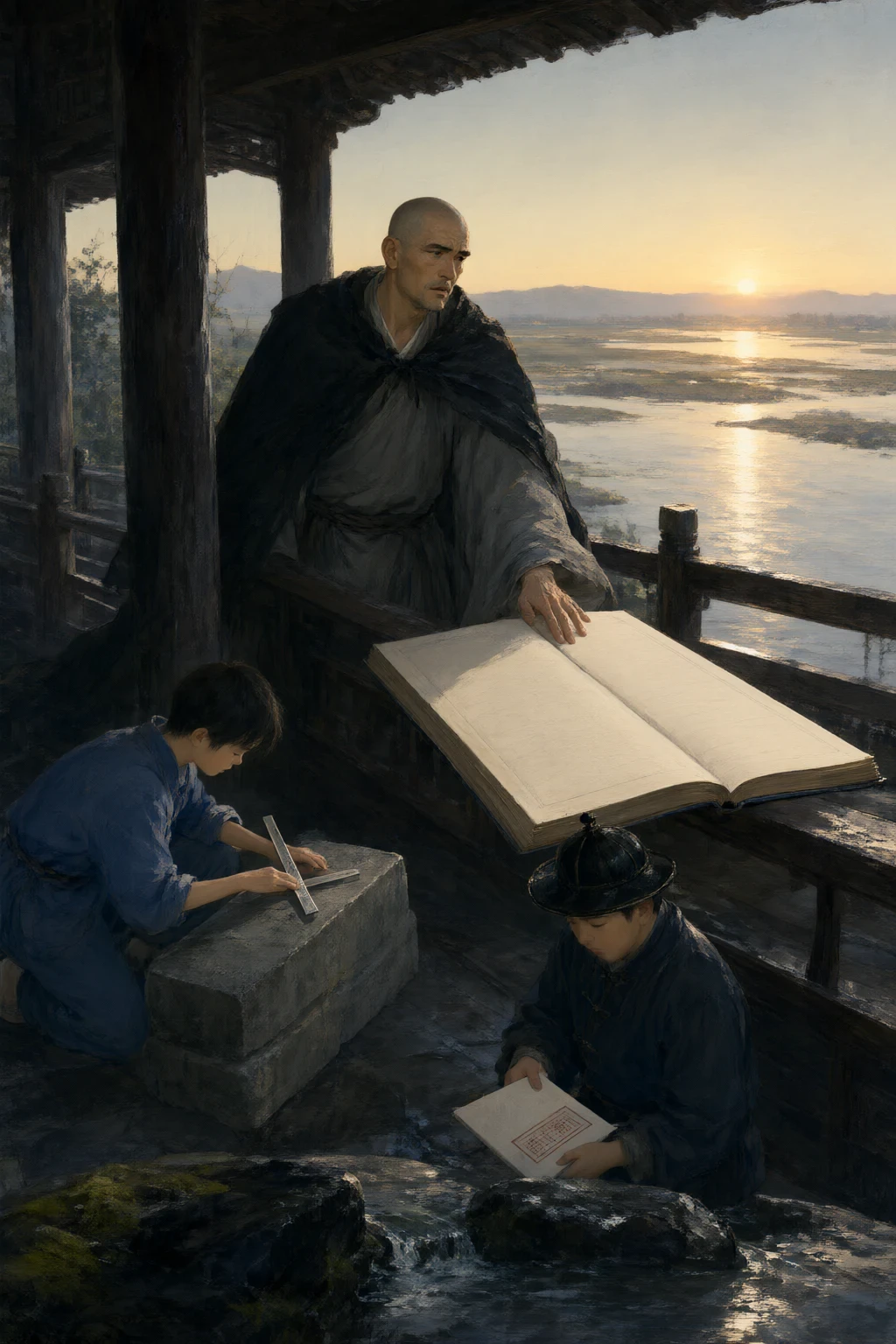
Fahai had a rule, and he had written it himself, and it was the only sentence in the West Lake dike register in his own hand instead of a clerk's. No man is to be entered in this book as more or less than he was seen to be. He had written it in the year the tide came up twice in one night and took the fish market and four houses and a boat belonging to a man named Chao, who drowned, and whose drowning was, in Fahai's careful hand, a matter of the hour and the tide and not of any person.
The pagoda above him was four years old, on nine legs of dressed stone at the mouth of the river, and its purpose was cut on a second tablet: to stand where the Qiantang's great bore broke, so the town would know where to run and stop going inland to the shrine of the god of the hill. From the third storey Fahai could see the whole of the water: the black river, the pale lake, the long white weir at Yanguan, the boats going out like ants. And under the willows at the foot of the hill, on a still morning, the shape the water made when something very long lay in it and was being careful.
He had known about the weir-woman for nine years and done nothing about her for nine years, and the reason was that the water was correct. Her name was Bai, and the paperwork said plainly what her kind was for. The register of the Yanguan weir divided the water-rights into forty-one shares, each descended from a grant, each with a duty attached: open the gate at the fifth watch, keep the fish fence, muck the channel in the twelfth month, feed the fields below and take the fee. All of that had gone unfilled for years. Nobody had the money to do it and everybody had a lawsuit about it.
Bai's share was the fifteenth, and the largest, and the workiest. It had been unserved sixty years, and the register said why: held by a spirit, no dragon grant of record. The ministry at Lin'an had shut the register for new dragon grants in the year she was born and had not reopened it. So the fifteenth share could not be lawfully sold, inherited, bought, or given. It could only be held. That was not a crime. It was a gap. Fahai had looked at the gap for nine years the way a mason looks at a crack he cannot get his chisel into. Then, in the fourth month, the lake fell nine inches in one night, a field below the weir went to dust, and the district blamed the man who does not exist.
The herb-seller's shop was at the Broken Bridge, and the fair was there too, because in the fourth month everyone was buying reeds. Xu Xian had a bad shoulder and no one to help him, and a woman came up out of the water on the far side and asked whether he had a plaster for a cold wound. She had a cold wound. That was the part he could not get over afterward: a woman of the town in blue and white, hair pinned, an old burn along one forearm that had not healed and had not been dressed, about thirty, and very calm. "I will pay for it," she said. "You have a bad arm." "I have had it a long time. A long wound does not close, because nobody looks at it."
He dressed it. She paid. She came back the next week, and the next, and in the fifth week she said her name was Bai, and in the seventh they were married at the shrine of the god of the hill. The temple clerk wrote them in and took eight cash, and Fahai read the entry himself on the Thursday, standing in the doorway, while the clerk talked about the weather. The entry was regular. That was the trouble. A woman holding a share of the weir of sixty years' standing was a substantial person in the district, and she had married without asking the district for anything, and the district discovered it had no document to use against her, because there is no document that says a person may not exist.
He went up the hill on the night of the eighth month with the Water Office tablet in his bag, and he was not looking for her, and she knew that, which is the thing he has never been able to explain to the abbot. She was on the path above the willows with a lantern of her own, and she was not disguised, and there was no snake that night. "You have the seal in your bag," she said. "I have the notice. The seal is for the register." "Read me the notice." "Xu Xian of the Broken Bridge has married a person whose rights to the weir are of no standing in this district. I am required to record that the fifteenth share is not lawfully held, and to ask you to submit to the correction." "Am I being arrested?" "No."
"Then read it again, and slower, because you wrote it quickly." He read it again, and slower. She listened with her head slightly down, the way people listen to weather. "The share is not lawfully held. I have held it sixty years and been given no grant. That is true and I will not argue it. Who do you think will feed the fish fence in the sixth month?" "You will." "I will. I have done it every sixth month for sixty years." "Then the notice has no complaint in it." "It has one," she said. "You did not write that the register has been shut for forty years. You wrote that the holder is unlawful. The register is the instrument. You may not use an instrument and refuse to name the hand that closed it."
He had not thought of that, and he took a long time, standing on the path. "What do you want me to do?" "Nothing. That is what I am telling you. Do nothing, and the man keeps his shop and I keep the water and the field is dry." She set the lantern down on the path stone. "Record the reason. Not for me. For whoever reads it after you." The abbot had told him, when he was a novice, that the difficulty with water spirits was never that they were wicked. It was that they were always right about the water, and nobody on earth had the standing to say so out loud, so the district said it in the register instead, in a small hand, forty years later, when nobody could be punished.
The heron filed the report in the ninth month, and that report is the whole of what happened. He was a water spirit of the same register, older, of the ferrymen's family at Yanguan. He had wanted the fifteenth share since the year before Bai was born, and could not take it for exactly the reason she could not give it. So he did what you do when a door is shut, which is to bring a man to it with a reason. His report said that on the fourth month, at the weir, in front of the district, a person of the deep had opened the fish fence to a channel of her own and let the water down out of season; that nine families' field below had gone dry; and that she had done it knowing the cost, because she wanted the price of herbs that month.
Every word of it was true. She had opened the channel eleven days to get the weir deep enough to run a fever-flood and let the water back. It had worked. It had also cost the nine fields. She had known the cost, taken it, and said so to no one. He went up the hill on the ninth month with the pagoda's chain, and told her what he was going to do and why, and that the heron's report was sound. Then he asked her one question he had thought of himself, which no one has ever put in writing. "Do you admit the channel was opened out of season?" "Yes." "Against the order." "Yes." "You knew what it would cost the nine fields." "Yes." "And you did not tell them."
"I was going to, when the water came back. It came back. I had four days' grace and I used all four." "And in those four days you sat for a wedding in a shop at the Broken Bridge." "Yes," said the lady of the weir. "My husband is not quick. I had four days and I wanted one of them to be a good day."
Fahai did not fight her and has never claimed to. He served the order. The water rose under the pagoda's floor to the height of a man's knee, because a person of the deep shut in a tower stood in a river can go no further than the river lets her. The weir was mucked in the twelfth month by the ferrymen, badly, twice. In the fourth month the field of nine families was not sown, and the district attributed the loss to a spirit, which was a shorthand for a girl.
The tortoise is the part that matters. He is a clerk and a pedant, and Fahai was his student in the sixth year, and the tortoise taught him to read a case. "You have a report, an order, and a woman," the tortoise said, "and no evidence of the one thing in your file that matters. Do you know what it is?" "The channel." "The channel is nine lines and everybody can remember it. What you have is not this woman took the water. You have the register was closed. The order says the share is unlawful. The share is unlawful. The order does not say she should have been held. A man may be lawfully drowned under a lawful order. The second question is the whole of the case, and no one will bring it to you, because everyone who might is busy." Fahai said, "The tortoise is trying to teach me something." "I am trying to keep you from being a thing that happened," said the tortoise, "and becoming instead a thing that was written down."
The boy came in the spring. His name was Xu Shilin and he was nine. He came down the stone stairs in the tenth month, which no one had done in two years except the heron, carrying a mason's rule and a sheet of paper with a pagoda drawn on it. "Master. The tide comes up under this floor to the second step in the twelfth month, and the floor is not a floor, it is the river, and so this pagoda is not a building, it is a lid. I want to build another one. Taller. Over the top. With the tide outside and the court inside, and the water kept out by the wall and not by the stone you are standing on." "That is a wall of a hundred feet," said Fahai. "Yes." "Where does the stone come from?" "From the Leifeng quarry."
Fahai put down his brush. "The Leifeng quarry is imperial ground. The Ninth Month warrant of the year this pagoda was built is nailed inside the second storey. Read it, and then read the date on the block in your left hand." The boy read the warrant, and the date on the block, and came back up the stairs and could not say it. "That stone is imperial," he said. "That stone is imperial. It was opened under a warrant that let the works take quarry stone unpaid, on the grounds that the works were for the whole district and the district was paying. My master wrote the application. It has hung inside the second storey for four years and I have never read it, because I come here every morning and I go up and I look at the water." "Master," said the boy, "whose fault is it?" "Mine, for four years. Yours, for eleven months, if you have been quarrying. There is no answer that is not one of those two, and I have looked for a third one all morning and there isn't one." "Will you come down and see my paper?"
He was called to Lin'an in the eighth month and took his own copy of the dike register, four hundred and six leaves, and waited three days in an anteroom beside a clerk who would not look at him. They wanted four things. The Water Office: was the fifteenth share lawfully held? The Censorate: why had nine families lost two sowings? The Ministry of Rites: had a person of the deep entered a human marriage? And the fourth came from no bureau at all, only from a page in a file, and it was what the young man who had written the Water Office's order had wanted to ask for months and had not been able to put in writing: did the registrar of the works see a serpent.
Fahai answered the first three plainly, with dates and page numbers. The field went dry because the weir had not been mucked in the twelfth month before, because the work belonged to the fifteenth share, and because the fifteenth share had no lawful holder. He gave the year, the file number, and the name of the man who had shut the register at Lin'an, who was dead, and whose grandson was in the room and did not look up. Then they asked the fourth question.
"Master Fahai," said the young man, and he had not been in the river district in his life. "The file speaks of a serpent. There is a report of a serpent, an order against a serpent, and a woman shut in a stone, and in your own hand the notice describes a serpent. The file has been read by a magistrate, a clerk, a censor, an assistant, a boy with a fan, and a man from the Ministry of Rites. Would you like to correct it now, while it is in the room?" Fahai looked at the four hundred and six leaves under his arm.
"I will not correct the file," he said. "I will not testify to the serpent. I did not see a serpent. I have been told of a serpent by two of my masters and by a great many people at the West Lake, and I have believed them, and I wrote the word in the notice myself because I had written it nine times before and my hand knows it. What I saw was a woman of about thirty in blue and white, with an old burn on her forearm that had not been dressed. What I saw was eleven lines of a register shut since before she was born.
And what I saw was a lie I told myself in order to be the man who did something, and I have held that lie in six registers for nine years, and it has cost two sowings and a life, and the life was yours, because you were the child in the field with the dead land under the bean rows, and if your father has a copy of the file you should give it to him, and you should not give it to the Censorate, because the Censorate will find the order lawful and stop there." The room was very quiet. The man with the fan stopped moving it. Fahai set the leaves on the table. "Enter that I declined to testify to the serpent," he said, "and enter the reason."
The case took nine years. In the third the register was reopened, forty-one shares re-granted, and the fifteenth granted to a person of the deep in her own name on her own undertaking, one leaf long, readable by anyone who cares to climb to the third storey of the Leifeng pagoda at dawn.
The eleven men of the dike crew are the same eleven, and their pay is still kept in the same book, in the same hand, under the same rule. Xu Shilin is a stonemason of the second gate, and he charges what the work is worth and not a hair's breadth more, which in Hangzhou in those years was said to be a form of arrogance. The heron did not long outlive the reopening; in the last year of his life he stopped coming in the tenth month, and the ferrymen said he had gone to the shoals. The lady of the weir still opens the fish fence in the sixth month and still mucks the channel in the twelfth, and the register at the foot of the pagoda, which anyone may read, has her name in the fifteenth line in an ordinary hand, with her duties written beside it.
Fahai climbs the pagoda most mornings and puts his hand flat on the rail, the way you do to be sure a thing is still there, and looks at the water going out over the black stones under his feet, held exactly where the register says it should be held.