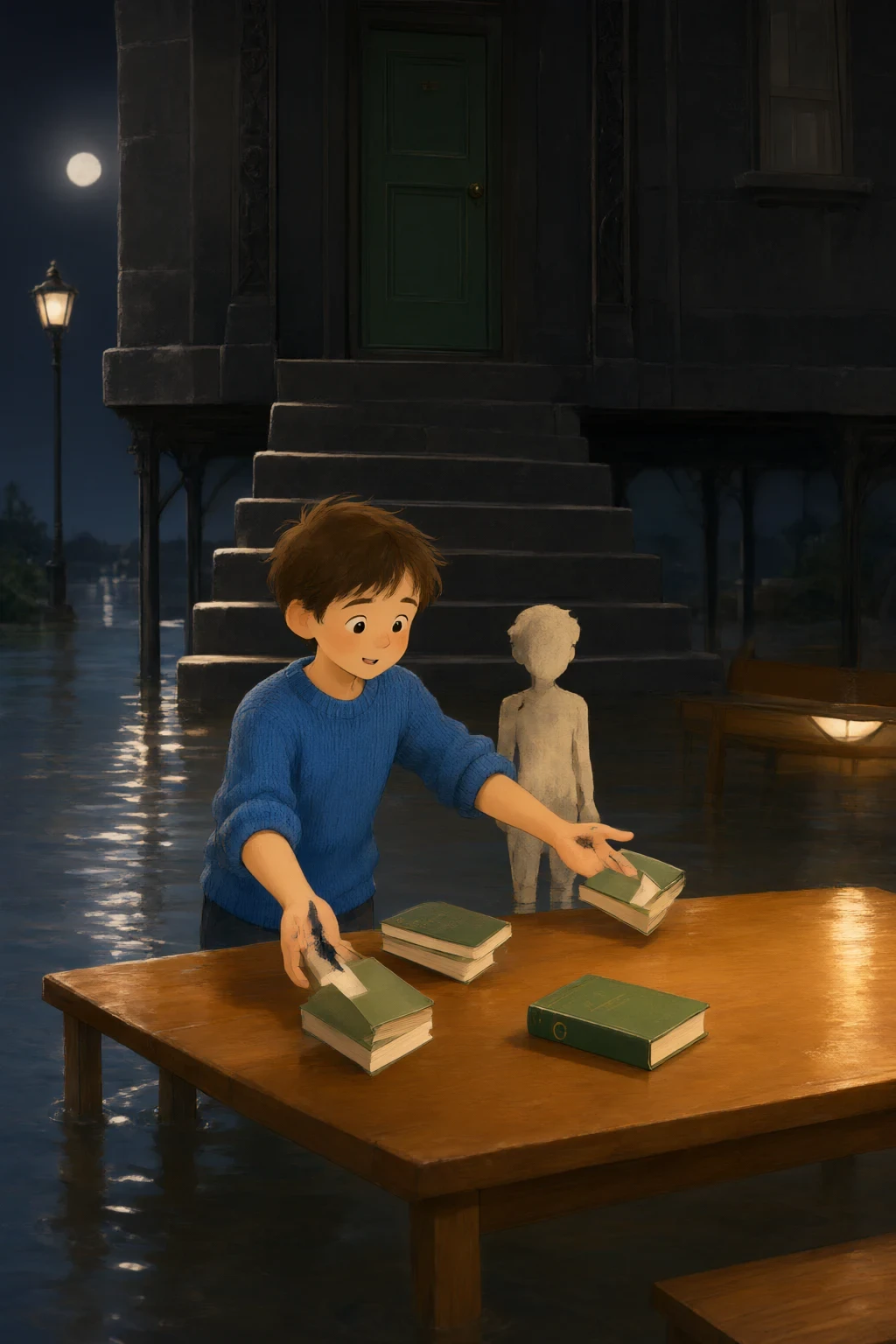
Niko was sitting on the Verandah with a coil of rope across his knees when he saw the water cross the black sand. It came the way a crowd comes to a fair. A long grey shoulder first. Then a roar. Then everything. The white railings went under. The green bench seats went under. Sixty-one steps of the upper Stair went under, one after another, and the sea climbed the seven shallow steps and stopped at the third, level with the pale line worn into the porch lintel. “That line,” said Wick. “There. See.”
Wick was about ten. He was made of pasted wet pages, soft at the edges, with a small keyhole burned black in the middle of his chest. Water stands on his shoulders and never falls off. People down in Greyhaven say he is a library thing gone wrong. Niko says he is a boy who has not made up his mind yet.
In the Tide Library there is a tidemark on everything. A pale salt line at the same height on every wall, every post, every boot, every cheek. It shows how high the sea got the last time the sea came. Niko has had one on his left boot since he was nine. So has Wick. So has the kettle.
Keeper Anja Roe came out onto the Verandah in the dark. Her cassock was black and heavy and stiff as board, and the hem of it was bleached white. Her hood had slipped back a long while ago. Her right hand was in a blackened wool glove and stayed in it. “Now then,” she said. “Up. Both of you.” “The lanterns are out,” Niko said. “All of them. The whole length of the deck.” Anja looked at the row of dark hooks for a long while.
“Up,” she said. “And count the readers on the way. Anwen is counting them twice. I want a third count from a boy who cannot count.” “I can count,” Niko said. “Count on the way up.” Inside, the water had got past the gutter of the Spine and was running the whole length of the floor. It came up through the stairwell in one long sheet, the way you pour. And the books were going.
They came off the shelves of the Stacks in ones and twos, and then in dozens. Open, all of them, pages fanning out, swimming for the top of the stair. Niko had seen a book swim home once, off the mud Shelf. He had not known it could be loud. A hundred books going up a stairwell sound like rain on a roof, if rain were made of paper. “Benches,” Niko said. “Catch them on the benches.”
He caught them. He stood in the water with his arms wide and pushed the wet books up onto the amber-oak benches, and Wick ran along beside him holding the fallen ones upright so the pages would not fold. A book about bees. A book of sermons, swollen shut. Niko counted without meaning to, the way Anja had told him to. Ninety-eight. Ninety-nine. A hundred. And there was one more. It sat in the middle of the bench, in the middle of the flood, on a place where the water was standing a finger deep, and it was dry.
Niko waded over to it. It was smaller than his hand. Green boards, a green spine, a gilt capital G stamped on the spine, and no title anywhere. He put one finger on the top cover. Dry. Not damp. Not even cold. Dry the way a stone in a fire is dry. “Found you,” said Wick. “Good. Book.” “That is a joke,” Niko said. Wick said nothing, which is how he says most things.
Niko sat down on the wet bench with the book on his knee and opened it. The pages were blank. They were dry. And the paper smelled of nothing at all, which in that building was the strangest thing about it. He turned a page. Nothing happened. He turned another. “But who decided that a book waits?” he said. “But who decided that? Why will you not say something?”
The book said nothing. That was the whole of it. A small green book with a G on it, waiting on a bench in the middle of a flood, and it did not say one word back.
They took it up. The stair is too narrow for two people, so Niko went first with the book held against his chest in both hands, and Wick came after him, dripping. The water broke and slapped at Niko’s knees. Twice a step he was sure he had left a boot on a lower tread. At the top he turned round and looked back down into the flooded Spine, and all the books were lying flat on the benches with their pages up, like a room of sleepers, and the water was still climbing.
Anja found them on the Roof in the first grey light, with the wind coming off the flat and the whole black Shelf laid out west of them under a moon that was going. “Now then,” she said. “Give it here.” She held the green book in her gloved hand a long while and did not open it. She turned it until the gilt G faced the sky.
“It is not ours,” she said at last. “Three hundred years of ledgers and not one line for a green book. It came in out of the sea, and it is not in the sea.” She looked at Niko. “You carried it in. So you will look after it.” “That is not the same as being given it.” “No,” said Anja Roe. “It is not. Ink dries. Go on.” Then they went down and looked at the mark.
It was the market morning up in Greyhaven. The Library stood in its own reflection, doubled and upside down, while the water went out across the Shelf taking the shine off it. Sister Anwen Tarn was already at the Porch with her slate. She counted out loud before she opened anything. “One. Two. Three.” Then she stopped, and Niko saw her cold blue-white palm go flat against the stone. “It is up,” she said. “Up how much?” said Anja.
Anwen held her hand up. She had measured the mark with her thumb and her finger the night before. She measured it again, and it was one line higher. “A finger’s width,” she said. “A finger’s width, since yesterday.” Niko looked. It was true. The pale salt line that had been level with the lintel, level with the door, level with the inside of his own left boot since he was nine, was up now. Not level with anything. Up. “Whose is it?” said Niko. “That is the question,” said Anja.
They went along the wall and found out where the mark came from. The mark outside the Porch was up a finger’s width. The mark inside, on the wall of the Spine, was up two. The mark on the inside of the green-black door was up three. And Niko’s own boot, when he pulled it off on the third step, had the old mark on it, level and pale, exactly where it had always been, lower than any of them. “Somebody,” said Wick. “Stood. Further.” “No,” said Anwen. “Somebody stood further in.”
Nobody could say whose it was. Niko asked, and Anja said she did not know. Anwen wrote it down and then put a line through it. Perran Hesk came up the stone in his salt-white coat and said that a tide is a line, and a line can be measured, and a measured thing is a known thing. Anja said, “Now then. Not this morning,” and Perran stopped talking.
Afterwards Niko took the green book down to the third step and stood there with his back against the rail, because he reads standing up. He held the book on his palm and opened it and turned the pages, one after another, all morning while the water went out and the gulls argued over the whale ribs and the wind dried the salt white.
Not one word. Not on any page. He asked out loud anyway, because he always does, and the sea answered him the only way the sea ever answers, which is by coming back and going away again. Then he shut it, and looked at it, and said out loud what he had decided. “I am keeping you,” he said. “You waited. So I am keeping you. And I am going to find out what you are for.” The book said nothing. But it stayed dry. And seven nights off, down the flat, the water was already on its way back.