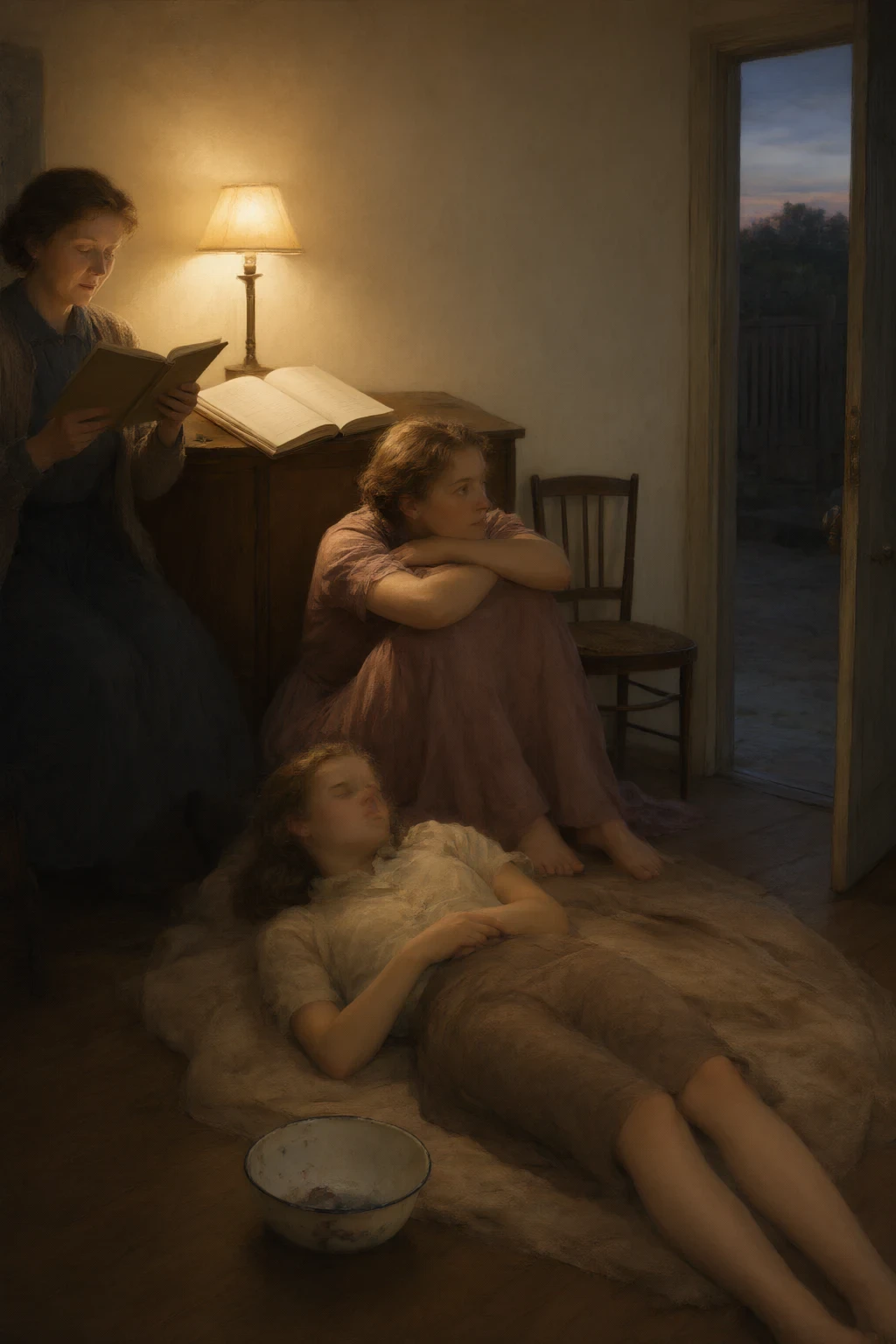
The family version of Anne went like this. She was somewhere else. She was a girl of fifteen in a rented house in a provincial town, in the summer of 1946, and she spent that summer at a window, and everybody said so, and the saying had the satisfaction of an explanation: the war, the food, the father, the mother's cough, the new school in September, the whole of a decade could be put down to she was somewhere else, and the phrase did the work of an explanation and required nothing further.
They said it for forty-five years. They said it at the table on Sundays, and the two of them said it, and when the mother died they said it at the graveside in the voice you use for something that is finished, and in 1991, when the house was empty and came to be cleared, Sigrid Vinge, who was seventeen in that summer and sixty-one by then, and who was a landinspektør and had been for thirty-four years, found a hard-backed exercise book in the drawer of the writing table and understood that the family version had been, in its way, the exact opposite of the truth.
It was a schoolbook, ruled in four columns, bought for four kroner at the shop on the square, and the columns had not been printed. Anne had ruled them herself with a straight edge borrowed from the father, and she had headed them, in the careful upright hand of a girl who was being written up for her penmanship: dato. himmel. hvad jeg så. spørgsmaål. Date. Sky. What I saw. Questions. There were ninety-two entries. The first was the ninth of June and the last was the ninth of September, and between them there were eleven days with nothing in them, and ten of the eleven were Sundays, and had not been left blank out of piety but because the sun was behind the bakery's gable at four o'clock on a Sunday in high summer and there was nothing on the wall to measure. The eleventh was the thirtieth of July, and under the empty column she had written regn and nothing else. The fourth column was empty for eighty-nine days out of the ninety-two.
This is what she was doing, because the family version and the book are both true and only one of them was ever said. Across the gårdsplads there was the house where the baker lived, and on the gårdsplads wall of that house, facing the wall of theirs, there was a chimney. It was an ordinary chimney, a brick stack with a clay pot on it, a metre and a half by a metre, forty years old, and the only remarkable thing about it was that the low evening sun in a Danish summer came down the street at such an angle that the shadow of its west edge fell, for a few weeks in the year, on the opposite wall at four o'clock. The house they rented had a back door, a stone step, a yard eleven paces by twenty-two, and a line for washing. From the step, on a clear evening in June or July or August, the shadow was there.
Anne had found it the way anyone finds such a thing, by accident, and then had gone on with it every clear afternoon for ninety-two days because she had noticed something about it, which was that it was not walking at the same speed. She measured it like this. She had a strip of paper from the father's office, gummed on one side, which she folded into a right angle so that it stood on the yard's flagstones and made a small square at the foot of the wall, and she held a pencil behind her back so that her hand would not shade it. She marked the position of the edge of the shadow on the strip, at the hour, in centimetres above the flagstones, and wrote the number in the third column of the book in the evening, and never once, in ninety-two days, did she write a number she had not read off a mark she had made. And in the fourth column, on three days only, there was a sentence.
The 24th of June. Sky: high cloud, wind south-west, cold for the day. What I saw: 61.5. Question: why is it different every day when the clock says the same thing. The 3rd of July. Sky: clear, hot. What I saw: 63.0. Question: it is standing still. Why is it standing still. The 29th of July. Sky: clear, hot, thunder later. What I saw: 61.0. Question: is the sun going backwards. The other days are not repetitions of the same sentence, and Sigrid did not read them as repetitions. What they are is a piece of equipment being used for a purpose its owner did not fully understand yet, which is the condition of all the best instruments, and she could see the purpose arriving. The 19th of June. Sky: clear. What I saw: 62.0. The bakery man came out at four and stood where I stand and looked at the wall for a while and went in again.
The 1st of July. Sky: rain all afternoon. What I saw: nothing. The 2nd, same, and the 3rd, same, and on the 4th: 62.0, and the column for questions is empty, and in the margin she had drawn a small square with a line under it, which Sigrid decided, after some time, was not a drawing of anything and was almost certainly the sign she had been given at school for datum. The 14th of July. Sky: clear, very hot. What I saw: 63.0 again, the same as the third. The wall is a lie. It is the same number and it is not the same shadow, because the light was yellow at four and white at four, and the wall was four degrees cooler, and nothing I can measure has changed and something has.
The 8th of August. Sky: clear. What I saw: 60.0. Father has taken the strip away to measure a wall in the harbour and has not brought it back, and I have used the knotted string, and it is worse, and I have written the number with a cross through it, which I am told is not correct and which I am leaving.
Sigrid read those three sentences in the front room of the empty house on a Thursday in October, in the light off the yard, and then she did a thing that she has described, in different company and to different people, in different words, and always with the same ending, which is that she got a piece of graph paper and a pencil and sat down at the kitchen table, and she plotted every figure in the third column, and the curve went up and then stopped and then went down. The curve stopped at its highest point on the twenty-first of June.
She sat with that for a while. The sun's declination changes fastest at the equinoxes and not at all at the solstices, and the rate of change is a thing you can have written to you in a table, and it is in every almanac in the country, and it is not, in the ordinary way of things, the kind of thing a person looks at. And here was a fifteen-year-old with a gummed strip of paper and a pencil, on a back step, ninety-two times, arriving at it, in 1946, in a country that had been occupied for five years and was short of paper, because she had stood in front of a wall long enough for the question to become unavoidable.
She checked it again the next winter, with better light and a proper protractor, and the answer came out the same and then some: the twenty-first of June, and not the twentieth, and not the twenty-third, and with an error in the middle of the season of under nine millimetres on a wall four metres from her hand.
Then she went and looked for an instrument, because that is what you do, and there is not one. There is no instrument in Denmark, or anywhere, that measures the shadow of a chimney edge in a back yard. What there is, is the almanac, and a page of tables, and the fact that the daily change in the sun's height is greatest in March and least at the end of June. She laid her points against the table for the same latitudes, read off what the table said the shadow ought to be doing, and her points and the table lay on top of each other to within a centimetre over the whole season, and the two points that did not were the second of August and the ninth, which were her father's wall and her knotted string.
A retired schoolteacher in the town, to whom she took the graph paper because she wanted somebody to see it and because she was thirty-four and still got a small satisfaction out of showing a thing, looked at it for a long time and said the thing that she had been waiting forty-five years to hear anybody say, which was: well, that is a lovely piece of work, and then, after a moment, he said: from the fourth column, the question.
The sister had gone to a school in the provincial capital in September, for a two-year course, and had come out of it into a hospital ward in the capital, and had married a man who repaired boilers, and had lived forty-five years in a town two hundred kilometres away and had a daughter and had not been unhappy and had not once, in all the letters, written about the summer of 1946 or the wall. Sigrid had the letters. She read all of them in the winter, which was the other thing she did that year, and the first thing she noticed was that the first three were written in the same hand as the exercise book and the rest were not, and the second was that the writing got worse in the same way, a lateral drift of the downstroke, a tightening of the loops, from left to right, so that you could date any page of them by holding it up against a page of the book. It had started in the exercise book, in August.
What I saw: 60.5. The wall is cold. What I saw: 59.0. There is moss on the lower stones where the shadow does not reach, and the same moss on the top stones, and nothing in between. What I saw: 58.0. I have decided it is not the wall that is moving. And on the ninth of September, the last day, the entry is short, and is the only one in the whole of the book that is about something other than the wall. Sky: clear. Wind: none. What I saw: 57.5, and the smell off the bakery, and S. coming in with her bag at seven, and standing in the doorway, and looking at the wall instead of at me, and saying: you have got that thing again.
And the fourth column, which had been empty since the twenty-ninth of July, and which she had ruled at the front of the book one Sunday in June with a straight edge borrowed from the father, and had then left standing all summer like a chair at a table: Hvad mente mor med sommerfuglen? What did mother mean by the butterfly.
It was in a collection on the shelf, and Sigrid had not opened the book in the house until that October and had not thought about the summer at all, in the sense of not having thought about the summer, which is to say she had thought about nothing else for forty-five years and had never once thought about this.
She went and got the book and found the story and read it standing up. The caterpillar comes to the flower, which is growing in the ground, and asks it what it should do, and wants to hear the birds and to see the sun and to know what the world is like, and the flower says, in effect, that the world is very beautiful where you are and that this is what it is for, and that you should not go. And the caterpillar does not go, and in the end it becomes what it was always going to become, and lives one more season, and plays, and dances, and then stops, which is the arrangement, and the story is about a creature whose whole life is a single season and who finds out in the last week of it that it was enough.
The mother's version of it, on the sofa in that house in the summer of 1946, at about ten at night, is the part of the whole ninety-two days that Sigrid can remember with her eyes shut and cannot put in a column. There was one lamp and it stood on the sideboard, because there was one lamp, and the two girls lay on the floor on a blanket because the floor was cooler than the sofa, and the mother read from the book with her thumb going down the page ahead of herself, which she did, and which neither girl has ever mentioned to the other. She read it twice. The second time Anne did not follow the words and lay still with her hands behind her head and looked at the ceiling, and at the end of the second reading, when the mother said that that was all, Anne said: what did you think it meant.
And the mother, who had a cough that winter that was still worse in the summer, said: I don't know, and then said, kindly: it was lovely, and then said: are you tired, girls, because it was half past ten. The yard door was open. There was a moon, because the middle of that June was the same kind of year as this one, and the boy next door was practising something on a bicycle with a dynamo that he did not have on the next one. Somebody had made bread-and-milk and had put the bowl on the table and had then gone out, and the bread-and-milk was still on the table at the middle of the next day, because nobody in that house could bear to throw bread away and nobody in that house could think what else to do with it, and it went hard, and the mother cut the crusts off in the morning and gave them to the dog.
There was no meaning in the story. That was the whole of the answer, and the answer was true, and it was given at half past ten to two children on a floor, and it has cost Sigrid Vinge forty-five years to be able to hand it over in a column on a page in an exercise book, in a hand that is not the one it was asked in.
She did not write any of that to her sister. She considered it, on and off, for a year: whether to write and say that she had found the book, and that the answers to the three questions were arithmetic and astronomy, and that the solstice was on the twenty-first of June, and that their mother had meant nothing at all by the butterfly. She wrote two drafts on the back of a survey field note, which is what a person does instead of writing a letter, and both drafts were in the flat register of a woman drawing a boundary, and both were four times too long. What she did instead was on the ninth of September of that year, which fell on a Sunday, in the front room of the empty house, at four o'clock in the afternoon, when the sun came down the street. She had the book, and the same rule, and a pencil, and she had brought the strip of paper and the gum from the office.
The shadow of the west edge of the baker's chimney was on the gårdsplads wall, two and a bit metres up and about a metre and a half to the left of where the flagstone joint was, and it moved a little while she watched it, which it did, and which was the entire phenomenon, and which she had not seen since she was seventeen. She held the strip against the stone, marked it, and took her hand away, and the mark was where it was. Then she opened the exercise book to the last written page, which was the ninth of September, 1946, and turned over, and there was a blank ruled page, and the four columns of it were the four columns of every other page, ruled in June by a fifteen-year-old with a borrowed straight edge.
She wrote the date. She wrote the sky, which was clear, and the wind, which was none. She wrote, in the third column, the number, which was 57.2, and then, because it was true, she wrote the other four things, and the rule in her copybook at the time had been a hand, and it was not a hand. In the fourth column she put a sentence. It was the answer to the one on the last written page of her sister's season, and she gave it to the question in the language the question had been asked in, and it was one line, and it cost her most of the afternoon.
When the sun came off the wall she went out with the strip of paper in her hand and looked at the flagstones for a while, and then she pressed the strip back onto the gårdsplads wall at seventy-two centimetres, which was her sister's highest mark, in the fourth week of June, and which is the height of the little white flower that comes there every spring, and which the children of that house had scratched their initials into in 1946, before the mark was made. The paper took in the damp at once and softened and stopped flapping, and the wall behind it was the colour it had been in 1946, and nobody had ever taken the trouble to write that down either.