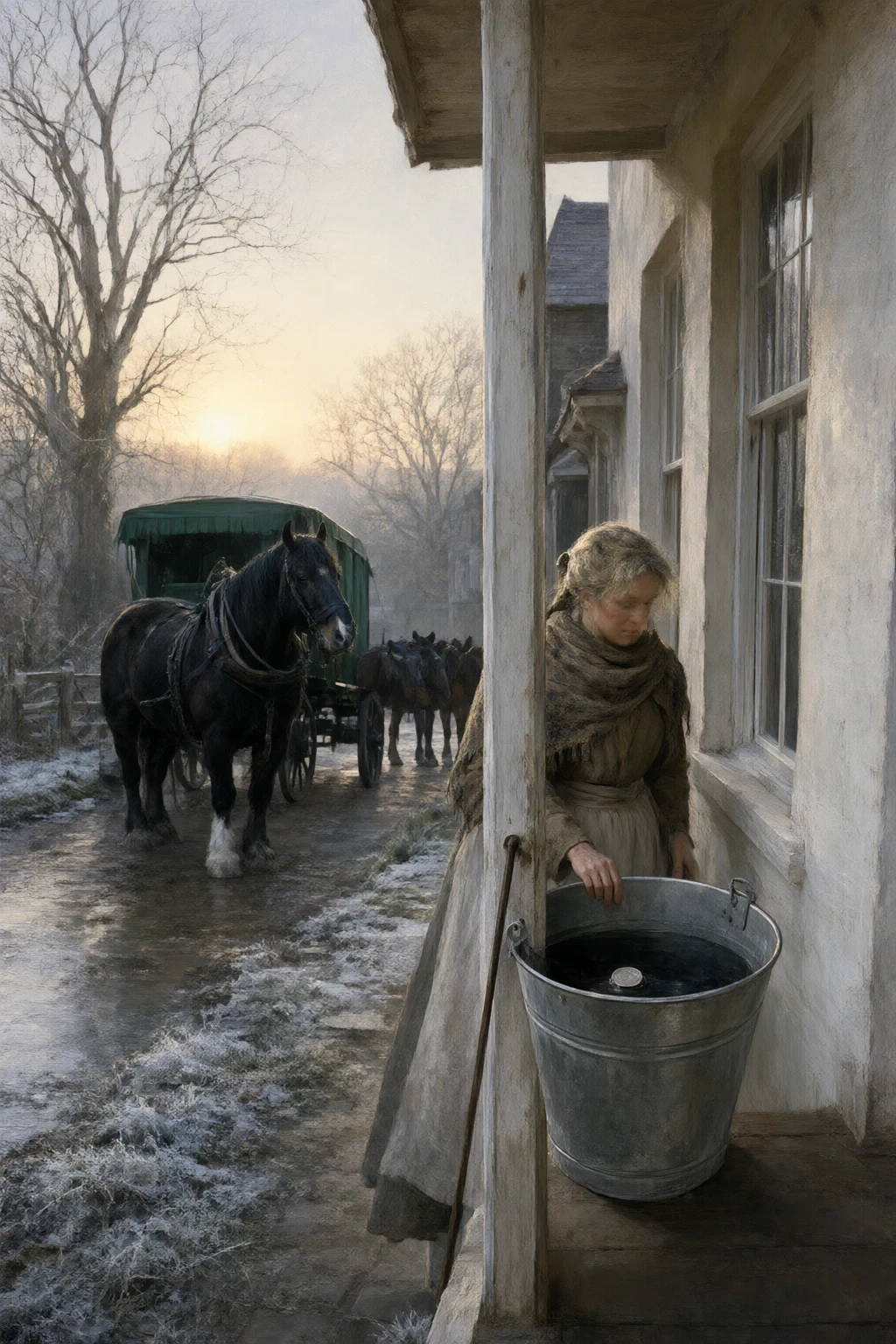
The winter at Harrow’s Landing is not a season so much as an argument against one. The Gilded Menagerie spends it on the churned ground of the old brick ropeworks, under nine elms that have never been pruned, in four tin sheds and the Packing Shed with a wire across the door that says MENAGERIE — HEATED, which is true in the sense that a man inside it is not dead. The guy-ropes come down in November and go up in March. Between them there is mud, in the ordinary way, and cold iron, and a soup that Odette Vrain makes on a ring stove out of whatever has not been eaten, and a smell of wet canvas that gets into the wool of everything the company owns and is still there in June. In the first hard frost Barnaby Hallam stood in the east yard with his blanket off, and nobody could get him into it.
He was a draught horse, black with a grey muzzle and a white sock on the near hind, sixteen hands, heavy as a loaded dray and built out of the same parts. He had been in the Gilded Menagerie for thirty years and had drawn the Big Top wagon, the water butt wagon, the Paper Caravan and, on three occasions, the Widow’s Pew. He stood in the yard because that was where he stood. He got up when it was light. He was fed. He was unhitched at nine in the morning in good weather and at ten in bad, and he did not object to anything, and the last thing anybody could remember him doing was a wet spring nine seasons ago, when he had turned his head at a bucket. That was the whole of what was left of him, and the company had a name for it, which was keeping fit for the season. Nobody was frightened of Barnaby. That is worth saying, because people are always frightened of the big ones. What the company felt, in the yard, in the frost, was a kind of embarrassment, the sort a school feels about a master who has stopped attending. His nameplate on the third barred wagon said BARNABY HALLAM — DRAUGHT. Underneath, where a Keepsake should be described, it said PAIL, and the carpenter who had made those plates in 1895 had put it there laughing, and nobody had ever corrected it, because it was funny, and because Barnaby did not look at it.
“His fourth is due in February,” said Halloran Quill. He said it in the Packing Shed, at the long table, with the ledger cases stood along the wall behind him in a row like the barrels in a pub, and eleven hundred of them, and the tin roof putting the sound of his own voice back at him. The Bookkeeper was fifty-eight and had been in this wagon thirty years and had inked his cuffs to the elbow and worn a green eyeshade in a shed with no window at eye level, and the one lens was a disc of shell, so that everything he looked at came to him faintly amber. Mateo Brill was at the other end of the table with his back to the stove, working a rope through his belt, and his tail through the back of his belt, and the whole arrangement of his body a thirty-year habit of getting out of his own way. “Fourth,” said Mateo. “Fourth. It is the same set amount and it is the same length of term, and the countersignature is hers, and the house will be full on the Friday because it is the Friday they have the pantomime.” “She will countersign it.”
“She countersigns everything. She has countersigned everything since before you were in the cage, and she will countersign this in a tin shed in front of four hundred people in a wet parka, and it will be entirely proper, and there will be nothing whatever wrong with it.” Quill turned a page. “Which is the part I would like somebody to notice.” “What part?” “The part where it is the fourth.” Mateo Brill put the rope down. His hands were brown to the second knuckle and the nails were flat, and he could still tie, and everybody in that shed knew he could still tie. “Mmm,” he said. “The first takes the hair and the nails. The second takes the hands. The third takes the mouth — not the words, the mouth, the chewing, the throat, the way you swallow.” He looked at his own hand. “The fourth is the voice.” “Your fourth is due in June.” “My fourth is due in June,” Mateo agreed.
The arithmetic of it was not secret. Every performer in the company could do it in their own heads, the way you can do your own age. Junie Sparrow had done hers out loud in the spring, in the Scented Row, sitting on her shelf with her boots off, and had got to the fourth and stopped, and had said, at ten years old, “Is it fine? Is it fine? Is it fine?”, three times, to nobody. She has had one. Mateo has had three. Odette has had none, on pencil, which is a different and worse arithmetic and which nobody has been able to explain to her. Barnaby has had three, for thirty years, which is the reason there is a barn. And in the winter, because there is no water in a showground, the water round is done by hand, bucket by bucket, from the butt wagon, by a child. Junie Sparrow did the water round, and did it well, and nobody had given her the job. In the winter there is no trough in a showground and no standpipe, and the butt wagon is filled from a cistern behind the packing shed, and somebody has to walk the length of the yard with a bucket in each hand and give the six horses on paper, and the four that are not on paper, and the mules, their due, twice a day.
She had also worked out, on her own, and without telling anybody, that Barnaby Hallam was the only one who watched her do it. The other animals put their heads over the rim and drank. Barnaby would not drink over the rim. He waited until she had set the bucket down, and then he took the handle in his teeth and tipped it, and stood while it emptied, and put it down again, and looked at her, and waited. “He wants the second one,” she told the yard, in a whisper, to nobody, the second week of February. “He always wants the second one. I think the first one’s for the drink and the second one’s for the day.” No one answered her. She was ten. In a company of six and eight hundred people, a remark like that is either a joke or a fact, and nobody there could tell which, and everybody remembered it.
The Director came out to the yard on the second afternoon, in a coat the colour of a candle end and black kid gloves, and stood at a distance from Barnaby the way everybody stood at a distance from Barnaby, which was about nine feet, and which no one had decided on. “September,” she said, to nobody in particular. “You were at the Six Bells. The taproom, because the tent was not up. The rope was being pegged in the fair.” “Yes, ma’am.” “Four hundred and sixty people in that field and sixty in the taproom and one of them was the pot girl, and the terms were read in the taproom because the terms must be read where somebody is paying to hear them.” She had the Ledger under her arm, or something the shape of the Ledger, or something she had made the shape of the Ledger. “That is a formality I have always been glad of. It is a formality that has kept this circus out of the hands of the law for thirty-one years, and I have never once regretted it, and I have thought about it more than you would believe.” The big black animal turned his head a little way, the way a heavy animal does, and the frost came off his muzzle and went into the air. “There is a thing in the entry I have never understood,” she said. “And I would be obliged if somebody in this company would go and find out what it is.”
Odette Vrain had been in England for eleven years and had been running for ten of them. She was at the Packing Shed door with her arms folded when Quill came out, and she did not ask what he wanted, because in eleven years you learn that a Bookkeeper who comes out of a caravan is not coming for a conversation. “Say it quickly,” she said. “Do this. Now. Do not be kind about it, I can tell when you are being kind, it is the worst of your habits.” “The witness column of Hallam’s original entry names a public house and a parish,” said Halloran Quill. “The Six Bells at Nether Wask, in the parish of Nether Wask, three hundred and eleven miles back down the road, before the Line was made. The witness line is signed by a person, which almost nobody is, and the person is E. Skellow, and Skellows kept the Six Bells for three generations and there is no Skellow in the trade north of here and there has not been one since.” “So find a Skellow.” “There is one. She is the last of them. She is sixty-one and she has a bad hip and she has not left the parish since her husband died, which was 1911, and I cannot leave this caravan.” Odette laughed. It was not a cruel laugh. It was the laugh of a woman who has spent ten years being extremely good at the one thing in the world that does not help. “Uncle,” she said. “You have not left this wagon in thirty years.” “No.” “Then you will not enjoy the expedition.”
August Vane decided the expedition in eleven minutes, in the yard, by putting a hand on the near rump of a horse and feeling how much of the animal was still horse. “We take the Pew,” he said. “Two of the light horses and Barnaby, and we go down the Wask road, and we are back before the frost breaks.” “No,” said Mateo. “He is the fastest thing on wheels we have got, and the light horses cannot pull the Pew over the Harrow neck in a thaw, and we are not splitting the team in February.” August had his hat off. He always had his hat off when he was talking to the company instead of to a house. “And I will tell you why, and then you can tell me it is a bad idea, and then I will do it anyway.” “He does not go in a wagon,” said Mateo Brill. “He goes on the road. He is a road animal. He has not been under a roof in eleven years, and he has not wanted one, and you cannot put a man in a wagon and ask him what he thinks.” “He is a draught horse.” “He is a draught horse,” Mateo agreed, “and he has drawn the Pew twice, and the second time he went through a toll bar and I went with him, and I would do it again.”
August looked at him for a while. His aunt was watching from the foot of the steps of the Paper Caravan, in the grey coat, with the sealing wax on its cord knocking against her hip, and she did not say a word, because it was not her wagon, or because she wanted to see. “All right,” said August. “Yoke him on the off side, and put the bucket where he can reach it, and if the ice comes in on the Wask road we turn round and we do it in the spring.”
The road south in the second week of February has one week of fog in it every year, and it comes in the small hours and lies along the drainage ditches until about ten, and every gasjet on it is a small gold ball with a black road running out of the bottom of it. They went down it in the fog for four days. Nell Ferrule came because nobody told her not to and because she was useful, which is the whole of why she is where she is. Odette rode. August rode. The Pew was green and curtained and shut, because it is not a wagon for riding in and there is no pretending otherwise. Barnaby walked on the off side in a breastcollar, and he was not harnessed to anything at all, and Mateo had taken the traces off, and the whole of the rein was in a sloop on the pommel, loose, which was not a thing the Bookkeeper had ever seen done in a circus and had not had the nerve to say was wrong. The first day he said nothing. The second day, somewhere past the Ring Taste, with the fog coming up white off the fields, he turned his head and said, “That is the Wask,” and they were a day and a half from it. Mateo said, “You cannot know that.”
“I know the water,” said Barnaby Hallam, “and that is the Wask, and I have not smelled it since the year the fair was in the field and they pegged the ropes all night and I could not sleep for the noise of it.” And then, for two days, he would not stop. That is a thing about a horse four renewals deep for thirty years: he has lost the month, and the year, and the name of the town, and the whole of the winter, and he will not lose the water. He brought them up out of thirty years one at a time as they came, without being asked, in a fog on a chalk road, and in order, the way a man brings up the names of the streets of a town he has not seen since he was nine.
The trough at the crossroads at Nether Wask, which was the parish’s, and which was not the parish’s, and which is a different animal entirely from the trough at the Harrow landing, which is ours and is kept full. The water butt at his mother’s, that he carried round as a boy on a yoke, two buckets, a mile and a half, and the weight of it took the skin off his hands at the handle ends and he was not allowed to say. The tap in the taproom of the Six Bells, which was a hand pump and which everybody hated, and the sound it made, and the fact that he had asked for a jug before he had asked for anything else, and a boy had said, a horse as big as that, in a room like that, and his mate had hit him. And the sea, which he had never seen, and which he brought up anyway, out of something, at four miles short of the coast, at Saltcombe, where a child on a wagon step shouted at him and he turned his head, because a salt wind is a wet wind and a wet wind is a wind off water. Odette Vrain rode alongside him for a mile and a half and did not say anything at all, and at the end of it she said, to the Bookkeeper, in the low sweet voice:
“You said the cost is a day. You said a human day for every night in animal form, and that it is not pain, and that he is simply a person with less and less behind the eyes.” “I did.” “It is a day,” said Odette. “It is not a person. He has given up every day he ever had and he has kept the water, and I have been in this country eleven years and I have never once seen that written down anywhere.”
“Water is all he has,” said Halloran Quill, that evening, in a stable with a lamp in it. The Bookkeeper had not been outside the wagon in thirty years and was being spoken to from three feet away. “I have been nine months with that animal. He does not know the month. He does not know the year. He came out of a winter in 1908 and asked me what the ring was for.” “Is that the memory?” “That is the memory. The cost is one human day for every night performed in animal form, and it does not hurt, and he cannot remember that it happened. So he loses a day at a time, for thirty years, and what is left is a man who is extremely interested in water and who can still hold a pail.” Odette said, from the settle, in the low sweet voice she used when she was not under stress and about to be under stress, “And on Friday the fourth renewal takes the voice, and then there is nothing left of him except the water, and the water is not a person, and the water does not have to answer for anything.” “That is the arrangement,” said Quill. “It has been the arrangement since 1895. It is not a matter of opinion. It is a matter of four renewals and a countersignature and a column in a book.” “And what is the pail?”
“The Keepsake. Every performer names one object at signing and the object holds the human half answerable. Hallam’s is in the entry in my hand and I have read it a thousand times and it says a pail.” “He has not been able to lift it since the second renewal,” said Mateo. “He has not needed to. A pail is the only Keepsake in this company that an animal can still use. It is the only object in eleven hundred cases of paper that a horse can carry water in.” Quill took off the eyeshade and looked at the little of him that was left in the lamp. “Which is the only reason there is any Barnaby Hallam at all. And on Friday the fourth deepening takes the hands that hold it, and there is no answer to that anywhere in the box of forms, and I have looked.”
Nether Wask was four hundred people, a chapel with a bell that had not been rung since Advent, a smithy, a shop, and a stream about four feet wide with a ford and a footbridge and a set of steps that nobody maintained. The Six Bells was shut and had been shut for nine years. The sign was still up over the door, and the paint on the bell itself had gone the colour of a two-pound note, and there was a zinc pail on a nail inside the porch, on its side, with the bottom gone out. Nobody had taken the pail down in nine years. Enid Skellow was sixty-one and had been sixty-one for some time, and she came to the door in a shawl over a petticoat with a stick that she used for walking and not for hitting, and she looked at the two horses, and at the green wagon behind them, and at the large black animal on the off side with his feet apart in the road. “Six Bells,” she said. “No,” said Odette. “We were. Thirty years ago. In the autumn.” “The circus was in the field.” “The circus was in the field.” Enid Skellow looked at the black horse for a long time. Then she said, “You’ve brought him.”
They took the back room of the shop because the Six Bells had no back room, and Enid made tea out of a caddy that had come to her from the licensing court, and the three of them sat at a table with the horse outside in the road, and the Bookkeeper told her, in the careful voice he used for clients, that they were after a formal matter, a small one, an old one, and that it was in a book, and that somebody at the time had signed a line. Enid Skellow put both hands flat on the table. “There were sixty in that taproom on a Thursday,” she said, “and I was nineteen, and I’d had a half of mild at the bar which I wasn’t to have, and I was stood on a chair to see over the crowd because I was the one pouring, and a man that was a bit over the rail reading out of a book in a green eyeshade. Same eyeshade as him, near enough.” Quill took the eyeshade off and put it on the table.
“He came in at eleven,” she said. “With a bag. Canvas. He’d been on the road three days with a load of brick, and he asked for a jug of water before he asked for anything else, and he drank it standing up by the fire and he didn’t sit down, and he put the bag down at his feet and kept his hand on it.” “Was he alone?” “He had a man with him, a small one, that was his mate, and the two of them had come eleven miles to see the show and were disappointed because the tent wasn’t up. And when the reading started he put his hands on the back of a chair, both of them, like a man holding on at a council meeting, and he listened to every word of it without once looking at the book.” Nobody said anything. “And at the end of it, when the reading man asked him to name the keepsake, the thing he’d brought, he put his hand in the bag and took out a tin. A zinc pail. A new one, with a new handle, and he set it on the bar, on the cloth, in front of everybody, and he said, “That one.” And the reading man wrote it down. And then he asked me a question.” “What question.”
“He asked me who filled the trough at the crossroads.” She looked up. “The one on the Wask road, where the four ways come, where the drovers water. It’s a parish trough, and the parish had not filled it since Michaelmas, and the boy that worked the tap had told him so when he asked, and the man said, all right, and then he asked me, he says, who’s going to see to the trough at the crossroads. And I says, the parish. And he says, the parish does what, waits till somebody writes a letter.” Odette said, very quietly, “What did he do?” “He gave me a shilling.” She said it without weight, the way you say the price of tea. “And he said, put that in the parish box and tell them it’s for the trough, and don’t tell them off who. And I did. I put it in the box on the Monday and I told them it was off an anonymous gentleman, and they filled it, and it was full until the summer, and then it was empty again, and the summer is always the summer.”
August said, “Mrs Skellow. What did he say when he signed?” “That’s the other thing,” she said. “That’s the thing I’ve never had anybody come for. Thirty years and I’ve never had anybody come for that.” They waited. “The reading man made him say his name, because a signature’s got to be a signature, it’s got to be out loud in a room with a paying public in it, otherwise it’s nothing. Everybody in that taproom had paid, me included, a half of mild, and it counted, and there was a woman up the stairs with a kid on her hip who’d paid for a glass of something, and that counted too. So he had to say it, and he said it twice, and the first time it was nothing. And the second time he said it like a man saying a thing he has said before in a room, to hear what it sounded like coming out of a mouth. He said, Barnaby Hallam. And then he says, that’s what it says. It says Barnaby Hallam. And the reading man says, it does. And he says, right. Then it’s me.” She put her hand out flat on the table again. “Thirty-one years,” she said. “And a man told you he was Barnaby Hallam and you came all this way to ask me what he said.”
Odette Vrain was standing at the window with her back to the room, and she had said nothing for eleven minutes, which for Odette was a medical event. “Wait,” she said now. “Wait. You said he asked who would see to the trough.” “I did.” “Before the keeping of the pail. Before he named the pail.” “Before he named the pail, yes.” “He had already bought the pail,” said Odette. “He brought it in the bag, didn’t he. He bought it in Wask, or on the road to Wask, and he came eleven miles with it, and he had already decided what he was buying. And then he asked you a question, and you told him the parish did not see to it, and he gave you a shilling.” She turned round. “He signed for money.” “He signed for money,” Enid Skellow agreed. “Everyone said so. It was a great deal of it. That was the thing about him, that night. He wasn’t a man going to a show. He was a man doing a business.” “Then where is it.” “That,” she said, “I couldn’t tell you. I was nineteen and it was a shilling and a pail. Thirty years is a long time for a girl to hold a thing like that.”
They got back to Harrow’s Landing on the fourth evening, and the frost had not broken. The Bookkeeper did not speak to anybody for a day and a half. He worked in the caravan with the cases out and the green baize light on, and he did not enter the renewal, and on the second morning Odette came in without knocking, which nobody did, and found him reading the entry for Barnaby Hallam made at the Six Bells at Nether Wask on the eleventh of October in the year 1895. She read it upside down over his shoulder, which she apologised for and did not stop doing. “The Keepsake column,” she said. “The Keepsake column,” said Quill. “A zinc pail, new, with a new handle. Named aloud. Bought before he asked his question.” “And the money column.”
“The money column is a sum. It has been a sum for thirty years and it does not say what the sum bought, because I did not write down what the sum bought, because I was not told.” He turned the shell lens so that the amber went off the page. “I have been the only man in this company who can read the whole of any contract in it, and I have been in this wagon thirty years, and I did not write it down, because I was not told, and because I have never once refused a superior, and because it is not my column.” “Whose is it?” “It is mine,” said Halloran Quill. “Every column in this book is mine. That is what nobody has understood about the Gilded Menagerie for thirty-one years. They think the magic is in the wagon. The magic is in the wagon. And the wagon is a room with a man in it, and the man is a man who writes down what he is told, and has never once declined to.”
August Vane went to the caravan on the Thursday night, which he had done perhaps nine times in seven years, and knocked, which was more than nine times. She was at the long desk with the cases out and the green curtain drawn, and the sealing wax on its cord on the blotter beside her, and the brass key in front of her because she was working. “Aunt. I am going to ask you for something, in words, like a person, and I would be obliged if you did not do the thing where you ask me what I want it for.” “August can ask for a thing,” said Imogen Vane. “August has been able to ask for a thing since he was six. It is the asking that has never once been any good to anybody in this family, and I say that as a woman who has spent thirty-one years doing the not asking.” She did not look up. “Say it.” “Do not countersign the pail.” The pen stopped. “The pail,” she said. “A zinc pail to be kept full. You have countersigned that line eleven times, once a year, for thirty years, at a penny a time, and if you countersign it on Friday then the fourth renewal of Barnaby Hallam goes with it, and if it does not go with it then he is a horse at a depth where he can still speak, and still fetch water, for the rest of whatever there is.” He had his hat in his hands. “Aunt. I have wanted a professional word out of you since I was nine years old. Give me one now and I will never ask you for anything again.” She put the pen down, and looked at him for some time, and her face did the thing it did, which was to go out like a lamp.
“I am going to say it slowly,” she said, “because I have been saying it to myself since February and I should like the practice. On Friday I countersign one thing or the other. If I countersign the renewal, the circus has a winter. If I countersign the pail, the circus has a winter, and a shed with no tin on the north side, and nine elms instead of nineteen men, and a boy in a tent in March who has never in his life been colder. Both are the whole of the money. That is the sentence. There is no third sum.” She picked up the key. “And I have not countersigned a thing in this circus in nine years that I did not have to, and I do not intend to begin at fifty-one on a Friday night in a tin shed, for a bucket.” “It is a bucket for a horse,” August said. “Yes,” said the Director. “That is the part I have found hardest to say. It is, and I have checked it twice, and it is not even in my column.”
The pantomime was on the Friday and there were four hundred people in the Packing Shed, which holds two hundred, and the surplus stood in the coal. The Director sat at the end of the long table with the Ledger open in front of her, and the ringmaster, and Mateo Brill in his shabby tailcoat with his tail through his belt, and the whole company on the boards, and the pot of soup going on the ring stove, and the tin roof letting the noise of four hundred people come back down on all of them. And in the middle of the second scene, out of the coal hole, a big black horse walked into the middle of the shed and stood there, and the shed went quiet in the way that sheds do. Nobody had put him there. The Bookkeeper had put the line in, in the Keepsake column, in the middle of a pantomime, in a room with four hundred paying members of the public in it, at twenty to nine on a Friday in February, and the Director could have countersigned it at any point in the following half hour, and the countersignature would have perfected it, because that is what a countersignature does, and everybody in the shed knew that. She did not countersign it. Mmm, said Mateo, low, to nobody, from the side, with his hand at his belt. The one line she would not sign was a zinc pail to be kept full. She had countersigned that line eleven times herself, once a year, for thirty years, at a penny a time, and the arithmetic of the thing was that the fourth renewal of Barnaby Hallam was the whole of the Harrow’s Landing ropeworks, the nine elms, the Packing Shed, the tin, the mud, and the winter.
They did not stay for the pantomime. The four of them went out into the yard in the dark, and the fog had come back, and there was ice on the butt of the water wagon and no moon. Odette said, “Say it out. The mechanism. Out loud, in words, so that I have heard it.” “The renewal was not entered,” said Halloran Quill. “A name not entered in the Ledger is a name that never signed. He is four renewals deep and he is going into the fourth, and if the fourth is not executed then the deepening stops, and what he is, is what he is. That is all. It does not come off. There is no way to come off. It has never once been done.” “So he is a horse.” “He is a horse at a depth that can still speak, and still remember the water, and still fetch it.” Quill was looking at the big black shape in the fog. “It is the difference between drowning in four feet of water and drowning in five, and I know which of those two a man can get out of.” August said, “And the pail.”
“The pail is a zinc pail on a nail in the yard at Harrow’s Landing, and it will be full in the morning, and every morning after that, and I have been keeping it full for thirty years as a matter of house policy, and I have the strongest possible motive to go on, and I am the only man in England who can enter it, and I have entered it, and it is witnessed, and it is done.” Enid Skellow came up the road in the spring, on a cart, with a bad hip and a tobacco tin, and she would not stay and she would not take anything, and in the end Odette Vrain, who is a rider and can manage an animal, took her round the yard and the nine elms and the Packing Shed and told her, accurately, what had happened in the end. And then Enid went and got the tobacco tin out of her bag, which she had brought, and she would not give it to anybody, and she would not put it back in the bag, and she said, “There’s a horse wants a drink.” And she put the shilling in the pail. She put it in the pail, silver down into the water, and it went down turning and lay on the bottom where you could see it if the pail was in the light, and it was not a great deal of money, and it had not been a great deal of money in 1895 either, and it had been the whole of what he did with a great deal of money. The Bookkeeper wrote it up.
Keepsake, zinc pail, new, new handle, named aloud at signing at the Six Bells at Nether Wask before a paying public. Consideration, one shilling, the trough at the four ways on the Wask road, parish of Nether Wask. Stated by the person who received it and not otherwise disputed. Witnessed this day, the Packing Shed, Harrow’s Landing, four hundred and eleven paying persons of the public. It is the smallest page in the eleven hundred cases. It is the only one Halloran Quill has ever entered in the morning without being told to, and the only one that has been kept, exactly, for thirty years, by a man who is a horse, and who has never once been asked. And Barnaby Hallam drank his water out of it, at Harrow’s Landing, in the spring, in the way that a horse drinks, with his ears back, and did not look up, and did not say anything, because he is not a person any more, and does not have to be, and the pail is in his hand.