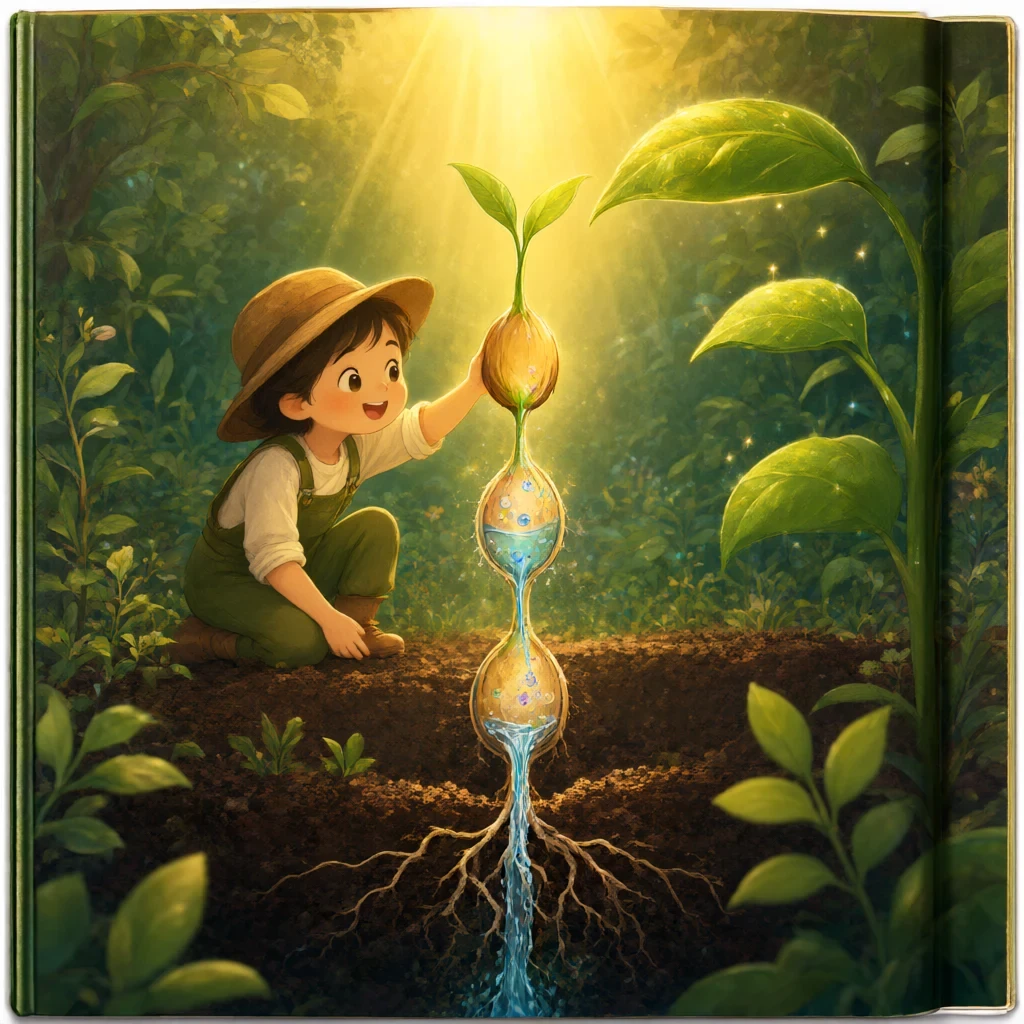
On the morning the community garden opened, a bean plant leaned so far that it needed a spoon for support. The seed was no ordinary seed. A tiny green spark slept inside it, waiting for a leaf to wake.
“It must be hungry,” said Tala. “The soil is not tasty enough.” She sprinkled sugar onto the dirt. The plant drooped deeper. Grandma, who grew beans behind the bakery, brought two matching pots. “Plants are surprising eaters,” she said, “but not that kind.”
One pot held garden soil. The other held the same soil beneath a shiny plastic lid. They gave both seedlings equal water and put them in the sunny window. By afternoon, the uncovered plant had lifted its leaves. Under the lid, the soil stayed wet, but the seedling looked pale.
Tala lifted the cover. Beads of water slipped from the soil. “Are you hiding its sunlight?” “You covered the soil so air could not reach the roots and excess water had no easy way out,” Grandma said. “The plant needs room.”
A clear bag over a leaf soon misted with tiny beads. “Plants take in carbon dioxide through tiny leaf openings,” Grandma explained. “Roots take up water. The leaves also release oxygen. Chlorophyll in the green parts captures light energy.” “So the plant does not eat soil?”
“Roots drink water and minerals from soil. Plants use carbon dioxide from air and water to make sugars, using light for energy.”
They made a simple experiment. A green pondweed sprig sat in a clear jar, upside down underwater, where sunlight could reach it. A second sprig sat in a dark box. The next day, bubbles gathered around the lit sprig. The dark jar had few or none.
“The bubbles are oxygen,” Tala said after the teacher showed her how the light helped the pondweed make sugars. “The plant is using the Sun’s energy.”
She drew a leaf with arrows: water from roots, carbon dioxide from air, light into chlorophyll, and oxygen back outside. A new leaf stayed pale when they covered it with a paper hat, while a neighboring leaf grew green. Tala opened her notebook. “It catches light energy. It does not trap a whole sunbeam.”
That evening the seedling’s leaves softened. Tala thought it was dying. Grandma reminded her that plants also use stored sugars at night. While the Sun is gone, a plant can use energy it stored during the day; it still takes in oxygen and releases carbon dioxide as it does this work.
The garden’s plants began to pale together. The gardener had covered their soil with thick mulch. Water stayed near the surface while roots searched below. A heavy basket had crushed one bed.
Tala’s first rescue failed. She pulled away the mulch, but the roots had been crushed. Grandma showed her a young tree beside the gate. Its roots went around stones and through cracks toward deeper damp soil. “Make a raised bed,” Grandma said. “Loosen the ground, give roots a way down, and leave room for every drop.”
Tala and the children built the bed from old boards. They loosened the soil, moved the crushed basket, and made a shallow channel for rain. They planted beans and peas in the same sunlight and watered the roots deeply.
The leaves stood straighter. On a warm evening, dew formed on them. Tala reached for the watering can, but Grandma stopped her. “Air gives water back sometimes. Check the soil before you decide.”
One hot day, a hose burst and water rushed across the path, carrying soil toward the gate. The children wanted to build a wall to stop every drop. Instead, they cleared a drain and moved mulch away from the stems. The excess water found the rain barrel, and the roots breathed.
They left fallen leaves in one corner. Fungi, bacteria, and small detritivores began to break the dead material down, readying the ground for another planting. The children watched the garden as a partnership: leaves made food in light, roots drank from soil, and hidden workers returned what dead leaves had used.
When the first pod opened, seeds shone inside. Tala understood that the plant had captured light energy, used water and carbon dioxide to make sugars, and sent oxygen back to the air. It was not eating the ground like a child eats a biscuit.
The next spring, she planted one saved seed near the school clock. A new leaf lifted toward the window.
The bell rang at sunrise, and the garden team walked the rows with gloves and a watering can. They checked the soil with a finger instead of judging by looks. They left roots room, cleared channels, and watched for clouds.
At dusk, the children smelled a leaf’s warm, grassy scent. They could not see the night work inside it, but they knew the plant was still using stored energy, not standing frozen until morning.
When rain came, runoff slid downhill, seeped into the ground, and returned to streams. A fallen leaf softened under fungi and tiny animals. Roots drank. Leaves received light. The garden stayed alive through changes the children could observe.
Tala closed the gate gently so no soil would escape. Above the gate, the Sun shone on leaves, roots, fungi, worms, insects, and the living web beneath one green blade. The seed had not eaten the soil. It had caught enough light, with water and air, to build a new beginning.