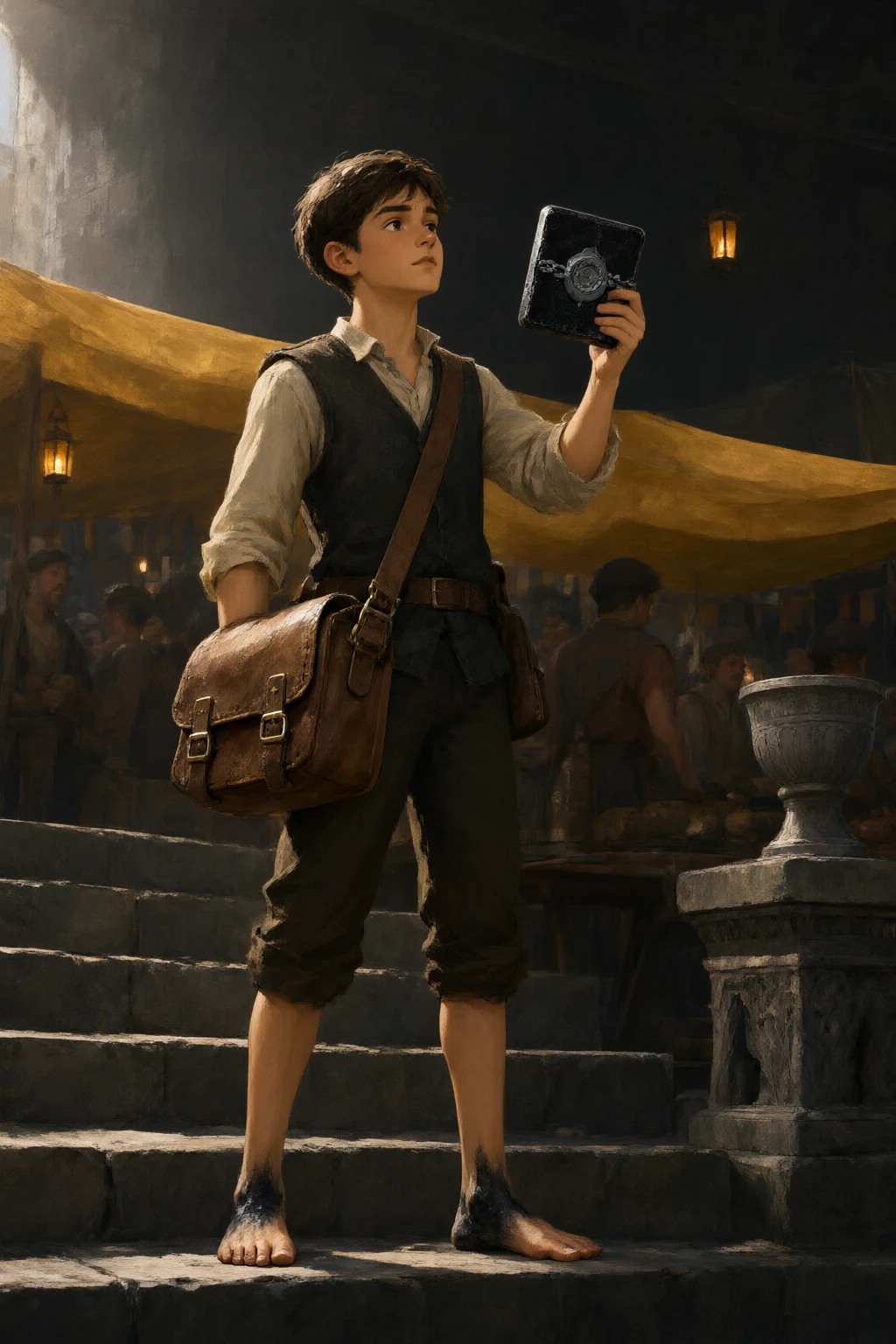
The tally came to Dain Callow at the Sixth Gate at dusk, and the first thing he did with it was hold it up to the last of the light and look at the wax. It was a palm-sized tablet of black basalt, dressed smooth, with a count cut into it in a relay clerk’s square hand: nine hundred and forty measures of drawn strength, to be taken from the brands of the Sixth Chain and given back to the common Measure. The join was filled with grey wax and the seal was pressed into it with the braided chain-die, which is what every tally in the caldera goes through and what no hand here can counterfeit, because the die lives in a locked case under the Third Terrace and only comes out when a tally is sealed.
He turned the tablet over and looked at his own mark while he did it. It was on the inside of his left wrist where he could read it by rolling his forearm: a raised pale comma with a dull orange core, the size of a grain of wheat. A promise to come. He had sworn it at fourteen in front of a witness-flame the colour of an apricot stone, and it had come up in about the time it takes to say the words twice. That is the whole of it. The comma says come. It does not say come with this, and it does not say come with something true.
Couriers run the night chain because the nights are the only cool part. Dain went out at the top of the dark with the tally inside his shirt, and by two hundred yards onto the causeway he had stopped thinking about the wax and started counting instead. Eleven on the satchel buckles, worn thin where his thumb went. The causeway eleven miles of it, its joints sealed in obsidian glass gone hard and bright black, the floor’s slow orange fissures running close alongside. You learned it by its seams: a stretch at the fourth hour where the glass had run thick and the road rang hollow, and a stretch at the seventh where the couriers before him had worn the shine off it.
Nine hours. Six of dark, three of light, and the Measure called at noon on the platform at the north end of the Ninth Terrace market, with the re-draw on the agenda whether or not anybody had anything to say about it. The chain did not run on judgement. It ran on forty-six posts and eleven rules and a rule about seals, and Dain Callow was the twenty-second courier of the Sixth, aged seventeen.
Nine-Fork is a stall. Two trestles of slate under a yellow-brown awning of oiled sailcloth gone stiff with age, a kettle on a tripod, and a woman called Ulla Vint who has held the post for nineteen years. The goods are flour, bootlace and boiled sweets, and the small cut glass of the post itself: a bell on a bracket, a register book, and a die-case with no die in it. Couriers call it the Nine-Fork stall. Dain called it the Nine-Fork stall even when Ulla told him, twice, to call it Nine-Fork. There was nobody in the market but her. Lanterns at ankle height along the base of the basalt wall threw enormous orange shadows up the black stone, and Ulla’s shadow went up thirty feet with a kettle in its hand. “Eleven,” she said. “Eleven.” She put the kettle down. She did not reach for the book. She looked at the flat place the tablet was making under his shirt. “Tally,” she said. “Tally.” “Give it here.”
He gave it to her. She turned it. Her fingers went over the wax once, the way you go over a hem. They went over it a second time. Then she held it up into the lantern and tipped it, and Dain felt the beginning of something in his stomach that he had no name for yet. “No,” Ulla Vint said.
The market was extremely quiet in the way a market is quiet when the fire under the kettle is the loudest thing for forty yards. “No,” she said. “Look at the die.” “It’s the die. It’s always the die. It’s the only die.” “It is not the only die, Twenty-Two, it is the one die, and this is not what it looks like.” She put the tablet flat on the slate and turned it so the light came across it, and set her thumbnail beside the seal. “Eight links. Seven of them are edges.” “Seven links.” “Count them.”
He counted them. Seven. And the eighth place, where the eighth link should be, was smooth. Not worn. Worn he knew: worn was the rounded shining hollow a thing gets when a few hundred thousand seals have pressed on it in a hundred and forty years, and there were two such places on that die and both were at the ends. This place was flat, the way a file leaves a thing flat. “It’ll have dropped a link. They’ll have dropped a link out of the case.” “Does your case keep them in oil.” “It keeps them—” “In oil, Twenty-Two.”
He shut his mouth. The case was kept in oil. He had seen the die lifted out of it for the turn of the season and put back. And if a link had dropped out, the case had been opened, and the lock under it is in the Third Terrace, two hours down the chain, and he was standing in a stall at four in the morning with a stopped clock. Ulla turned the tablet over, gave it back, and he took it although he did not want to. “If I pass this,” she said, “it goes to the Tenth at the hour and the Twelfth at the hour, and every brand in the Sixth Chain loses a fraction of what it was sworn to hold. And no one on that platform will be able to read one mark on one person in that market, because the seal on the order will not read.” “You can’t stop it,” Dain said. “The chain is a chain. If Nine doesn’t pass, it goes round to Eight and comes at it from the other side, and I’m standing here with a dead clock.” “I know what the chain is,” said Ulla Vint. “I’ve held it nineteen years.”
A re-draw takes the drawn strength out of the brands and never says out loud which brands, only how much in total. And four hundred years ago somebody had proposed taking brands outright, on a scale, and had got as far as a page, and the page was in the House of the Quiet Ledger with the names torn out of it.
Nine hundred and forty measures, off the Sixth. The Sixth wore more brands than any other chain, because the Sixth was the one that ran, and running took promises, and the ones who ran were the ones who promised to come. He could read his mother’s bar from across a room, and she had gone grey at thirty with nothing on her mind but a roof. He could read the mark of the woman he had run with last month, a hooked stroke on her throat for a promise to protect; if this went through at noon she could no longer be held to it at full strength. Neither could the woman at the Fifth, nor the man at the Seventh, nor the twelve people he had learned by name in one season.
Nobody had ever said that out loud. That was the craft of it. It was not a harvest; a harvest was a word, and words get refused. It was an audit, and an audit was boring, and the only person in the caldera positioned to object was a boy barred by a law older than the relay from ever being a keeper. Behind him, in the dark, something on the causeway rang. Then something else. “Sixteen,” she said. “And Seventeen behind him.” “Sixteen is an hour behind me.” “Sixteen is an hour behind you, and he is standing on the seventh seam with a sealed wax he cannot set down and cannot open, and he has said come.” She turned round. “When you stop, Twenty-Two, you do not stop one courier. You stop all of them behind you. Everyone behind you is out in the open holding a promise to come, and they are standing still, in the heat, on account of you.”
He said nothing. He had not thought about the other people. It took her eleven seconds to put it into words, and those were the most useful anybody had given him all night. “Then I lodge it,” he said. “At noon. At the platform, in the market, in front of everyone, I read out that the die is filed, and the re-draw cannot be entered, and the Sixth has not been re-drawn.” “A courier may lodge a detention. Once per tally, at a Measure called in the open, and the comma holds, because the comma says come and you are still coming. Nobody’s used one in nineteen years.” “They haven’t had a reason.” “Then I’ve a reason.”
The relay master had a girl waiting at the Ninth’s back turn with a fresh mark on her throat. Hooked stroke, promise to protect, the brand still pink at the edges, sworn that morning at first bell in front of somebody who thought there was something to protect. She was fifteen. Teasel Darn, of the Sixth, and Dain knew her the way you know every courier in your own chain: the sound of her, and where her seam is, and that she is better on the causeway at night than anybody his age. “Hand it over,” said the relay master, Saben Ketch. “Darn runs the last leg. She’s fast. It will be in the platform book on time, and Nine-Fork’s refusal goes in the book as a formality, and you can say the die was filed after the fact and the whole thing stands.”
And Nine-Fork’s stall would close in a week, and Ulla Vint would be sixty-eight and would have kept a post for nineteen years and ended it for a formality, because a boy was too proud to let a girl carry his mistake. “No,” Dain said. “Twenty-Two.” “No.” “A fresh protection oath, on her throat, sworn this morning by a man who is not in the chain and who signed for a thing he did not name, because the desk said to him. That mark is real. You are handing it back.” “Run it,” she said. “I’ll be there at ten.” “No,” Dain said. “You’ll be there at ten, and you’ll be a courier who carried a filed die and never opened her mouth about it, and you will never be able to tell anybody why it was allowed. The reason will be that I was embarrassed.” “That’s not—” “It’s exactly that. Hold the stair. I’ll ask you for it properly at noon, in the market, where it counts.”
The climb took four hours and the descent three. He was at the top of the switchbacks with ninety minutes when the market came into view, and he was in time to see the platform being built, which is what they call it though nothing is built: trestles up before dawn, the raised stone permanent at the north end, the graduated cup standing on it, two lantern-fires at its sides, and four hundred people in between by the time the terrace can see any of it. Kel Rusk was there, because the Ninth was his terrace and he had built that plinth every market day for twenty-six years. He was sitting on it with his beard burnt short on the left side and the bronze ring he carried on a cord in his pocket conspicuously not on his hand, and a boy with a barrow was moving stone and shouting numbers at him. “Fourteen courses,” Dain heard him say, four hundred feet down. “Three spans. Give me the barrow.”
Kel Rusk came down the two steps and put a hand out for the tablet, the way you take a tool from an apprentice you have decided to trust. “That’s a re-draw, that.” “Fourth gear in. Nine-Fork stopped it.” He turned it over and looked at the wax the way Ulla Vint had, and he did not have fingers for it, and he turned it back the wrong way, and looked again, and his jaw moved. “Eight links on the chain-die,” he said. “There’s eight.” “There’s seven and a flat.” “There’s seven and a flat.” He gave it back. “If you read that out in front of my market, on my stones, the Sixth is a defaulter by the afternoon, and there’s no second. You know that.” “You’re seventeen.” “I know how old I am. Go on.” “No.” “No?” Kel Rusk looked up. “Then say it plain, so I can tell whether I’ve heard a boy or a chain.”
“The Sixth Chain re-draw. Nine hundred and forty measures off the brands of the Sixth. It is sealed with the chain-die. The die on this seal has no eighth link. It has been filed. The wax is whole, the count is legible, and the seal cannot be read, so the order is not entered, so it cannot be executed. I am lodging a detention under the ninth rule of the running chain. I am courier Twenty-Two of the Sixth. I ran this tally from the Sixth Gate. Nine-Fork refused it at the fourth hour. I have not broken my comma.”
The silence after that was the loudest thing that had happened in the Ninth Terrace market in twenty-six years. Sister-Coll Ferrow came out with the cup, filled at the covenant vent and carried, and lifted it to the rail and read out the day’s number. The number was low. The market took it the way the market takes rain. Then somebody at the back asked the question. It was a woman on the Second Course with her sleeves pushed up and both forearms out, and what she said was, “Which of my marks.” “None of them,” Dain said. “Yet.”
And Kel Rusk, behind him on the platform, said, “It would have been the running marks. A re-draw doesn’t know you from a lamp. It takes a fraction from every brand, and the running have got the least spare and the most years on them.” He put his hand flat on the stone. “And I’ll tell you what the running have got, since nobody’s said it. They’ve got the six hundred years of it. Every road in this caldera is a road because somebody in a chain swore once, in one season, with nothing spare, and it held, and the road is still a road now with nobody holding it at all.” Sister-Coll put the book down and looked at the seal and asked for the die, and the relay master was not in the market and did not come, and a runner went down the stair for him, and the number sat unwritten in the re-draw column, and noon went by.
The relay master came into the Sixth Gate on the second day and put the tablet down on the desk and did not sit. “Eight links on the die,” he said. “Seven and a flat. A link doesn’t fall out of a case in oil. Somebody took a file to it.” “Somebody took a file to it,” said Ketch, “and it is not the first time that die has been touched, and it will not be the last, and the reason is in a drawer in the Third, and in eleven years when you are twenty-eight and still standing in this room, you will have earned it.”
“Here is what you did and what it cost. The re-draw is set aside until the die is recut, which is nine months, and then it will be executed properly, with a whole die, and it will be fair, because the Sixth took more than the Sixth was owed and I have the reweighing that says so. Your mother’s bar comes down by a hair.” He lifted his own forearm and showed it: a bar, forty-one years old, the core gone from orange to rust. “So does mine. So does hers, and Darn’s, and the woman with her sleeves up. All of them, by a hair, and they will all live. I have been trying four months to find a way to do that without a file. There is not one. I made a mistake. I would like to be allowed to say the second part out loud.” “The first part,” said Dain, “is that the Sixth is a defaulter.”
“At second bell tomorrow. I have written the notice and it is signed, and I will lodge it myself, and you will stand behind me when I do, because it is true.” “Why,” said Dain Callow. “You could have had me stopped at Nine-Fork and the re-draw done in secret and nobody in this caldera would ever have known. Instead you have a defaulter, a file in a die case, and a boy of seventeen who can read a seal.” “Yes.” Ketch turned round and went up the stair. “That is the whole of what I have to say, and I have been saying it badly for four months. I wanted the number secret so that it would be small. Numbers that are public are large. You taught me that today, in front of four hundred people, with a filed die.”
The comma on Dain Callow’s wrist was the colour of a cooling hearthstone for the rest of his life. The core had gone from orange to a dull red, and any adult could read it in a glance, and there is no language in the seven cities for a mark at half strength, because the covenant has only three shapes and one of them means broken. It meant spent. That was the whole difference between his and a black mark, and the whole difference was about nine hours.
Dain Callow never became a keeper. He ran the chain nine more years and was good at it. The old law barring a man of the running chain from the keeping of the record is still in the index in a square hand, and Dain could have told you the number of the leaf it was written on, and the year, and the clerk’s name, and he never wrote it out, because the reason for it was on a leaf that was not in the index at all, and he had spent enough of one clock already on a thing he could not find the reason for.