The frog had a well. There was no bucket in a castle courtyard. There was a stone well on the edge of the town, four streets from the fish market, and the frogs had held it for eleven generations. A frog that rents a well and pays rent on it is a tenant, and a town that argues with its tenants has no tenants in spring. The rent was one beetle a week in summer, paid into a slot cut in the stone. There were forty-one frogs in that well, and not one of them was a prince.
The ball came in on a Tuesday and hit the water with a sound the whole street heard. It was the size of a small melon and it was gold-coloured, and it went to the bottom and wedged itself in the silt between the well stones, which is the one part of a well no arm can reach. The frog saw it go and did not follow it, because Tuesdays are a bad day to be four beetles short. He went in on the Wednesday.
The prince came on the Friday with a groom, a captain, and a boy holding a box. The boy asked, reading from a list, if he had found the ball. He had. The boy said the prince would be grateful. "Grateful how?" said the frog. The boy looked at the prince. "Whatever you want," said the prince. The frog put down the beetle he was holding, to get both hands free. "Say that on the record," he said.
The clerk lived at the well-head. "If a person says whatever you want to a person who has got a thing out of a well," said the frog, "that is an open promise, and I am a tradesman. I will have it in writing, with the terms on it, before the ball comes up." "You are a frog," said the prince. "I am a frog with a lease," said the frog, "and the lease is longer than your father's."
They had to fetch a second seal. The prince, nineteen and regretting the entire afternoon, sat on the well-head with his boots off while the clerk wrote and the frog dictated. He was not being difficult. He was being exact.
The ball came up at ten past four, and the prince said it was a pity: it was only gilt, the core was lead, and the court had been told it was solid and his father had said so in a speech. The frog said nothing. It confirmed the prince's opinion of his father. The clerk read the terms. The frog had asked for four things. One: the wide stone step at the well-head, the one nobody uses, permanently, at night. Two: a written lease on the corner of the lily-pad. Nine years, renewable, at the old rent.
Three: the cart that goes to the Thursday market, in the small hours, whenever he wants it. Four: the right to be addressed as Your Frogness, which the frog explained was a formality and not an ambition, and which the prince agreed to at once.
They put him on the long table in the middle hall, on a plate. It was not a trial. He had cleaned his eyes for it. It was a curiosity: strawberries, and milk, and two hundred years of a family that had never seen a frog on a table. "A frog," said the frog, when the princess came in last. "Good evening. My name is Ferrel, I have the well, and I should be told where I am to be."
The queen objected to the plate on the grounds of the cloth, and the frog said that was reasonable, and asked for a saucer, and for the corner by the fire with a low stone, because he could not see out of a window from the floor. "You have a well," said the prince. "I have a well, and you have forty rooms," said the frog. "I am not asking you for a room. I am asking you for a corner of one, which is a smaller thing, and which is the shape of everything I have ever wanted."
The princess said, "Then kiss me for the ball, and it will be done." There was a silence in the hall of about a second and a half. "No," said the frog. "The contract says I catch, you pay. There is nothing in it about kissing, and I am not going to do a thing that is not in a contract. A frog kissed for payment is a frog handed a present instead of a wage." The princess said he was being very odd. The queen said the interview had gone on long. The frog agreed with the queen and asked whether the corner was available. It was available.
He was installed on the Thursday. The stone went down first, and the saucer of milk beside it, and the stool the page carries round for the old men at the gate, three inches high, the best thing in the room. The window went over the courtyard, over the orchard, out over eleven miles. He had watched beetles being sorted all his life, and he had never seen weather come in over a ridge. But the door was shut from the inside, and on the second evening a cat came in off the roof, sat six feet off the stone, and looked at him for an hour.
"You cannot keep me," said Ferrel on the fourth evening. "I have the saucer and the stone, and I have said thank you." The cat put its head on one side. He had not said it in some months. There was nobody in that house to say it to.
The prince came to the west corner in the fourth week and sat down on the floor beside the stone with his back against the wainscot, which is not a thing anybody had ever seen a prince do. "You have not asked me for anything else," he said. "No." "Everybody in that hall wants something, and they wait for me to be asleep, and then they write, and the letter always begins by describing how well they are doing." "I have been polite to eleven people this month," said the prince. "I should like somebody to be polite to me and want nothing."
They sat there for an hour, and then two people with nothing to say to one another, left alone, say the actual thing. The prince had forty rooms and no trade. He was heir to a building. The frog had a well, a lease, a cart on Thursdays, and a stall where he was owed eleven pounds, collected in beetles. So the prince did the sums. He was quick, and had the household accounts in a quarter of an hour, and at the end of it he said, in a different voice, "There is a great deal of this that is not necessary." "Which part?" "The winter coal. Four rooms are heated that are not used. It has been done for sixty years and nobody has ever said so out loud."
The work took nine weeks, three people resigned over it, and the prince signed all of it. And when it was finished he said, "You know you will have to be something. People will not have a frog in the north end." "I am a frog." "You are the something," said the prince. "You have just drawn me a kingdom and you cannot give it back." Ferrel thought about that for a long time, and the page waited, because he had asked it to.
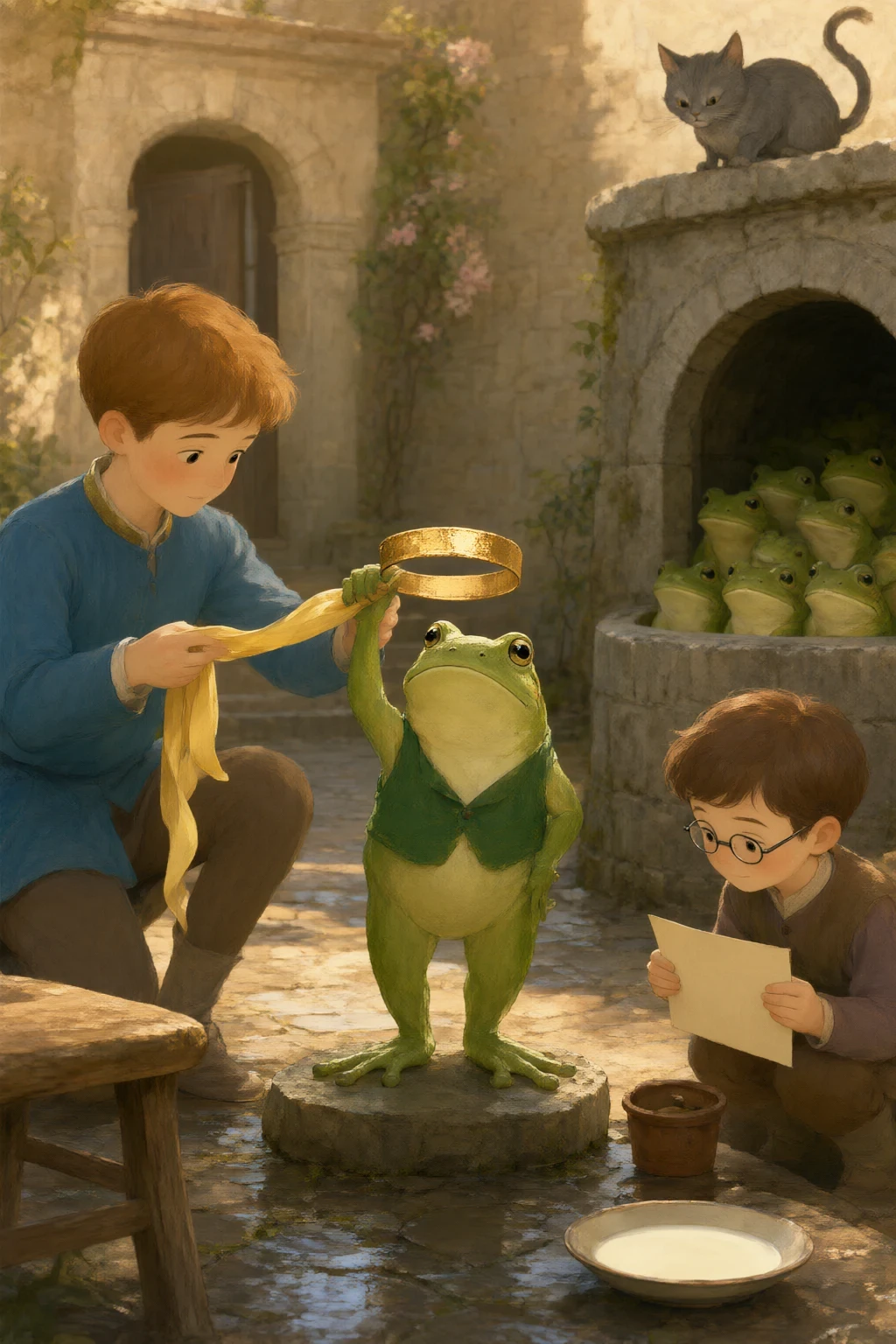
The coronation was in the courtyard on a Sunday in June, because there is nowhere high enough in a hall. There was no crown in the kingdom. The treasury was a well with a slot in it, a corner of a pond, a cart on Thursdays, and a fairground stall. What was on the table by the well-head was a sheet of foolscap, a pot of gold size left from gilding, and the page's own idea, which the prince pretended to find ridiculous and then paid for. "You cannot," said Ferrel. "I have already."
The page measured a circle and the boy gilded the edge, and the prince held one end of a ribbon more the colour of butter than of gold, and Ferrel held the other and would not let go for some time. Then the frogs came up one at a time, all forty-one, and the cat on the wall watched all of it and did not come down. Afterwards he walked the outside of the north wall, because he could see all eleven miles from it. He put the stone down, and the saucer, and the stool, and the crown, standing on the well-stone, propped against the lamp.
In the morning the dew had taken the gold off the rim in a single strip. Ferrel shaved a fresh piece off the long straight edge at the back of the cart and sent the page up the hill for two more sheets at eight on a Tuesday, because he had been thinking about a hoop.