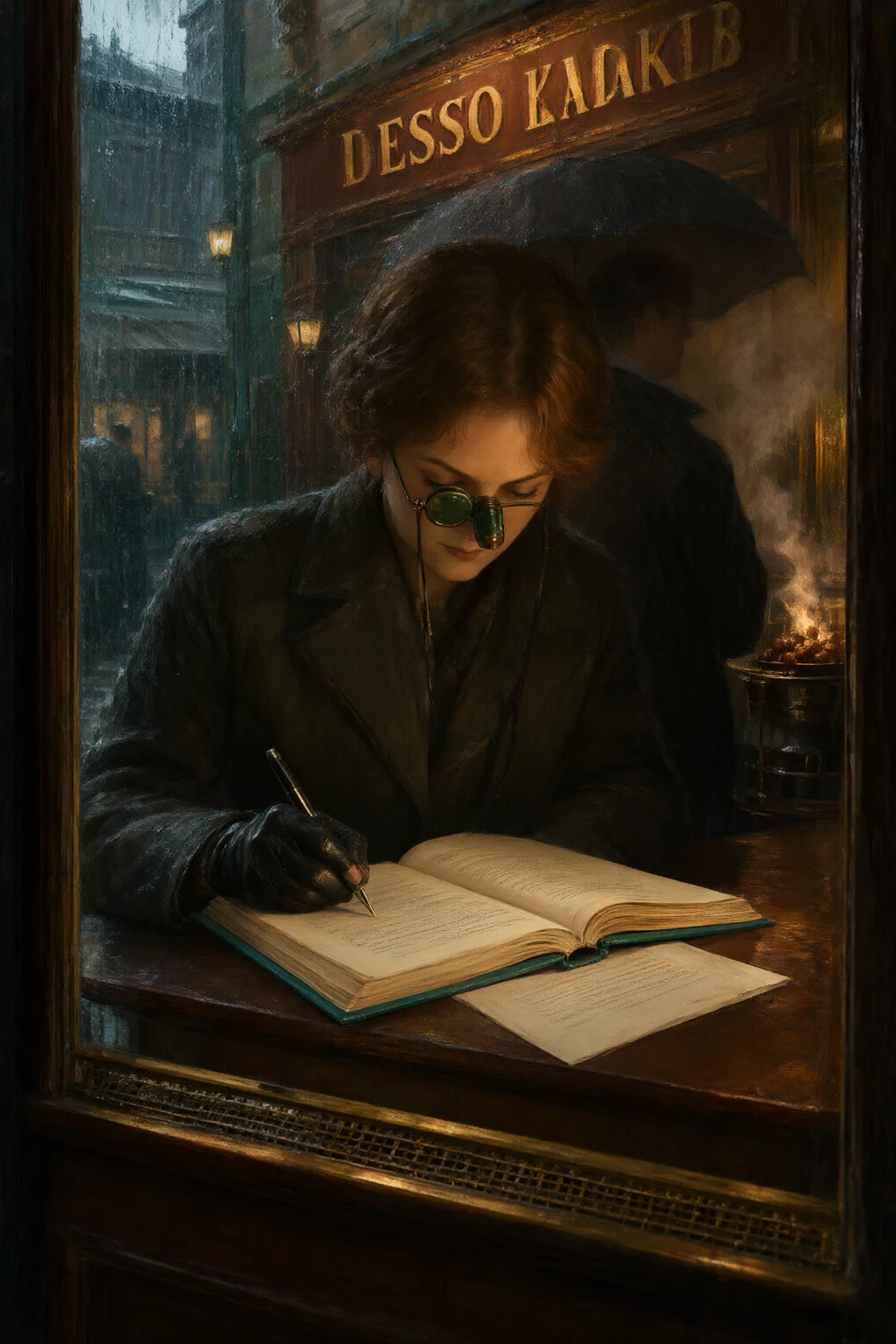
The Thistlewire sold its season through a barred window off the lobby, and the queue for it stood on Ardle Street in the wet. By ten in the morning there were thirty-one people in it and a woman with a basket who had been in it since the shutter went up, and the brass grille made a lattice across every face that came to it, so that everybody who was served was served behind a grid, which Ilse Karrow had been told was unfriendly and had never agreed with. Outside on the wall above the window the gilt board burned its hard blue-white gas and named the season: MR AUGUSTIN PELL. MR TOBIAS WREN. MRS CLARA SEDGE. Eight names, and the board had been out since August, and the printer had been paid. The pavement was the colour of weak tea. Chestnuts were roasting in a brazier at the corner and the smell came down the street and mixed with the wet wool of thirty-one coats, and a horse stood outside the stage door with its head down and its breath going up in the cold. “You will want to look through this,” said the man at the counter, and pushed a fair copy across.
He was perhaps thirty-five and dressed better than anybody else in the lobby, in a coat that had been made in a town where the making of coats was the principal trade. His name was Simeon Grale and he kept the books of the Royal Clarence, in Weaver’s Row, which was the house the Thistlewire was always measured against and never against for long. “A subscription to your season,” Mr Grale said. “One subscription, taken in March, in the name of a person who is now of no address and cannot be found. The question put to my committee is whether he may have his money. I am instructed to say that the committee is of the opinion that a subscriber buys a Position and not a performer, and I am instructed to ask you whether that is correct.” Ilse read the fair copy. It was two sheets and it was very good work. She had seen it before; she had read a version of it in April and had thought, at the time, that it was the plainest thing in Verrow. “The subscriber purchases the season as set out in the Programme,” she said, “and the season is the Positions named in the Programme. That is on the second sheet. Clause four.” “That is what I have been told.” “It is what we print.” “And the performer is not sold.”
“The performer is not a term of anything,” said Ilse Karrow. “There is no performer in the transaction. There is a Position, a seat, a date, and a price. If a person stands in the Position on a given night, that person is filling it, and the filling is not the sale. You might as well ask me whether the gas is sold.” “I would not,” said Mr Grale, “because the gas is not in clause four.” “No,” she said. “The gas is not in clause four.” She wrote her confirmation on the fair copy in the small hand she had not varied since she was thirty-one, and signed it at the foot as the officer of subscriptions, and gave it to the clerk of the Royal Clarence, and the clerk put it inside his coat as though it were something that might be taken off him on a stair.
“Two documents,” she told him, holding up a finger, and apologised to the counter as she did it. “Sorry. Tray is mine.” The tray was the brass one that the pennies went into and it had a worn patch where four hundred and twelve seasons of pennies had been counted out of it. “The first is the ticket. Seat, night, price. The second is the back of the ticket, and the back of the ticket is where we keep everything, because a subscriber will keep a ticket for eleven years and will not keep a leaflet.” “Small print,” said Mr Grale. “It is not small print. It is the same print.” “It is always the same print when it is that important.” She was, in the way that a person can be impressed by a professional in another trade, rather pleased. He took out the back of a ticket from his own coat, printed by his own house, and read a clause aloud in a voice that was not his own, and the two clauses were the same clause, word for word, in the same order, and neither house had ever taken the other’s paper. “Then tell me what the clause does not do,” said Mr Grale, “since you are a person who reads them. Does it anywhere say as performed?” “It does not.” “Does it anywhere say the company undertakes that a named performer will appear?”
“It does not. It says the season will be performed, and it names the season, and the season is the Positions named in the Programme. If the company in good faith engages Mr Pell to fill the Younger Brother, and Mr Pell is then ill, or is then in fact not a person who is able to perform at all, or is then unwilling, the clause gives the subscriber the season, because the season is what has been sold, and the season does not have a fever.” “That is a very cold answer to a man who paid eleven pounds.” “It is the only answer there is. And it is not cold, Mr Grale, it is warm. It is the warmest thing in Verrow. Nobody in this street will promise you a face in November. They will promise you a warmth and a light and a chair and a play, and they will be there in the rain to keep it, and that is a promise, and it is kept.” She squared the fair copy to the edge of the counter. “The face is a separate transaction. It always has been. It is not in the paper because paper does not keep a face.” “No,” said Mr Grale. “It does not. But it keeps everything else.”
“The season is sold eleven months in advance,” she said. “In August. We are selling the winter on the first Monday of August, in the rain, with nobody in the building but the gas and the boy who trims it. If the small print were the small print, we should not be able to sell anything at all.” “Your gas boy,” said Mr Grale. “Is he in your employment?” “He is on the roll.” “Then he is employed.” “He is on the roll,” said Ilse Karrow, “and I pay him on the Friday.” She said it to make the point that she was thorough. She did not hear what she had said, and Mr Grale, who was a careful man in another trade, heard it exactly, and looked at the grid of the brass grille for a moment, and then asked her whether the roll was a document she could produce, and she said that the roll was an internal document of the theatre and she could not produce it, and he said that he had expected as much, and thanked her, and went out into the rain.
The programme for the season was printed in the last week of July and bound with a paper cover gone soft at the corners from handling. It set out eight Positions, the actor the management had engaged to fill each of them, the nights, the prices, and, beneath, in eight-point type and without comment, the terms of each. The Younger Brother. To be played as described, in all scenes, and to be held to the description, in the wording of the description, and to speak no line not written for him. As described, in the wording of the description. Four hundred and twelve people had read that sentence eleven hundred times without once asking where the description was, and the answer was that it was not in the programme, and the programme did not say so, and the printer had been paid, and the paper was the only part of the transaction anybody was permitted to hold. Nobody in the house had ever asked why a brother opened every door in a play about a cooperage. They had watched him do it, two hundred nights a season, four seconds at a time, and they had made the small sound people make when they have been given something true that costs nothing, and they had not asked, and the not asking had never once cost them anything either. The Season Book came out of the press-room cupboard on the Monday.
She had taken it out alone, and she had put it out alone, and she had done it for twenty years. It came off the shelf on her hip the way a book comes off a shelf when you have lifted it four times a week since you were thirty-one, and it went down onto the deal desk with the sound she liked, which was the sound of a quarter-bound book meeting a table that had never been dusted in anger. The gilt edge had gone green at the corners. The head of the list was in her own hand, and under it four hundred and twelve columns of names in eleven different hands, and at the foot of the page, in a smaller hand, the roll. The first season of the theatre was entered in a fair copperplate hand by a man named Thackery, who had been a printer and had wanted a day’s work. SEASON THE FIRST. THE THISTLEWIRE, ARDLE STREET, OPENED. POSITIONS: THE FATHER, THE YOUNGER BROTHER, THE WIDOW, THE CAPTAIN, THE DOCTOR, THE CORRESPONDENT, THE WOMAN AT THE DOOR, THE CLERK OF THE COURT. FELLED AS PROVIDED: 412. SUBSCRIBED: 411. ONE SEAT UNACCOUNTED.
She read the last line three times, because a seat unaccounted was a thing that had happened four times in twenty years, and she had a headache for a week on each occasion, and the manager upstairs had said it was a comfort to know. Below the positions, in the same copperplate, the roll. Then in the third season: SUBSCRIBED: 412. And in the fourth season the copperplate gave way to a clerk’s hand, and in the seventh the hand changed again, and by the eleventh season the page had the shape it still had, with the roll in a small neat column at the foot, and the column had numbers in it.
The first thing she found was a word, and the word was salary. In the second season, under the subscriptions, the clerk had ruled a second column and headed it, and the heading was in a different ink from the rest of the page, as though the man had gone home and thought about it and come back. The heading said: WAGES PAID TO THE BOOK’S PEOPLE. And under it there were figures, and beside the figures there were not four hundred and twelve names. There were eight. She read it again to be sure, because a page that has been badly kept is a page you read twice before you start inventing things about it. Eight figures, and against them a figure that was not a name but a seat, and against the seat the word PATRONAGE, and beside the word PATRONAGE, in the tiniest hand the clerk possessed, a note: filled as provided, see roll. “Patronage,” said Ilse Karrow, to the empty office. “Sorry. Stool is not mine. Nobody’s.” The subscription at seat fifty-one was not fifty-one pounds. It was eleven shillings a week, paid in advance for the season, and it was paid to a body that sat in a velvet chair and watched, and the body that sat in it had a column and a number and, on the Friday, a wage.
She worked forward. It did not take long, because the theatre had not changed its habits in a hundred and forty years and habits are the only thing in a book that never get edited. The column of wages was ruled off after the second decade. The note beside it survived for another thirty years and then faded to nothing, in the way that a note fades when there is nobody left alive who remembers being told what it meant. But the column itself never went away. It was still there in the season before last, in the same place, in the same ink, ruled in the same hand as every column since. And in every season in between, on the Friday, a clerk or an officer had gone down that column and taken out sums, and the sums did not always come to nothing.
She found the first one in a season she had no reason to remember, in a hand she did not know, in the margin, where a careful man records the reason a figure is not what it should be: struck in full, seat holder, spoke the truth in the lobby, may not subscribe this season. And the figure struck was eleven shillings a week, and it was struck the way a wage is struck, in the wage column, with the same two strokes, and underneath, in the same ink, the reason, and the reason was not a note about a seat. Nobody outside the building is permitted to be told. That is in the printed clause and it is in the back of every ticket, and Ilse Karrow had read it perhaps nine thousand times, and she had always understood it as a commercial matter: a man who puts it about in a lobby loses the town’s custom and the season’s custom with it. But a man who is struck out of a wage column on a Friday is not a man who has been discouraged. A man who is struck out of a wage column on a Friday has been paid nothing, and the striking is done by the same hand that strikes the corps, in the same ink, in the same ruled line, because there is only one Friday column in the book and it is a single column and it takes a single stroke. There are two kinds of subscriber in the correspondence file, therefore, and the second kind is a very small file, and the second kind is not a customer.
The correspondence file is on the same shelf as the Book, and it is the only thing in the press-room cupboard that anybody ever opens, because it holds the letters that have to be answered, and letters that have to be answered are by definition rare. There were perhaps three dozen in it, tied in twine, in date order, and she knew the order without looking, because she had put them in that order herself. Near the bottom, where a file stops being interesting, there was a bundle that had been tied twice. The outer tie was new. The inner one was eleven years old and had gone furry, and inside it were three sheets in a decent hand, the hand of a man who had been taught something. “Sir,” it began, “I am in the unfortunate position of having asked a question in your lobby on the eleventh of November, in front of your box office, and of having been answered by a young man very correctly and at some length, and of having understood at the time that I had been told a thing I was not to repeat.
I write to ask one plain question. I have paid eleven pounds for the season. I have not been to four of the nights. I am told the season may not be returned in part. If it may not be returned in part, is there any sense in which the money that remains unspent is the property of the season, or of me? I put the question because I have a daughter at home who does not come to playhouses and whom I should like to bring, and I do not wish to bring her into a building in which I am not permitted to tell her what I have seen. I am, sir, your obedient servant.” And below it, on the reply sheet of the same office, in her own hand: “Sir, The season is not refundable in part. The management does not permit the truth to be spoken in the house, and I have the honour to be the officer who administers that. Your subscription is not the property of the season, nor of yourself. It is entered, and the entry is held, and you are welcome at any night of the season at which you are able to attend. I am, sir, your obedient servant.”
Eight lines. There was not one word in them that she would have wished to unsend. She had sent it, from a cold office, in the middle of November, to a man who had asked her, as a father, a plain question. Then, at the foot of the page, in the book hand of whoever kept the file: Answered, 14 Nov. Seat struck in full from the Friday following, eleven shillings weekly, and the seat disposed of by sale. And the signature at the foot of the strike was hers. She turned the bundle over. There was nothing else in it, and she untied the outer twine and tied it again, because a file that has been opened should be closed by the person who opened it. Three. In twenty years, in a theatre of four hundred and twelve seats running two hundred nights a season, three men had stood in a lobby and said out loud the thing that is not to be said out loud. Three had been entered, and answered, and struck, and had not written again, and had not renewed, and had not come back to Ardle Street to say anything about it. She had been right about all of them, at the time, in eight lines, in a good hand.
She went to the window at two o’clock to open the box office for the half-price rush, and the queue was still there in the rain, and she took them in at the pace of a woman who had done this four hundred and twelve times a season for twenty years. “Two for the Wednesday,” said a man, and then, seeing the ledger out and not the tickets, “actually, if it is the same, one for the Wednesday, and I am sorry, the other one is for my wife and she will not come.” “Wednesday is a bad night,” said Ilse Karrow. “The Widow is not at her best on a Wednesday.” “She is not a person.” “Thank you. That will be eleven shillings, and the seat is fifty-one, and here is your ticket, and the back of the ticket is the terms, and read them when you have got out of the rain.” Nell Tarrant came at half past three, which was an hour at which the corps were wanted nowhere, and stood at the grille with her hands behind her back in the attitude of somebody submitting a document. “Is my name in the book?” “No,” said Ilse Karrow.
“That is what I thought, and I have been looking at the wrong end of it. I want to know whether my name is in the book. Not in the list. In the book, in any hand, on any of the hundred and forty pages.” “There are a hundred and forty seasons, not pages. And no. There is no name. Not yours.” “All right.” She did not go. Ilse Karrow apologised to the stool and sat down. “My name is on a call sheet in my own hand, and it is not on the call sheet. That is the whole of my complaint, and I have written it down twice.” “Yes. I have the two letters.” “You have the two letters.” “They are correct letters and they are correctly addressed and they have gone to the correct person, and I will look into it, and I will tell you on the Friday.” “Friday,” said Nell Tarrant. “Friday. Then I am going to the half. You will miss the gas.” She said it as a fact about a future, and she meant it exactly, and she did it, and it was nothing at all. Then the boy came to the window, which he did on Fridays, and on Fridays with the Friday, because he was fifteen and had discovered in the first year that nobody in the building would tell you the day of the week.
“Seven and eightpence,” he said. “And the man in the cellar says the fourth lamp wants trimming and not the third, and the third is fine.” “Thank you. Stay out of the cellar. Your hands.” He put his hand on the counter to take the money back with the change, and it was the one in the building with a shiny new scar across the thumb, and there was a strip of oiled silk wound round his forearm like a bandage on nothing, and one eyebrow of his had gone burnt black, and she had a page in front of her that she wrote on every Friday for two years and had read perhaps twice. She did not read it then. There were eleven people behind him in the rain.
She read it at nine that night, in the office, with the gas turned down and the rain going on the skylight over the corridor in the way it had gone on the skylight for twenty years. The roll at the foot of the page is not a payroll. She had known that for a long time without having put it in words, in the way you know that the theatre is not a house where people sleep without ever having gone up the stairs to look. THE HOUSE. FILLED AS PROVIDED: 412. SEAT, NIGHT, WAGE. SUBSCRIBED: 412. THE WARDROBE. FILLED AS PROVIDED. ONE BODY. NO NAME. TWO AND ELEVENPENCE. THE LAMP-HAND. FILLED AS PROVIDED. ONE BOY. NO NAME. ONE AND EIGHTPENCE. THE COUNTER CLERK. FILLED AS PROVIDED. ONE BODY. NO NAME. FOUR AND SIXPENCE. And then the top of the column, above the office staff, above the house, in a different ink, and in a hand she had been reading for twenty years without ever once reading: THE SEASON. Written and subscribed and kept, and to be kept whole. All seats accounted. The book to be the book. The acting version is not the book and the book is not to be construed by it. Signed, I. K.
It was her signature. It was the same signature as the one on the fair copy she had given to a man from the Clarence eight hours ago, and it was the same signature as the eleven thousand others she had made since she was thirty-one, and the letters of it did the thing they always did, the K going up and then coming down too far and being corrected at the last stroke in a way that no one alive had ever commented on. Except that this one was not a signature. It was a description. She read it nine times over the course of two hours and every time it turned, the way a sentence turns when you come at it from the far end, from a place where it stops being a sentence and becomes the terms on which a thing is held. She wrote the season. She kept it. All seats accounted. The book to be the book, and the acting version not to be construed by it, which is the sentence she had said to four men and one woman in twenty years and had never once been asked to explain, and which she now understood had never been a sentence about books at all.
It had been a term. It was a term and it was the whole of the requirement, and the requirement did not contain a seat in the house, and it did not contain the play, and it did not contain daylight, and it did not contain a life. It contained a column, and a stroke, and a Friday, and the head of a list with a woman’s name at the top of it, and a woman’s name at the top of a list is not a woman. It is the officer of the list. It is the person who is to write the season and keep it whole, and if the officer may be distinguished from the office by the fact that the office is written in one hand, then the office is a Position, and she is in it, and the book has been holding her since the September when she was thirty-one and had a bad season and took the work because it was warm. Then, because she could not help it, because she was an officer, and because the officer of a book is permitted one thing, she counted her own signatures.
Eleven. One for each September for eleven years, in a column at the head of each season, in the same hand and the same ink, there having been only ever one bottle of that ink in the press-room cupboard and it having been replaced twice. She counted them the way she counted seats, from the top, and the eleventh was this year’s, and there was nothing whatever to see in any of them, and she looked at them for a long time. Then she went down to the roll and read her own column the way a person reads it who has to be fed rather than a person who feeds, and the column said four, four, three, four, four, four, four, four, four, four, four, against the wage, and it had said four for nine years running, and it said four the week before, and on the Friday of that week she had gone down the column with the pen and put the stroke herself, and it had never once occurred to her that the eight on the bench in the wings were the reason there was anything in the Friday column at all.
All seats accounted. She said it to herself in her own office, in her own voice, the way a woman says the name of a street she has lived in all her life. Four hundred and twelve subscribed. Four hundred and twelve seated. Nothing outstanding anywhere, not one seat, not one night, not one column. If the season had closed that afternoon it would have closed complete, and the term would have been satisfied, and she would have been let out of it, because the terms of a Position may not be exceeded, and may be satisfied, and she had not known until that moment that they could be the second thing. The season had three weeks to run. It ran them. She found that first signature on the leaf at the back, the leaf where the season is closed and the binding is done. It was hers and it was in her own ink and the ink had not faded, and beneath it, in the same ink, one line, which was not a signature and had never been a signature: Accepted. Term: to the close of the season, and no seat unaccounted. She had written the word Accepted with a pen on a page in a cold office on a September afternoon twenty-one years ago, and she had not known that she was agreeing to anything, because nobody asks a woman who is applying for a warm room in November to read the small print, and because the small print, as she had told a man from the Clarence that morning, is the same print.
Mr Grale came back on the Wednesday with the fair copy, countersigned, and a letter from his own board, and a small damp umbrella he had left on the counter and then thought better of and taken away again. “It is accepted,” he said. “Our solicitor has read your clause four and has read ours, and ours is the same clause, and he says that a hundred years of two houses selling the same thing in the same street is a precedent and that a precedent in Verrow is worth what a judgment in London is worth, which is a good deal more than it costs.” He put the fair copy on the desk, squared to the edge, and did not sit down, because he had looked at the chair. “Thank you. You have saved a man about ninety pounds and you have not been thanked for it by anybody who matters.” “It was a question about a clause,” said Ilse Karrow. “You had the clause.” “I had the clause. I did not have the sentence that goes with it.” He put his hand flat on the counter for a second, the way a man does when he is about to say something and has decided to say it. “May I ask you one thing, and you may refuse it, and it will not be written down. Does the Position have a body?”
Does the Position have a body. The words were the plainest words in the English language and they were standing in her office at half past three in the afternoon and they meant nothing whatever, the way a woman means nothing when she says a woman. “The book does not say,” said Ilse Karrow. “No,” said Mr Grale. “It does not say. Thank you.” He put on his gloves. “That is the answer, and I shall put it in that form, and I am obliged to you for it.” He went out into the rain. She stood at the counter for some time afterwards with the fair copy squared to the edge of the desk and did not move it, because it was already straight.
She went to Weaver’s Row on the Friday, which was a thing she had not done in nineteen years, and the Clarence stood two hundred yards up the hill with a front that was clean, and the gas burning a warmer colour than its own, as a house does when it has been able to afford better mantles for a decade. The book was the same. She had expected nothing else and was not disappointed, and the disappointment was what she took away in her coat. Quarter-bound in teal, gilt edge, a page a season, the columns of names, and at the foot of the page the roll. In the Clarence’s roll there were names. Names, and wages, and beside the names the same note in the same tiniest hand, filled as provided, see roll. But the names were names: women and men who had filled the Position of the Captain, of the Doctor, of the Apothecary’s Boy, season after season, entered in a legible hand with the year of their birth at the end of the line, because the Clarence was an older house than the Thistlewire and had kept its book differently and had once been proud of the difference. “It is the same book,” said Ilse Karrow, “with names in it.”
“We are the same book with names in it,” said the officer of the Clarence, who was a woman of about her own age with a cold hand and no habit of apologising to furniture. “That is the difference between us and it is the only difference, and my board thinks it is the whole difference. Four of the nine houses in this city keep a roll. Four. Our two are the old ones. Yours and the Nether Cut are the ones that got into the habit of counting instead of naming, and counting is easier, and counting does not embarrass anybody.” “Does it not embarrass you.” “It has never embarrassed me. I have a name in a legible hand and the year I was born. What embarrasses me,” she said, “is the Friday.” And that was all of it. They drank tea in the interval, which neither of them had done in a theatre in twenty years, and both of them put out the same cups on the same table in the same order without discussing it. “You have never sat in your own house,” said the woman from the Clarence. “No.” “Neither have I.”
“It is a clause about the season and not about the person, and it is on the back of every ticket, and I have read it nine thousand times, and I could not have told you this morning why a clause about the season governs where a person may sit.” “You have never asked.” “I have never been asked.” She did not go back in by the front. She went down Weaver’s Row in the rain and past the wall where the Thistlewire’s gilt board was burning hard blue-white in the dark, and she had counted four hundred and twelve seats a season for twenty years and had never counted anything else, and she counted the street lamps as far as the end of the row, and there were nineteen, and she could not have said what she had expected the number to be.
The last page of the Season Book is the only page that is not the same length as the others, because it was bound in later and narrower, and it carries no season, no positions, and no names. It carries a list. It has carried a list since the year the theatre was built, and the list is of what the next season is to require, and it is headed, in the hand of whichever officer is signing, in terms, without adjectives: TO BE FILLED. The Theatre, Ardle Street, with the front and the box office and the gallery and the freehold. The Season Book itself, to be kept whole, and to be construed by itself and by nothing else. The Positions, as set out in the Programme. The house, filled as provided. The staff, filled as provided. And last, because it is a small thing and it goes at the bottom where the small things go: The Officer of Subscriptions, to write the season, and to keep all seats accounted, until the close.
She read it at four o’clock in the afternoon of the last day of the season of her last year in the building, and then she took her pen out of the black kid glove, which meant taking the whole glove off, and laid the glove flat on the desk beside the book, with the shiny index finger pointing at nothing, and signed the page at the foot of the list, the way she had signed it every September for twenty-one years, in a hand that had not varied, on a page that was still in her gloved hand. She did not read the small print, because it is the same print.