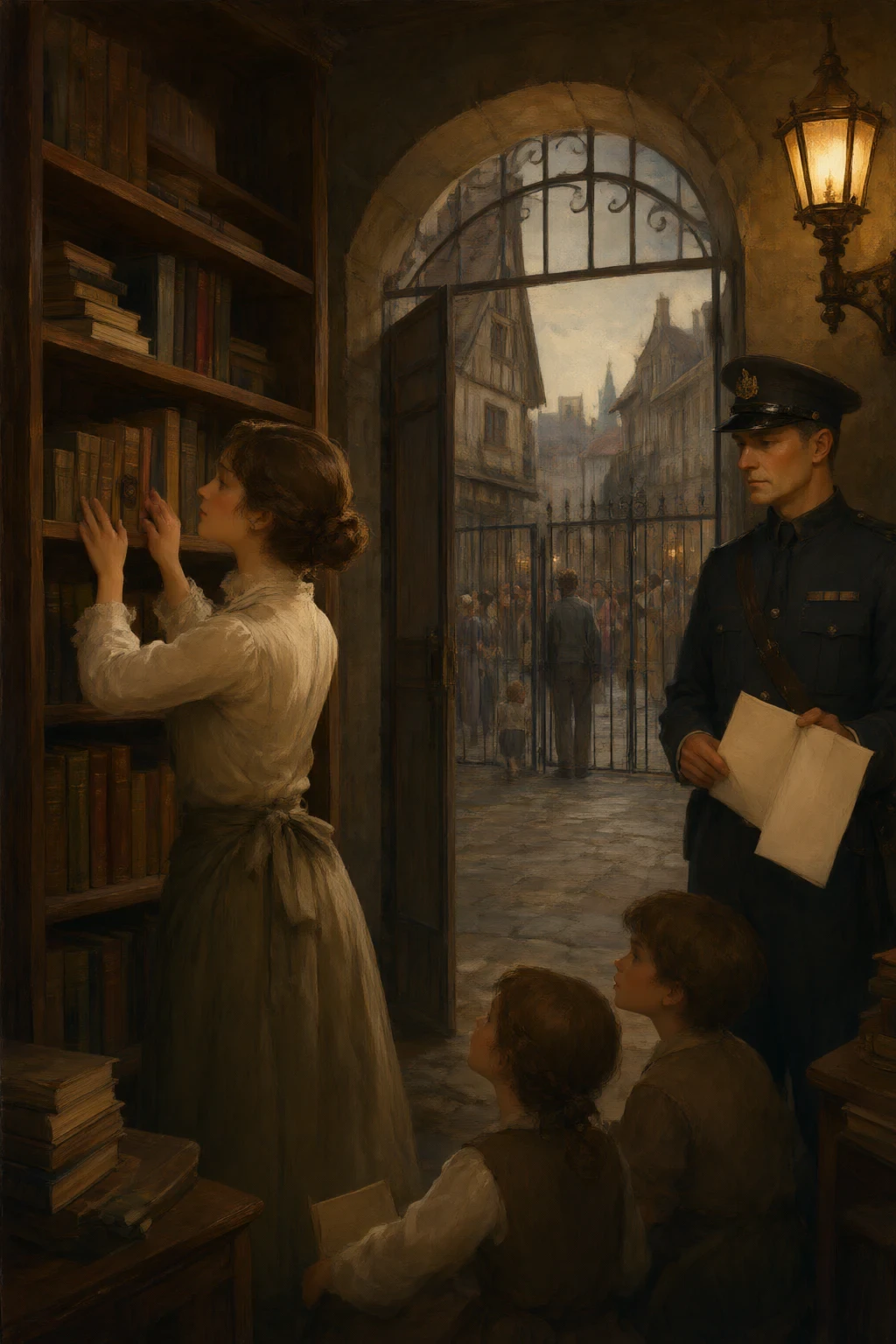
The first library in Bellwether had no doors. It had a wide arch, a roof of green glass, and a narrow channel cut through the floor so rainwater could run toward the gardens. People entered from three sides. The walls held shelves, benches, and the warm smell of cedar. In the years after the bridge collapse, it became the only place in the city where a person could sit somewhere without paying.
Its builder, Mara Vale, was serving a ninth year in North Prison for taking blueprints from the city architect’s office. The blueprints had been the plans for a new wall. Mara had copied them, then used the wall’s foundation as a foundation for the library. She had not burned a building, injured anyone, or hidden weapons. She had violated a law written to protect the public from a danger the public had not imagined.
The prosecutor still called it architectural theft. The city council had a different title for her. It called the library the “Vale Commons,” as if the name could make a building independent of the woman who had dug it. Children brought her drawings. The reading room stayed open after the evening bells. During the winter shortages, people slept beneath the shelves because the heating pipes were the only ones that worked.
Mara knew none of that from prison. She received a weekly letter from a former apprentice, Ilyan, with measurements, complaints, and descriptions of the roof that had begun to leak. She answered by drawing a better bracket. She was allowed to send drawings, though inspectors sometimes called them evidence of ongoing unauthorized activity. The letter offering the pardon arrived in October.
Mara read it three times in the visitation room. The governor would release her immediately if she appeared before the city council, placed her own name below a public declaration, and renounced all claim to the library. She would state that the building had been created “without lawful authority” and that its plans, materials, labor, and trust belonged to the city. She would also promise never to design another public structure.
The library would remain open. The council promised to preserve its programs and improve its foundation. In exchange, the city would own the work without dispute, and Mara would owe it no claim.
When she was returned to her cell, Mara walked the corridor slowly. The offer felt clean because it named her work without mentioning who had used it. The city wanted the library, not the woman. The city wanted the trust, not the years of unpaid work. The terms made the public’s dependence a reason to erase her, and the erasure would be recorded as a gift. She asked for paper. The prison supplied a blank sheet and a pencil stub.
For two hours she drew the library from memory. She drew the channel in the floor, the curved shelf where children sat, the hidden hatch to the rain tank. She drew the flaws too: the west door that flooded, the narrow reading alcove, the chimney that smoked when the wind came from the south. When she finished, she saw that the library was not an argument. It was a set of decisions made by many hands and sharpened by a year of use.
She had planned the first room after her brother died. He had been a builder who worked on the flood defenses. When the wall was built, it redirected the current toward the poor quarter and left his old neighborhood without a market. Mara had studied the plans and understood that the danger was not an accident. The wall was approved by people who called it necessary.
The city had a new boundary, and the people behind it had a new flood. The blueprints in the architect’s office showed the same choice in cleaner lines. She had taken them because she wanted proof. She had copied them into a public archive instead of selling them. Then she had built the library where the wall’s stolen stone had been stored. The stones were still damp when workers laid them into the arch.
That was the crime the prosecutor had recognized. It was not the reason the council could accept. Mara put the drawing away. If she refused the pardon, she would remain in prison. If she accepted, she would stand before a crowd and call the library unlawful. Children who had learned to read there might hear that their place had no right to exist. The city’s workers might receive the message that devotion bought nothing against property. Her own freedom would be the price of making all of that easier.
The next morning, the prison van drove her to the council chamber. The hall had tall windows and portraits of former governors. Two hundred people sat in folding chairs. Children sat on the floor with library books. Ilyan stood beside the architect who had reported her, now old enough to have white in his beard. The council president read the declaration.
Mara repeated the prepared words until the end: “I built the library without lawful authority, and I renounce all claim to it.” The room waited. She looked at the first chair. Her brother had once sat there to answer a question about the flood wall. He had said, “I built what I was told to build.” The room had accepted that as an explanation. Later, when water entered his neighborhood, the explanation had not kept the water out.
Mara took the paper from the secretary’s hand. “I did build without lawful authority,” she said. “I took the plans, changed their purpose, and used materials assigned to a public wall. I knew the law did not permit that.” A murmur moved through the hall.
“But the declaration asks me to say that the library belongs to the city because my work was invalid. The city did not build it. The children did not build it. The people who repaired its roof, kept its lights, read its books, and slept there in the winter did not build it either.” The architect shifted in his chair. “You are being asked to surrender a legal claim.” “I have no legal claim.” “Then you are not surrendering anything.”
Mara placed both hands on the table. “The work has a claim. It is called a library. People have made it useful because they chose to enter it. That is not ownership, but it is not nothing.” The council president said, “The offer was generous. You may have your name on the building, but the city will administer it.” “Where will the books go?” “Wherever the city decides.” “Where will the reading hours go?” “According to need.”
“Need changes. People change. If you call the library lawful only when it is convenient, the name is a leash.” The room grew louder. A mother stood and said her daughter had learned to read there. An older man said the library had kept him from sleeping under the bridge. Someone shouted that the city had no money for another project. Ilyan raised his hands, asking for quiet.
The president gave him the floor. He did not defend Mara. He said, “The east wall will fail in rain unless we replace the western footing. The roof holds for now. The reading room is full every evening. We can maintain the library without her, but not without deciding what we want to maintain.”
The architect spoke next. He was the man whose office she had entered. “She took my plans,” he said. “If she receives a pardon on the condition that the work becomes the city’s, the law has a boundary.” “The boundary is useful,” Mara said. “I do not need to become useful by pretending I did not cross it.”
Back in the prison, Ilyan came for the next visiting hour. He brought photographs: the repaired roof, the crowded reading room, a sign that said the library was closed for repairs. The repairs were real, but the closure had been ordered by the council to keep people from gathering during the vote. “The president says the building is unsafe while the legal review continues,” Ilyan said. “It was unsafe yesterday. You wrote that.” “I wrote that the east wall was unsafe. The west wall is still standing.” “Then the closure is about the vote.”
Mara looked at the photographs. A child had drawn a door on the side of a library she had designed without permission. The drawing made the building look lighter, as if it could escape the city’s decision. “I will not sign a false declaration,” she said. “Even if it keeps the library open?” “Even then.” Ilyan’s face tightened. “You said you wanted the library to survive.”
“I do. I also want the people who keep it to know that survival is not the same as surrender.” He wrote down her answer. Then he asked, “What should I tell them?” “The truth. Tell them the library is unsafe in places, the city has a legal claim, and I did cross a line. Tell them they can decide without pretending the choice is simple.”
That night, Mara wrote a letter to the council and read it aloud to the empty cell. She described every change she had made, every worker she had paid, every design she had taken, and every benefit the public had received. She included the children who had learned to read there and the winter guests whose names she had never learned. She did not ask for a pardon. The council sent the letter to the library. By morning, it had been copied and carried outside.
Mara’s case returned to court. The judge did not dismiss the trespass. She served six months of her sentence, and the city paid the court costs from the library’s maintenance budget. The sentence was harsher than she had hoped and less severe than the council had demanded. It was not a reward for good work. It was a consequence she had earned.
At the end of the six months, the library opened under a citizens’ trust. The city held the title. The trust controlled the shelves, the hours, and the budget. Ilyan was its first licensed architect. Mara was named in the archive as the original designer and barred from public commissions for three years. Her name appeared on a brass plaque beside the plans she had taken and altered, not above the entrance where visitors could admire it.
The first day back, children crowded around her. One asked whether she would read the hard book on the top shelf. Another asked whether the city had taken the library. Mara answered that the city had taken responsibility for it, and the community had to decide what responsibility meant. A boy frowned and said that sounded like an adult answer. “It is,” she said. “You are allowed to ask for a better one.”
In the reading room, Ilyan showed her the western footing. The wall had cracked because Mara had chosen speed over a slow cure. “You could make it beautiful,” he said. “It should stand first.” “You always say that.” “Usually I am wrong after the first storm.”
He laughed, but not because the matter had become easy. The city still owed money to the workers whose labor had been unpaid. The council still held the power to close the building during a budget crisis. The children who had found shelter there still asked whether it would be there when they came back.
Mara opened the maintenance ledger. The last page had a list of repairs and a column marked not yet possible. She added a line: Teach the next person what cannot be skipped. Then she closed the book and went to move the first shelf away from the leaking roof. Her hands moved slowly. The work did not make her free, and it did not make the law disappear.
Outside, the green glass caught the afternoon light. People entered from three sides. The door she had once built without permission stood open, but the hinges needed oil. A line of children waited with books under their arms. Mara took the oil from her pocket and began.