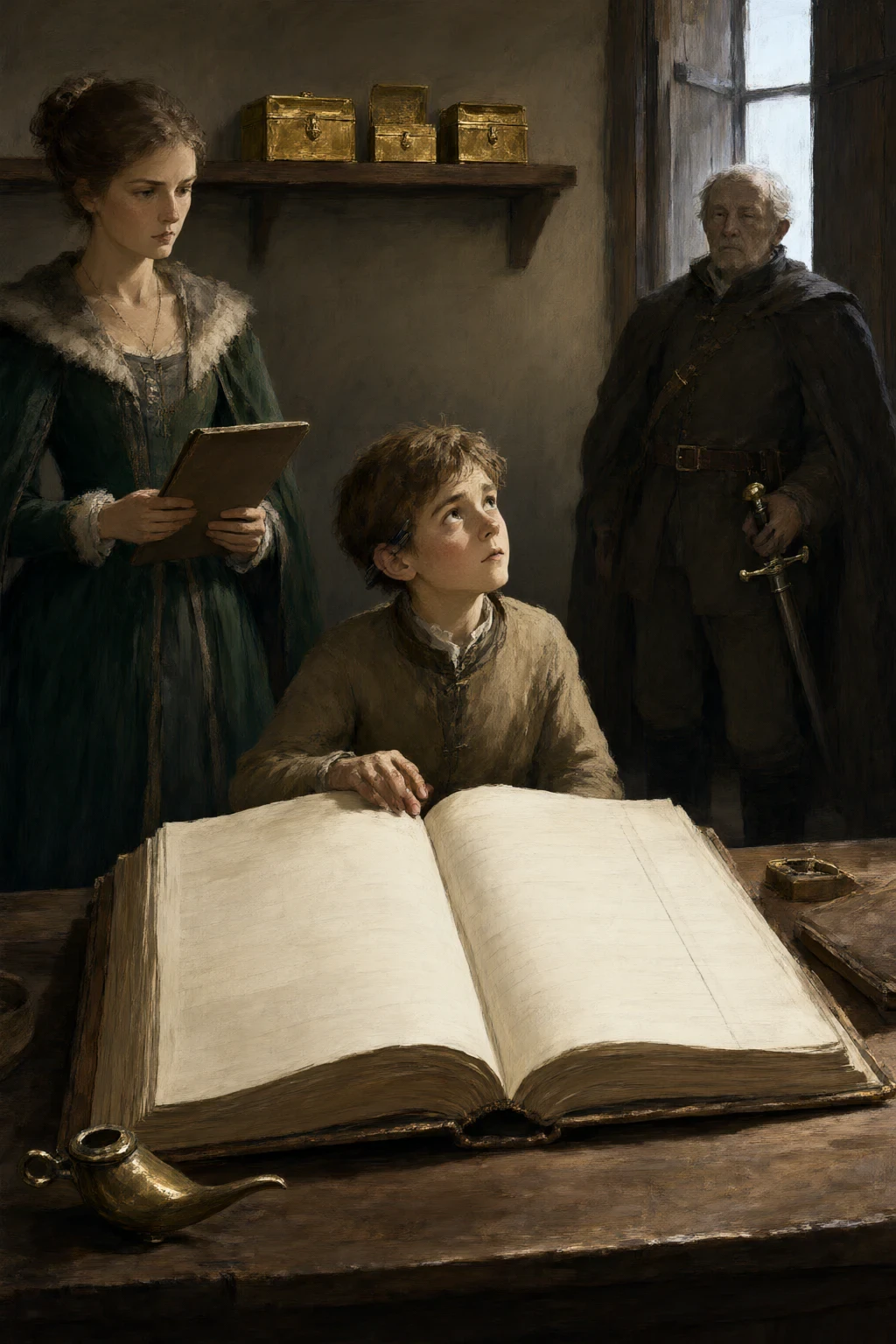
King Aldric's will was four pages long and three of them were questions. He died in the eleventh month of the ninth year of his reign, in the room he used for arithmetic, with the year's accounts still open on the table beside him, and the last entry in his own hand was a small one: the toll of four head of cattle at the lower ford, half a mark, and the reason for the half, which was that the man had argued. The kingdom was the size of a bad afternoon's walk. Eleven villages, one market, one bridge, one mill that had been a mill for two hundred years, one ford, one road, and a water-gate on the river by the mill that let boats up in summer and took a toll, and that water-gate was the only thing in the whole of Aldric's dominions that reliably made money.
The will said, on page one: I, Aldric, King, being in my right mind, which I have been twice this month and once for a fortnight, ordain as follows. My kingdom, the whole of it, with its debts, goes entire to the one of my sons who can do a thing. He cannot have help, and he cannot look in the schedule, and he must do it in one hour. If no son of mine can do it, the kingdom is divided into three parts in value, the debts are divided in value too, and each of my sons receives his part in money at the valuation, and the valuation is made by my clerk. Which of my sons is my clerk is set out on page four.
Page two held the three questions, one to a gold case, and there was a mark in gold on each case, and a hair inside each one, and the hair was the King's own, taken from the back of his own head in the year he was crowned, which the old man had thought a good joke at the time and had never repeated to anybody. The three questions. First: what does every man have, and no man can lose? Second: what does every man want, and no man can hold? Third: what is it that is called a fool's gold, and is not? Underneath, in a small hand:
The three rooms are in the west range and they are locked. There is a key to each on the table of the west range. The hour is counted from the striking of the bell at noon, and the bell is rung by my clerk, and I have instructed my clerk to ring it honestly.
The three sons came home. Wolfram was thirty-one and had been a soldier and had opinions about the roads. Hartmut was twenty-six and had been three times married and owed money in four towns. Kuno was fourteen and had been at a small school in the hill town and had come home for the funeral and had been very quiet at it. They were in the west range at noon with three keys. Ilse rang the bell.
The first room had a table, a chair, a shutter, and no window, and a word cut into the middle of the table, in the old style, four inches deep: TOLL. The second had the same, and the word: BOND. The third had the same, and the word: CREDIT. There was a mark on the table in each room, a mark in gold, to be taken and kept, by whoever answered. Hartmut went first, because he was the second son and knew exactly what that meant. He came out after twenty minutes and said: "The first is the head. Every man has a head and cannot lose it." "Wrong," said Wolfram. "I have it in writing that it is wrong, from Ilse, who read the page." "Then the will is a swindle, and my father was a swindler, and I am going to bed." He went to bed. He was twenty-six and had been three times married and he had come home for a funeral and been given a mark.
Wolfram took forty minutes in the first room and came out with the mark in his hand and a face like a closed gate. "The first is the head," he said. "The second is land. The third is the crown." "That is three answers and not one," said Kuno. "It is the truth, and it is three answers, and if the old man wanted one answer he should have asked one question." "He asked three." "He asked three identical questions wearing different clothes, and I have given the world the benefit of the doubt, and if that is arrogance then I will take the valley and the mill and I will not take the debt, and I will not take the debt because I am not a fool, and that is the first sensible thing anyone has said about this family in ninety years." The mark stayed on the table.
Kuno went in third, at half past one, and he had a mark's worth of time. He had never been in the west range. He had not been in the counting house either, except once, when he was nine, and had been told to get out of the way of a clerk with a cart. In the first room he read the word in the table. He stood over it for a while. Then he said, out loud, in an empty room, to be sure the room was listening, which was a habit of his, and which was why the room was listening: "A name." He took the mark. In the second room, twenty-one minutes later, he did the same thing, and he said: "A name." In the third room he was in and out in nine minutes. "A name," he said, coming out into the yard, and then, because he was fourteen, he said it a fourth time, to the yard, in a voice that cracked, out of relief.
The bell had not finished ringing when the four of them were in the counting house, and the counting house was a low room with a bad ceiling and four tables, and on three of the tables were the sons, and on the fourth was Ilse, who was twenty-nine, and who had been keeping the accounts of the kingdom since she was nine because Aldric had wanted a clerk nobody could buy and had found one. She had the last leaf of the will in her hand. She had had it for two years. It was the leaf with the seal, and the seal was broken, and the answer was on it, and she had read it every year of the last two because that was what she did with the last leaf; she checked the numbers on it against the numbers in the schedule.
She put it on the table. Answer the first: a name. Answer the second: a name. Answer the third: a name. And the answer is right, and the answer is the answer, and I wrote the same word three times because I was sixty-one years old and I could not think of three different questions and I would not write one question three times. Wolfram said, "Then it was a swindle." "It was a swindle," said Ilse, "and it was also a test, and the test was not the question. He gave you a mark for answering. He did not give you a mark for reading." "He has given us the kingdom," said Hartmut, from the doorway, in his nightshirt. "Has he not. It is the whole of it. Aldric, at his funeral, having spent a mark a piece on us like a man tipping a boy at a christening." "Yes," said Ilse. "Then I will send for the steward and we will have it read out." "It has been read out. He has it in his hand." She nodded at Kuno, who had not moved and had not spoken since the bell. "Kuno."
The valuation took nine days. The debts came to forty-one thousand six hundred marks, which was the water-gate's own paper, the mill's paper, the guild of weavers' paper, three towns' paper, and a bond held by a woman in the hill town who had been owed since before Wolfram was born. The revenue, land, mill, ford, bridge and market together, came at a fair price to six thousand two hundred. "It is a kingdom," said Wolfram, "worth six thousand two hundred marks." "It is a kingdom with forty-one thousand six hundred marks on it," said Ilse, "and the difference is thirty-five thousand four hundred, and the difference is divided three ways, so each of you has eleven thousand eight hundred marks of the difference, and nobody has ever yet found a use for that." Kuno said, "Is the water-gate in the schedule?" "No." "Why not?"
"Because the crown keeps it," said Ilse. "It is not property. It is the crown's. It is in the second book, under the head of revenues of the crown, and it is not valued, and it is not divided, and it is not anybody's." "So we have the kingdom," said Kuno, "and not the gate." "You have the kingdom and not the gate," said Ilse, "and the gate has made more in eleven years than the mill, the ford, the bridge and the market have made together in thirty." Hartmut sat down on the table. Wolfram went out of the room and stood in the yard and came back in.
"The will gives the heir a choice," said Ilse. "Page four. The whole of the kingdom, or this room, at four hundred marks a year, with the book, and the work, and the north window that does not shut properly. The old man wrote that clause because he had done the arithmetic in the twelfth year of his reign and he knew that a boy of fourteen handed a debt of forty-one thousand marks would have to be given a way out, and he would not have given him a way out to do nothing. He gave the way out to the counting house. He thought better of it than that." Kuno looked at the page for a long time. "I have never added a column in my life," he said.
"You have done sums. You are quick at them; the schoolmaster wrote to me about it, which I have in the third book, and which I did not show your father because your father would have said the schoolmaster was a fool for writing." "Then I will take the room." "You will take the room," said Ilse, "and in four years I will leave, because I am not going to be a clerk in a kingdom that a boy of fourteen runs, and I have an offer from the hill town, and I have taken it, and it is a worse room and more money, and the difference between this room and that one is that in this room you can be wrong without anybody writing it down." "You could stay," said Kuno. "I could," said Ilse, "and I am going to the hill town," and she shut the book, which was how the interview ended.
On the last evening she gave him the last leaf, because it was the end of the year and the year was closed. "You will want to see the third book," she said. "That is the one with the gate in it. It is not the book your father wanted you to have and it is the only one worth having." Then she said, "There is one more thing on that leaf, and it is not advice, and it is the only line in that will that is not an instruction, and I want you to have it now, because I have carried it for two years and I am not going to be your clerk." Kuno read it.
It was a receipt. Four thousand marks, lent by Elsbeth Raal of the hill town to Aldric, king, in the year before the year she was born, at four per cent, and repaid: nothing yet, and the signature was the King's, and under the signature, in a different ink, a later line in a shaky hand: The repayment is good. The King is a good paymaster. He has never once asked me for a year. "Is that in the schedule?" said Kuno. "It has been in the schedule since the year I was born," said Ilse. "Forty-one thousand six hundred marks includes four thousand marks to my mother. I have carried that line in my hand since I was eleven years old. I have never once thought it was a kindness. I have thought it was arithmetic."
The three gold cases went on the shelf in the counting house, because the will did not say where they should go and there was nowhere else for them to go, and the hairs stayed inside them, all three, because nobody ever opened the cases properly. The mark on the shelf came off with a cloth. The will itself was rolled and put in the second press, with the bonds, because it was paper and paper was expensive and there was no reason to have it twice. The first year of the new arrangement went like this.
Kuno kept the third book, which was the gate, and he kept it badly for eleven weeks and then well. He learned the water in a fortnight, which is a thing nobody had expected and which the schoolmaster had predicted in a letter to a woman who did not read it. He learned to write the gate's takings in a hand that a man in the hill town later described as a clerk's hand, and used it for eleven years. On the fourth of December he opened a new column in the gate book, at the right-hand edge, past the tolls, and headed it with one word, and set the year's total in it. Interest on the debt for that year was nine hundred and forty marks. The gate, in Kuno's column, came to one thousand and six.
He did not write anything under it. He put the book on the shelf, and the two old cases were on the shelf above him, in the dark, with the three hairs still in them, and one of the cases had a hair in it standing up on end, out of the gold, as if it had decided to come out and look at the number.