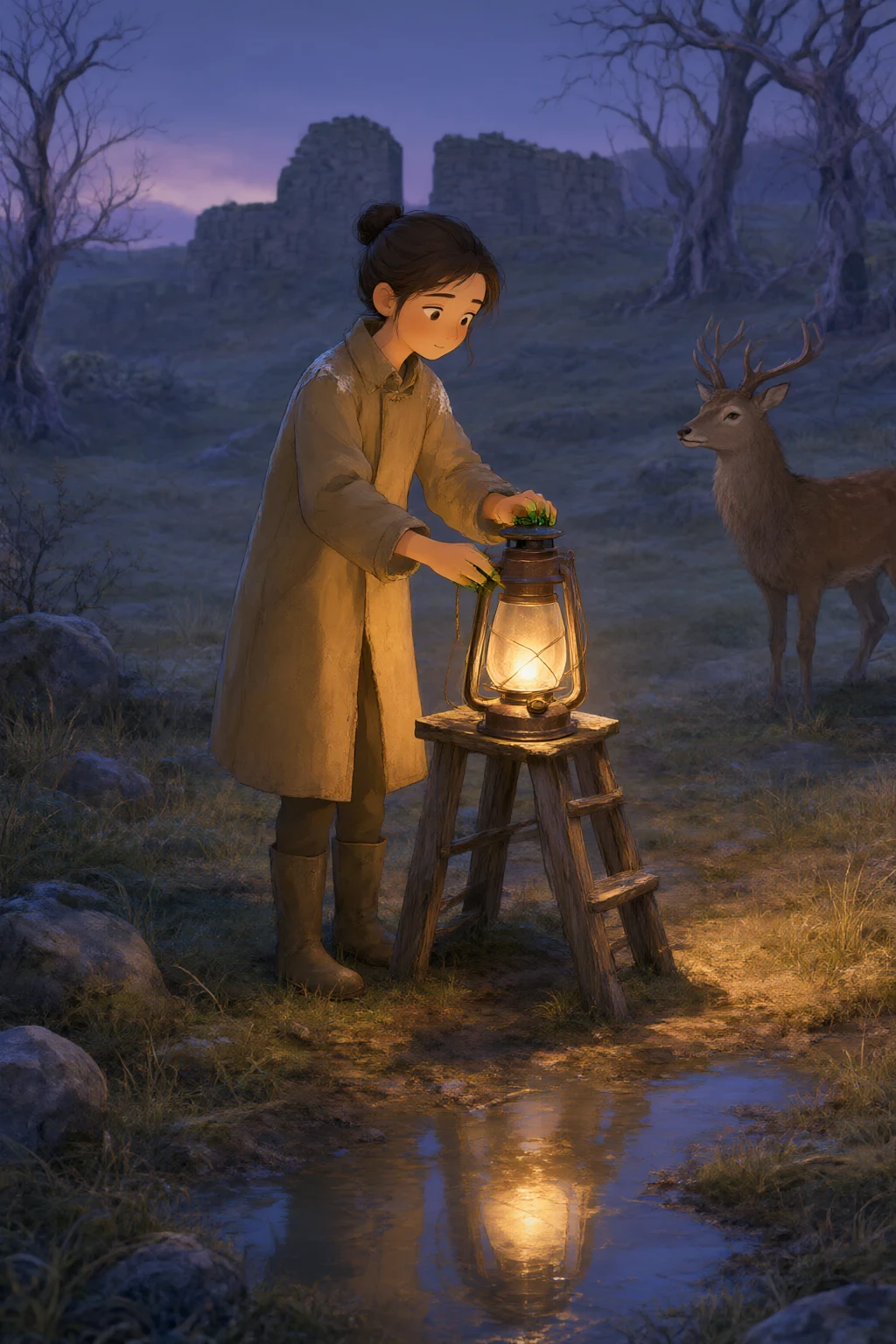
Under the Row the ground was black-wet gravel. Past the last lamp it was bracken, and where the gravel turned to bracken you could see the join in the ground. Nessa Brack had been told since her first season: if you can see the join, your lamps are too few. She was fourteen. Two fingers of her left hand were stained green-black with sap and she did not hide them.
The Warden’s order was nailed up at the Cross. Lamp forty-one was low. Nessa would take a full lamp out to the Ring on Saturday, and the eastern stretch on her round. Not the eastern stretch and the Row. Both. “Nessa.” Oren Vall set his brass-capped staff against the step and let his left knee click twice. “Aye. Aye, but—” Then nothing, long enough that she counted. “Who else is doing your round?” “Your knee.” “Aye. Aye, but that is not the same as an answer.” So it goes, she thought, and went to get the lamp.
The Barren Ring is two miles east and it is bare: chalk and gorse. No trees stand there. The lamplight has never reached it, so it is the dark end of everything, with the Walking Wood standing up on the far side, slow as a man carrying a cart. Nessa set the lamp on the flat iron cap of the stile, where the wind could not get at the glass. She set it down on purpose. That is the part that matters.
Merrin Vale came with her, in her red knitted cap with the earflaps down, the one with the hole she had knitted closed four times now. “Is that allowed?” Merrin said. “All the way to the Ring?” “Not past the stile. Keep behind me, and do not go into the dark to look at anything, whatever it sounds like.” “It only sounds like birds.” “That is what I mean.” From the top of the Ring the village was a string of warm circles, and past them it got darker fast.
Merrin sat on the bottom step with her hands in her lap. “The birds stopped again,” she said. “Stopped what?” “Mid-sentence. Like somebody puts a hand over their mouth. I do not think they want to.” Merrin tipped her head. “I think they are quiet on purpose.”
Nessa did the eastern stretch last, and at four o’clock she was at the Ring. She meant to walk up, look, and walk down. It took nearer forty, because every time she got to the stile she stood there. Lamp forty-one was burning, not guttering once. And she thought: nobody is out here. A lamp in the dark and nobody with it, and by morning it will be out, and that is two trips for one lamp, so it goes. Then she said, out loud, the way you do when you have been alone too long: “I will come back for you in the morning.”
In the morning it had gone. Not out. Gone. Lit, and standing, and thirty paces downhill from the stile. Merrin found it first, because she was the only one who went looking for a light instead of a lamp. “Nessa! The light’s down there!” “It can’t be.” “It’s DOWN there!” The oil was above halfway. The iron foot was bedded in a print of moss, and the frost inside it was unbroken. Nessa put her hand flat in the moss. It was cold all the way down. “It hasn’t moved.”
“It’s not HERE, Nessa, I can see the light on the bracken—” “Look at the moss.” “Nobody carried it in the night. Nobody pushed it. It is on the stile. It is exactly where I put it.” “Then why is the light down there?”
Tace Aldren was at the front of the crowd, goggles pushed up into untidy hair, the burn-scarred inside of her forearm bare to the cold. “Right,” she said. “So the border’s moved.” Nobody argued with her, which is how you know she is right about the fear and wrong about the thing. “The sap on the board’s drying in patches,” she said. “We’re dimming lamps to save oil. Dim lamps don’t hold a line. Draw-filing hell, Oren.”
“A lamp burns as long as there’s oil in it and somebody awake who means it,” Oren Vall said. “That is the whole craft. Somebody awake who means it.” Nobody had been out there. Nobody had stood beside lamp forty-one in the night, and the tally slate at the top of the Row said so plainly. A tally does not care how brave you are. It only counts.
They took the question up to the Scriptorium, where questions go when they will not sit still. Elder Sable Ashdown stood at the reading stand. Her beard was fine as lichen, three strands of it silver-leafed, and the eye on the left of her face took the light like a wet stone. She read in a soft sing-song, then stopped and said the same line again, slower, as if the first was for the room and the second for the trees.
“Then the Wood said—” she sang it, and stopped. “Where the lamps end, the Wood forgets where it was to stop.” “It has moved,” said Tace. “It has not moved,” said Elder Ashdown. “It has been found.”
Lamp forty-one stands on the stile. The lamps have never reached the Ring, so the line there has never been a line. It has been a thing people agreed to remember, out in the dark. And then on Saturday evening somebody carried a lamp to that stile, set it down on purpose, and meant it. And a line came up out of the ground around that lamp. A small bright honest circle, with dark on both sides of it.
“A line that holds round one lamp out on the Ring is a very good line,” she said. “A very old line. It has been there four hundred years, waiting for somebody to be careful.” “Then where is the light?” Nessa said. “It is downhill. The lamp is on the stile. I put it there.” Elder Ashdown nodded. “Child. Hold a lamp up on a hill in the dark. Tell me where you can see.” Nessa thought about it. “Downhill,” she said.
“Downhill. The hill falls away east into the wood. Light runs downhill a very long way, and uphill it stops at your boots.” She stopped, and said it again, slower. “The lamp did not walk. The light did. It went downhill because there was a lamp at the top of the hill worth walking downhill for.” Nobody had thought of that. It was so plain that Tace put a hand over her mouth.
Afterward Oren Vall came back from the tithe store with a locked tin and a small key on a bootlace round his neck. Inside was a strip of paper, and on it, in a hand that got worse downward, was a column of numbers. Forty-one. Forty-one. Forty-one. Eleven years of it.
“Forty-one is the last lamp before the light stops,” he said. “Eleven years ago my sister asked to be buried under a lampless stone. I promised her I would keep the last one, and I have not been out to the Ring since the year she was buried.” He shut the tin. “So I wrote the number on the slate every night instead. A man who does that and stays in his chair is not keeping a promise. He is counting.” “It is not nothing, though,” Nessa said.
“No. Aye. Somebody meant it, out there in the cold, and I meant it in here with a stick of chalk. A lamp is a promise made by somebody still paying attention. I had better be one.”
Merrin was on the step outside in the sun, with her cap off because it had frozen to her hair. “Can I say the thing I noticed?” she said. “Anything you like.” “The birds were singing properly this morning, when I found the light. All of it, right through to the end. They have never once done that.” She looked up, very pleased. “I think somebody said it out loud for them.” Elder Ashdown stood in the doorway behind them, with her good eye on the bracken.
Nessa walked out again on Monday to fetch lamp forty-one in. She had told Merrin she would, and then she did something she had never done: she did the thing she had said she would do, at the time she said it, and not the day after. She lifted it. It was heavier than she expected, and she carried it two miles, with a hundred and one windows on a slate behind her all the way home.