The letter came up the road on the Tuesday post, in the boot of a man from the Pennyfields who had two hundred miles of dust in his boots and no opinion about the circus whatever. Nell Ferrule read the envelope twice. The address was right. The hand was not Halloran Quill’s, which meant it had not gone through the Paper Caravan, which meant it had come out of Harrow’s Landing by hand, which meant somebody had carried it three hundred miles because they did not trust the post. Inside, on good paper, in a small upright hand: Miss Ferrule will inform the company that I shall be at Pettifer Bridge for the first night of the season and that we shall do the renewals. Set a chair for me. Bring the brass. Nell counted the sentences twice. Then she put the letter in the cash tin under sixpence and a bad shilling and went back to the flap, where the queue was already going along the bridge railings in a long curve, and the enormous plane tree over the dry fountain had begun, in the last of the chalk dust, to drop its first dead leaves into a basin that had held nothing but grit since June. One, two, three, four, five, six.
Imogen Vane had not been down the road in six years. August’s aunt was a woman who left a mark on a season the way a wheel leaves a mark on a road, and then went back to the winter quarters and sat in a wagon with a curtain across the one window and did whatever it was the Director did when the Director was not being looked at. Seven, eight, nine, ten, eleven, twelve. She was going to do the renewals.
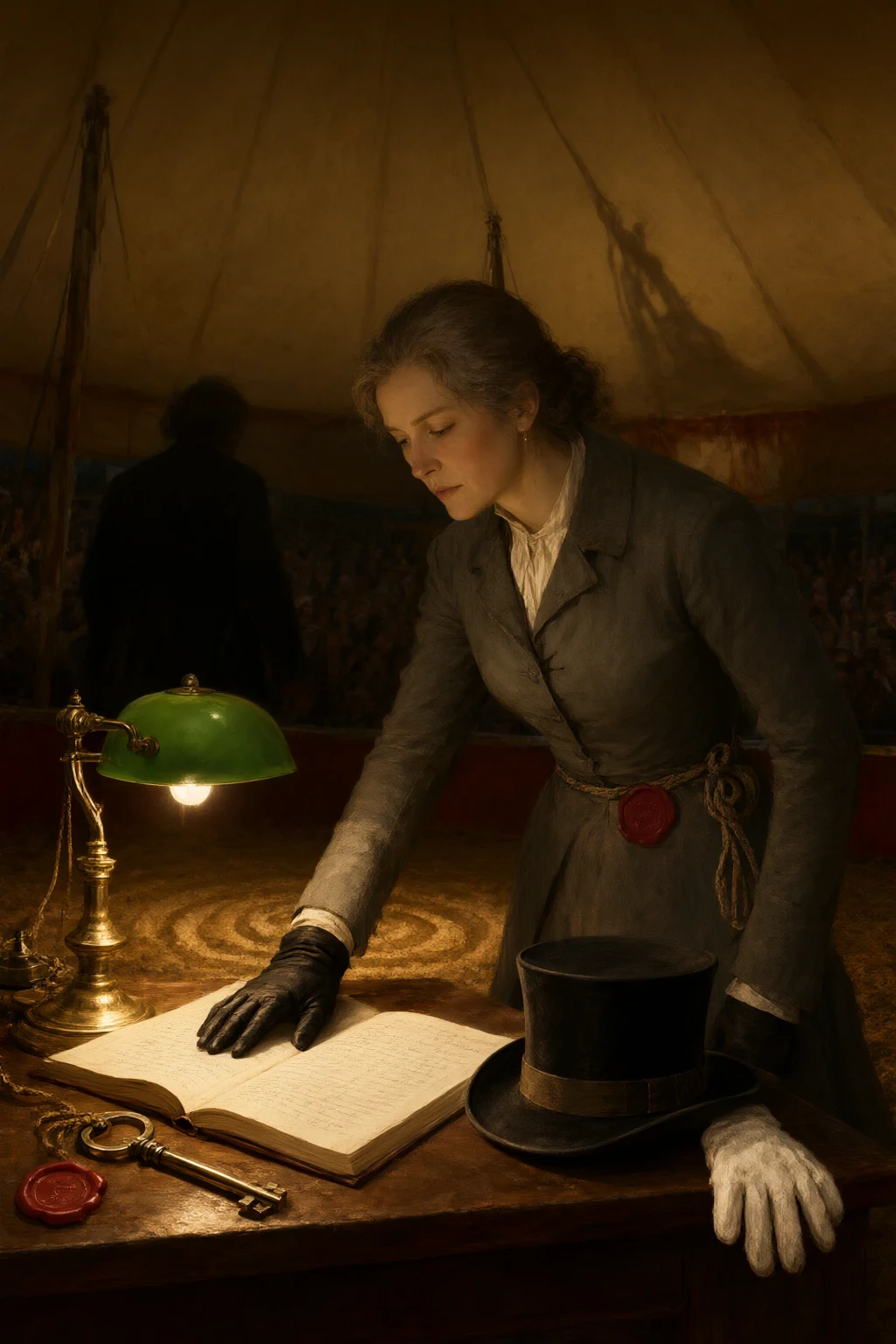
She came in on the Tuesday dusk with a lamp carriage and no ceremony, and the first thing Nell saw, from the booth, was that she was smaller than the letter had suggested. Grey travelling coat gone the colour of a candle end at the top. Black kid gloves. A bunch of sealing wax on a cord at her belt, and that was the only part of her out of rhythm. August met her at the ring fence with his hat off. He had the single white glove on his left hand with its cuff threaded red, and it was the brightest object in the yard. “Aunt,” he said. “August.” She let him take the hand. “August can hold a room. I hear the season has been full.” “It has.” “It has been the fullest in nine years. I only wanted to see whether the room knew.” She said it the way she said everything, which was to say that the sentence was a term, and the terms of this circus were the only vocabulary it had ever really used. Then she looked past him at the Big Top going up on its ring-pole iron, the sixty feet of unbleached canvas already lit from underneath by the corona burning under the ridge, forty-one jets throwing their spidery shadows up the inside of the wall, one of them already sooting dark at the sixth from the left. “Sixth jet,” she said. “All week.” “It was the ninth in August.” “It was the fourth in June.” “Then it is walking.” She put the gloved hand flat on the rail, as though feeling for a pulse in it. “Everything in this circus is walking somewhere, August. That is the business.”
She told them in the morning, on the canvas, with the ring still empty and the rakes leaning against the barrier and the smell of hot iron and trodden sawdust coming up through the boards. “The season’s renewals,” she said. “First night. In the ring, with the rope across, and the table, and the brazier, and a witness from the house.” She said the list the way you say a rosary. “Which is how it is done, and how it was done in my mother’s time, and how it will be done when I am not here to ask for it.” There were thirty-one of them on the grass and the shavings, and the number meant something different to each. Mateo Brill cleaned his thumbnail against his belt and said nothing. Junie Sparrow had her hand up before the word was out, and had to put it down again, and said, “Is it fine? Is it fine? Is it fine?” “It is fine,” said the Director. “It is exactly fine. It is the one hour of the year where nobody can be surprised.” “Can we refuse?” said Odette Vrain, from the edge. There was a small silence of the kind that comes when a company discovers, together, that nobody present has ever seen it happen.
“Strictly speaking,” said Halloran Quill, turning the shell lens up so that the amber came off the baize, “no one has refused in the ring. In nineteen years of Ledger I have not had to enter the word.” “That is a law, or an observation, Uncle?” “It is a column, my dear, and I keep it.” He put the lens down. “Which is the only reason anybody in this circus is still a person by Tuesday.”
Mateo found Nell at the booth in the afternoon and stood with his back to the flap, so that his shadow lay across the cash tin, which he had not done on purpose but which made her count faster. His hands were the trouble. She had first noticed them in May, in the dawn rehearsals. Now they were broad and brown to the second knuckle, the nails flat and yellow and not meeting the ends of the fingers properly, and there was a shine on the joints that a man’s joints do not have. And yet he could still tie. On the twelfth of June she had watched him tie a bowline in one of the traces with his thumb, the way you would tie a bootlace with your foot, and he had done it for her twice, slowly, without being asked, and then had said Mmm and gone to work. “He has had three,” said Odette at the second booth, not looking up from her whip. “This is the fourth.” “I know how many he has had.” “You are counting.” “I count things.”
Odette laughed without much in it. She was twenty-two, and the only performer in nine seasons who had signed in pencil, and she wore a scarlet-and-gold riding coat with the seams gone threadbare at the cuffs and carried a crop she had never once used on anything. Over the summer the two of them had got into the habit of trading information in a booth that was not built for it. “Do you know what the fourth is?” Odette said. “No.” “Neither does he. That is the thing about it. Nobody knows what the fourth is until it is fourth. That is not a complaint, Nell. That is the arrangement.” She set the whip down. “And I have six years of pencil and no mechanism behind it, and I have spent every one of them being proud of it. Tonight a contract is going to be read over a table in front of eight hundred people, because that is what she does. Which means the thing I have been saving my life for is going to happen to somebody else, in my circus, while I sit in a wagon and watch.”
Night came in with the smell of the river, which was not much of a smell, because the river at Pettifer ran over chalk and smelled of nothing but itself. August had the ring roped off across the front eight feet of the rosette, a woollen carpet out of the Widow’s Pew laid over the boards, a deal table, one chair, a brazier, and the Ledger open on a reading slope under a green baize light, so that the ruled lines were the brightest thing in the tent and the gas was not. They took a witness out of the house, because that is the rule. The rule is why there are no contracts signed in private in this circus, and the reason there are none is that nobody wanted the trouble that comes on a magic nobody can see. “A paying member of the house,” said Imogen Vane, to a full tent, with the corona turning on all of them. “Near enough to hear. Sir, you are near enough. Come up. Do not be frightened, nobody has ever been harmed by standing in a ring.”
The man who came up was a farmer, and he was so frightened that he took his hat off and held it in both hands, and the crowd laughed, and the Director said, “You will want your hat on, sir, you may be a while,” and he put it on, and the evening came off the ground and ran. “Clause one,” said Halloran Quill, reading. “That the Signer, in signing, surrenders his name, and surrenders it entirely, so that no person upon any road shall thereafter be required to answer for it, and the Signer shall not be sought.” “Thank you,” said a voice from the third cage row, which everybody let go past. “Clause two. That the body so surrendered shall take the shape of the animal the Signer most resembles in character and not in blood, judged once, at signing, and never judged again; held at half, that is to say human in the face and animal in the hands, able to speak, and to eat, and to be cross backstage.” “Can I still eat?” said Junie Sparrow. “Everyone eats,” said the Director, kindly.
In the booth, with the flap up and the street beyond it gone blue, Nell Ferrule had the clause book. She could not read a contract. She had learned her trade in a booth over three seasons by the shapes of the letters: which hand made which, which clerk inked which column, which man wrote small and slow and which man wrote as though the paper had insulted him. That is a real trade and it is not the same thing as reading. She had got this far because three years ago, in a hand she could see very well and could not have described to anybody, she had signed her own way onto a page. It was not a forgery. It was fifty small correct acts, done on nine separate evenings, by a girl of ten who had worked out from a shelf of ledgers that the whole art of the thing was the order of the entries, and who timed her page between the lamps going round. It has never been possible for anybody to explain, including to her, how a page carrying fifty correct acts came to be one honest lie. She has looked at it. It holds.
She had the clause book because there had always been a clause book in the booth, for the nights and the weather, and because when the renewals were read she had a job. She read the numbers. The numbers went into the column, and the column into the docket, and the docket was the only part of this that anybody could check. She could not read clause eight. But she knew the shape of a clause that had been set in type for the annual form, because they all came off the same forme, and they all had the same shoulders and the same foot, and the same slight thickening where the type had filled, and they all sat on the page at the same height. Clause eight did not sit at the same height. It sat half a line lower. It was the same measure. The ink was blacker than the ink around it, and there was one word in the fifth line with a different right-hand stem from every other word in that line. She did not know what the word was. She could not have told you any of them. But she could say that it had been made on a machine, and that the machine was not this one, and that it had come up the road in somebody’s coat, in the week the beer came. One, two, three, four, five, six, seven, eight, nine, ten, eleven, twelve, thirteen. She counted to sixty-one and she said nothing, and afterwards nobody in the whole company was ever able to explain why.
Clause three had been the same since 1897 and had ruined more careers than weather. Clause four gave the term. Clause five gave the Keepsake, and they had to name it aloud, and twenty-six people in that ring held up a small object in the last of the afternoon’s light: a brass compass, a shoe buckle, a wedding ring gone green, a tin whistle, a child’s hair ribbon, a dog’s brass tag, a bent nail, and, at the very back, a small hand mirror cracked across one corner, which Mateo Brill did not look at, and which Odette Vrain put away so fast that her sleeve came down over it. Clause seven was the money, and the Director read it with real enjoyment, because the sums were not sums, they were flour and canvas and boot leather and the weekly wage of a strongman, and the crowd liked it, and the band played eight bars, and somewhere behind the canvas a dog that was not on the books barked twice and was quiet. Then she said, “And the eighth.”
“Clause eight,” said Halloran Quill, and there was nothing at all in his voice. He had read for the whole hour without stopping and turned the pages with two fingers, and the amber of the shell lens had laid a warm film over everything he looked at, so that the ruled lines and the red column and his own hand at the foot of the page were all one soft colour, the colour of a lamp seen through a horn. “The countersignature of the Director. That upon the countersignature of the Director the transformation shall deepen by one degree, and the term shall be lengthened by one season, and the deepening shall be set and not variable; and that the countersignature be given clause by clause, and not in one instrument, so that each clause shall stand entire of itself and in no dependence upon any other, the Sinder’s name notwithstanding.” He stopped. The band stopped, because Junie Sparrow had a hand up and Mateo’s eyes had closed and somebody in the fourth row was saying what, what, what, and the Director looked at the Bookkeeper for a length of time that the people who were there remembered for the rest of their lives and could not afterwards put in order. “Continue, Mr Quill,” said Imogen Vane. “That is the clause, aunt.”
“That is the clause.” She had not moved. “Go round the ring with it. The first, and then the second, and so on. The house has paid for a process.” And she did. She went round the ring with it. She stopped in front of each performer and asked them, one at a time, in front of eight hundred people, in the warm bright lamplight of her own arranging, and the crowd did not go quiet, because it was funny. It was funny the way you ask a man at a party to say a word. And the performers said yes, one at a time, and were applauded for it, and the band played, and the Bookkeeper entered it in the column he had kept for thirty years, correctly, in the correct column, in the correct hand, and the countersignature went onto the page in wax and a steel pen, and it was the most scrupulous piece of paperwork the Gilded Menagerie ever did.
Because that is the whole of the trick of it, and she did it perfectly, and it is worth saying why. The magic obeys the wording and not the intention. It does not care about a Director. It cares about a clause, and a clause must be signed to exist, and a signature must be given by somebody who can be held to it. A clause signed once, in private, before eight hundred unseen witnesses, is a piece of paper in a wagon. A clause signed here, now, where a paying man from Pettifer Bridge can hear the words and see the wax, is a clause with a room inside it. And the room is full. And the room remembers. She gave them the door one at a time. Eight times. And the door only opens from inside, and the company was on the stage, and the house was laughing. Nobody in the ring refused. Nobody in the house said a word. There is no recorded instance in the history of this circus of a performer standing in that ring and saying no, and the reason is not fear, and the reason is not even the terms. The reason is that the band is playing, and the crowd is on your side, and the whole thing is funnier than the alternative.
The compliments were at the end, and they were the best part of the evening, and everybody there will tell you so for forty years. The Director went round the ring a last time and stopped at each performer and said the same thing, and the same thing was this. “Your work is noticed. The house is satisfied. The Director is satisfied.” She said it to Odette Vrain, who had been signed in pencil since she was sixteen, and who stood in the scarlet coat with the colour gone out of it and understood, standing in front of eight hundred people, that the thing she had relied on for six years had not been protecting her from anything at all. A contract in pencil is an obligation with no mechanism behind it. It is arguable. It is sometimes lost. And on the eighth clause, on a pencil, there is nothing to hold. The deepening had not been happening to her for six seasons. Nobody had told her. She would have gone on being proud of it until the winter, when there would have been nothing to be proud of. She said it to Junie Sparrow, who said, “Is it fine? Is it fine?” and did not know that it was not a compliment, because it was the same words, and because it had been said to the boiler.
And she said it last to August Vane, who took his hat off in his bare right hand and stood there in the gaslight and got the thing he had wanted since he was a boy in a housecoat on a wet lawn. “Your work is noticed,” said Imogen Vane. “The house is satisfied. The Director is satisfied.” “Thank you, aunt.” “Do not thank me. That is the boiler’s. I have never once in my life written a compliment of my own, August, and the day I do, I shall not use it on the ring.” The band played. Eight hundred people went out into a street that smelled of chalk, and the town went to bed the way chalk towns go to bed, one street at a time. There was one more night here, because there were always two, and the eighteen wagons came off the road and stood in a field behind the gasworks making the noise that tired wagons make.
Mateo lost the word about an hour after the countersignatures. He noticed it the way you notice weather. There was a sentence in his head about the second act and it would not come out, and he waited, the way he waits for a lion to decide, and the sentence stood there with its mouth shut. He went to the Widow’s Pew in the dark and sat where he always sat. August found him at two in the morning in shirtsleeves with the tailcoat over his arm, and stood a while, and said nothing, because the man in the dark could not tell him anything, and because August had spent seven years looking for a way to be loved by his aunt in any form at all, and had this evening been given the most professional thing a person can be given. “August can hold a room,” he said at last. Mateo turned his head. “I should like to put you in tomorrow.” Mmm. “No contract. No countersignature. Nothing for her to sign. I want the lion. On the second night, in front of this house, and I want it in the middle of the laughter, because they will not believe it is you.” Mmm, said Mateo Brill. “No,” said August Vane. “Fine. Half past seven. Do not be late.”
The second night went like this. August put him on at half past seven, in the act before the strongman, when the house was loudest and most pleased with itself, and the act before the strongman is the one nobody watches, because the strongman comes next and everybody is talking about the strongman. “Gentlemen and ladies,” said August Vane, in the voice, in the third person, with the hat and the one white glove, “the Gilded Menagerie has the honour of presenting, in his ninth season with us, a man you have seen at the gallows twice, Mateo Brill.” The lion came round the barrier on a short chain and the house made the noise the house makes. It was a bad lion. Everybody in the tent knew that, because it had been in the show nine years and had never once done anything the audience recognised as work. It walked. It stopped. It looked at a trainer who was not there any more. Then, at the old place, where the act has always gone, it opened its mouth and put its head sideways the way it was taught in a shed in 1897 by a man who has not been in this circus since 1897, and no words came out, and the house laughed, because it had been told there would be words.
Mateo Brill stood in the middle of the ring and did the only thing he could do, which was to hold the thing’s eye with his own for a count of nine while the thing decided, and then let it go, and stand up straight inside a dead lion’s skin, and take off the shabby grey gloves he had worn for the act, one finger at a time, in front of eight hundred people, so that they could see the hands. The hands were brown to the second knuckle. The noise that came out of that tent at half past eight on a Tuesday in a chalk town went up past the canvas and out into the dark. The men in the gasworks heard it. The boy stoking the Lantern Works came out to look. The men in the cages came to their barred doors. And Odette Vrain, who had watched nine seasons of men do difficult things quietly, put her hand flat on the rail and said, “Do this. Now. Again. Listen to them.” In the booth Nell Ferrule stopped counting for the first time in three seasons. “That’s not a lion,” said a man at the window, buying, not looking up, “that’s a man.” “That’s the bill,” said Nell.
And at the end, in the ring, with the act over and the house still on its feet, the ringmaster took his hat off and said, in a completely different voice, a voice with no third person in it anywhere: “That is the end of it. Get your money back from the window if you can. I mean that. If you have not enjoyed the last hour, take your money back and I will not be offended.” They were on their feet for the lion for eleven minutes. He could not have told them a single thing about himself. He had no words left. He had a lion’s mouth and a man’s eyes and nine seconds of a dead animal’s attention, and it was the best thing the Gilded Menagerie did all season, and there is not one clause in the entire Ledger that could be pointed at to say so.
The Bookkeeper did not sleep, and the reason he did not sleep was one stem in clause eight, wrong, in a line he had read aloud to a full tent, and which he had let stand, and which would be read in the winter by somebody, eventually, in the ordinary way that these things are read. He sat in the Paper Caravan with the green curtain drawn and eleven hundred cases behind him in the dark, and read the page again in the light of the one window, and the lens put a soft gold over the whole of it, so that he could see the sense of the words and not the shape of them, which is the difference between a man who is reading and a man who is looking. Strictly speaking, he thought, I would argue that a Sinder is not a person. There is no such thing. I would argue it to a committee. I would argue it in a court and I should win. And I have been in this wagon thirty years, and I have never once been asked to read out anything that was not a contract, and the whole of my life has been the keeping of columns. He took up the pen and made the entry and ruled the line.
If the clause stood, it stood for the company and for the hand that wrote the fresh ink, and the countersignatures went on into the winter, and the term lengthened, and the deepening was set and not variable, and every year the paper got a little heavier and every year the person inside it a little less, and in the end there would be a man with a lion’s jaw who could not say his own name, and it would be entirely legal, and written out in ink, and ink holds. He ruled the line. The trouble was not the magic. He had understood it since 1893. It was a good magic. It worked. The moon over the yard had once put in an appearance on the strength of nothing more than a signature. The trouble was the wording. The magic was a servant and it was a perfect servant and it did not know what it was for. The trouble was that the orders were in ink, and ink holds. That was all. There was no curse on this circus. There was a clause, badly set, on a good machine, in a fresh bottle of black, at the end of a standing form nobody had read since 1888, and the whole catastrophe of it would turn on the shape of one stem.
He had a career. Thirty years in a wagon with a curtain. The best eye in the company. Eleven hundred cases of other men’s handwriting, every blot and bad s in them somebody’s whole life and a great deal of money, all of it in a room six feet by fourteen feet under a green baize light. It was the best life available to a man who had not wanted one. He made the entry. He shut the case. He turned the key and hung it on the nail by the door, where every performer who came in after that would brush past it in the dark. Then he took out the other book, the small one, the one that did not go to the Director, and turned to the last written page, and read the entry he had made there in 1888, the one nobody would audit, because there was nobody left to audit it. He read the entry. He turned the key. He shut the case. He went out into a night with a whole season’s worth of dark on it. Then, in the small hours of the morning after the second show, in the amber of the one window, with the green curtain over the glass and the winter coming up the road behind the company, Halloran Quill said to the empty room, in a voice with a hedge in it: “I would argue that a Sinder is not a person.”