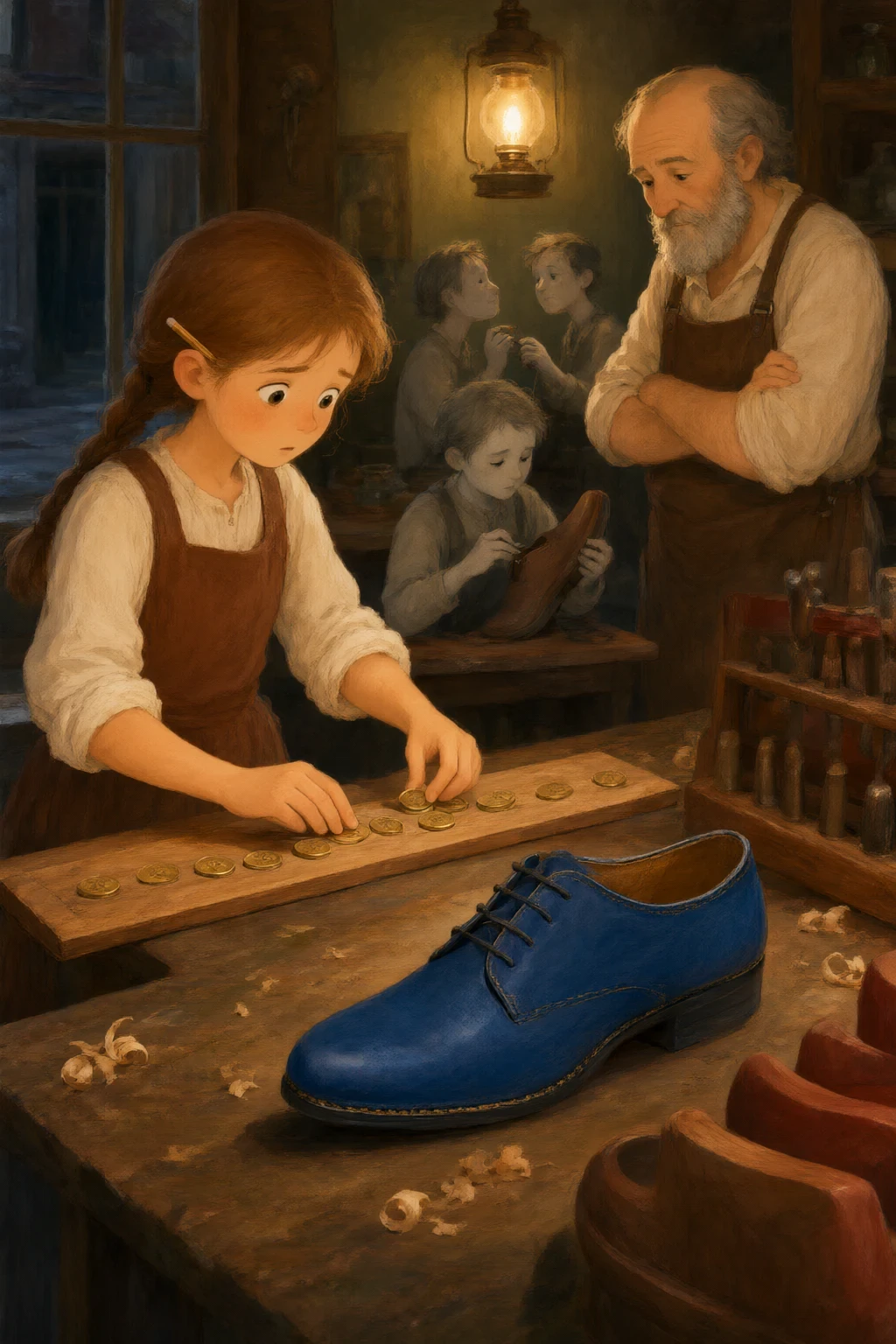
Simon Flack had a shop with a good door, a bad window, and eleven pairs of unfinished shoes on the counter that nobody wanted to buy. "That colour has a name," his daughter Nell said, holding one up to the light. "It is called tired." It was grey-brown. It was the colour of a wet path on the fourth day of rain.
Nell was nine. She could read a sum, and she could count a box of nails without being told twice, and she had noticed that the other cobblers in the row had all been in business longer than her father and did not have to be good at it. "Friday is the fair," she said. "You have nineteen customers a week. You want forty." "I want forty," Simon agreed. "Wanting is free."
On the Thursday night, Simon went up to bed at six and woke at midnight to a sound like a hundred tiny clocks. He came down with a candle. There were two men in the shop, and they were about the height of his knee. They were thin and grey. Their fingers moved so fast that his eye gave up on them and started seeing a blur instead. They were making shoes.
They made the small ones first. Blue, with a gold stitch running down the middle of the back, and the stitching went through the leather four times before it took hold. Then they made the large ones, brown, for a man in the village who limped and had complained about it every day for a year. And then they did the grey-brown pair. They unpicked the whole thing and started again, and the tired colour went away and something else came in its place, and Simon could not say what the something else was, only that it was the kind of colour a shoe should have had all along. By dawn they were gone. Simon put the shoes on the counter, where they stood all day, and every single person who came in picked them up, and nobody put them down.
The next four days were the best four days of his life, and he has never admitted that to anybody. He sold the blue pair by noon. The brown pair had three offers before lunch. The grey-brown pair, remade, went for the price of a good coat. He took the money into the back room and put it in the tin and sat down and laughed at nothing at all. But Nell had a school book with a marbled cover, and in the margin of page one she began to write. In the first margin: 2. In the second: 5. The third: 13. Simon took the book away from her on Thursday. "Don't bring that to the fair." "I am not bringing it anywhere," Nell said. "The book is staying on the table. It is just counting."
On the third night, while Simon slept, she took a candle and went into the back room. Under the shelf where the lasts were kept, there was a wooden box with a hasp. Inside the box there were keys, and under the keys there was a ledger with a green cover. Most of the writing in it was round and slow and belonged to her grandfather Ambrose. But a dozen pages in the middle had been written over in a hard, spiky hand, and every line of them was in red.
The first red line said: To Simon Flack, of the Shoe Row, received sixty marks for the roofing of the shop, in the winter of the year the roof went. To be returned at one mark in the pound, with sorrow added. Below it, in smaller writing: The sorrow is two, not one, because the fund waited. Nell was not good at sums and was good at things worse than sums. She read it three times. Then she went and found her father in the yard, asleep sitting up, with the moon on his boots.
He told her the whole of it, badly, in the wrong order, and it took a while. The winter the roof went, the shop had shut for three months. Ambrose was old by then. The guild put sixty marks in and the roof came off that same week. Simon said he would pay it back when the good year came. The good year came and went. Then another. Then Simon stopped meaning to and started just not doing, which is a quieter thing and much harder to fix. "I thought they were a gift," he said. "Everyone thinks that. Three hundred years of cobblers have thought that."
"Did they cost anything?" "Everything costs," Nell said. "That is not the same as nothing was free." She went back to the box. She read the red page again with a page of her own propped on her knee, and she did the sums the way she was taught, out loud, in order, checking each one twice. Two grey men. One night. And against each night, on the right-hand side of the page, a value, and it was never written in money. It was written in the word owed.
They went to Watergate Street on Monday, which was market day, and it took them most of the morning because Ida Marrow was in and out and behind a counter full of wool. She was sixty and thin and did not offer them a chair. When Nell put the green ledger on the counter, Ida read the red page, and then she read it again, and then she said the first sensible thing anybody had said about it in twenty years.
"It isn't mine," she said. "That's the first thing you need to hear. It was Widow Marsh's. It's nine widows now, and three of them are in this room's ceiling beams. I can't forgive it. I only keep it." "So we can't pay it all at once," Nell said. "We know that. That's not what we came to say." "Then say what you came to say." "We came to say: here is a page with a straight line down it. One night for one night's work. And the last line has got room on it for a date."
Ida Marrow took out a pen and a ruler and did not shorten the schedule by one mark. Nell wrote it out in the green ledger on the facing page, in her round slow hand, and her father watched her do it and did not once tell her she had it wrong. Two columns. Every line exactly the same length. Twenty-two years of back work, and then a new block, and a hundred and four lines in it, and then one line more with a space at the end for a day of the month and a year.
"There," Nell said, and put the pen down. "Now it is on paper, and paper is not a person, so nobody has to be angry at anybody." The two grey men kept coming. They still worked at night, and they were still not paid, and there was now a page in Watergate Street that said exactly what each night of that was worth, and the shop was paying it off, one line at a time, in silver, in board, in the use of a back room, in a stack of firewood delivered on Thursdays.
Nell counted. She was honest to the penny. When her father was short she marked the gap and left it showing, and she did not go looking for a way to make the columns meet that had not met.
The last week was in November, and the last night was cold enough that the ink in the fund box skin had to be warmed before it would take a stamp. Ida Marrow read the final figure twice. Then she turned the book round to show Simon Flack, who was not a reader of ledgers and had gone the colour of the ceiling beams. "There," she said. "It balances." He put his hand flat on the counter, which was a thing he did instead of saying things.
Nell took the pen and wrote the last date in the empty space, the way they had practised for four months, and closed the green book, and put it back in the wooden box under the lasts where it had sat for twenty-two years. On the bench behind them stood one finished pair of blue shoes. They were not spoken for. They would be there in the morning, and the morning after that, and nobody in the shop had asked where they came from, and Simon had stopped offering to explain.