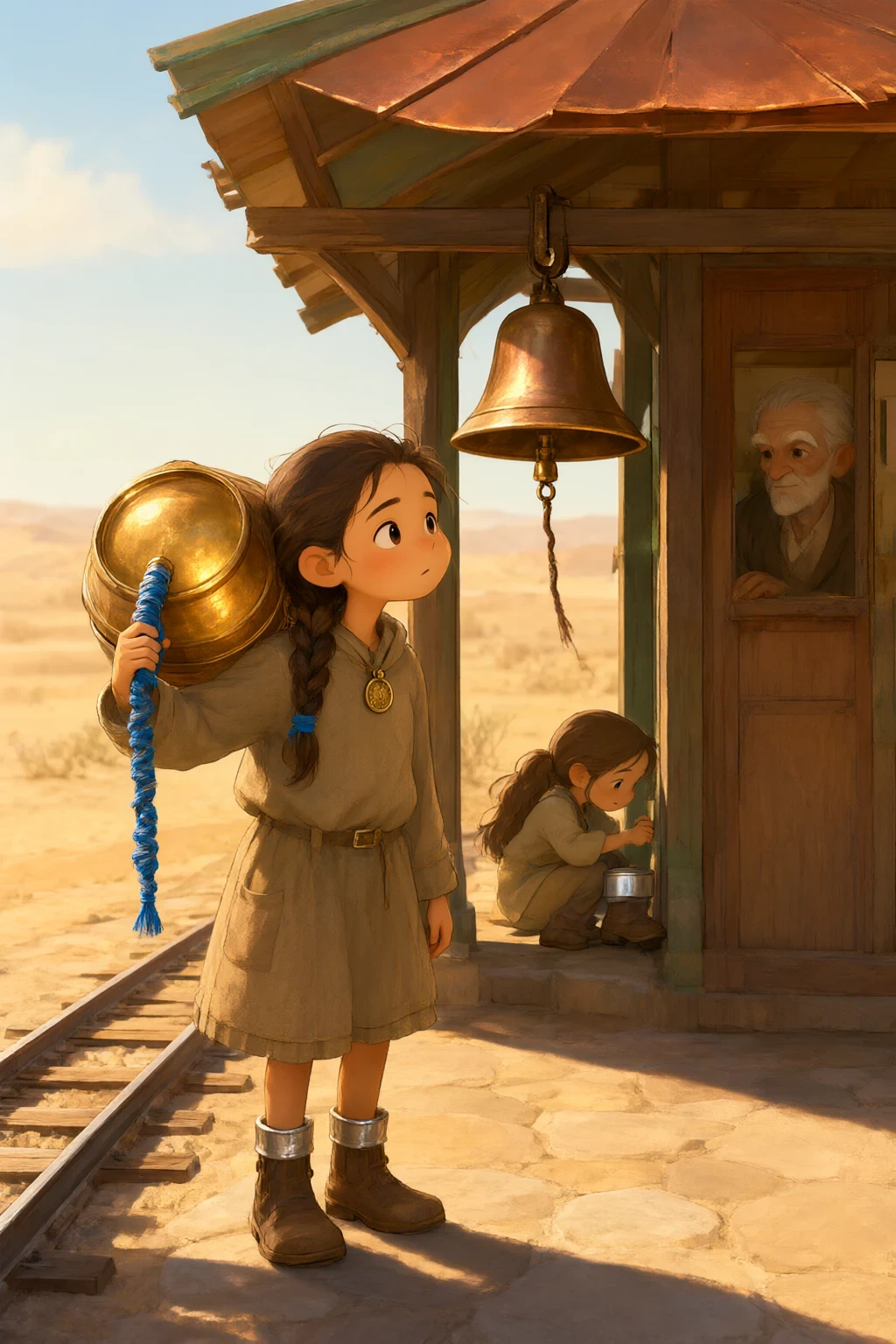
Nim Ferrous found it under the brake van, in the place where Marmalade slept and where nobody had been told to look. The jar stood up in the sand, as tall as Marmalade and twice as round. Its brass was the colour of a honey tin, crusted with sand the way frost sits on a window. A loop of blue twine was tied round the handle. Then a second. Then a third. Nim counted them with one finger. “Fifty-eight. Fifty-nine. Sixty.”
The rest were packed under the twine. When she tried to lift one, the glass hummed, low down, like a cat in a basket. Marmalade came out backwards, the way a ferret comes out. One of her boots was a size too small and its cuff was patched with cut tin.
The train went west toward Emberwhistle Halt: one platform, a copper roof gone green at the edges, and a bell as big as a barrel, rung by hand. The man at the booth was Ivo Tarrow, sixty-two, a driver once. Over his left eye he had a white eyebrow burned to a stub at the tip, and nobody had ever asked him twice. “Put it on the board.” The fares were chalked on a plank. The jar went onto it, and it complained. “A hundred loops,” said Ivo. “You counted them.”
“A hundred. I got to sixty, and then the rest were underneath.” “Do you know what a hundred years is?” “A long time.” “It is a number.” He wrote with the chalk. “Three hundred and sixty-five days in a year. Twenty-four hours in a day. A hundred years is thirty-six thousand five hundred hours. Say that back to me.” “Thirty-six thousand five hundred hours.” ““Nobody in the Basin has ever lived past one hundred and four,” said Ivo. “He is on the wall in the long room at Kellvetch, in the book of ticket-payers. He died owing nobody a thing.””
He laid his thumb on the jar’s shoulder. “So. Nobody can spend this. Not you. Not me. Not the man in the white hat who thinks a hundred years is a hat full of coins. That is the arithmetic of it.” “Then what do I do with it?” “You do not open it. You carry it. That is your job, and I am telling you, so you do it exactly.”
Then an old woman came up out of the sand, in a coat with the buttons gone, with a stick that had been a chair leg. In her hand was a ticket, real green-ink, with a number somebody else had written. “Are you the Fane woman?” said Ivo. “I am,” she said. “Ossie Fane.”
There was a brass tag round the jar’s neck, and there were two names on it. One had been scratched through so hard that the brass had torn, and you could just read it. T. FANE. The other was written over the top in a smooth, confident hand. OSSIE FANE. “A machine cannot lie, and a Ledger cannot be un-written,” said Ivo. “It can only be carried forward. But a hand can scratch, and a careful man never leaves the old name showing.” He turned the jar round in his hands.
“So two people in the world care about that. One is standing here with a stick. She has just bought a hundred years for the price of a good coat, and she is the only one who gains by it.” Nim looked at the old woman. The old woman looked at the sand. It would have been easy, after that, to decide she was a thief.
Ivo did not say it out loud. He had put the words in the right order and stopped before the last two of them, and where he had stopped was exactly where her own thinking had stopped.
“The loud man scratched it,” she whispered. “I saw the knife.” “He had a white hat,” she said, before anybody asked. “White as milk.” “Sometimes you hear a thing twice and only one of them happened,” said Ivo. “Let us count instead.” On the back of the brass was a number, scratched very small. “A hundred loops, not ninety-one,” he said. “Ninety-one is an ordinary jar, one loop for every year paid in. A hundred loops is a dowry, and a dowry is all hundred years promised before the first may be spent.” “What is a dowry?”
“Somebody pays an hour a year into a jar, on their birthday, for a hundred years. It is the oldest custom in the Basin, and nobody may sell it. The buyer of a dowry is a thief. The seller is worse than the buyer.” He wrote in the corner of the board, under the fares.
“Tobit Fane. Signalman at Balloonmast Ridge, thirty-one years on the wire. He paid an hour a year and never got to the hundredth birthday. He died in the cold month with a whistle in his hand, and nobody saw it.” Ivo looked up. “So who paid the hundredth one?” Nobody said anything. “You did,” he said. “You were the only one left with a reason to. There are packers at Kellvetch who saw you carry it down the cellar aisle a week after the funeral, with a lamp in your hand.” Ossie Fane looked at the number on her ticket.
“He gave it to me in his own hand, on this platform, the year before he died. He said, when you are eighty you will be very tired, and this is one hour I do not need. Then he got on the mail.” “And somebody sold it out from under you, and scratched your uncle’s name off the tag, so the sale would look clean.” “Yes.”
“Then here is the hard part,” said Ivo, “and I am going to say it once, and then we are going to have tea. “You did not buy a hundred years. You gave the hundredth one. Those are not the same act, and the difference between them is the whole of what I know. It took me forty years to learn, from a dead brother whose name is still in a book at the east end of this Line.
“A jar of hours is not a fortune. It is somebody’s life with the edges taken off. Only keep it, and pay your own hours in beside his, one year at a time, and one day it will be full of yours, and then you may look at it. That is the arithmetic of it.” “Can a person pay in hours that do not come out of her?” said Nim. “You can pay in what you are given. Not in what you never agreed to part with. That is the other half, and it took me thirty more years.”
“The Yards hold anything that is not claimed, and nobody has ever claimed a hundred years. So it will sit in a rack at Kellvetch, sealed, getting heavier. And she will be eighty-two, and then eighty-three, and one morning a packer will tie a blue loop on the handle for her, and by then it will be hers.”
The mail came in at noon, and Sol Brannen came down the platform in white gloves, the right thumb stained green into the weave. Captain Ferrite had told her twice already that a jar rides in hands or it rides nowhere, and she had not argued, because he was right. He did not ask about the jar. He asked about the number. “Thirty-six thousand five hundred hours,” he said. “Confirm you heard that correctly.” “Yes, sir. Thirty-six thousand five hundred hours.” He wrote in a small book inside his coat.
“Nim Ferrous. Junior courier. Counted a hundred loops and did not open the jar. Confirm you heard that correctly.” She had never in her life been written in a book. She said, “Counted it. Did not open it.” “Good,” said Sol Brannen, and shut the book.
Nim gave the jar to Ossie Fane, and the old woman held it against her coat with both arms. Nobody ever found out who had held the knife. A jar went back where it belonged, a hundred years of somebody’s living went unsold, and an old woman went home with a debt in her arms. The one thing Emberwhistle did not have that afternoon was a suspicion. It had been a good suspicion. It had very nearly been right. Marmalade walked back to the brake van with the jar’s tag in her hand, which nobody thought to stop.
“He said he was sorry,” she whispered. “The loud man. I only heard half of it, but he was sorry about the knife, I think.” And that was the half she had. It turned out to be enough.