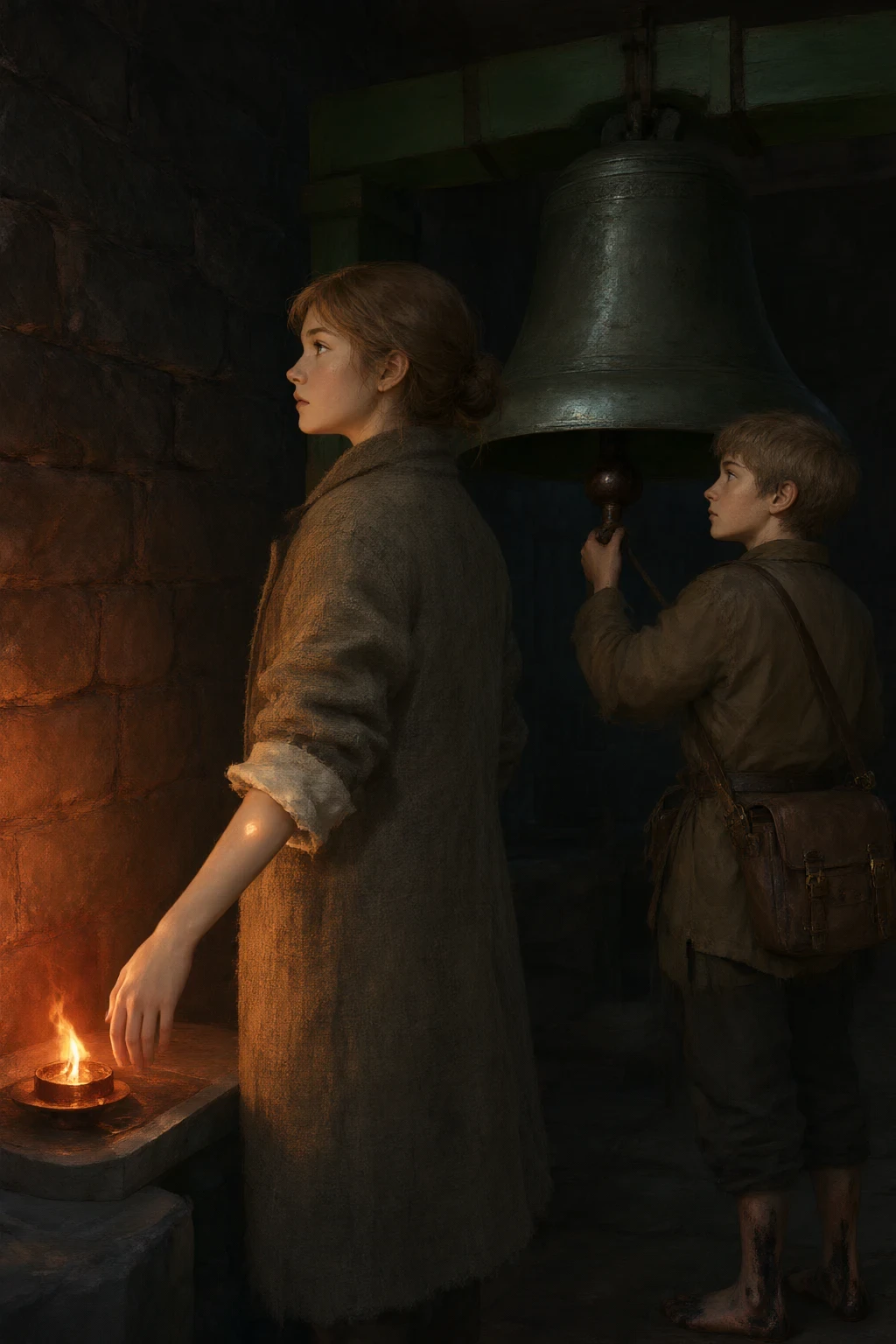
A Quiet Audit is not a ceremony. It consists of a burden, a bearer, an heir, a flame and a keeper, and it ends when the keeper says the word, and the keeper is the only person present who is not a party to it. It is the only legal route by which a promise may change hands. It is also the only route by which a promise may be destroyed, provided everyone in the room is quite certain, and the law does not ask them to be certain. The law only asks that they have been. Ashara Venn was twenty-two and had run four audits before this one, all of them small: a fourth-year clause moved to a son, a toll-stall bar moved to a widow, twice a brewing-bowl of a thing a woman had sworn to a cousin and wanted rid of before the cousin’s wedding. The kind of work that gives a keeper a reputation for being quick, and which teaches you nothing, because a light burden can be carried by anybody with the sense to stay out of the wind.
The fifth was put to her on the eleventh of Ashfall at the top of the Bonding Stair, by the woman she had been apprenticed to for eight years, and not in a corridor. Sister-Iven Carshal made her climb all nine hundred steps, which took most of the afternoon, and stand at the top in the flat grey light that comes off the vent haze at four o’clock in the season, and only then say it. “I am the bearer,” Iven said. “Of the Watch of the Going. I have held it unentered for sixty years. I have not the measure left in me to swear it again and enter it properly. I am asking you to hold an Audit with me on the ninth of Emberfall.” Ashara looked at her throat. That was the whole of her first question, and it took her the rest of the climb to form, and she was ashamed of how long it had taken. “Two hundred and nine courses of stair,” Iven said, before Ashara got the words out. “You are counting them again. Stop counting.” “You have a hooked stroke on your neck. A hooked stroke is a promise to protect. The Watch is a hooked stroke. Any keeper can read a stranger’s covenant in a glance, and you have worn one where your collar shows for eight years, and I never asked what it was.” “Noted,” said Sister-Iven Carshal.
The Watch of the Going is the seventh of the great oaths and the only one of the nine whose text anybody can recite. It runs to a hundred and four words, and Ashara had said all of them at fourteen. The operative part is the second clause. The founder swore that the great bell of Cindergate should be rung for every sworn person in the chain at their going, and that the account of that person be closed in the Ledger before the second stroke. Not before the bell. Before the second stroke. Which meant the bell and the record had to be brought to the same place at the same moment by somebody who could do both, and a bell rung for a person the Ledger could not name was not a ringing at all. It was noise.
A great oath is not a private arrangement between a bearer and a flame. The founding instrument is one instrument, and every small oath sworn under it hangs from the nine great oaths the way fruit hangs from nine branches, and a branch that is not held is a branch the tree is not carrying. So the Watch is not a duty. It is a load. Leave the load out and the tree finds a different shoulder, and the shoulder is always somebody standing nearest the flame at the wrong hour. Which is how a great oath nobody swore becomes a hundred thousand small oaths that are very slightly harder to read than they ought to be.
Ashara had not learned that in a book. She learned it at the north end of the Ninth Terrace market at noon on the day the first mark in the chain went unreadable, which was eleven years ago: a bar on the forearm of a toll-keeper at the Twelfth-Gate who could not be asked to produce it, because it could not be read. That gate’s flame was fed from the dregs, the fourth grade. In the fourth week of that year the keeper began to find his own arms hard to read in the morning. Not gone. Hard, as though somebody had taken a very fine needle to a letter and gone over it eleven times. A tired man at a gate who cannot be certain of his own arm is being robbed at a small daily rate by people who know he is. There were eleven such marks in the chain now, in a count Ashara kept in a hand she showed nobody. The keepers’ explanation was the dregs. A dull flame has to lean, and it leans on whatever stands nearest it, and the fraction it takes is too small to notice for a long time. It was a maintenance problem. The Measure was low.
The Measure had been low for sixty-one years. It stood at three thousand and forty-eight measures in a cup graduated to nine thousand, called aloud every fifth day at noon from a raised platform at the north end of the market, and it was the number the seven city-states had been quarrelling over for forty years, and no city-state had ever proposed a measure that was not somebody else’s problem. Ashara had proposed measures. Eleven of them in eight years, one more than is good manners, in the council’s own grammar, because that was the only grammar in which a proposal sounded like a proposal and not like a girl talking. Ashara proposes that the Sixth Chain post a keeper at the Twelfth-Gate, with a barrow and a lantern and no authority whatever. Every one had the wince attached, and she had stopped noticing it two years ago and had not stopped doing it.
The founding register is a single sheet of first-fire glass, a metre and a half long, cooled to a hard bright black, with the nine great oaths cut into it in the founder’s own hand. It is the only object in the caldera the law protects better than a person. Ashara took it out on the thirteenth and read the seventh oath quickly, the way you read a thing you already know, and then again with a finger, the way you read a thing you have begun to doubt. The seventh oath was there. It was in the fourth column, and the fourth column was the one everybody in the chamber had believed was the third, and no number was cut into the glass at all. Ashara had been calling it the seventh since she was fifteen, on the authority of a shelf-list in her own hand, and Iven had made the list. “There is no seventh,” said Ashara. “There is a fourth column.” “There is a fourth column, and there are nine oaths, and I have said seventh for eight years, and you wrote the list. I want to know what number is on your list.” Iven took the slate stylus out of her left sleeve, which she did at least four times a day, and which was less a writing implement than a place to keep her hands. “Noted,” she said, and went out.
Kel Rusk came on the fifteenth, because the bell had not been rung in sixty years and the headstock had gone into the ground on one side. A bronze bell of two thousand one hundred and eighty pounds on a larch beam in a caldera is not a decoration. It is a structural claim. He came up with his own barrow and a boy of fifteen to push it, because Kel Rusk was fifty-two and could not climb in midsummer and had said so on the record, in writing, twice, and would not climb in the shoulder season either but would now. His beard was burnt short on the left side and greying unevenly. He sat on the step outside with his back to the wall and looked up at the bell before he said anything, which for Kel Rusk is a greeting. “The larch is not sound,” he said. “Forty-one years, cut green, and there is a wind off the vent in the afternoons that gets at the grain. Fourteen spans, and about two inches of them gone on the north end, and the north end is carrying the whole weight because the south pin has crept.” “How much do you want?” Kel Rusk took the bronze thumb-ring out of his pocket on its leather cord and turned it over in his fingers, the way other men turn a ring they are wearing.
“Two spans of larch, green, and I do not care who cut it, and the beam set before the first frost, because frost on a green headstock in a bell-house is how a bell goes down. Four iron straps and eight wedges, two of the wedges driven from the south end, because the south end is the one that has crept.” He put the ring back. “Give me the barrow.” “And the bell?”
“The bell is sound. Bronze does not get tired. What the bell has got is a clapper cracked its whole length, which happened on the night somebody last rang it, and a headstock letting the clapper come down off-centre because the beam is out of level.” He tipped his head back. “I have laid four hundred and ten thousand spans of sworn stone in this caldera and I will tell you the thing about stone that people will not believe, because it is not true, and they will not believe it because it is true. A wall built by a man who swore to build it will stand when the oath is spent. I have walls four hundred years old standing on nothing but the fact that somebody was watched while they did it, and I have nine walls from my own two hands, laid last winter, that are not going to be there in fifty years. The difference is not the stone. Somebody saw me do the first lot and nobody saw me do the second, and there was no fire.”
On the seventeenth Ashara went and found Dain Callow, seventeen, a courier of the Sixth Chain, sitting in the lee of a wall on the Second Terrace with his boots off, which he was not supposed to do on a working day and which he did anyway. His heels were the black scorched kind that means a boy has spent his childhood on a causeway with obsidian in the joints. She had wanted him for four years, since he was thirteen and had asked her, in front of a witness, why a courier could not be made a keeper, and had been refused, and had not asked again. The refusal was law, thirty-one pages in the third book of the keeper’s rules, and the reason was in the fourteenth: that a person trusted to carry an unopened thing all day across eleven miles of heat is a person who has already been made an instrument and does not need to be made a second one. It was a good reason. It was four hundred and nineteen years old, and nobody could find anybody who had ever said it out loud, and he had asked in front of a witness, and had been told, and had gone back to work. “Thirty-One,” he said, when she sat down. “You will want to see the ring-book.”
“Of course you will,” he said, before she had answered, and did not move to get it. He counted the eleven worn brass buckles on the oilskin satchel with a thumbnail while he talked, which he knew he did and which nobody had ever told him to stop. “Before you do, you should know what the book is. It is not a record. It is a working list. The Warden’s book. Two thousand leaves, under the third shelf, where the damp gets at it. And it is the only place in this caldera where anybody has ever written down that a person died.”
The number of names was five thousand and forty-one. That was sixty years of them, at a rate Ashara checked twice, because the rate did not look wrong, and the rate being not wrong was the first thing that made her sit down on the step and go over the arithmetic from the year. The last name in the book was Ivet Carshal, of Cindergate, of the north stair, nine years old, who died in Deepcold in the year of the harvest proposal, which is to say sixty years ago, of the winter cough, which in that year took two hundred and eleven children off the third and fourth terraces. The line after Ivet Carshal was blank. Then the book began again with a column heading, and the first name under it was Oren Tadde of the Twelfth-Gate, and the third was a woman of the ash-pits at the Sixth. No date of burial, no witness, no account, because an account cannot be opened for a person nobody can name. Three hundred and eleven of them. Dain had found it in two nights and had not told anybody and had not been going to, and Ashara understood about nine hours later that he had been not telling her in order to see whether she would find it, which is a thing couriers do. “Where are they,” she said. “Not the names. Where do you get the names.”
He counted a buckle with his thumb. “Sixty-one off the list are the ash-pits at the Sixth. The book says died and says nothing else, and everybody at the Sixth knows and nobody at the Sixth writes. Eighty-eight are water. They went off the causeway, or into the intake, and there is no body found and nobody to say the name. Ninety-six are Harrowfoot.” Ashara looked at him. “Harrowfoot does not swear. Odo Harrow is its magistrate and its only magistrate, and it has eleven hundred people and a book the size of my hand, and not one of them is in the chain and not one of them is in the book. The rest are strangers. Sixty-six, off a road open to anybody, born in the wastes or in a village that has not been on a roll in a hundred years.” “Eighty-eight and ninety-six and sixty-six,” said Ashara. “That is two hundred and fifty. Where are the other sixty-one?” “The other sixty-one are hers,” said Dain Callow, “and I am not going to be the one who says it out loud on a step.”
What Ashara wanted on the eighteenth was a name in the Ledger for each of the three hundred and eleven, in nine days, with forty-six relay posts and a sealed wax that crossed the caldera in under two hours, and it was not going to work. She worked out how in a quarter of an hour, at the archive table, with her cuff pushed back and the ember-brand on her forearm standing up pale with its core the colour of a coal that has not finished deciding. The flame brands an oath only where the swearer both intends it and is able to keep it, and the flame does not require anybody to be good. Only to be able. She could not swear a keeper to the Watch, because the Watch cannot be kept by somebody who does not know what it is. She could not swear it to herself. A great oath costs a season or a decade; she was twenty-two, with eight good decades if she spent them on nothing at all, and there were three hundred and eleven names absent, and no way in the world to close their accounts in a lifetime, let alone hers. The flame would know that, the way it knew whether a mason meant his course, and would do nothing whatever. Not blaze and fail. Stand there with its little orange heart and not take her.
The measure she said aloud, to nobody, was this. The bell is rung, or the bell is not rung. If it is not rung, the Watch has no bearer, the tree leans on the nearest shoulder at the dregs-flames, and the leaning goes on until one season in which a hundred marks cannot be read at once, and the day after that nobody in the chain can prove a thing they swore. If the bell is rung, somebody rang it, and that somebody carried the Watch. “Ashara proposes,” she said to the empty room, and heard her own voice do the thing it does, and the empty room did not wince, which was somehow worse.
On the twentieth she asked Sister-Iven to enter the name of Ivet Carshal, and she asked it badly, and she knew she was asking it badly, and did it anyway. “The Ledger cannot take a name from a keeper,” Iven said. “A keeper certifies. Only the Keeper of the Quiet Ledger amends, and the Keeper of the Quiet Ledger is sixty-eight with one hand that is not steady.” “Then amend it.” “No.” “She was nine.” “She was nine,” said Sister-Iven, “and she is in the book, and the book is the working paper, and a working paper is not the record. And you know the law better than I do, and so you know the bell was rung for her. On the night she died I went up into the bell-house and I rang it. Twice, because you are not permitted to stop before the second stroke, and the second stroke is the one that closes the account. It was the last account ever closed there in your lifetime or mine.” “Then she is rung for. Then she is the one name we do not need.”
“Her name is not entered. The account was closed and the name was not entered, and those are two different facts, and if you cannot hold two different facts in your head at once you will not last a week in this chamber.” She took the stylus out of her sleeve and put it back without having done anything with it. “Noted.” Two days. She went back in. “If I cannot enter the name, then I certify against a declared gap. A keeper may enter a finding of known and acknowledged absence, dated, in her own hand, with the cause, and the oath then passes to a bearer bound to close the absence as he is able and enter the remainder as it comes. Article Twenty-two. It has been used eleven times and all eleven were about weather.” “The eleventh was about a flood, and Article Twenty-two is in the fourth book, and the fourth book is the one on this table, and you have it open at the page.” “Yes.”
“You have been working on this since the seventeenth. Nobody does four days of work and then comes and asks me for something she does not want, and then, two days later, comes and asks me for it wearing it.” She held the stylus without using it. “Noted. Write the finding. Put the number in and not the reason, because you do not have the reason. And put your name to it and not mine, because if you put mine to it I cannot be asked afterwards whether I had been mistaken, and if you put yours to it you can be.”
The ninth of Emberfall was a Thursday, and the light in the bell-house was a low raking orange with the sun behind the vent haze, and the twenty-eight people permitted to stand there were twenty-eight, because the law allows an Audit the bearer, the heir, the keeper, the flame and two hundred and five others, and because nobody wanted more than that in a stone room the size of a good bedroom with a bell in it. Sister-Iven made the fire at eight on a low tray of grey stone under the copper grille. The flame came up slowly and went from yellow through orange to the particular hot copper-red that is not in the fire at all, and the room filled with the smell of scorched iron, and the twenty-eight stopped talking, because everybody in the chain can tell a fire from a witness-flame, and not by the colour. They did the form first. The burden, said by the bearer, in its own words, one hundred and four of them, standing up, in a room with no windows. Ashara had heard it four times and found her mouth dry, because the Watch is written in the second person throughout, having been cut into glass by a man addressing his successors and not a court.
I will be rung for. I will be held. My account will be closed before the second stroke, and there will be a name to close it against, and the name will be the right one. I will not be spent on anything else. Not one word about the bell in it. That is the part people find difficult, and it was going to be the whole of the ninth. Sister-Iven said, “I take the burden,” and the flame took her. Nothing happened for a count of four, which Ashara counted, and which the twenty-eight also counted, in the way a room counts. Then the fire lifted off the stone in one movement, the way water lifts off a hot plate, and stood in the air at the height of Iven’s throat, and the mark came up out of her skin under the mark already there, a hooked stroke, not beside the old one but on it. It had gone into the same place as the mark she had worn for eight years, which Ashara had read as a promise to protect and which had turned out to be a load held, held for sixty years without ever having been sworn. The two lay on each other like a page laid on a page, and the upper one came up pale and hard, and it was done.
The cost came out of her in front of the twenty-eight and took four days. By the fourth day she had lost the light out of one side of her face. The Measure on the ninth was one thousand three hundred and sixty-eight, against three thousand and forty-eight on the eleventh of Ashfall, and the market was given the difference on the next fifth day at noon by a man with a slate. There was a silence on the Ninth Terrace at noon that people who were not there would not believe, because a number going down by sixteen hundred and eighty in one night is a different animal from a number going down by forty.
The transfer cost eighty measures, and it came out of a boy of seventeen who had not asked to be equal to anything, and what it took was the soles of his feet. He did not make a sound. That was the thing Ashara wrote about afterward, in the only part of the finding that is not formula: that the heir bore the transfer without sound, and did not stagger, and did not go grey; and that he sat on the step, put his hand flat on the stone, and looked at his own forearm while the mark came up on it; and that he said, “That is going to be expensive at my age,” and was not complaining; and that she had asked him, on the stair, in council grammar, whether he understood, and he had answered, “Dain Callow is aware,” in the voice he uses for relays, and she had taken that for formality, and it had not been formality. She certified. The form is nine lines, and the one that matters is the fourth, which is not a question but a determination: the keeper has determined that the heir is equal to the burden, neither above it nor beneath it.
The keeper has determined that Dain Callow of the Sixth Chain is equal to the burden of the Watch of the Going, neither above it nor beneath it, by reason of the fact that he is the only person in the chain who can count. And under the ninth line, where the finding of acknowledged absence goes, she entered, dated, in her own hand, the number three hundred and eleven, and beneath the number the reason, which was: not established.
Afterwards they hung the bell, because it had been standing in its old frame for two days and Kel Rusk had a beam in the bell-house he had cut himself and would not leave. He set it while the twenty-eight watched, which is the ordinary condition of a fixture: somebody is watching, and there is no fire in the watching and there never has been. The headstock came level. The yoke stopped checking. The clapper, cracked its whole length, which he would not replace and would not let anyone replace, hung true inside the bell, and when he tapped it with the heel of his hand the note that came out was the note the founder heard, which is to say not a good note, and a true one. Dain Callow went up the nine hundred steps at four in the afternoon to find the ledger for the first entry under his own hand, and Ashara went with him, and neither said anything for a long time, because two hundred and nine courses of stair is a long way to be quiet on purpose. At the top he put his hand on the rail, where the copper wire and the bread are knotted. The rail was warm, because the rail is always warm, and the stair smells of cold bacon and candle smoke all the way up and nobody has ever found out why.
“Thirty-One,” he said. “The bellhouse. You have been calling it the bellhouse for eight years. It is Thirty-One. It has always been Thirty-One.” “You have been calling it the bell.” “That is different. Thirty-One is a place. A bell is a thing you are allowed to argue with.” He got his breath and put both hands on the rail. Down on the caldera floor, eleven miles off, the fissures ran their slow orange under the basalt, and the whole city was lit from underneath and from nowhere else, and the lamps had not been lit yet. “Two hundred and ninety-eight of them are going to take me eleven days,” he said, “and I cannot write on a rail, and I do not have a table on Thirty-One, and I would like it noted that I have not said no to any of this, and I would like the table.” “Noted,” said Ashara Venn.
Then she pushed her left cuff back past her wrist and held her arm out into the last of the light, palm down, the way you hold out an arm to be read. The comma stood up on her forearm, pale and hard, with its core the colour of a coal that has not finished deciding. She did not say what it was. Nobody asked. They stood there while the light went out of the caldera and the children lit the lamps one at a time from the bottom up, and then Ashara went down the nine hundred steps to write the finding up fair, because it was hers and it would be read. The Measure was called at noon on the following fifth day, at the north end of the Ninth Terrace market, from a raised platform, by a man with a slate. He said it out loud twice, to be sure of it, and then put the slate down and went back to the bellows, because a number is only interesting until it is not.