Something was wrong with Coldrow, and it was wrong indoors, which is a thing nobody in the valley has any way of saying out loud. The dough would not rise. Not in one house. Not in forty. A woman in Weir Lane lifted her cloth at eight in the morning and the dough was exactly where she had left it, so she put the cloth back and went to stand at the lee window and look at nothing. The soup went cold twice in the same pot. The miller shuttered a window on the wrong side of his house. Everybody was waiting for something to stop, and nothing stopped.
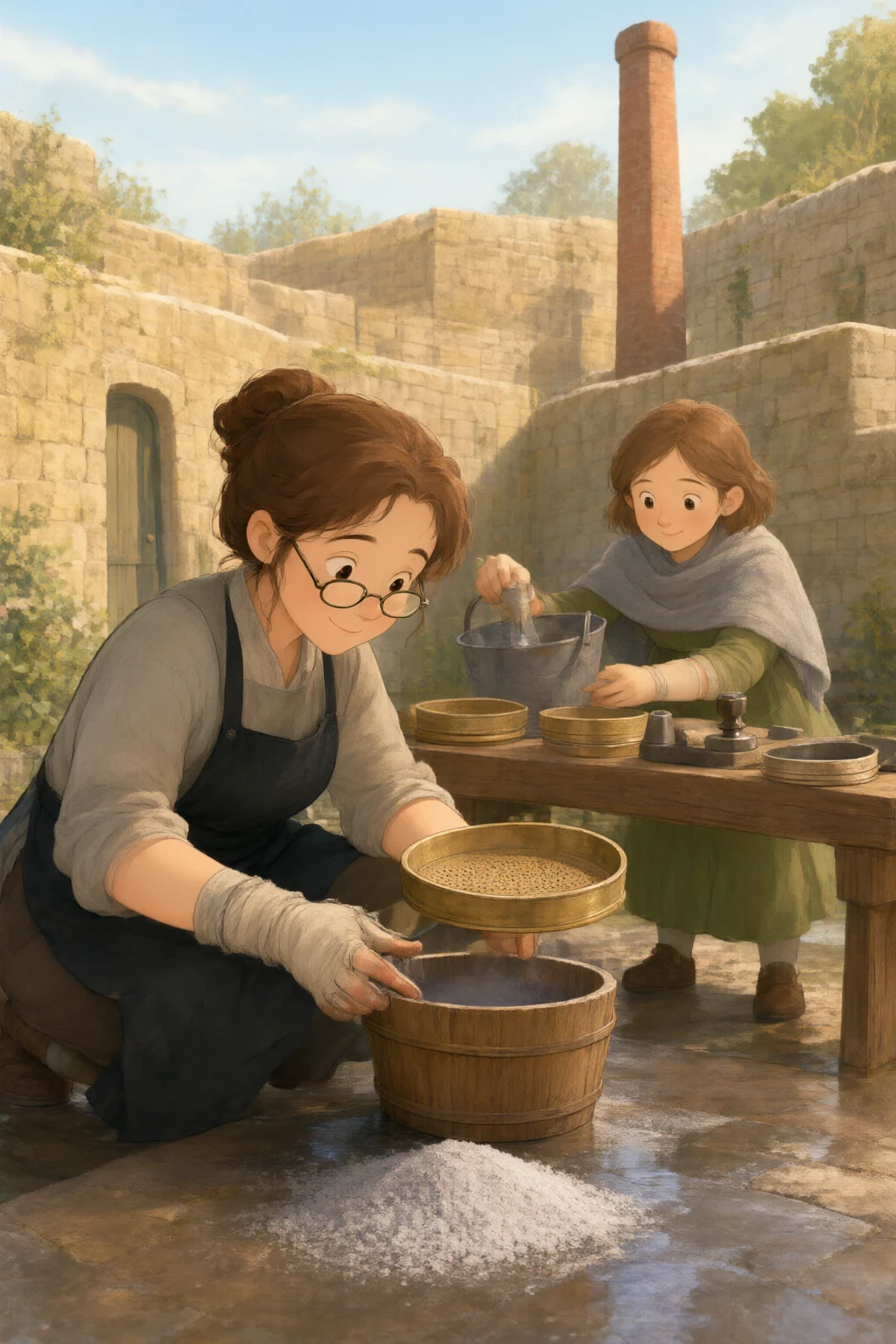
Marget Oskell saw all of it in one morning, on her way to work. She was sixty-three. Her black apron was worn white at the knee, her spectacles hung on a knotted grey cord, and the tips of her fingers were stained smoke-brown. In her pocket she carried a shallow tin of dry ash, and when she was thinking she tapped it with her thumbnail, and it made a small dry sound, like a beetle walking on paper. “Have you seen it twice?” she said, to nobody, at the third step.
The note had been coming out of the colonnade for nine days. It did not stop when the wind stopped. “Reader,” said Tamsin Quill. Tamsin was sixteen and she carried the water for the sieves. She had a grey shawl over a green dress, her hair cut at the jaw and uneven because she had cut it herself, and a broad strip of cloth wrapped round her right hand and forearm that she never took off in front of anybody. “The sixth sieve has gone. You can put a thumb through the mesh.”
Marget looked along the graduated row of brass on the bench, coarse to fine, every one polished by four hundred years of hands that are now all dead and are now all in the colonnade. She looked at the finest of them, the one that takes the last of the last of a person. “Give me that one. And a bucket. And fetch the hand-bell from the Chart House in a cloth, so nobody thinks we have lost it.”
They climbed from the Washing Steps with the finest sieve, the bucket, and the hand-bell wrapped in a cloth. Marget set the bucket on the paving between the fourth pillar and the fifth, took out the hand-bell, and struck it once on the flat of the anvil stone. It made no sound. It never has. They keep it on the Chart House table because it is useful for nothing and therefore believed. “Right,” she said. “So it is not a hand. Now listen.”
The colonnade was full of hard low sun in narrow shafts with the green dust turning in them. The note everybody was frightened of came out of the fifth bay. Marget put one hand on the rim of the bucket and the other in her pocket, on the tin, and waited through a great many gusts. The wind came down off the ninth weir, hard and cold, and the bell in the fifth bay said its note, and said it well. And the ash in the tin lifted.
That was the first strange thing. Dry ash does not move. It has been banked under a corrugated lid since before anyone now living was born. Tamsin made a small startled sound and hummed one note, the way she does. It was not that note. Marget did not say so, and put her hand flat over the tin.
Here is how an ash reader works, and it is the oldest job in Coldrow, older than the tuner, older than the Kiln, older than the colonnade. A body is burned. What is left is sieved through nine grades of brass, coarse to fine, and what a person weighs on the beam is a thimbleful. A thimbleful. Marget Oskell has weighed nine hundred and forty-one of them, and she knows the weight of a person the way other people know a face.
So she tipped her own thimbleful in beside it, tapped the tin twice on the rim, and compared the two. It was not that there was more of it. It was that it would not settle. A thimbleful of ash is a close, packed thing. It goes into a bucket and it lies down. This sat up in the middle in a low grey mound with its sides too steep, the way snow sits on a wall in a thaw. She pressed the sieve down onto it and the mound cracked and puffed and sprang back.
“Have you seen it twice?” she said, to the ash. She sieved it over the bucket, fine grade, twice, the way you do. She weighed the grit against her own thimbleful on the little beam. The beam went over, and over, and settled. “Two,” she said. “There are two people in that bell.” Tamsin said nothing. She was looking at the mound, which had not moved, which was still sitting up in the bucket with its sides too steep, refusing, as if it had somewhere else to be.
“Nineteenth of Frostmonth,” said Marget Oskell, to nobody in particular, “and the bell in the fifth bay is a two.” The Crown Kiln is a low hall of firebrick and soot east of the stream, and the light inside it is the orange of a foundry and not of a lamp.
Bela Truce was at the furnace mouth with a gather swinging on the end of a long blowpipe. She did not stop, because you do not stop for a conversation with a gather turning. But she turned her head, and one ear of hers was redder than the other one, as it has been for forty years. “Truce. I want a gather by mark. You answer by mark and I will not ask you by number.”
“Then I will answer by mark,” said Bela, and set the gather down on the marver, and wiped her forearms on her leather apron, which was burnt shiny at the front. “Ask.” “Eleven years ago. Fishmonth. The fire with two in it. What gathers went into the bell that now hangs in the fifth bay?”
“Come out of the roar,” said Bela Truce, and came into the middle of the hall, and stood in front of the annealing rack with her hands behind her back. Her black hair had a long grey streak in it where a gather had dripped a long time ago, and it was the only thing about her the fire had not improved. “The seventh from the mouth,” she said. “The one with the flat wax.” “And the other one?”
“The ninth from the mouth.” She put her thumb on the rack. “This one. The one with the notched wax. I notched it myself with a cold chisel, because I could not be certain which of the two I had in my hand, and a notch is a thing you can see with your eyes and a number is not.”
One bell, one person. That is the whole law of the Crown Kiln. Marget Oskell may not sign a name into glass unless she has seen it twice, and she has never in her life signed a name she saw once. The bell in the fifth bay was sealed with one lead disc, and the disc carried one name. WENNA LARK. “So the seventh from the mouth is Wenna Lark,” said Marget. “And the ninth from the mouth is a person whose name nobody has ever said out loud.” “They are sisters,” said Bela Truce.
“They are sisters, and I have to know which is which before I can do anything, and I cannot do it myself. The burn sheet is burnt through at the top.”
“It is burnt through at the top,” Bela agreed, “because the top of the paper was nearest the mouth of the kiln. And the top line is the one that says who went in first, and it is gone, and the second line is still there. And the second line is the sister. And the sister was not the first, because I took them off the tray in the order they were carried out, and the older one was carried out first.”
Marget took out the tin and tapped it with her thumbnail, four times, and counted her words on her fingers.
“Then say it out loud,” she said. “You made the gathers. You are the only person alive who made them. I cannot write a name I have seen once, and I have seen that name once, in a burnt book, in the first hand, and nobody has said it in this valley for eleven years. And if I put it in glass on the word of a woman who cannot read a single number in this valley, then it is not a certification, it is a rumour, and I have never signed a rumour in my life.”
“Eleven years,” said Bela Truce. “Eleven years. And the grandmother is eighty-eight and she still sets two places, and one of them is going to keep being set, because if nobody says the name then that place is not a place at a table any more, it is a hole, and she has been eating eleven years of soup across from a hole. That is the cruellest sentence in this valley, and I am the one who has been saying it.”
The hall ticked and cooled, and behind them a bell on the cooling wall shifted in its row and said nothing. She had two names she could say, and one of them was already on the lead. “Have you seen it twice?” said Bela Truce. “Twice,” said Marget Oskell. “Say it, then. And do not say it quietly.”
So Marget Oskell said it, into the orange light, the way you say a thing you have decided to say. “Hesper Lark.” And Bela Truce nodded once, the way you nod at a fire that has taken.
“Right,” said Marget Oskell, and sat down on the cooling wall among the bells lying in their rows like sleeping animals, which you are not supposed to do. “Then it is Hesper Lark. And I have seen it twice, and I am signing it, and you will hear what I say, because you made the gathers and you are owed the hearing of it.” She counted her words on her fingers.
“I, Marget Oskell, ash reader and certifier of the valley of Vesset Grail, have this day seen the name Hesper Lark twice: once in the burn sheet of Fishmonth, in the hand of the furnace man, the top line burnt, and once in the mouth of Bela Truce, blower of this Kiln, who took the second gather off the tray in the order it was carried out. The bell in the fifth bay holds the ash of two people, and the name of the second is Hesper Lark.
I set my mark to it, and I will answer for it to the last day I have.” She took out the wax and the punch and a lead blank, and cut the name in crooked, the way they all are. Then the two of them went up the Washing Steps in the frost, with the water going glassy and green over the nine broad weirs, to the house at the top of Weir Lane where an old woman of eighty-eight had two places set, and had been setting them since the year the snow was early.
Marget told her plainly, and without any comfort that was not true, because there is a rule about that too. The old woman listened to the end. Then she got up and put the second plate in the drawer, and sat down again, and said that it was a relief, and it was not, and it was a relief. Then she asked when it would sound. “When the wind fits,” said Marget Oskell. “And can it say her?”
“No. It cannot say a word. It cannot say her name. It can only say the shape her mouth made, once an evening, when the wind comes down off the Washing Steps at the right angle.” She put her hand on the door frame. “That is all any of us get.”
At the end of that week Marget Oskell went back through the seal ledgers from the front, with her spectacles on and her burnt fingers going down the pages, looking for the one she knows is in there and has never been able to find. It may be this one. It may not be. She turned the page and counted her words on her fingers, though there was nobody to count them for. “Have you seen it twice?” she said to the ledger, in an empty yard, in the warmest place in Coldrow in the cold of the year.