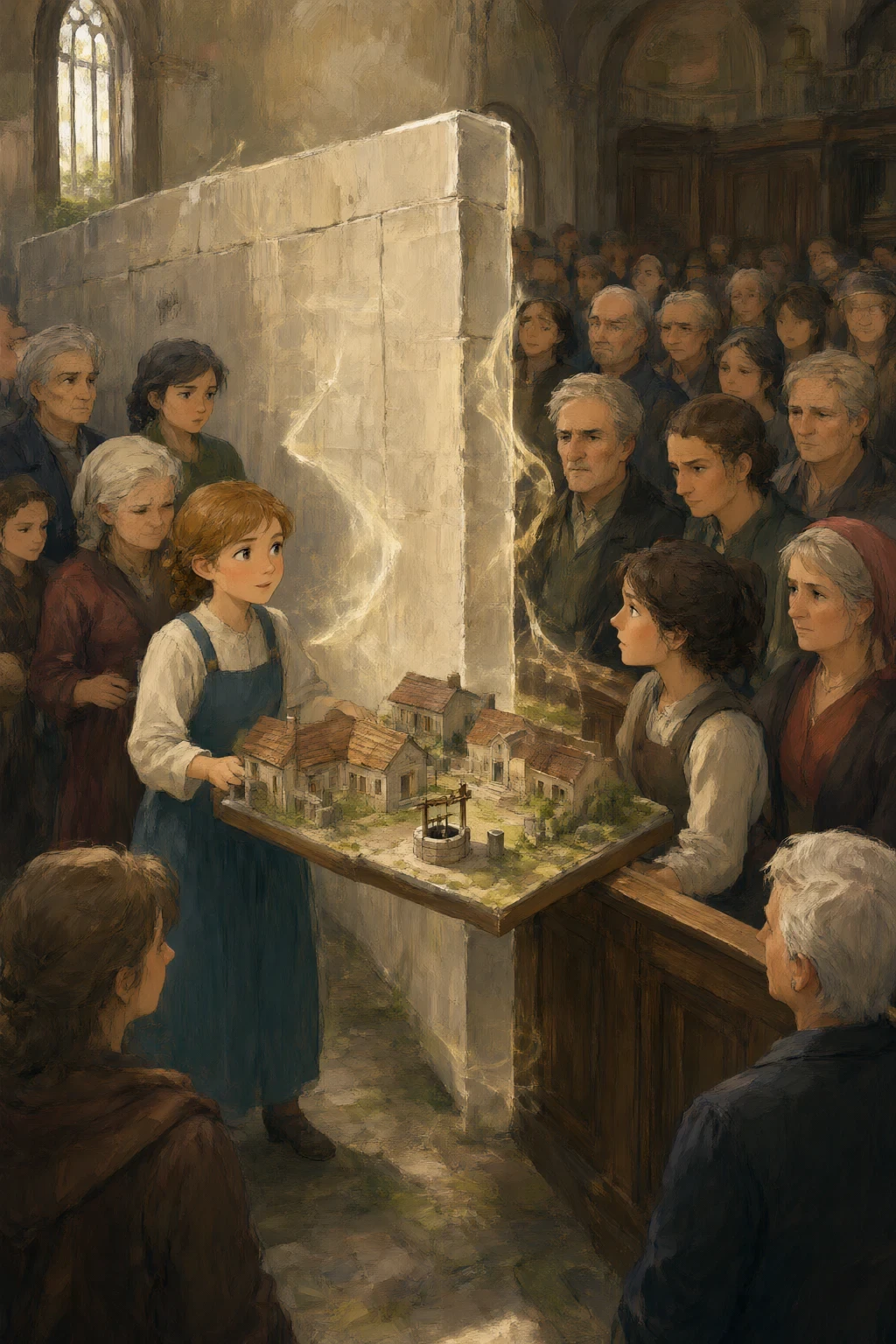
Every Sunday, the children of Low Orchard drew maps on the pavement. The maps showed the safe route from their houses to the market: through the arch of the old station, past the bakery’s blue door, and away before the buses began coughing black smoke.
Mina lived on the other side of Bell Street, where the pavement ended in a line of weeds. Her school was in Low Orchard, but every journey to it began with a checkpoint.
The proposed wall would not have crossed the street. It would have sealed a narrow lane between Bell Street and the river, turning Low Orchard into a pocket. On one side stood the houses of Bell Street, where a burst water main had flooded three basements last winter. The city promised a wall, pumps, and dry gardens.
On the other side stood Low Orchard, whose families used the lane for schoolchildren, deliveries, and a shortcut to the clinic. The wall’s architects called it a flood barrier. The children called it the brick that would follow them home.
Mina’s mother cleaned offices in the center. Her cousin Tavi had asthma. During the rain, the lane’s puddles reflected the hospital sign in long silver pieces. A gate, officials said, would remain open from six to eight. But six to eight was not enough for a child carrying a blue inhaler, and not enough for a woman finishing a night shift at ten.
At a school assembly, a map appeared on a screen. The wall was a thick red line. Someone had drawn tiny houses on both sides, but only the houses on the left were colored. A voice said Low Orchard would be “protected from the water.” Mina stood up. “Whose water?” The room became quiet. The presenter’s smile tightened. “The river’s water.” “The river runs beside both sides.”
“That is not what the map means.” Mina’s teacher gently reminded her about respecting the speaker. Afterward, she walked Mina to the bus queue. “Do not let them make your neighborhood disappear from the room,” she said. “And do not let them make you cruel just because you are afraid.”
The next day, Mina copied the map onto a sheet of brown paper. She marked every bus stop, the clinic gate, the bakery, and the two footbridges that vanished in high water. She did not draw a line through Low Orchard. She wrote NEED A WAY THROUGH across the lane. She gave the paper to her mother. “Can you help me take it to the hearing?”
Her mother looked at the crowded roads. “I can get you there after my shift. I cannot promise the room will hear you.” “Then I will ask the workers who use the lane.”
Mina began at the bus depot. The driver, Mr. Vale, knew which streets flooded and which promises vanished from council plans. He gave her a timetable and a list of passengers who had complained. Mrs. Ilyan, who ran a repair shop, showed her how to record the difference between “no access” and “slow access.”
At the clinic, a nurse named Jo wrote that the two-hour gate would cause missed medicine deliveries. She also admitted that the wall would protect vulnerable homes from another flood. Mina did not erase that sentence.
At the evening meeting in Bell Street, people spoke against the wall too. A woman named Pella feared losing her garden. Two shopkeepers said the pumps would make their insurance cheaper. When Mina stood on a crate to speak, a man in the front row laughed and called her “the wall’s mascot.”
She gripped the crate until her palms hurt. Then she asked, “Which side is the water on when it reaches your basement?” The laughter stopped, but the man did not look away. Mina’s mother had come straight from work, still wearing blue cleaning gloves. She stood near the door, too shy to interrupt.
Mina’s voice shook. “I am not asking for our neighborhood to stay dangerous. I am asking for the plan to show the danger on both sides.” The council chair said, “The wall has already been modeled.” “Modeled for a normal storm,” said Jo. “The last normal storm was six years ago. The gate schedule is on the school route.”
Pella raised her hand. “Our basement took four inches of water. We are not trying to drown anyone.” Mina nodded. “Then design a wall that does not make children drown in another way.” Someone in the crowd called that impossible. Mina pointed to her map. “Then the map is incomplete.”
Afterward, the man who had laughed came to her table. His name was Oren, and he lived in one of the protected houses. “My daughter’s school is on your side,” he said. “I thought the wall would keep the river away from everywhere.” “My cousin needs the lane.” “I know.” The hearing ended without a decision. The council promised another map.
For six weeks, Mina carried the brown-paper map to every place where adults argued about it. She learned that the river did not choose sides. Floodwater rose under a bakery, entered a nursery, and stopped at a sandbag left by a family who had arrived early. She learned that a gate could be “accessible” on paper and unusable in a storm.
She learned that some people feared another flood more than they feared losing a shortcut, and some feared losing a shortcut more than they feared another flood.
Mina’s map grew crowded. Blue lines showed proposed gates. Red circles showed homes that flooded. Green dots marked buses, clinics, shops, and the place where an older neighbor could rest. She added a note in the center: A wall can protect a street and still harm a neighborhood. Show the harm. Then, two days before the final hearing, someone stole the map from the school cloakroom.
Mina stood by the empty hook and felt the floor tilt. Without the map, their voices would sound like complaints. With the map, they could point. Her mother found her there. “Can you make another?” “Same map?” “A truer one.”
They worked through the night. Mina’s mother cut brown paper into a long strip. Mina drew from memory and from a photograph she had taken of the flooded lane. The next morning, Mr. Vale let them ride on the early bus. Passengers copied their turns and detours onto the paper. The clinic marked where the gate was too narrow for a stretcher.
Pella drew her basement and the pump that might save it. Even Oren added a note about the school bus turning into Bell Street after heavy rain. At the hearing, the council chair called the new object “anecdotal.” Mina’s mother stood. “It is a record of what happens when a plan meets a street.”
The chair asked whether Mina was speaking for everyone. She looked around the room. Low Orchard families, Bell Street families, bus drivers, shopkeepers, and clinic workers occupied different rows. “No,” Mina said. “I am speaking for the children who use this lane. I am also saying that the adults who use it do not all need the same thing.”
That was the sentence she had been afraid to say. It did not make the room comfortable. It made the room listen. The council approved a higher wall with two gates, a flood-warning system, and a paved emergency path. The gates would open whenever a storm warning was issued. The emergency path would belong to the town, not to either neighborhood. Bell Street got the pumps it needed. Low Orchard kept access to the clinic and school.
A neighborhood association would review the plan every season, with equal places at the table for residents who had not owned homes in the district. Some people objected. Pella worried the wall would still be too low. A Low Orchard organizer said the new path was another name for a route through their homes. Mina’s mother worried that the council would forget its promises once the cameras left.
Mina did not call the plan perfect. At the next hearing, she presented a list of questions: Who would repair the gates? How would a power outage be announced? What happened if the emergency path became blocked by a fallen tree? The questions entered the official minutes. They were not victories, but they stayed where decisions could find them.
One afternoon, heavy rain filled the gutters. Mina stood beneath the new gate with Tavi and watched water curl around the paving stones. It reached the old flood line and stopped at the wall. The pump started with a low mechanical thump. The lane on Low Orchard’s side remained open. A stranger asked, “Is it safe now?”
Mina looked at the slick bricks, the closed school gate, and the red warning light blinking above the clinic. “It’s safer than before,” she said. “Not safe enough to stop watching.” The stranger nodded, as if that answer was useful.
Later, Mina and her mother walked home by the emergency path. A new sign marked the place where a schoolbus could turn. Someone had scratched away the word temporary. Beneath it, someone else had written scheduled to be checked.
Mina opened her notebook. She drew the wall, but she did not draw it alone. She drew gates, buses, puddles, gardens, and hands holding different pieces of the plan. In the margin she wrote: Every side has a cost. The map must show the cost. Then she walked across the lane before the gate closed.