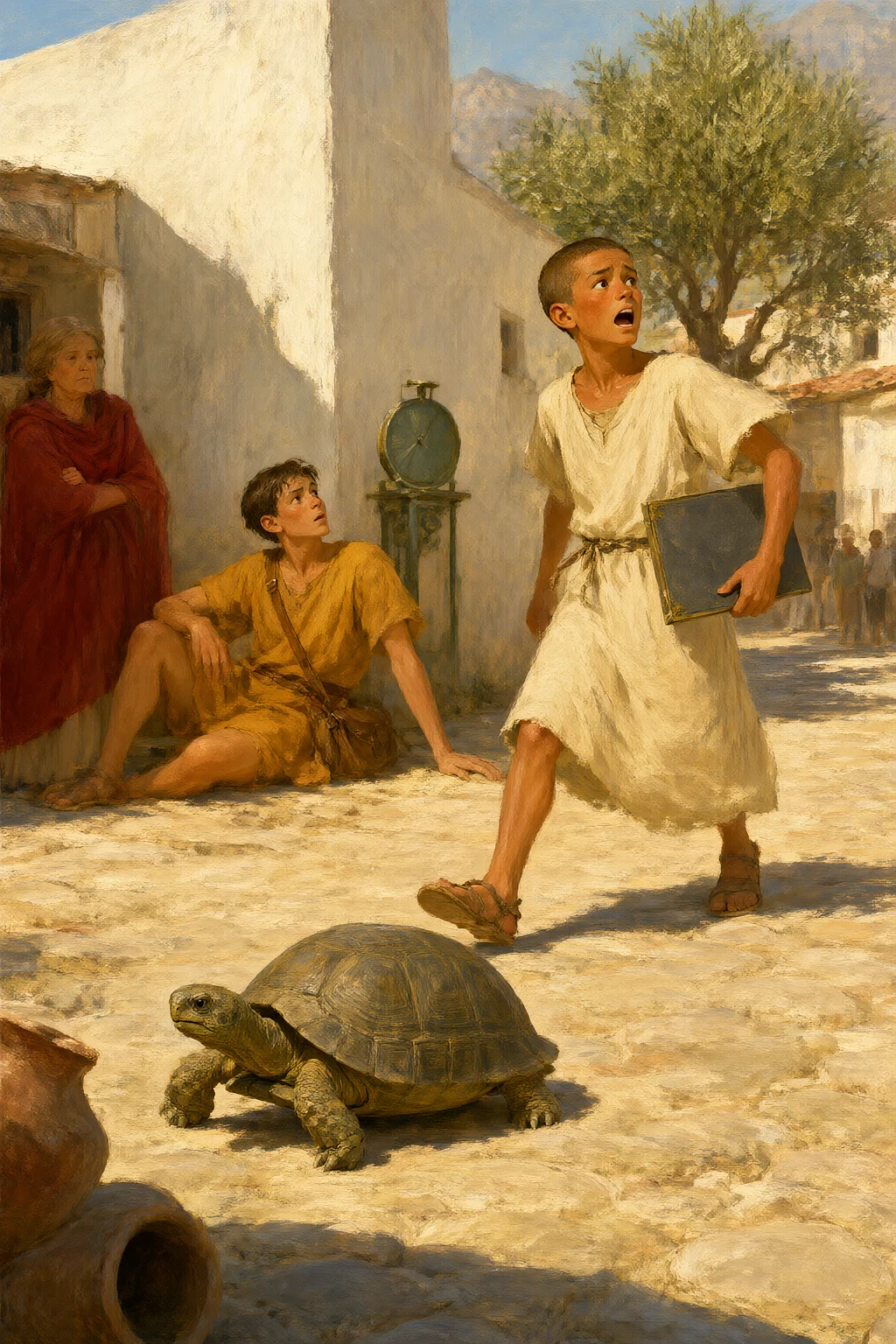
The decree was four lines long and the last line was the reason for it. It was posted on the whitewashed wall of the stoa where everybody read everything, which in a harbour town is a kind of custom. It said that the conduit beneath the agora had been repaired at the town's expense. It said that the fountain of Krene, which had run dry and then run foul for two summers, would be opened on the ninth day of the month. It said that a foot-race of one stadium would be run from the fountain to the altar of Apollo, that the winners of the divisions would receive wreaths of olive, and that the first amphora of the clean water to come out of the cistern would be carried by the winner to his own street and shared there.
It did not say why a foot-race would be a good way to spend a town's water. Timon's father read it twice, the way he read everything, out loud, badly, with the water jar in his hand. "They want us at the fountain," he said. "They know what a festival does to a town. If the boys are running somewhere, the men will follow them, and if the men are standing at the fountain, they will drink from it instead of the harbour. And in a month the harbour will be drinking from it too, out of politeness." "So why is the prize an amphora?"
"Because an amphora is a chore," said his father. "Nobody wants to be the one who has to carry four gallons home and hand it round to the neighbours. Every man in this town will find a reason why he cannot enter. And the decree has a clause, read it, read it -- every deme sends one competitor or pays a drachma." "Our deme has a potter, a widow, and a boy who delivers, and a drachma is my winter." "It is," said his father. "It is."
The house of Timon's mother was up the slope of Parnes Street, and in the yard behind it there was a low stone pen, and in the pen there was a tortoise. The tortoise was called Zeus. Timon's grandmother had named him, on the day he was brought home in a sack by Timon's great-uncle, who had got him from a stone in the quarry road and had not been able to work out what he was. She had looked at him and said, Zeus, because he was not going anywhere, and the name stuck, and by the time Timon was born the whole street said it that way, and when the women of the street wanted to be funny with each other about a man who was late they would say, at least you are not as late as Zeus. Over the pen there was a board.
This was the part that made the neighbours uncomfortable. The board was two hands wide and a foot deep and had been painted, and there was writing on it, and the writing was a list. The list had a heading and then a column of times and a column of places, and beside the times and places there was a third column, which was what had to be done. Timon read it out loud to the assembly, when it was read out, because he was the one who could read it. FIRST WATCH. Out of pen. Round the fig. Back. Do not start hot. SECOND. Along the wall, north side. Shade until the sun clears the roof. THIRD. Water. The trough at the tanner's, not the cistern. FOURTH. The long straight. Slow. Steady. Do not look at anybody. FIFTH. If a runner lies down, stand.
Beneath the fifth line, in a different, smaller hand, somebody had once added: SHE WILL NOT EAT ON THE ROAD. "That is my mother's writing," said Timon. "It is not a plan," said the man from the dye works. "It is a list of chores with times on it." "It is a plan," said Timon's grandmother, from the doorway. "A plan is chores with times on them. That is all a plan is. You may laugh at a plan, but you may not laugh at a plan that has been kept for nineteen years, because keeping it is the whole of what it is."
The demesman of Parnes Street had one week to produce a competitor or one drachma, and the potter had one drachma's worth of nothing, and on the fourth evening Timon went down to the pen with a piece of chalk. He was twelve. He had no particular gift except that he could add, and that he could not be stopped once he had started, and his grandmother had noticed both of these about the same time. "I want to know the length of the course," he said. "Every man in the agora could tell you that." "I know what every man in the agora could tell me. I want it written down and I want to know what it is in feet and in minutes."
The length was six hundred and twenty-five feet. The boy who was to start the race with the water-clock was called Kleon, and he was fifteen and bored, and he told Timon that the whole race was meant to take about four minutes if a man were quick, and that the boys ran it in two, and that the tally was chalked on the board at the altar and that nobody had ever come close to the boys' figure because boys were not entered, they just ran it, which was different, because running it was running, and entering was entering. Timon did sums on the back of a shard of a wine jar.
He worked out how long a man of nineteen can hold a fast pace, having watched his sister's betrothed try to keep it up the Parnes Street slope and go grey. He worked out how far a man can run in the sun on a stony road in the fifth hour after sunrise. He worked out what Kleon had said, which was that the tortoise's board accounted for five watches, and that five watches was longer than the whole race, and that a tortoise who kept to the board would still be on the course after the winner was home. Then he went down and told his grandmother. "Zeus is going to lose," she said. "Yes," said Timon. "Then we are not entering him to lose."
"No," said Timon. "We are entering him because the drachma. And I want to say out loud on the day, in front of the assembly, how long the course is and how long Zeus is scheduled to take, so that everybody writes the number down. Because a man who has said a number out loud in public cannot afterwards be surprised by it." She considered this. "You have thought about how to lose honestly," she said. "That is not the same as thinking about how to win." "I have thought about how to win," said Timon. "It is the same thing. If everybody has written the number down, then the only thing left that can be interesting is the other one."
The hare's name was Cleombrotus, and he was a courier, and he had a leather bag and a good tunic and a very loud opinion of runners. There were eleven men entered, and four of the boys, and a fat man from the wine trade who had entered because the wine trade enters everything. And there was a tortoise. The assembly laughed. The laugh went on for some time. Timon's grandmother stood at the back with her arms folded and did not look at anybody, and there is a thing about a person who is not laughing at a joke, which is that it makes the laughing stop a beat later than it would have. "From the city," Cleombrotus said, looking down at the pen. "Is it coming?" "It is not coming," said Timon. "It has been here nineteen years." "Then it knows the way."
"It knows a way," said Timon. "It is not the way the decree means." The herald blew the pipes. The runners stripped and oiled. Kleon turned the klepsydra upside down on its stand at the fountain, and the water began to fall into the bronze basin, and the basin's shadow moved along the stones at a steady rate, and every man there had seen it a hundred times and had never once thought about what it meant. "Any last words?" said the herald, who did not expect any. "Yes," said Timon. "Go on."
"The course is six hundred and twenty-five feet. Kleon's water-clock says a fast man does it in about four minutes. Zeus's board says five watches, and I do not know how long a watch is because the board does not say, but it is longer than four minutes." He looked at Cleombrotus. "You will not be able to hold it after the turn at the olive tree, and when you cannot hold it, do not try to hold it, because the second hour of a hot race is where men hurt themselves. There is shade in the second yard on the north side. Use it." The assembly was quiet. "You have coached a tortoise," said Cleombrotus, "and given me the road." "I have read a board," said Timon. "You may catch up to it."
The fast men went out like water down a drain. Cleombrotus led by nine paces at the fountain wall and twelve by the tanner's, and Timon stood at the altar with Kleon and a slate, and wrote the times down as the runners went by, and the numbers came out exactly the way he had said they would. Zeus came out of the pen at the second watch. He was on schedule. He went along the north wall in the shade until the sun came over the roof of the wool shop, and then he stopped in the one place where a low wall makes a shadow, and waited there for the length of a breath, or a hymn, or whatever it was that the old woman had decided a watch was. Cleombrotus came round the turn at the olive tree in one minute and a half.
Then he came round it a second time, slower, on the same side, and he was not running any more, and the men behind him were not running either. The second yard on the north side was in shade and Cleombrotus went into it, and came out of it, and stopped, and put one hand on a house wall. There were no runners behind him at all. There were three, and a fat man, and a boy. The rest of the field was spread out along the course in small groups, and they were walking, and they had begun to walk some time ago. Zeus reached the trough at the tanner's at the fourth watch, drank, and went on along the long straight, slow and steady, not looking at anybody, exactly as written.
The hare lay down. He lay down in the dust at the edge of the course with his bag under his arm, and he lay down the way a man lies down when he has finally got permission from his own body, and he was not asleep at first, and he was saying, to nobody, that the road was longer than it had ever been in his life. Timon got there at about the sixth watch. He was out of breath and he was crying, which he denied afterwards and which everybody in the crowd except the hare could see, because Timon had not eaten and had been shouting numbers for two hours. "You are on the course," said Cleombrotus. "I am off the course. I am carrying the slate. I am not entered." "Give me the slate." "No." The hare laughed. It hurt him.
"You are twelve years old," he said, "and you are standing in the road telling a man of nineteen that he has got the arithmetic wrong." "Yes," said Tim. "What happens if I finish?" "Then somebody else gets the amphora and takes it home, and you get a wreath, and it is a very hot day, and you will feel exactly as if you had won, and everybody will say so, including me." "What happens if I lie here?"
"Then Cleombrotus the courier finishes a foot-race, and a tortoise finishes after him, and in six months no one will remember either fact, and I will have wasted a morning." Timon crouched down. "But the decree has a clause about the deme, and the deme is Parnes Street, and Parnes Street pays a drachma when it has no competitor, and Parnes Street has not paid a drachma in six years, and it is not the drachma I care about. I care that you are on a public road with your legs full of somebody else's race." At that moment something came round the corner of the wall.
It came round very slowly, and it stopped, and it stood there in the road about four feet ahead of the hare's face, and it did not go past, because there is no going past on a road, and everybody in the crowd understood the same thing at the same moment and made a sound that was not quite a laugh. Timon got up and walked to the yard wall where the board hung, and the crowd could all see him do it, because he did it in the middle of the road with a crowd on both sides. "Zeus," he said. "Fifth watch. If a runner lies down, stand." The tortoise stood.
That is all it did. It stood in the road for a while, with its head up, and the crowd waited, and the hare's face went red, and Cleombrotus said, with his hand still on the wall, "I have never in my life been so glad to be beaten by a wall."
Zeus came in last, at the end of the fifth watch, and the water-clock had been emptied and turned and started again twice, and by the reckoning of the boy's own slate, at a time the boy had written on the wall of the stoa that morning in front of the whole assembly, with his own hand, and had asked a bystander to witness it because he did not trust himself not to be quietly doing the sum wrongly. The fat man from the wine trade was declared the winner by the stewards, and then stood in the road and asked, quite genuinely, whether anybody would like to help him carry it.
The amphora was four gallons of the first clean water out of the cistern of Phaleron. It stood in the middle of the road with a wax seal on it and a garland on the neck, and it was a beautiful object and a chore, exactly as Timon's father had said. They took it up Parnes Street on a board with six men on it, one of whom was a tortoise. The fountain was already open at the bottom of the street, and a queue had formed, and when they set the amphora down on the step and broke the seal, the whole of Parnes Street got the smell of it at once, which was a smell nobody in that town had smelled in two years.
Timon's grandmother did not drink any. She went home, and the tortoise was walked up the hill in four minutes, which was the whole of the distance, and got put in the pen, and got a scrap of wet cabbage. Then Timon climbed onto the stool with the chalk and added a sixth line to the board. The fifth line had said: If a runner lies down, stand. The sixth said: If the tortoise stands, somebody must go and talk to the runner. Have a word ready. It was in a different hand. It was smaller than the rest.