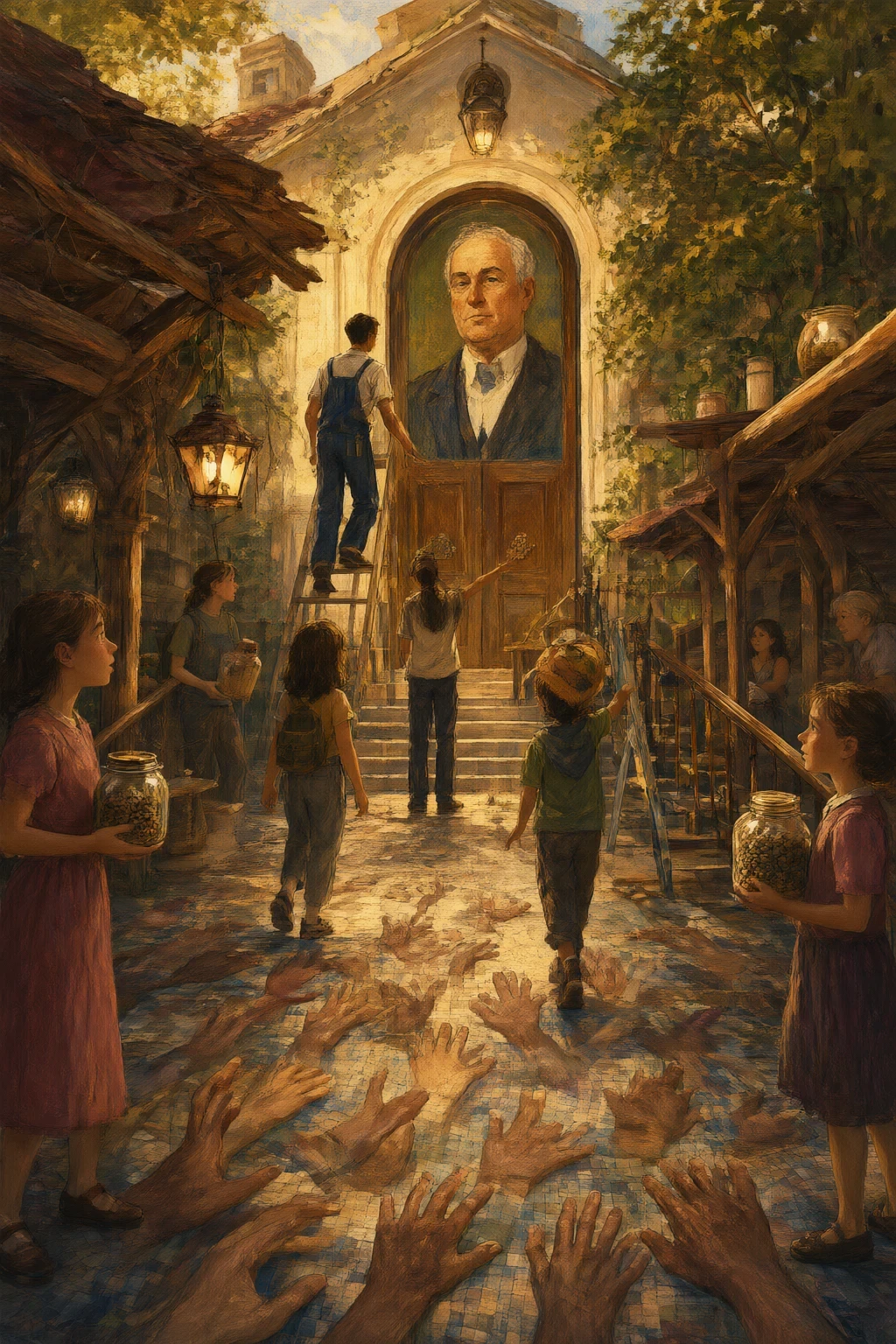
The community hall had one beautiful name and nine inconvenient problems. On the front door, a brass plate read Juniper Hall: Founded by Elian Voss, Builder of Better Futures. The paint had been renewed so often that the letters stood above the wood like little golden rails. Inside, the floor dipped near the kitchen. One window would not close. The stage lights buzzed whenever the oven came on.
No one could remember who had promised to fix them, and the name on the door made people hesitate to ask.
Nia’s mother cleaned the hall on Tuesday evenings. She knew which floorboard squeaked, where rain entered, and which fuse box complained before a light failed. Nia knew the rest: the children’s art hidden behind the cupboard, the coffee tin that held buttons, the old wheelchair ramp whose wooden edge had split.
The hall was to celebrate its fortieth birthday in three weeks. The committee planned a speech, a cake, and a new plaque. Elian Voss, the founder’s granddaughter, was traveling from the city with a polished story about Elian’s courage. Nia’s mother looked at the work order on the noticeboard. “We need someone to fix the fuse box before the party.” “They said it was a celebration,” Nia said.
“It can be a celebration after the lights stay on.” On Saturday, Nia went to the hall early. She found Tomas Ardan, the maintenance worker, beneath the broken window with a screwdriver in his teeth. He had been repairing the same building for nineteen years. He knew which roof tiles flexed in a storm and which cupboard door should not be forced.
The committee called him “the caretaker,” though he had repaired plumbing, painted murals, fixed the lift, and once rescued a child’s shoe from the lift shaft. “The founder’s granddaughter arrives tomorrow,” Tomas said. “The stage lights need new sockets.” “I thought someone was coming.” “They said the hall should look finished.” Nia looked at the sagging floor. “It isn’t.” “No,” he said. “But it has not fallen down.”
Nia asked the committee chair, Mr. Arun, why the hall’s name belonged only to Elian. He said Elian had paid for the first roof and organized the first meeting. Nia asked whether he had repaired it. Mr. Arun looked at Tomas’s unfinished work. “He was one of many volunteers,” he said. Tomas heard this. He set down a coil of wire. “I was here when the first storm came through.”
Nia knew that argument could be made into a contest—founder against maintainer, important beginning against invisible years. She did not want to make Elian smaller. Without the first hall, there would have been no place to repair. Without repairs, there would soon be no place at all. On the committee noticeboard, Nia drew a second door. It was blank.
“Recognition should not take someone’s work away,” she said. “It should show what the work is supposed to do.” Mr. Arun frowned. “A door?” “A responsibility door,” Nia said. “We could put every person’s name on a list, but lists get dusty. What if each person chose one job they promised to keep doing?” Tomas stared at her. “That sounds like an awful lot of promises.”
“Not promises people can’t keep. Work people can see.” The child-care teacher, Salma, suggested that each task should be paired with a budget and a partner. The bus driver said a task without spare parts was only a wish. Mr. Arun said the anniversary was not the time for a new system.
Nia looked at the name on the front door. “It is the time we tell the truth about this place.”
The children began holding a meeting after school. They did not call it a committee. They called it the Door Meeting. They made a list of places that hurt: the loose step, the flickering light, the locked cupboard, the bathroom with no privacy hook, the kitchen drain that smelled after rain.
For each, they had to answer two questions. Who could fix it? Who would make sure it stayed fixed? A name alone was not enough. A name with no tools, time, or authority was another decoration. Nia wrote Tomas beside the fuse box. Then she crossed out the maintenance worker and wrote Tomas Ardan — fuse box, lift, and emergency repairs — with Salma checking the monthly safety list.
At first Tomas refused the honor. He said he was not famous. Nia answered, “The work is famous. It is just not written down.”
The anniversary morning arrived cold and bright. Elian Voss’s granddaughter, Mara, stepped into the hall carrying a portrait of her grandmother. The portrait showed a woman in a hard hat, one hand on a beam. It was a good picture. It was not the whole truth. The committee gathered beneath the new plaque: Juniper Hall: Founded by Elian Voss, Builder of Better Futures.
Mara thanked everyone for preserving her family’s dream. Then Nia stood up. “My name is Nia,” she said. “I am here because I have swept this floor and found a dead beetle, carried a chair up the stairs, and watched the light blink when the oven came on.” No one laughed. Children in the back sat very still.
“Elian Voss built the first hall,” Nia continued. “Tomas Ardan keeps the hall alive. My mother cleans it. Salma keeps children safe. Mr. Arun finds the money. People bring food, repair, teach, open doors, and close them again when a storm comes. A name on a door is not a prize. It is a job.” The room became uncomfortable. That did not mean it was wrong.
Mara looked at the plaque. “My grandmother would have wanted the hall to stand for everyone.” “Then let it stand by work,” Nia said. “And let the work be named.”
After the speeches, the children unveiled a row of smaller signs—not on the front wall, where the founder’s name remained, but beside each doorway and cupboard. Tomas’s sign named him for emergency repairs. It also named Salma as the person who would check the safety list every month. Another sign named the floor squad, with a broom, a squeegee, and a monthly repair allowance.
Nia’s sign named her as “door meeting recorder,” though she had already decided that sounded too much like a title and changed it to “questions keeper.” Mara accepted the old plaque down from the front door. Nia expected the hall to feel diminished. Instead, the door opened onto the yard, where children were carrying chairs through the rain.
Tomas went to check the fuse box. It sparked once, then held. Before the children went home, they made a short inspection. Tomas showed them how to test an emergency light and how to report a loose stair without turning it into a dare. Nia wrote each report on a card and carried the first one herself: Stage-left floor dips two fingers. Needs boards and a budget. Mr.
Arun signed it, then asked whether a child could be responsible for the whole building. “No,” Nia said. “But a child can notice a problem, and adults can be responsible for fixing it. That is how the work gets done.” Mr. Arun carried the card to the maintenance office. It was the first time he had entered without a committee meeting on the calendar.
The first repair was not the fuse box. It was the budget line for spare bulbs. Salma showed Nia how to record the cost, date it, and place the receipt in a folder. Tomas laughed when Nia labeled the folder evidence, but he did not change the label. “Evidence can be a broom,” he said, “if it shows where the dirt is.”
Nia thought about the name on the front door. A name could be a key, but it could also be a locked cabinet. Her new system left the cabinet open. Anyone could read the list, ask for help, or disagree with a job. The children counted the lights. One. Two. Three. Four. Five. The buzz beneath the floor quieted.
Nia’s mother found her near the stage. “You made a lot of work for yourself.” “Some.” She folded the blank-door drawing into her notebook. On it, beneath Elian’s name, she had drawn a row of small tools: a brush, a wrench, a broom, a key, and two open hands. “Does the founder get a job too?” her mother asked.
Nia considered the question. “She gets gratitude,” she said. “Gratitude is not the same as maintenance.” Outside, the rain began again. Tomas did not call for help. He went to the roof gutter with a ladder, and two children followed because the Door Meeting had decided that showing up was part of the job.