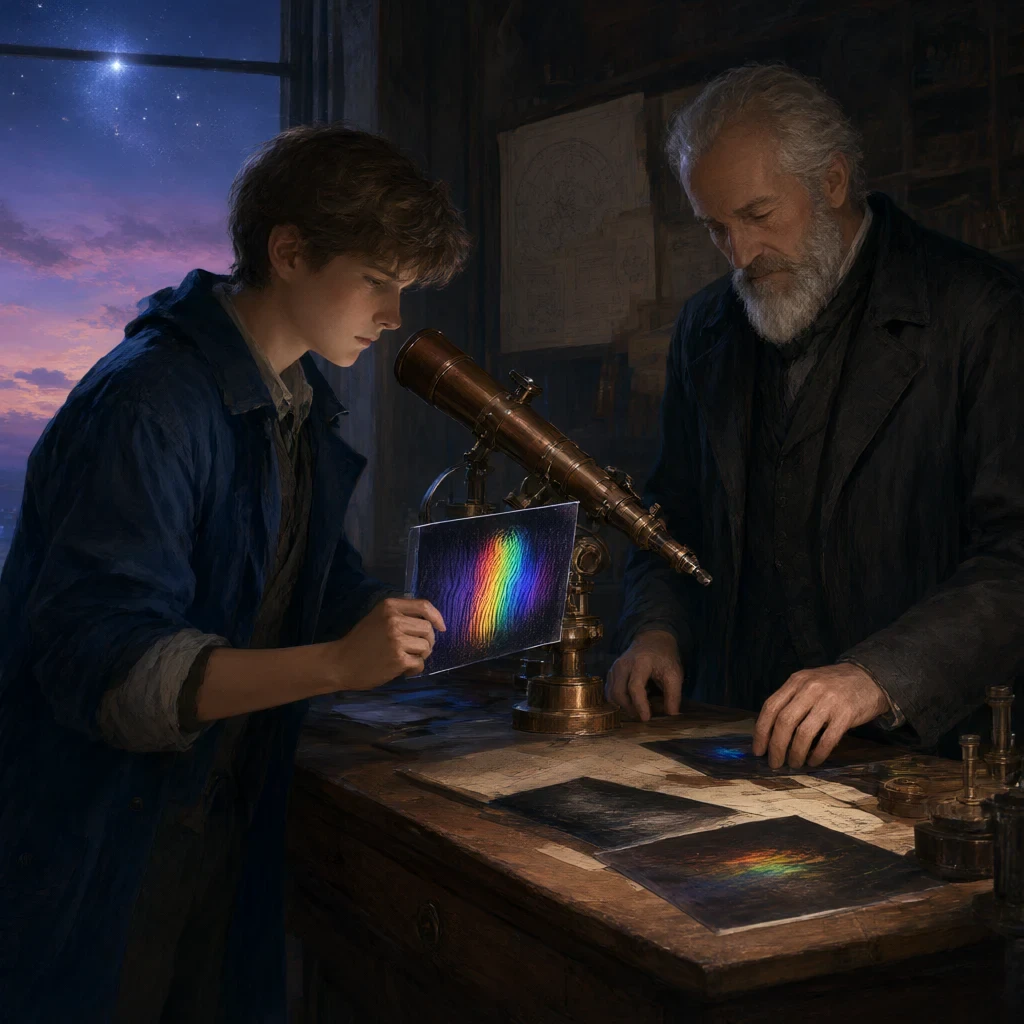
On the night the observatory’s oldest telescope turned toward the western sky, apprentice Neri found a rainbow lying still inside a beam of white light.
The beam came from a star hidden behind the blue dusk. It passed through a prism in the instrument room, and the colors spread across a dark plate. Most of the plate was smooth, like sunlight through a window. Dark threads crossed it at exact places. Some were narrow. One was a little wider. Another had a smudged edge. “There,” said Master Orun, without looking up from the instrument log. “The star has a fingerprint.”
Neri touched the paper’s edge. The marks were made by the star’s atmosphere, he knew. Light from the hot, dense interior emerged as a continuous spectrum: a spread of wavelengths with no deliberate breaks. Then, as the light passed through cooler gas, some wavelengths were absorbed. The gas did not paint its own color over the whole spectrum. It removed selected colors, leaving dark absorption lines.
The same gas, when excited and made to glow, would produce bright emission lines at the same wavelengths. The wavelengths were its address. A pattern of lines could identify the gas. “The atmosphere is thinner than the core,” Neri said. “For the lines we can see, yes.” Orun tapped the widest line. “But a finger print is not a name cut into a window. It is an impression made by what the finger encountered.”
Neri’s first task was to identify the gas. He had a stack of reference spectra from three nights of observations: a cool cloud of glowing gas, a laboratory tube, and a distant, pinprick source. The laboratory pattern was narrow and orderly. The cloud’s lines were broad and shifted. The star’s pattern had several marks in common with the cloud, but one strong line in the laboratory plate was missing.
Neri wrote HELIUM beside the star plate. Then he crossed it out when the missing line could have been hidden by the instrument’s narrow range. He wrote NEON, because the remaining marks seemed to fit. Orun asked him to check the neighboring wavelengths before committing.
The helper was a brass ruler marked with wavelengths, and the plate had been exposed for only twenty minutes. At the edge of the ruler, the emulsion was fogged by moonlight. Neri could not tell whether a line was truly absent or simply too faint to record. “The gas might be neon,” he said. “Might is a useful beginning,” Orun replied. “It is not an observation.”
They took turns watching the telescope. The source rose a finger’s width above the hills. Neri adjusted the spectroscope and let the same starlight fall through its slit. The continuous glow remained, dark lines shifting slightly in position as the instrument’s temperature changed. He compared the marks by width, darkness, and spacing. One dark line was shallower than the reference. It could be a weak line blended into a broad neighboring feature. The missing line remained missing.
By midnight, Neri had collected three plates. Two showed the same pattern. The third had a pale gap where a line should have been. He argued that the star’s atmosphere must contain neon, but not enough of one of its expected lines. Orun asked him what would happen if the gas were mostly something else and the instrument had clipped the evidence. Neri had no answer that made the star obey him.
A courier arrived with a message from the lower observatory. A bright line in the laboratory spectrum had shifted after a flame was moved away from the tube. The line’s color had not changed to a different color; it had moved to a neighboring position. Neri examined the star’s lines again. They were all a little to the right of the cloud reference. The lower observatory’s flame experiment showed the same kind of movement.
“Someone is moving the gas,” Neri said. “Or the light is telling us the gas is moving relative to us,” Orun said. “A motion along our line of sight changes the observed position of a line. It can make a pattern look slightly unlike the laboratory one. That is a complication, not a different fingerprint.”
Neri sketched two traces over one another. The star’s strongest lines were not exactly where the neon laboratory lines lay. He measured the shift twice, then looked at the ruler’s uncertainty. A tiny change in the plate’s placement could create much of the difference. The evidence allowed for a cloud moving toward or away from the observatory, but did not prove how fast.
Dawn turned the dome white. The apprentice wanted to announce neon before the morning train carried the news away. Orun stopped him. “Write what the plate supports,” Orun said. “What did you observe? Which lines match? Which are faint? What might the instrument have missed?” Neri wrote: Several wavelengths agree with the reference. One expected line is not securely detected. Some positions differ slightly, possibly from motion. The strongest conclusion is a likely identification, not a certainty.
The astronomer read it and nodded. “Now go outside.” The town’s market had been opening in the gray morning. A butcher had set out red lanterns, a baker carried trays, and a child chased a hoop through the stalls. None of it belonged to the observatory experiment, yet Neri watched the same principle in the street. A lantern flame made a continuous glow, and a colored glass filter removed some wavelengths. The market’s different glasses made different patterns.
A missing color was not proof that a particular dye had never touched the cloth.
When he returned, Master Orun had placed three reference plates beside the star’s observations. The patterns were not identical. One was clean, one was broadened by rapid motion or pressure, and one was faint. Neri sorted them by what could be measured: the wavelengths of dark lines, the brightness of the gaps, the width of each mark, and the position of the brightest emission line in the glowing tube.
They made a composite comparison. The star’s pattern matched the gas reference at several wavelengths. The strongest shared lines were too numerous to dismiss easily. The absent line was still a problem. It was not equally strong in every source, and a cool gas can contain enough of an element to show a weak line or too little to register at all. A missing line was weak evidence, not proof of absence.
It could also be obscured by overlap, poor exposure, or an instrument limit. Neri wanted to call the gas neon. Orun asked him to state his evidence in a sentence a traveler could check. Neri said, “The observed dark and bright lines occur at the same wavelengths as the reference gas, and several distinct marks agree. One expected line is not securely seen, so the identification is likely, not proven. The slight shifts could be motion, broadening, or measurement uncertainty.” “Good. The stars do not owe us certainty,” Orun said. “They give us patterns and we decide how much the pattern can bear.”
As night fell again, a pale ribbon of the suspected gas drifted across the telescope’s view. Neri turned the spectroscope toward it. Bright emission lines appeared where the cloud shone on its own. Several fell at the same wavelengths as the dark gaps in the star’s spectrum. This was not a magical mirror image. The dense source provided a continuum; the cooler gas removed particular wavelengths from it.
The glowing gas, excited by unknown processes, radiated those same wavelengths in its bright lines. The match was a relationship between observations, not a spell that made one substance appear from nothing.
A stronger gust shook the dome, and the lines broadened. Neri checked the instrument and found the slit shifted by a hair. That explained part of the width. The other part might belong to the source itself: different motions and temperatures could blend neighboring wavelengths into a wider mark. Width, then, was evidence to describe, not a reason to erase the rest of the pattern.
The apprentice prepared a final notice for the town astronomers. He described the likely gas, the matching wavelengths, the missing line, the possible motion, and the limits of the instrument. He did not say the fingerprint was a name carved by the heavens. He said the evidence supported a pattern and required another observation to test it.
Neri did not feel satisfied. A pattern could be borrowed from a reference file that had been made under different conditions, and a reference itself could carry a mistake. He asked Orun how the laboratory plate had been produced. The answer came slowly: a sealed tube, a controlled current, a lens, and a plate exposed beside the star’s plate.
The wavelengths were anchored to a standard, but the two observations were not made by the same glass or on the same night. That was enough for a comparison, not enough for a claim of sameness in every detail.
They tested a blank strip from the same batch. A broad haze crossed it where the plate had been touched. Neri realized that the expected line fell near a patch of emulsion damaged by a thumbprint. He could no longer use that spot as decisive evidence. The surprise did not prove the gas was neon. It changed what the plate was able to say. A careful observer had to notice the damage before making a confident claim about the dark mark beside it.
At the next clear hour, Neri used a narrower filter and a fresh plate. The star sank behind the ridge. The assistant’s hand trembled as the dome turned, and the first exposure showed a bright horizontal scar. They discarded it, recorded why, and waited. A second plate was thin but clean. The line positions fell in the same places. The repeated pattern made the likely identification stronger, while the broad line continued to resist a neat match.
“Could the gas be changing while we watch it?” Neri asked. “Possibly,” Orun said. “But a changing atmosphere is a new observation, not a loophole. Notice whether the same feature changes on the next plate.”
The question changed the apprentice’s attention. He no longer searched only for a line that would make his guess true. He marked the features that did not fit: the absent line, the broad mark, and a tiny dip that might be noise. He also marked what the instrument could not reach. With each mark, the evidence became less tidy and more trustworthy.
Before dawn, a train carried the fresh plate to the city. Its passengers slept while a sealed message traveled toward another observatory. Neri knew that another instrument might see the same wavelengths, or might show that the gas was only part of the story. A different night, a different telescope, and a different observer could test the fingerprint. Until then, the correct conclusion was alive enough to be revised.
Orun read the notice by lamplight. “You have separated the sighting from the guess.” Neri looked at the dark plate. Its thin lines were not perfect, but they had survived the night. The star had not surrendered a secret. It had offered a trace, and he had learned to hold it without pretending it was more than it was.