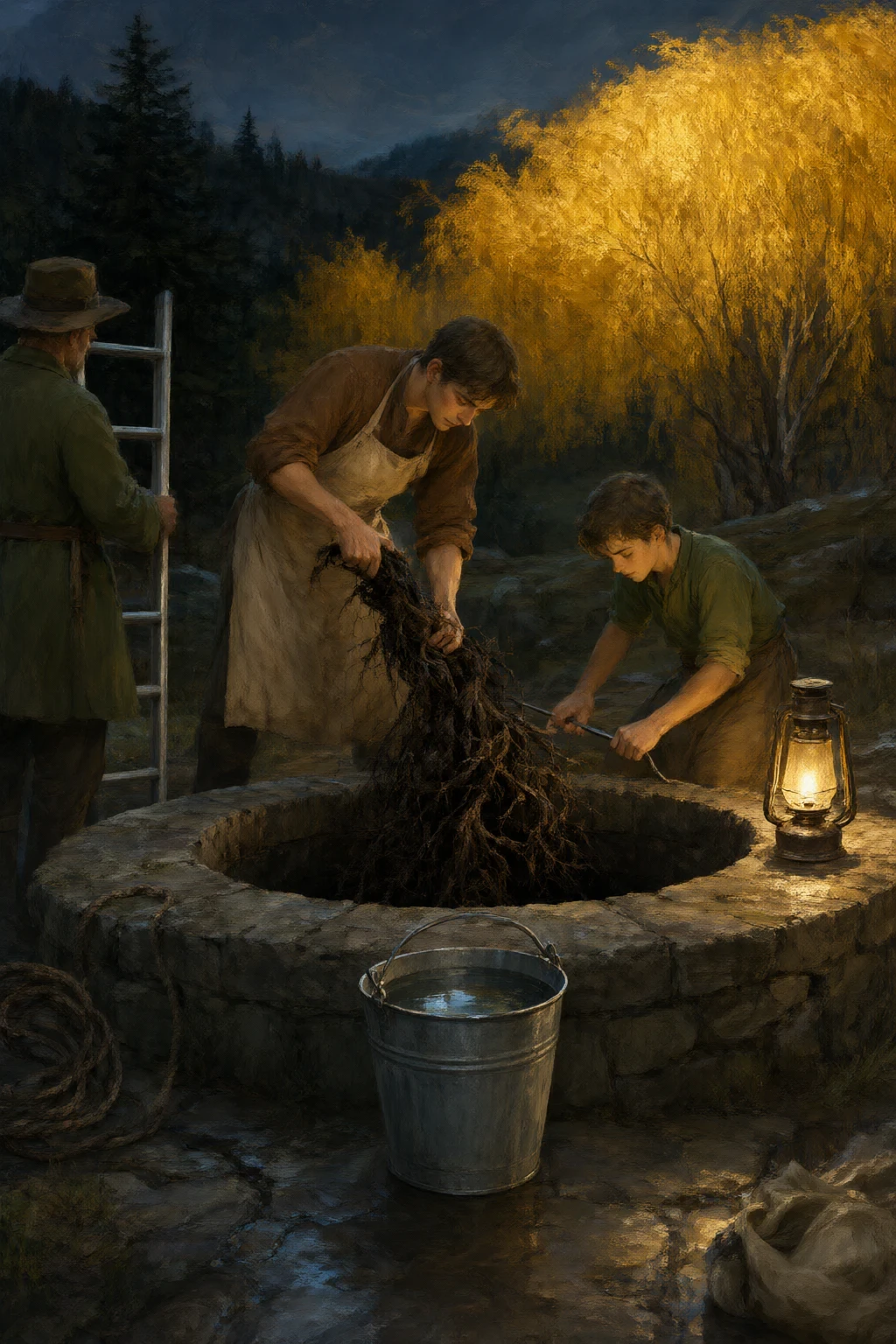
The brothers Halm were well-diggers, which meant that in a bad year they were the two most popular men in the valley and in a good year they were the two most idle, and the year this story begins was neither. Their names were Anselm and Jost, and their father had held the contract for the water of the Goldwasser for as long as anybody could remember, and had died in the winter of the flood, and had left them a house, a derrick, eleven hundred feet of copper chain, and one well at the top of the village street that had been sweet since before the church had a roof.
The Goldwasser comes out of the mountain a mile up and comes down through eleven villages, and in the last week of October the willows along it turn the colour of a coin. The valley people had a name for the week. They called it the gold week, and they did nothing about it except look at it, the way you look at a thing that happens to you rather than a thing you do. The brothers dug wells, and they were good at it, and their van had a little wheel on the derrick that their father had made out of a cartwheel and a cracked bearing, and the wheel squeaked, and the valley called the squeak the Halm brothers' announcement.
In the third week of June the water in the well at the top of the street went down four feet in one night, and did not come back. The valley had had a dry spring. Every well in the upper valley was down. The fields were being irrigated in strips, hour by hour, by agreement, and the agreements were being kept, mostly, out of embarrassment. The mill at Triesen, which was the largest building in the valley and the only one with iron in it, sent a man up to the village on the second of July with a leather case and a very good coat.
This was the water-warden. His name was Kilian Roß and the valley had known him for twenty years as the King, because in the year the Duke's water-court was set up he had been given a chain of office in gold, and there is nothing a valley does faster than give a man a name. "Your brother has the water," said the King. "I have the paper. It is the same water. I would like you to understand that before anybody says anything to you, and to understand it from me, because I am the only person in this valley who is paid to tell you the truth and I am not paid enough to tell it a second time." He set the leather case on the table and opened it and did not take anything out of it.
"The Duke's water-court has assigned the Goldwasser above the millrace to this mill for the term of nine years," he said. "Your father's contract is a contract for the same water. It is either one water or two. If it is one, your brother has been watering his field with a mill's water for thirty years and owes the mill, and the mill has known it, and the mill has not once said so, because your father was an old man and the mill has a policy." "And if it is two?"
"If it is two, then the mill is underpaid and your brother is overpaid, and somebody in Linz has made an error with a nib." The King shut the case. "I have written to Linz. I will write again in the spring. Until Linz answers, I would like everybody in this valley to carry on as they are, and I would like nobody to say the word sour to me until there is a reason on paper." The brothers carried on as they were for a month.
On the ninth of August a girl came to the well at dusk with a pail. She was eight. Her name was Berta, and her mother had been in bed since the spring, and Berta carried the water down the street every evening and had done since she was six, and the whole valley knew about it and nobody had ever said anything about it, which is the ordinary way a valley knows about a thing. She stood at the well and looked at the winch and then up at the two of them. "I have not got a farthing," she said. "You have not got a farthing," said Jost. "Then can I have the well?"
"You can have the well. Your mother is not to be carrying it up the street, either. That is the arrangement, and it is not a gift, and I am not to be thanked for it, and you are to bring the pail down yourself and not send your brother, because your brother is nine and cannot lift a full pail and will fall in." That was the whole conversation. Anselm Halm was forty feet down the shaft at the time, at the bottom, feeding in a joint of pipe, and he did not hear any of it.
What happened in the valley was this. On the Tuesday, the washerwoman, Gretel Reimann, told the baker that the Halm brothers had put a bar on the well and turned away a child. On the Thursday the baker told the priest, and the priest did not repeat it, and the priest's wife repeated it. On the Friday there were four women on the church step who had not been on the church step in the same four for a year. By the second week of September the valley believed that Anselm Halm had stood over a dying woman's child and said no. He had, in fact, been in the bottom of a well in Hungary for six weeks that summer and had come home once, in July, and gone straight to bed.
The first bucket of the sour water came up on the eighteenth of September, and Jost tasted it, and made a face, and put it down. Anselm tasted it too. It was bitter and it was cold and there was a smell of rotten eggs off it that filled the shaft and would not go out for two days.
"I will say it now," said Anselm. "Since we are alone. What has happened to this water is a judgement. It is not an accident and it is not a dry summer. That stream has run sweet since your great-grandfather was a boy, and it does not turn on a well, and it does not turn on a boy, and it does not turn on a girl at a winch. It turns on being refused. That is what water does. My grandmother said it and I thought she was an old woman with a lot of time on her hands, and now I have put a bucket beside my mother's pot and I have watched the pot go bad, and I would be a fool to stand in a dry field and tell you it is the summer."
Jost was fifteen and had been digging since he could hold a barrow. "You should write to the King," he said. "I have written to the King." "You wrote to the King about the contract. You have not written to him about this." "That is because he would write back," said Anselm, "and there would be two dates on a piece of paper, and then there would be a story, and a story is worse than a date."
Here is what the two of them did, in the order they did it, and it is worth setting down because neither of them ever called it a decision. First: they stopped clearing the spring head. Their father had cleared it every third year, and it had not been cleared in four, and the alders had got into the channel above the intake and the moss had got into the intake, and the intake was half the size it had been when their father dug it. Anselm said the water was low and the clearing could wait until the snow.
Second: in the last week of October they built a weir across the upper pool, to hold enough water back to fill the mill leat. The mill was short that month and the miller's man came up and said so. Anselm built the weir in a day and a half. He built it out of boulders and green alder, and the green alder is a bad thing to build a weir out of, but it holds for one season, which is all anyone expected. Third: they put a bar on the well.
Not a lock. A bar. A length of iron across the lid of the well, with a hasp, and the key on Jost's belt, because the well was the property of a man who had a contract with the Duke's court, and the water in it was being taken by nine families an hour, hour by hour, in a dry year, and Anselm said that if they were going to be the ones holding this water for the Duke, then they would hold it properly, and that the arrangement of the key would be written down. He wrote it down. It was a good piece of work. It took him two evenings.
The Goldwasser came in sour that October, and the sourness spread up the valley, and the well at the top of the street went from bitter to undrinkable in three weeks, and the doctor from the next valley came and took a flask away and said nothing to them, which was worse than anything he could have said. On the twenty-second of October the wind came. It came down the valley from the south-west, warm and hard, and it did not stop for two days, and everybody in the valley was pleased about it, because the Föhn means wetter weather, and because it is the wind that puts the gold on the willows.
The willows along the Goldwasser went from green to gold in one night and stood there on the second morning like a line of beaten metal, and half the valley came out to look at it, including the two brothers, including nine children, including a woman standing at the head of the village street with her arms folded that had come out on the same errand as everybody else. Jost stood in the road and looked at the willows and then looked at the well behind him with the bar on it. "We are being told something," he said.
The old forester was called Vogt and he had been in the valley sixty years and nobody under forty had ever spoken to him for longer than it took to buy mushrooms. He was on the road that morning, up a ladder, taking the last of the year's mushrooms off a fallen beech. Jost asked him why the willows went gold, and Vogt said because the Föhn strips them and the gold is underneath, and that a willow will do it every year and that the only people who ever notice are the people who stand in the road. Then Vogt came down the ladder, looked at Jost for a while, and said: "You are one of the Halms." "I am the younger."
"Yes," said Vogt. "That is the one who is kind. Your brother's sister would be a different matter." He put the basket down. "You have a weir in at the upper pool." "We have a weir in at the upper pool." "Then you have made a slow place, and the slow place is under the alders, and the alders put a taste into slow water that a fast river washes out in an hour. That is the whole of your sour water. It is not a judgement. It is an alder." He picked the basket up again.
"And you have cleared nothing out of the intake for four years, so the water that comes to you is the water that has been standing in a small hole in the ground since spring, going sour in its own bed, and the well is thirty years deep, and everything in the first four feet of that well is black marl, and black marl will turn any water in it bitter, and you dug past the marl yourself, in the year of the flood, because your father was ill and you wanted the contract, and you dug past it because you did not ask anybody."
They went down to the well together that evening with a lamp. The marl was in the first four feet, exactly as Vogt had said, a black clay with a smell like a struck match, and the water stood in it, and it had stood in it for three summers. Jost put his hand in the bucket and brought it up and it was clear, and cold, and it tasted of nothing at all. Then they went up to the spring head and pulled alder for two nights, and then they went down to the millrace with a bar and a lantern and broke a hole in the weir at one in the morning, and the water went down the mountain again at the speed it had gone at before their father was born.
They did the intake on the third night, on their knees, in the dark, with hooks, because a man cannot see into a pipe and cannot stand in one. The water came back sweet in nine hours, which is not a miracle and which they wrote down in a book with a date in it, because Jost was fifteen and had learned that a thing you do not write down is a thing that will be argued about.
On the first of May the King came up the valley with the leather case and the very good coat, and the answer from Linz, which was that it was one water and not two, and that the mill had a term, and that the term stood, and that the King was sorry. Anselm Halm took the case and the coat's compliment and said the thing he had come down to the road to say. "The mill has eleven hands on it," he said. "We were wrong about the mill. It was never the mill. It was the mill and what we told each other on the day we tasted the bucket."
The King looked at him for a moment longer than was necessary, and then he said, "I know. I have had the word sour in my ear since September, and I would have written to you about it, and I did not, because I am not paid to notice a well. I noticed a contract. That is my whole job, and I have never in twenty years pretended to be anything else." He got into the carriage. Then he put his head back out.
"The mayor wants to know whether the weir stays or goes. I told him I would ask the person who built it, and he said that was you, and I said no, it is not you, it is the valley, and he did not know what I meant, and I did not explain, because it is a long explanation and I am a factor of the water-court and not a philosopher." The weir came out on the fourth of May, in daylight, in front of the whole village, with Anselm Halm and Jost Halm and nine men with bars, and it took half a day, and a hundred people came and watched, and somebody brought a fiddle.
On the third Friday of the month the girl Berta came down the street to the well with her pail, and the bar was off it, and had been off since the night of the clearing. She filled it herself, and the wind, which had come down warm and hard all afternoon, took the surface of the water and made it move, and in the pail it looked like something in a bowl in a kitchen. She carried it up the street and put it by the bed, and it was cold, and it tasted of nothing at all, and her mother drank it and said, "There. That is the well."