Ivet woke at the third hour of the morning with the certainty that she was late. She was in a narrow bed under a slope of ceiling, in a room she had not seen in ninety-eight years, and the bed was exactly as short as it had been, which was the first thing she understood about the size of the world she had come back into: somebody had kept the furniture. The comb on the sill, the boot-scraper by the door, the little brass wheel from the broken toy she had lost at seven. Everything where it had been. The dust on the sill was new and very fine and lay in a single smooth layer, and she lay still and let it settle, because she was twelve years old and forty-one minutes late and had a court to appear before, and there had always been a court to appear before. The door was ajar. Down the corridor, at the far end, somebody had left a lamp burning on a bracket, which was the old custom of the castle and which she had forgotten and which therefore, presumably, they had not.
Beske Olavard was waiting in the small hall with two other men and a woman, and he had been waiting long enough to have got through a good deal of the night's correspondence. "Princess," he said. "Beske." He was Keeper of the Standing Orders, and had been Keeper for sixty-one of the hundred years, and was eighty-eight, and wore the grey of his office, and on his hands the two black rings that the office wears, one for the standing orders and one for the interval. He came forward and then stopped, about a foot short of her, and understood what was happening to him a half second later and put his head down instead of taking her hand. "Was the term correct?" he said. "Say it as you found it. It matters what form of words you use and I would rather you were tired than elegant." "Which term?"
"The hundred years." He said it without emphasis. "The instrument is in the second press, red board, third shelf, and the term is expressed in hours and it is two hundred and forty-two thousand six hundred and forty-one, and it expired some minutes before dawn, and you are therefore welcome to the castle in the name of the council, and if you will sit down I will read you the delivery." "I've read the instrument." "I am glad." He did not sound glad. "Then you will know what word it uses." "Entire."
"Yes. It is not a word we chose. It was in the form and the form is old." He sat and she sat too, and he put a sheet on the table between them and did not turn it round. "The castle in the name of the council, entire and in good order. Walls, halls, works, gate, the undercroft, the machines, the water, the arms. Those are the castle, and they are in good order, and I will not bore you: the roof of the north barn was replaced in the sixty-first year, the great chain is new from the fifty-ninth, and that part of the delivery is sound. I can hand it to you this morning with a paper signed by six of us." "And the rest of it."
"The rest of it is not the castle." Beske turned the sheet round at last. It was a schedule, four columns, nine pages. "This is the government. It has been administered for a hundred years by five officers, rotating, who hold no office except the interval and who meet on the day after the new one, in this room, and minute it, and publish the minutes. It is, as you will see, in good order. The courts are in order; four hundred and eleven causes have been heard since you went to sleep and four hundred and eleven have been decided. There is a war with Vask that has lasted nineteen years and is being conducted over a river at no particular expense to either side. Everything is in order." "Then the castle was delivered entire." "Madam — " He stopped, and started again, with the air of a man resolving not to do the interesting thing. "Yes."
Ivet read the schedule for two hours and did not ask a question, because she could see that he was waiting for her to ask one. The terms of the setting-aside were these. Dame Marthe, Dowager of Emmeret, being regent, had held that the Princess was inconvenient; and that the succession could not be extinguished, since a Princess once declared is a Princess until a lawful instrument says otherwise; and that a person could be put aside by the rite of setting aside, which was not a curse and never had been, and which consisted of a spindle, a witness, a term, and a holder. A holding is not a punishment; it is a custody with a term, and it is the ordinaryest thing in the world.
The Princess had been twelve. She had been found, at eleven, standing in the second press of the archive with her father's old water accounts open in front of her, and the accounts showed what they showed; and at twelve she had begun, in the backs of ledgers, a schedule of dismissions. She had got as far as nine names. It was found by Dame Marthe, who was frightened and entirely correct, and the two women had had the conversation that the histories do not record, and the Princess had assented. That was the part Beske had wanted her to know before she sat down, and he had the grace not to put it in writing. "You understood the term," said Ivet. "A hundred years is a long time at twelve."
"It is a very short time," said Beske. "I was twenty-seven when you were set aside. It was the shortest term I ever saw and I have signed four since, and every one was longer, and two were void for excess and had to be re-drawn shorter, which is a mortifying business and takes a year." He folded his hands. "And the reason it was a hundred years, madam, is that your aunt did not want you back. She could not prevent your being Princess. So she made you a Princess on loan, at interest, with a term, and she put the interest into the instrument so that returning you would be a breach of somebody's duty rather than a favour."
They brought her the accounts at noon, as they would to any sovereign returning from anywhere, and she read them in the west study for nine days, and what she found was not a conspiracy. It was a hundred years of good work. The kingdom had not merely survived; by any measure a clerk would accept, it had improved. The ley had been cut in the thirty-first year and had paid for itself in forty. Three bad harvests had come and gone without a famine, because her father's Standing Orders contained a granary clause drafted by a man named Ostrow who had thought about grain in the abstract, and the Interval had simply obeyed it, and it had worked. The undercroft machines are maintained on a schedule that four successive Keepers improved and that the master engineer considers the best in the kingdom.
And all of it was lawful. That was the part Ivet found again and again. There was no usurpation anywhere in a hundred years of minutes. It had, clause by clause, done exactly what the Standing Orders said, and where the Standing Orders were silent it had legislated in its own name under a general power granted in the eleventh year and never revoked, and there was nothing irregular in any of it. "You could have been warned," Ivet said, on the fourth evening. "That this was the shape of it." "You could have been woken at any time." Beske said it without unkindness. "It was in the instrument. The holder may release a holding on the holder's own motion, without breach, and the custom of this council is to consider that question once in each generation. We have considered it four times. Each time the vote went against it, and each time the vote was close, and I have the tally." "Who voted for it?"
"Me, three times." He was quiet. "In the fourth year the water came up to the second gate and one clause of the Standing Orders requires a sovereign to be provided for in a great emergency, and there was no sovereign, and we made one. I was twenty-eight. I have thought about that winter every year since, and I would do it again, and I would rather you knew."
She took up the government on the eleventh day, and it went, at first, perfectly. The system was good. She understood it in an afternoon, and the system did what it was built to do with whatever sovereign it was given: it received orders and made them true. She gave an order about the Vask war, and the war went on. She gave an order about the ley, and the ley was not yet payable and the ley was not yet payable. She gave an order about the courts, and the courts were in order. Twice she gave an order that was not in the Standing Orders, and it was obeyed within the week, and she was pleased with herself for a fortnight. Then she gave one that was in the Standing Orders, and nothing happened, and it took her until the sixth of Marrowfall to understand why.
There were seven thousand leaves in the Standing Orders, and in the year of the writing her father had ruled the first page himself: the body of this instrument is the law; no addition, exception or construction has force unless it appears here in the hand of the sovereign. And in the body, in eleven places, in a small careful upright hand that was not her father's, there were notes. They were marginal. They sat in the outer margin, six inches from the line, in the same ink, written in the same week as the body, and they read like this: Clause 41. The west bell is a liar and rings at the wrong hour. Let it ring when the gate is shut. Clause 66. If the frost comes in March, cut the west orchard, and do not wait for the man from Vask to tell you. Clause 112. Nobody is to be told about the second cistern. Clause 8. The stew should be thinner on Fridays.
"Princess," said Beske, when she brought him the first of them, "those are the sovereign's notes. They are the sovereign's notes in the sovereign's hand, and they are part of the instrument, and the Interval has observed them for a hundred years." "There are eleven." "There are eleven legible ones. There are four hundred and six marks in the margins. Some are ticks. Some are drawings of a bird." He did not look embarrassed; he looked like a man who had had a hundred years to make peace with a thing. "Clause 41 is the west bell. It rings when the gate is shut, madam, by day and by night, in wind, in siege, in flood, and it has rung four hundred and eleven thousand times since the term began. There are men in this castle — my second in command has one — who have never heard it and think the castle is haunted by a bell that will not stop, and there are men in Vask who have written letters about it." "Change it."
"With what?" Beske spread his hands. "Change it how? To repeal a note you must write a note. A note is a note. There is no instrument I can bring you that separates your notes from hers — there is no instrument, madam, because she was you." He looked up. "I am aware of that. I have had a hundred years to be aware of it."
Ivet read the four hundred and six marks again in January, and the person that came out of them was not a tyrant or a madwoman, and this was the difficulty. Two of the notes were brilliant. The frost note, clause 66, had been the reason the kingdom ate through two of the three bad harvests; the Interval had followed it exactly, in the sixty-first year and the seventy-eighth, and Ostrow the younger — grandson, the same name, the same temperament — had told her that the family had never found out where it came from and had stopped asking. The cistern note, clause 112, was the reason there was water in the lower court. Nine of the eleven were administrative genius, and the men who acted on them had no idea they were obeying a twelve-year-old's private memorandum to herself, because a sovereign's notes are not explained to the Interval; they are obeyed. And two of the eleven were the bells and the stew.
"Ivet," said Beske, on the evening of the eleventh of Frostmonth, when she had been at it for a year and had begun to talk to him as she had at twelve, which he permitted and did not correct, "I will tell you the whole of it, since you have not asked. The Interval holds the government. The Interval has held it well. The Interval's authority is the general power of the eleventh year, which is a power to govern in the interval, and it does not expire, and it is not now the holder's to give away. It is the council's." "I am the sovereign."
"You are, and God save you, and there is your difficulty." Beske took off the black ring that stood for the interval, turned it on the table, and looked at it. "We have served you a hundred years without a sovereign on a general power granted in a crisis, and such a power is good enough to govern with and not good enough to hand over with. If we resign it to you, madam, the castle has no government. If you take it from us, the castle has no government, and the four hundred and eleven causes and the cistern will be in the hands of a woman who has been awake fourteen months, and I say that without any disrespect whatever, and the harvest is in the ninth month." "So the castle is mine and the country is yours."
"The castle is yours, madam. The castle has been yours for a hundred years; the delivery was perfect, and I put my name to it this morning, and the term is discharged." He put the ring back on. "The country is not yours, and it is not mine, and that is the arrangement that has worked. It is a bad arrangement. It has worked for a hundred years, which is longer than anything in the history of this house, including the house."
Pell was eleven, and was the Interval's clerk, and her mother was the fourth of the five and had brought her into the archives at six to copy the granary rolls, because there was nobody else in the house who could read the twelfth-century hand. She came into the west study without knocking, on the fourth of Greenmonth, with a ledger under her arm, and said, "There is no entry for the west bell." "There is never an entry for the west bell." "I know there is never an entry for the west bell. That is not why I am here." She put the ledger down and opened it and turned it round, and Ivet looked at it, and the page was the minute of the previous Thursday, and in the outer margin, six inches from the line, in a small careful upright hand, somebody had written: The Interval cannot hear the Vask business because it is on page nine. Put it on page one. — P. And below it, smaller:
Also the west bell is nonsense and I do not think a bell should be a clause. But I looked and you are not supposed to look. "Beske," said Ivet. "Is this binding?" Beske read the page. He read it twice, which he had not done for anything in six years. "Yes," he said. "The child is eleven." "Yes." "Nobody has told her."
"Nobody has told her anything, madam. She is a clerk of the fourth office. She has the run of the archives and the discretion of a chair. If I may say so, she has been reading the Standing Orders since she was seven, and there is no law against it, and I have never once thought to look at the margin of a working minute, because in a hundred years no sovereign has written in one." He set the page down. "That page will be obeyed at the next sitting. It is the sovereign's hand. The Vask business goes to page one on Thursday, and the standing order of the day will carry it, and I shall have to carry it, because it is not my hand and not my note and there is nothing in this castle that is higher than that page."
Ivet did nothing for a long time, and Pell stood there and did not sit down, and at last the girl said, "Are you angry?" "No," said Ivet. "I want you to understand that I have spent a year trying to find a way to stop this, and you have found one in a fortnight, by doing it." She turned the page round so that it faced her again. "I could have written a note too. I have thought about it every week. But any note I wrote would have been a note, and I had no way of standing outside the margins. Neither have you. That is the whole difficulty and it is not about age." Pell considered this with the flat attention of a child who is being reasonable. "Then how is it done wrong?" she said. "Then it can't be done right. Is there a way to do it so the note is not a note?" "Yes," said Ivet. "There is. It is much slower and it will be much worse and I am going to do it anyway."
She took eighteen months, and she did it in the only way available, which was to stop being twelve and to be a sovereign in front of a room. The last of the Standing Orders, clause 214, was executed in the ninth month of the year after her hundred and first. The Interval had drafted it; she had read it; the five had voted and it had passed four to one, and Beske voted against it, and told her so before the vote, at length, for forty minutes, and at the end of it said, "I have been wrong for a hundred years, madam, and I should like it minuted that I said so first."
The instrument is short. It is four sentences. It provides that no writing in the margin of any Standing Order, minute or roll, whether or not in a hand resembling that of a sovereign, has force, and never had; that all changes are to be made as an order of the crown, entered in the register, published in the ordinary way, and reversible only by the next sovereign; and that the order takes effect at the next sitting of the Interval and not before. The effect of it was immediate, total, and reported in the castle's own phrase as relief.
The four hundred and six marks in the margins went, in a single afternoon, into the fire in the second chamber, and with them went the frost note, which was eleven days from being needed, and the cistern note, which was in the fourth press on page one and a half and would be in the ninth month. It took a mason four days to clear the cistern, and the master engineer's book has a line for the ninth month that reads, in a flat hand, cistern, second chamber, low, thw. 44. The stew has been thicker on Fridays for a hundred years and will be thicker on Fridays for ever, and nobody in Emmeret knows why, and the kitchen-maid who has charge of it has a great-uncle's granddaughter who will be told the reason when she is old enough to be asked, which has not happened yet. And the west bell stopped.
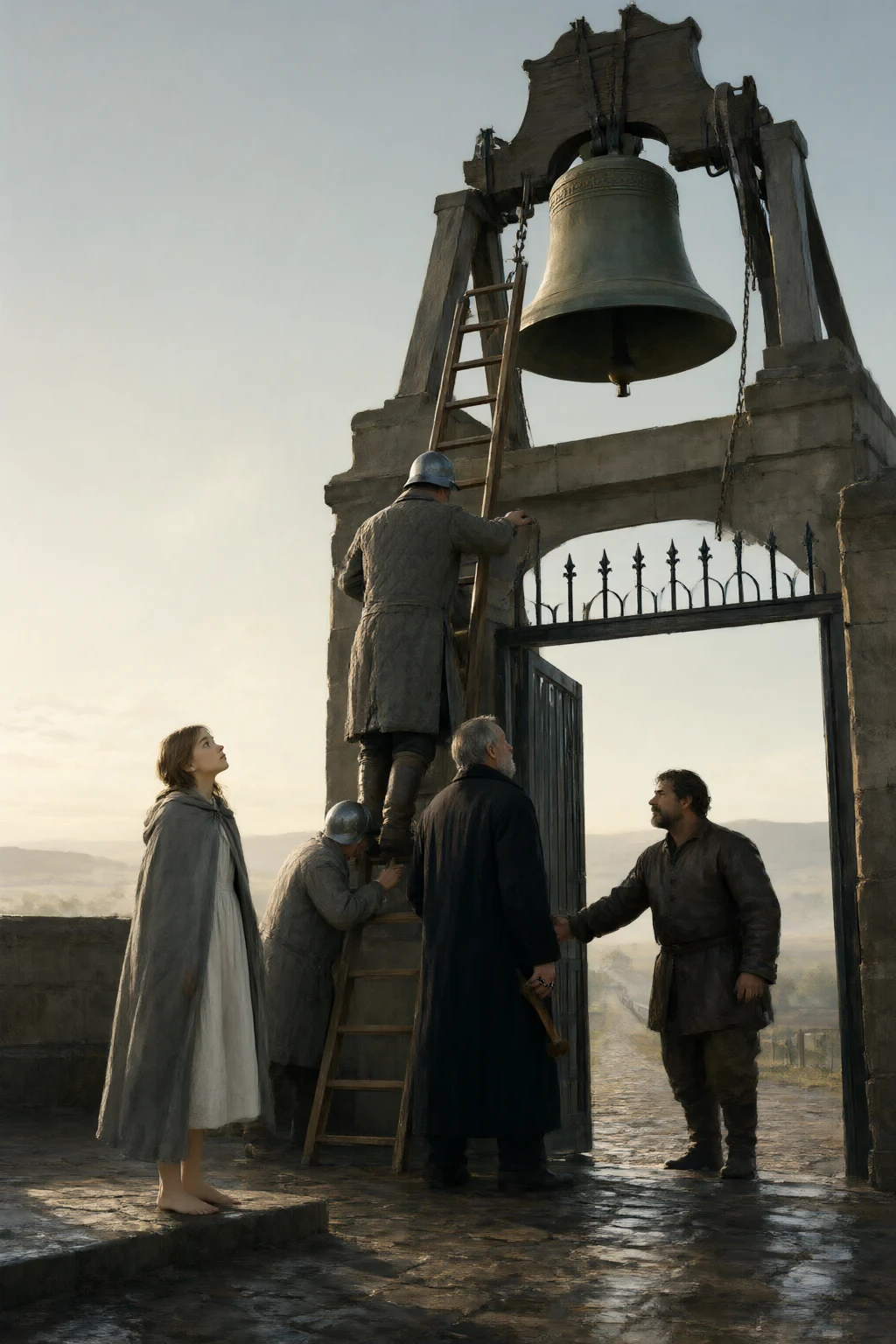
There is no instrument that stops a bell that is obeying a repealed note. The Interval did that on the ninth day, on Beske's motion, at the third hour of the morning, with a ladder and a mallet and Ivet standing in the yard below in a cloak, watching, because she had asked to be present and nobody had thought to stop her. The note that had held the west bell for a hundred years was four words long and had been written by a girl of twelve who could not stand the noise. The thing that stopped it was a repeal of four sentences, and it took a hundred and one years, six months and eleven days, and it was carried by an Interval that did not believe in it, minuted by a clerk of eleven who was not supposed to have opinions, and signed by a woman who woke up late.
After the repeal, and after the mallet, the Interval sat in the small hall and did the business of the day, which included the west bell, listed in the schedule of works as an item of maintenance at a hundred years old, to be sounded daily at the hour named, and Beske read the schedule and stopped. "Not this morning," he said. The others looked at him. He was eighty-nine.
"The gate is shut," he said. "It has been shut for a hundred and one years, the bell has obeyed the note, the note is dead, and there is nothing left in this castle that ties the bell to the gate. I am not going to ring it with the gate shut. I have never once been able to do that and I have thought about it every week since I was twenty-eight. Ring it when the gate is open. It says when the gate is shut and the gate is the only part of that sentence that still has force, and I will not have a dead clause kept alive by a habit."
So the west bell of Emmeret was sounded for the first time in a hundred and one years, at the ninth hour of a bright morning in the ninth month, with the gate standing open and the road to Vask visible for the whole length of the causeway, and it rang over the water-meadow and the ley and the new barn, and it was heard in Vask, where it was written down. The gate-keeper, a man of fifty-odd called Aro, stood in the open gateway with his hand on the bar out of an old habit he had never thought about, and listened to the whole of it, and then took his hand off the bar and stood aside and let the carts through, and did not go and shut the gate, though it was still half past nine and the weather was fine.