The house of Vantry stands a half mile up the north side above the works, and there is a figure written in pencil on the inside of the front door frame at a height of three feet nine inches, and there is another on the third tread, and another on the fourth, and there are four on the floors of the hall, and every one of them was written in a testing hand in 1974 or 1981, and not one of them has been crossed out, and all of them are legible to whoever reads them next. Cobb Tarn and Aldis Prome went up on the Tuesday morning of the twenty-second of October 1990 with a sheet of Bureau paper in a leather case and a hand bell they did not ring, because the hand bell is for the test floor and the test floor is a floor. They had come about the baby.
A great house is a set of measurements. When a child is born into one, the household is re-certified: every bed, every door, every stair and every floor, tested against the family’s declared sensitivity, and one child is designated the Sharp One, who is the house’s instrument. The Vantry household was certified in 1974 at a declared sensitivity of four tenths of an ounce, which is a great house figure, a promise about how wrong a thing in that house is allowed to be, and every bed sold to that house between 1974 and 1981 carries four tenths in pencil on the foot in a testing hand, and there are sixty-one of them in the house and in the box room at the top of the stair.
The instrument designated in 1974 was Lady Hesp Vantry, then twenty-five years old, and there is a minute of the standing committee of the fourteenth of June 1974 which records that she was certified on her own application and at her own cost, and that the committee noted it. The instrument designated in 1981 was her eldest daughter, then fifteen. The instrument designated in 1989 was her second daughter, then eighteen. The household has been blunt since 1989, which is a real and permanent loss and is the reason nobody in Featherstone will say the word tender in a shop, and which means, in the plain words the Bureau uses, that there is nobody in that house now who can feel the reference pea.
Lady Hesp Vantry wrote to the Bureau on the ninth of July. The letter is four paragraphs and it is in the finding office with the July correspondence, and Cobb Tarn read it twice in October, and the second paragraph is the one that took him two months to find a way to write down. It said that she had been certified in 1974 and had designated two of her own daughters in 1981 and 1989, and that the second daughter was married in the spring of 1990 and lived in Warminster, and that a son had been born on the eleventh of October, and that the house was therefore to be re-certified, and that she was not able to comply, and that she did not wish to be re-certified, and that she asked the Bureau to find some means by which the household might be certified ordinary.
There is no such thing as certified ordinary. There are four columns in the finding book: the date, the household, the declared sensitivity, and the instrument. Cobb Tarn read the letter in July and went to the wall and looked at four columns and came back to his desk. He had never in eleven years seen the third column empty, and he had never in eleven years seen the fourth column empty, and both of them had been written in a hand on every card in the wall since 1881, and the fourth column had been written on four hundred and six cards by four different people whose names are cut in stone and whose reasons are in the minute books and who are all, without exception, dead.
“Madam,” said Cobb Tarn, in the hall, at half past ten in the morning, “I am going to say the whole of it and then I am going to ask you one question, and the question is the only part of it that matters.” Lady Hesp Vantry turned her hand over when she introduced him to her husband, which is a thing she does, palm down, the way a person turns a hand down over a flame. She said, “This is Mr Vantry. He will tell you that I am unwell. He has been telling visitors that since 1989 and he is not entirely wrong and not entirely right, and I would rather you had it from me than from him.” “He is not wrong,” said Cobb Tarn. “I will not put that in the minute. What I have to say is this. Your daughter was born on the eleventh. The household is to be re-certified. To re-certify a household you test every bed, every door, every stair and every floor against the declared sensitivity, and you must have an instrument to do it, and your household has no instrument, and there is no instrument in this house that has not already been used up by the act of being designated.” “There are two girls in this house,” said Lady Hesp Vantry. “There are,” said Cobb Tarn. “And I am going to come to them.”
He was shown the bedrooms first, because that is the order, and because it is the order he has used for nine hundred and two cards. The house has five bedrooms on the first floor and two on the second. There is a bed in each of them with a figure on the foot, and the figures are in pencil and the figures have not been crossed out. The two front rooms are the rooms the girls had. The smallest of them, on the north side, is the second daughter’s, and it has been kept as it was, and the figure on the foot of that bed is four tenths of an ounce in a hand that Cobb Tarn recognised, because he is a registrar and he has read nine hundred and two cards and he knows the hands.
That hand was Aldis Prome’s. Aldis Prome had tested the Vantry beds in 1981 at the age of thirty-eight and had written the figures himself, on the foot of each of them, in pencil, in a testing hand, and had not crossed any of them out, and did not remember writing them, and said so. “If I wrote it,” he said, “then it is right. I do not discuss a bed I have not personally slept in and I slept in all five. I do not remember a bed I slept in. That is not a failing. That is the trade.” Cobb Tarn wrote down nothing, because there was nothing to write down, and the not writing was the first of the three times in a morning that he did not write something.
The cot was upstairs in the night room, and the cot was the reason for the whole day. It is a small iron bed with a rail on three sides and it was in the house in 1974, and it was put aside in 1981 and kept, and the figure on the foot of it is four tenths of an ounce, in pencil, in a testing hand, in 1974. Under the rules, it is a bed. It carries a figure, and a figure is a promise, and the promise is the thing that was sold, and it binds at the declared figure and not at the true one, and the true figure is the figure as it is, and the true figure is known by bringing the bed to the reference pea and comparing, and comparing requires somebody who can feel the pea, and there is nobody in the house.
So the cot is a bed with a promise on it that nobody in the house is able to keep or to check or to break, and the promise was made to the household by a shop on the towpath in 1974, and the shop cannot be asked either, because a shop has no instrument either, and has never had one, and a tolerance is a promise about how wrong a thing may be and the only way of ever finding out how wrong a thing is, in Featherstone, in two hundred years, is a person who feels it. Aldis Prome put his hand on the rail of the cot and looked at it for a while and said nothing, which for Aldis Prome is the loudest available act, and then he came down the stairs and told Cobb Tarn in the corridor that the cot would have to be entered, and Cobb Tarn said it would have to be entered out or in, and Aldis Prome said that a bed is declared in or out and there is no third thing and there has never been a third thing since 1690. Then Cobb Tarn asked him, in the ordinary way, what he was going to declare, and Aldis Prome said, “Four tenths,” and stopped.
They went down to the kitchen at eleven because the great house kitchen is the one place in a great house where nobody lies down. There is copper along one wall and steam under the range and a long table with the stamping on it, and there were four people in the room and one of them was not in the room at all and was upstairs asleep in the cot. Mr Vantry was fifty-one and had a comfortable way of standing with his hands in his pockets. He had been married twenty-six years and had lived in the house for all of them and had never been tested by anybody, which is not an oversight. The rule is that an instrument is designated from the household, and the instrument is a child of the household, and no man of the household is ever certified, and so there is no figure anywhere in Featherstone that describes Mr Vantry and there never has been.
That had not mattered until the eleventh of October, and he found out about it from a registrar, standing up, in a kitchen, at eleven o’clock in the morning. Lady Hesp Vantry sat with her hands on the table, palm down, and her face was cold, and the hand was warm, and she said, when Cobb Tarn had finished, “We are not a delicate house.” She said it in the past tense, and she did not appear to notice, and Cobb Tarn, who enters everything, wrote it down exactly.
The eldest daughter was twenty-four. She was the one designated in 1981 and she had been blunt since 1981 in the way that an instrument is blunt once the certification is done, and she had a job at the county office in the town and came home on Fridays. She had not spoken to her mother since the spring of 1989, and the reason was in the finding book in drawer order and on a card in Cobb Tarn’s hand, and the reason was that her mother had put her name there. The second daughter was nineteen. She had been designated in 1989 at eighteen and had gone blunt in the same way in the same month, and she had been married in April and had come up from Warminster that morning with a hatbox and had put it down in the hall and had not picked it up again. Four people in a kitchen with a figure on every bed in the house and no figure anywhere in the room.
“What I have to put to you,” said Cobb Tarn, “is that the instrument is not retested.” He said it to Lady Hesp Vantry, because she had asked him to come and she was sitting down. “A designation is the certification. That is the wording and it has not been altered since 1881 and it cannot be altered by the committee or by the town or by anybody at all, including the two of you together. When a child is designated, the child is the house’s instrument, and the certification is the use, and the use is the whole of it. The instrument may be used once. It is not worn out by the designation. It is finished by it.” “I was designated in 1974,” she said, “and I have not slept in a bed without a figure on it since.” “I know,” said Cobb Tarn. “That is not a fault. I am telling you what the rule is and not what you are.”
The second daughter asked the question, from the end of the table, in a voice that had not been used in that house for eighteen months. “Can anybody tell whether I still feel it?” “No,” said Cobb Tarn. “Because if nobody can tell, then I am.” “No,” said Cobb Tarn, again, and it was the plainest and the cruellest sentence of the morning, and he did not soften it, and he did not apologise for it afterwards, and it is in the minute exactly as it was said because Cobb Tarn does not improve on people. A finding is a thing found under a mattress, and a thing found under a mattress never goes back under a mattress, and the only way of finding out whether a person feels the reference pea is to put them on a mattress over the reference pea, and the pea is a standard and a standard is never used, and a person who is put under it is not being tested. There is no test. There is only the use, and the use is permanent, and a household that has lost its instrument is a household that has gone blunt, and bluntness is not a disease that a person has got better of by wanting to. That is what the title of this is, and the title is the charter, and the charter has been the charter since 1881.
They brought the boy up at half past one. He came with the schoolmistress from the terrace because there was a Bureau car in the lane and the schoolmistress thought she ought to bring anything that was available. He was nine. He was found at a school inspection in March to have a sensitivity that nobody had looked for, and the finding is in the wall, and the finding is in Cobb Tarn’s hand, and it is one of the four hundred and six in the fourth column, and against it, in the same hand, is the word SENSITIVENULL, which is a thing Cobb Tarn has written four times and which is the only word in the fourth column that is not a woman’s name. He stood with his back to the door of the hall, which is what he does, and which he does everywhere, and which nobody in the Bureau has ever thought to ask him about.
Lady Hesp Vantry had asked in her letter whether the boy at number fourteen on the terrace could be lent. She had written the word lent, and Cobb Tarn had read it in July and had gone to the wall about it, and the wall had nothing to say. “Madam,” he said, “there is no provision. There is no provision and I have looked. An instrument is not a thing that can be lent, because a lent instrument is a second designation, and a second designation of the same child is a retest, and the instrument is not retested. He is nine. He was designated in March. He has been used.” “Used,” said Mr Vantry. “Used,” said Cobb Tarn. “The word is in the charter. It is not a cruel word. It is a word chosen in 1881 by nine men who were careful about the only thing they were careful about.”
Lady Hesp Vantry turned her hand over on the table, palm up, and looked at it, and put it back. “He would have had a bed in here,” she said. “He would have had a bed with a figure on the foot of it, and there would have been a name in your book, and the name would have been Vantry, and I would not have had to write to you in July.” “No, madam,” said Cobb Tarn. “You would not.” Nobody had told the boy what an instrument was for. That is a fact about the town and not about the finding office, and Cobb Tarn has never been able to make it fit into a column, and it came out of his mouth in the hall of the great house at twenty to two in the afternoon in the form of an answer to a question he had not expected. The boy had been standing with his back to the door for forty minutes. He said, to Aldis Prome, without turning round: “What is it for.” “Four tenths,” said Aldis Prome. “Out. Four tenths.” “That is what it is for?” said the boy.
“No,” said Cobb Tarn. “That is what I am for. You are for the house. You are for the finding, and the finding is a card, and the card is in a wall, and the wall is the Bureau, and the Bureau is the only reason anybody in this town knows what a bed is. You are for that. You are not for the house, and you are certainly not for me.” He had said it in the flat voice of a man giving a figure and he heard himself do it, and he stopped, and it was the third time in a day that Cobb Tarn had said something into a room that he had not entered in the finding book.
The boy turned round then, and there was a bruise on the front of his own forearm in the shape of a caliper, four inches long and a quarter wide and healed to the colour of the rest of him, and he put the arm behind his back when he saw that the chief tester had seen it, in the way a man puts a hand behind his back at a customs house. Nobody in the room said a word about the arm. That is the standard of the room. Nobody in the Bureau has ever said a word about a tester’s hand, or a tester’s daughter, or a tester’s boy, and the standard of the room is the reason the town works, and it is not a cold standard, it is simply the only one anybody has ever agreed to.
The finding was made at twenty-five to four in the afternoon, at the long table, in pencil, on a card, and Cobb Tarn had to invent a word for it. He has described the four columns often enough in eleven years that he could fill them in with his eyes shut, and he filled in the first and the second that day without stopping. The third column is the declared sensitivity and the fourth column is the instrument, and the third column said four tenths from 1974, because that was the truth, and the fourth column said the name of a woman born in 1949 who had been designated in 1974 and was sitting at the table with her hand turned down, and Cobb Tarn wrote it, and it was the ninth hundred and third card of his, and the writing of those two columns took four seconds.
The third column on the new card had nothing in it that he could copy, and the fourth column had nothing in it that he could copy, and he sat there for a while with the nib on the card, and there is no third act, and there is no way to say nothing, and a finding is public and permanent in the language, and the name of this household has meant sharp in four counties since the fourteenth of June 1974 and cannot be made to mean it again tomorrow if it stops meaning it today. So he wrote two words in the third column and one in the fourth, and the words were NIL and NIL, and under the date, in the finding itself, he wrote: HOUSEHOLD CERTIFIED ORDINARY. No declared sensitivity. No instrument. Declared sensitivity 1974 (four tenths) lapsed 1989. The instrument is not retested.
He read the card back, and it was accurate, and it was the only card in the wall of Featherstone that was not a finding against a person, and it went into the wall at the end of the run, at the end of the shelf, where the space was, because the wall is kept in order of entry and there was room. He read it aloud afterwards, because Cobb Tarn reads, and the custom is that a finding is read where it concerns, and the custom has been the custom since 1881 and he had never once had cause to add anything to it. He gave the entry of 1974 first, because it came first, and he gave it from memory, exactly, and the room listened to the name of a house that had been sharp for sixteen years and a figure of four tenths and a woman’s name in the fourth column. Then he came to 1990. “The third of October, 1990,” he said. “Household of Vantry, certified ordinary. No declared sensitivity, no instrument, declared sensitivity of 1974 lapsed. The instrument is not—” He stopped.
He stopped in the middle, the way he stops in the middle, and everybody in the kitchen had heard him do it before and knew what it meant, because Cobb Tarn recites from memory and a man who is reciting does not stop unless the thing he is reciting is not there. “NIL,” he said. “NIL. The instrument is not retested.” He said the last four words twice, and then he said, flatly, “That is the finding, and it is in the wall, and it will be there in the year 2200 with my initials at the foot of it, and I have read it back and it is accurate.” Then he put the card down and said the thing that is in no minute book anywhere in the county.
“A finding is a thing found under a mattress, and a finding is public and permanent in the language, and the eighth rule tells you what a name means when a name is found sharp. It does not tell you what the name means on Tuesday morning when the same name is found something else, and there are two words on this card now and one of them is not a hundred years old, and the language has no rule for that, because in two hundred years it has never had to have one.” He looked up. “It is called sharp in four counties this afternoon, and it is called something else in four counties this evening, and neither of those is a lie, and there is no column in the book for a name that means two things at once, and I have looked, and I am the registrar, and looking is the whole of my trade.”
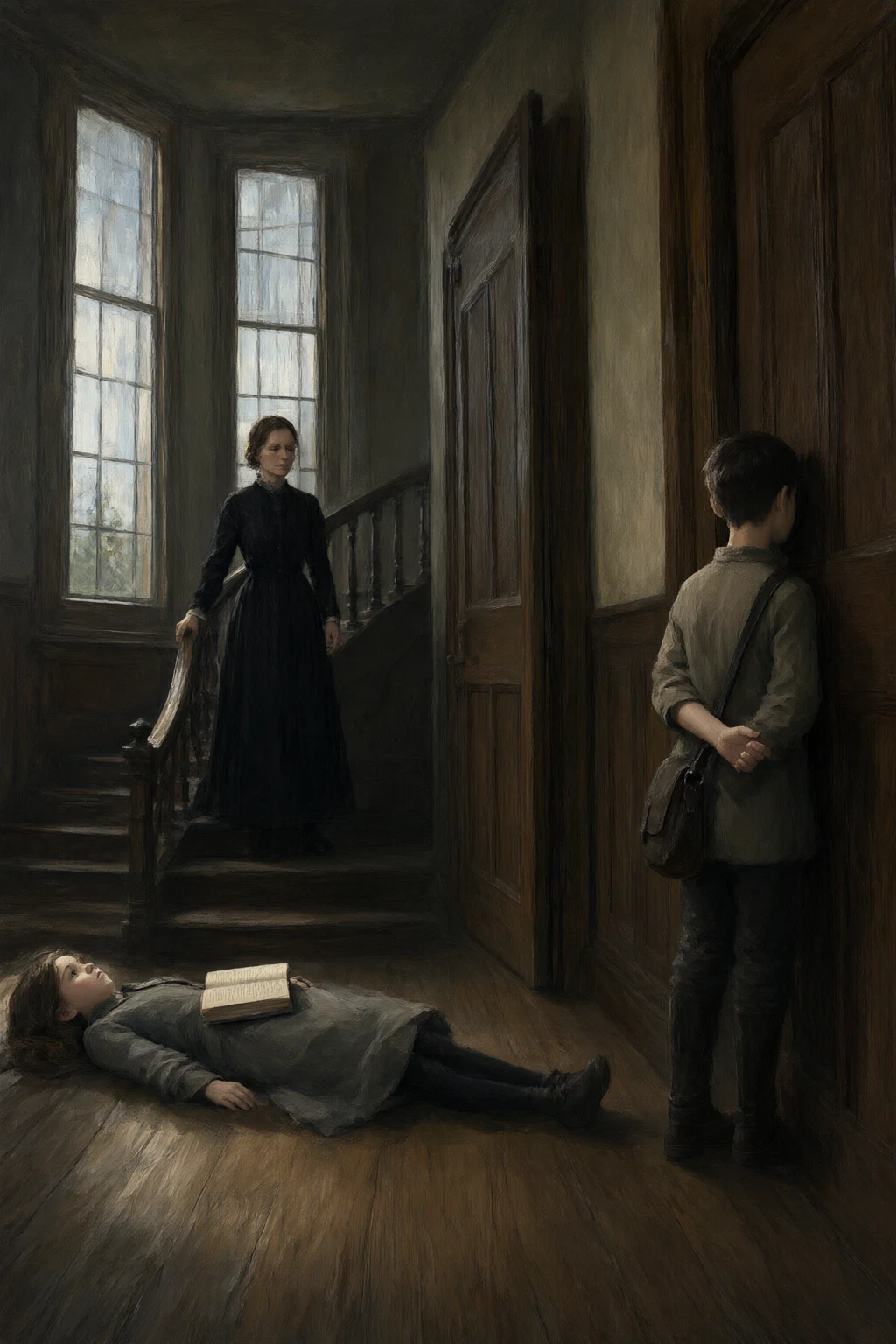
Marguerite Fenn was lying on the hall floor when they came out, with her coat folded under her head and a book on her chest, which is what she does, because she cannot sleep in any bed the Bureau has certified and she has not told her mother and she is fifteen. Mr Vantry found her there and asked her, in the ordinary way, whether she was all right, and she said yes, and then, without being asked, in the flat voice of a girl who gives tolerances to strangers in the street and cannot stop: “Your hall floor is in by one and one tenth and there is nothing whatever to be done about it. Your fourth tread is out at the fourth tread by a quarter of an ounce and the figure on it says four tenths, and the figure is the promise, and the promise is what was sold, and it is out. It has been out since 1974. It will be out in 2010. It is a tread, and it is the tread everybody in this house has used every day for sixteen years, and you do not have to do anything about it.” Mr Vantry stood in his own hall looking at a girl of fifteen lying on his floor. “You cannot tell that from down there,” he said. “No,” said Marguerite Fenn. “I cannot. I am telling you what is written on the step.”
Nobody went upstairs again after that. The four of them sat in the kitchen until the light went, and the copper went off tick by tick as it cooled, and the table was not cleared, because in that house nothing had been cleared or straightened or put away by anybody for some years and it was not disorder, it was simply the shape the day had taken. What they did not have was anything to say, and the reason they had nothing to say was not the finding. A finding is a card. They had all seen cards. What they did not have was a number. There had been a figure on the rail of a cot upstairs, and a figure on five bed feet on the first floor, and a figure on the inside of the front door frame, and on the third tread and the fourth, and on four boards of the hall, and at the top of the stair, and every one of them was a promise that somebody else had made to somebody in the house, in pencil, in a testing hand, and every one of them was still there, and not one of them was any use to anybody, and nobody was permitted to say so. Mrs Vantry had a cold face and a warm hand and had said in the past tense that they were not a delicate house, and could not think what a household is.
Mr Vantry had lived twenty-six years in a set of measurements about a child, and had never once been the subject of a figure of any kind, and had spent that morning learning that the house had been measured for his wife and then for his daughters and never for him, and that this was the normal arrangement and had been the normal arrangement since 1881. The eldest daughter, who was twenty-four and blunt and who had come home on a Friday and had not spoken to her mother since 1989, sat at the end of the table and looked at the third column of the card lying face up in the middle of it with NIL in it in a registrar’s small hand. The second daughter, who was nineteen and had come up that morning with a hatbox, put her hand flat on the board, the way a person does to find out whether a table is real.
Cobb Tarn put the card in his case and closed it and left it on the table, and said that the Bureau would send the finding to the household in a week in a printed hand, and that the finding was public, and that anybody in the town who cared to use the word would use it, and that the Bureau had no power over that and never had, and that this had been true since 1881 and was the price of the eighth rule. Then he and Aldis Prome went down the north side in the last of the light, past the terrace where the boy lived, and the boy was on the wall at number fourteen with his back to his own door, and neither of them stopped, and the chief tester said, after about a quarter of a mile, in the form, “Nought point four. In. Nought point four.”
And Cobb Tarn said that he did not know what that referred to, and Aldis Prome said that it did not refer to anything, and that it was the only declaration a man can make on a walk, and that it was not a test, and that nobody in Featherstone was to take it down. Upstairs in the great house, the son of the house slept in a cot that had been put aside in 1981 and kept, with four tenths of an ounce written in pencil on the foot of it in a hand from 1974, and the promise was that the bed was not wrong by more than four tenths of an ounce, and the true figure of that cot was a thing that had been knowable in one minute in the presence of one woman and one drawer, and the woman was blunt, and the drawer was a half mile away and down a cellar stair, and nobody was ever going to lie down in that cot to find out, and the child would sleep in it for eighteen years.