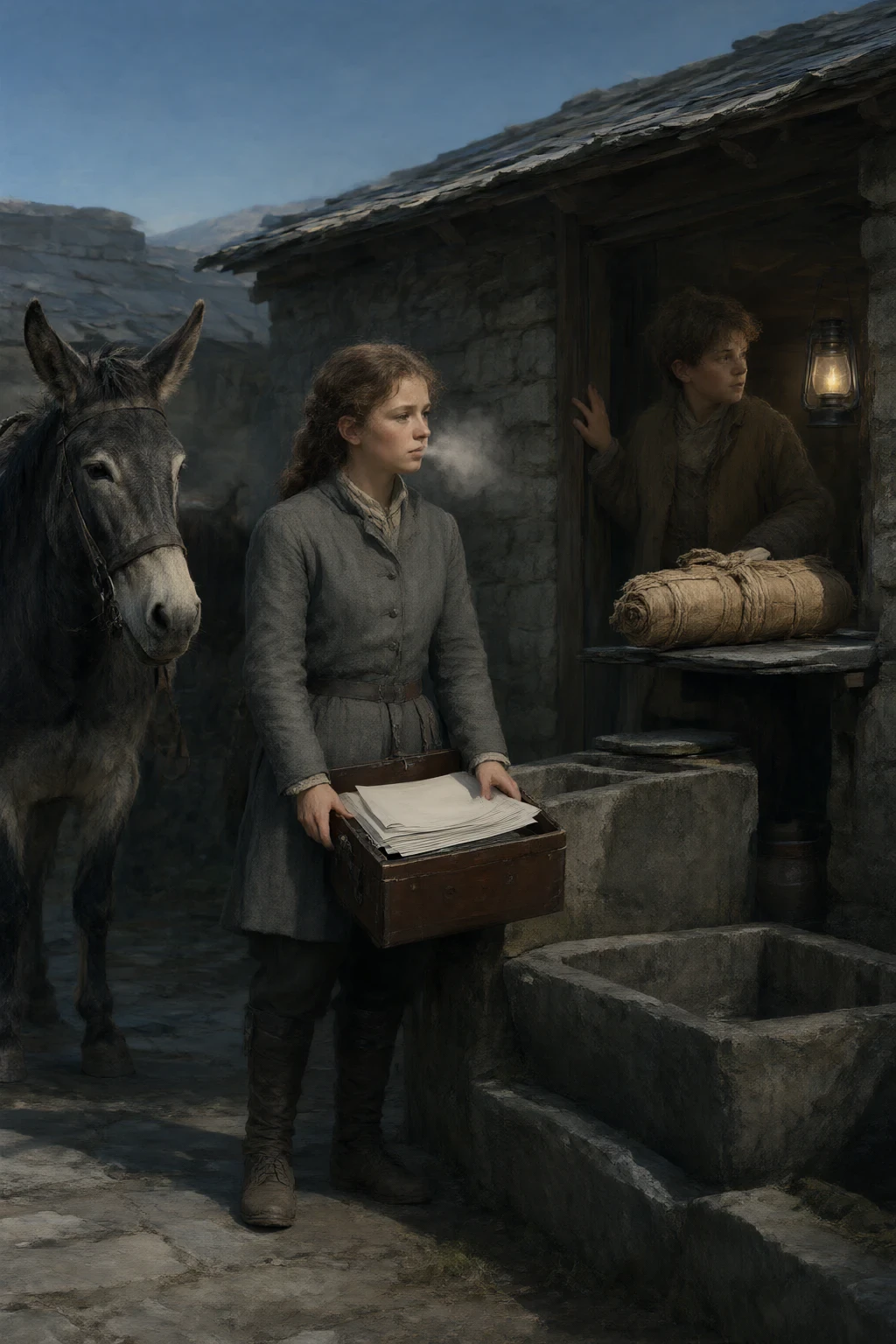
The Bureau of Vowed Obligations did not send a form. It sent a sentence, and the sentence was the whole of the instruction, and Marda Osk had it pinned inside the cover of her working book where she could see it every morning without having to decide to look at it: Every living vow sworn upon the pass shall be entered with the term, the shrine, the year of swearing, and the year of release, together with the name of the holder, the name of the keeper who wrote it, and the signature of the holder attesting the whole. Seven items. The last one was the reason she was on the mountain. There were, as far as anybody could say, somewhere between two hundred and nine hundred living vows on the pass, and four hundred miles of stair, and the only people who could supply the fifth, sixth and seventh items of the Bureau’s sentence were the people carrying the vows, who had to be found, and asked, one at a time, on foot.
Nine days in, Marda Osk had filled thirty-one sheets and interviewed eleven people, and she was doing the arithmetic of the rest of it in the evenings, in the copy-desk, with the Registrar coming over the ridge in one long unbroken push and the lamp needing oil, and the arithmetic was not working, and it was not working for a reason she could not put her finger on. The first eleven had produced: a season; a term; a term again; a silence; a sentence of forty-one words; a drawing of a stair done on the back of a form; a story about a horse; two years given as a number with no month; a shrug; a date so exact it was plainly a story; and one man who said, “I do not know, and I will not find out, and you may write that down.” That last one had taken forty minutes. The other ten had taken forty minutes between them.
On the second week of the eighth month the terrace above the Ninth Step filled, and Marda Osk went down and stood at the edge of it and looked at it for an hour without speaking to anybody, because it was the only place on the pass where four hundred people stood in the same square of ground at once, and she wanted to see what four hundred people looked like when they were not being asked anything. The terrace is paved in flat slabs worn into shallow dishes by six hundred years of standing still, and on a clear morning you can see nine of the shrines going up and two coming down, and every one of them has its own weather on it. On that morning there was a queue at the copy-desk, and the queue was not for Marda Osk and had never once been for the Bureau, and it had been going since before she came down. At the end of the market a man sold blank vow-slips, folded and tied in bundles of ten, on a board, at a price that was not advertised, and everybody on the terrace walked past him slightly faster than they walked towards him, and nobody denied needing one.
“He is a rogue,” said a voice at her elbow, and Ansel Dun put his head round a cheese wheel to deliver the information. “He is not a rogue. He is worse than a rogue. He has understood that if you do not have the words written down you will get the term wrong, and he has decided to sell you the blank of it. Nobody on this pass will touch him and everybody on this pass has thought about it.” “You have thought about it.” “Yes, right, yes,” said Ansel Dun. He had been given the job of carrying Marda’s case up and down the stair for nothing, in exchange for being allowed to sleep in the copy-desk, and he had done it for nine days, and he had not dropped the case, and he had not asked what was in it, and twice Marda Osk had caught him beginning to answer a question and had stopped him with a look, and once she had not. “You did not stop me yesterday,” she said. “You were on the High Ladder with the keeper at the Fourth Shrine, who was counting and did not notice me.” He shifted the case to his other hand. “I want it written down that I knew what the fourth question was, because you read it out on the way up. I want it written down that I knew I should not have answered.”
Marda Osk opened the case and looked at the fourth answer on the entry for the keeper at the Fourth Shrine, a man of sixty, whose term was nine years, and whose date was good, and was the best date on the whole pass so far. “Was he in the room.” “He was in the room.” “Did I read the question back to him.” “You read it back to him word for word,” said Ansel Dun, “and he said yes, and then he looked at the fire, and then he said yes again.” Marda Osk stood on the terrace with the sheet in her hand and the whole square of it below her, the dishes in the paving, the queue, the smell of cheese and ash and nine separate weathers, and she thought: eleven people, and four hundred to go, and every one of them in a room with a keeper, and every one of them to be asked a question she has already read back to somebody else. “Ansel,” she said. “From now on, when I read a question back to a person in a room, you stand on the other side of the Shutter-Stone and you say the word. Just the word. Nothing else.” He said, “Yes, right, yes,” and then stopped, and worked backwards, and said instead, “What word.” “Any word. Say it out loud in the yard so that I can hear it, and then I shall know that you were there, and I shall be able to put a witness to the fact that I knew.”
The Shrine of the Second Water had a mule yard, the only flat ground on the whole pass, shored against a retaining wall and always in its lee, and it smelled of animals in a way no other room on the mountain smelled of anything. The woman who kept the water-trough was Sefa Ollant and she was forty-four, and Marda Osk had been told by two people on the way up that she had a vow of fasting and had had it three years, and that was why she was thin, and that the pilgrims were careful with her. The form had six columns. Marda had ruled the seventh herself, in the margin, headed: year of release, and how the holder knows it. “Sefa Ollant. I am going to ask you about a vow you swore three years ago, and I am going to write down what you say, exactly as you say it, and I am not going to suggest anything to you, and if you do not know a thing I will write that you do not know it.” “I know it is three years,” Sefa Ollant said. “Yes. And the year it ends.” “I do not think about the year it ends.” “All right.” Marda wrote it down. “Does not think about the year.”
“But I know what it does to me. That is not the same as not knowing. Ask me what it does to me and I will tell you to the end of it, and it will not be a year, and you will have to do what you like with it.” “What it does to you.” “I can eat bread before noon.” Marda wrote it down. “Can eat bread before noon.” “Not before. Ever?” “Not before noon. Not in the morning, not on the way up, not standing at the trough with the cold on me. After noon it is as though it never happened. Eleven years I have not had bread in a morning, and I know the shape of the morning better than I know the shape of the afternoon, and I could not tell you what year it is.” “Could you tell me what month it is.” Sefa Ollant looked at the sky the way a person looks at a thing they have looked at ten thousand times. “I can tell you it is the eighth month,” she said, “because the mules go up the Ladder when the snow is off, and the snow went off. I have never once known the eighth month by anything but the snow.” Marda Osk wrote: Holds month by the state of the Ladder. Cannot give year. “Thank you,” she said, and was also aware, standing in the yard with the animals on her, that she had just been handed the most complete description of a human being’s interior life anybody had ever put into a Bureau book, and that it was going into a leather case, and that no one would ever read it, because the Bureau had asked for a year.
The mason was called Dorn Hask and he was fifty-one and had put eleven years into the Fifth Shrine’s stair, which is eleven thousand stone steps cut and re-cut over six hundred years, and he described his vow without being asked, in the yard, with a chisel in his hand, because he was the sort of man who talked while he worked and could not stop. “Forty years,” he said. “That is the term. Forty years of stone.” “When did you swear it.” “I swore it at fourteen. I was at the top when I said it. My father had me up here to learn the trade and I was angry with him and I said it to be different from him.” “So the year of swearing is fifty-one less forty, or a year either side of that, depending on — ” “Forty,” said Dorn Hask. “— depending on your birthday, which I do not have — ” “I am telling you the term.” “I know you are telling me the term.” “That is all I have.” Marda Osk had conducted four hundred and six hundred and eleven interviews in three cities and had never once had this. She wrote, term: forty years, and looked at the row, and the row was a dead thing, because a term is not a date. “I can work it out,” she said. “You swore it at fourteen. I need your birth year.”
“I do not know my birth year either.” Marda Osk put the pen down. “No,” said Dorn Hask. “I do know my birth year. I know it perfectly well. I have never had any reason to say it out loud on a mountain to a woman in a clean coat, and I have not come up here to find out what I am.” He went back to the chisel. The stone made the noise stone makes when it is being argued with, a grinding one, low and long, and it went on for a while. “Your hip,” Marda said. Dorn Hask stopped. “It is not a bad hip. It is not a hip that is going to kill me. It is a hip that knows what year it is in.” He set the chisel down. “There is a stone in me that will not let me lie on my left side, and it has done that since I was thirty-one, and thirty-one is fourteen plus seventeen, and it has done it for twenty years. If you want the year, that is the year. Ask the hip.”
The mule-driver’s helper was nineteen and his name was Ren Fisk and he had a term of one year and he knew the date to the day, and Marda Osk had a bad feeling about it from the first sentence, and the bad feeling was not a professional instinct, it was the same feeling she had had at the copy-desk in the low country when a man read a deed aloud and got the tenure slightly wrong. “Seventh of the seventh month,” Ren Fisk said. “Last year. I know it because there was a dog.” “Because there was a dog.” “There was a dog on the High Ladder. It came out of nowhere and it went down the wrong side, all the way, and it took two men and a rope to get it up, and everybody in the pass was up on the landing drinking water and talking about it, and I was one of them, and I said the thing.” “What thing.” “The thing. You know what is done on the Ladder when the dog goes down. You do a thing. That is the custom up here. If a thing is done on the Ladder it is held.” Marda Osk wrote, very slowly: Sworn 7th of 7th month, last year. Custom on the High Ladder. One year. “Who heard you?” “The landing, near enough. The dog, mainly.” “Repeat the words you used.” “I do not remember the words.”
“You remember the custom and the dog and the date to the day, and you do not remember the words.” “It was a drinking thing. It was a bit of a — it was a custom, that is all. It is not serious. Nobody took it serious. I have had a perfectly ordinary year. I have not done anything.” “I want to be careful with you,” Marda said, “because I am about to write down a thing, and I want to be sure of the thing.” Ren Fisk thought about it. That was the moment Marda Osk learned to be frightened, because he thought about it honestly and slowly, like a man deciding whether to eat. “There was a bit at the end,” he said, “where you name the year out loud, so that it can be found. So that the dog can be — so that it counts. And I said mine.” “You said your own.” “I said the year. I said it loud so it counted.” The boy stopped smiling. “And then I could not go down the Ladder. I have not been down past the landing since. I thought it was the cold. Everybody said it was the cold.”
Marda Osk wrote it down, in the plainest words she could find: Says a term aloud in a custom, on the Ladder, naming the year out loud, and has not been able to go below the landing for one year. Will not go down. Does not connect the two. Then she read it back to him, word for word, because that was what she did, and because she had believed for eleven years, and had been praised for it at the Bureau, that reading a question back verbatim was the most honest thing a clerk could do. “Does that say what happened?” “That says what you told me happened.” “That is what I asked it to say.” “It says what I told you happened,” said Ren Fisk. “You have not written down that I was happy about it. You have not written down that the dog was a dog and not a matter of a vow. You have not written down that I would like somebody to make me go down the Ladder.” “No,” Marda said. “I have not. Because you did not say it.” “You did not ask me.” “No,” she said. “I did not ask you.”
She stayed in the copy-desk until the lamp wanted oil and then she stayed past that, and read her own handwriting again, thirty-one sheets of it, and it was — she would have sworn to it under oath, and did — the most accurate record of sworn promises that had ever been made on the pass outside the Register itself. Word for word. No leading. No correction. Eleven people in nine days, not one wrong entry, and not one useful one either. Then she got out the Bureau’s sentence and read the last clause again: the signature of the holder attesting the whole. And she understood, sitting in the warm room with her back against the slate shelf, that she had been building a machine for nine days without noticing, and that every wheel in it belonged to somebody else.
On the second evening she went to Tovan Rell, because the Register was the only document on the pass that was not a copy of somebody’s memory, and he was the only man alive who could read it, and because she could not get through four hundred interviews without him and did not much like what that said about the rest of her life up here. He was in the copy-desk with the lamp at his elbow and eleven bundles of sticks on the table, tied and untied and retied in a sequence she did not understand, and a knife out, trimming the twine ends, which she learned later he did not need to do and did anyway. “I need one date,” Marda said. “One entry, one bundle, one year of swearing, read out of the head of the bundle the way the collation was done.” “I know which one.” “You do not know which one. There are eleven thousand.” Tovan Rell untied the third bundle, turned the head of it round, and gave it to her. It was a strip of linden bark with a date scratched on it and nothing else, in a small careful hand that was not the hand of the entries underneath.
“This is in the low-country reckoning,” he said. “It is the head the collation was sorted by. It is wrong. It has been wrong since the day it was scratched. The entries under it are right, and I have been able to prove that for thirty-one years and have never once been asked to, because nobody has ever wanted a date badly enough to be disappointed by one.” Marda Osk copied the date onto her sheet. Then she copied it again on a second sheet, and put the second sheet face down on the table. “I am going to have four hundred of these,” she said. “You are going to have four hundred of these and no witness to any of them, and every one will be a date nobody signed, and in nine years somebody will find that this pass was reckoned in two calendars at once, and he will write a paper about it, and he will be right, and it will be of no use whatever to anybody alive.” He said it without heat, the way a man says a thing he has said to himself in an empty room several hundred times and never had an occasion to say out loud, and Marda Osk understood that she was the first person he had ever said it to, and that he was not going to be thanked for it. “Why are you telling me this.”
“Because you have the disease the Bureau has and you have caught it in nine days, and I would like there to be one person on this mountain who is not carrying it. There is not going to be one. But there was you, until Thursday.” “Which disease.” “Believing that a thing written down properly is a thing dealt with.” Tovan Rell put the knife down. “Nine days. Eleven people. And you have not asked one of them a single question about what they want, and not one of the eleven was able to give you an answer, and you have written that down in your own hand as though it were their failing.” “It is not a question the form contains.” “Then write that down too, in the same hand, on the same sheet, and send it down, and see what they do with a clerk who has told them the box does not exist. I have been waiting sixty-eight years for somebody to send that sentence off this mountain. It will not cost you anything. I have watched it cost other people everything, and you will find it very cheap.” He retied the bundle. Marda Osk put both her sheets into the case and thought about it all the way up the High Ladder, and on the landing she drank water and did not talk much, because that is what the landing is for.
Pella Skarr was sixty-three and had a vow of silence on her of seven years, and Marda Osk had an appointment with her on the second afternoon in the upper room of a house below the Fifth Shrine, and she prepared for it the way she had prepared for all eleven, which was to write the six questions out on a slate and cross off the ones she had already asked in that exact wording, because a person who has been asked the same question twice gives a different answer the second time. She got four answers into the second sheet when she noticed. “The term as you have it,” Marda said, for the fourth time, “is seven years.” “Seven years.” “And you have been carrying it — how long, in your own sense of it?” “Seven years.” “And the year in which you swore it. You said on the stair that it was the third year of the flood. Do you still hold to that?” “The third year of the flood.” Marda Osk put the pen down. She had never once wanted to say a thing to a witness more than she wanted to say it now, and she did not say it, and the not-saying took a deliberate act, and she had to make it deliberately. “You have rehearsed this.” Pella Skarr looked at her hands. They were very clean.
“I have walked it up and down the stair for a month,” she said. “Past this room, and past the Fifth, and up to the High Ladder and back down. I have practised the year, and the term, and what I will say about the door, because I knew you were coming. Because everyone has known for a month. Because there was a man with a case at the Second Water in the second week of the eighth month asking at the copy-desk who had sworn what, and the first person to talk to you on this mountain was going to be somebody who thought about it afterwards and went home and told everybody.” “I did not ask anybody to tell anybody.” “I know,” said Pella Skarr, and it was not unkind, and it was not clever either. A second person came into the room without knocking, in the way people come into a room they grew up in. She was thirty-one, she had a good coat on, and Marda Osk knew at once that she was not on the schedule, because there were only six names on the schedule from that house and this was the seventh. “That is my daughter,” Pella Skarr said. “She has never been asked anything.”
“I have never been asked anything,” said Ivo Skarr, “because there is nothing to ask me. I have no vow. I was born on this pass and I have never been off it, and it is not because of a vow, and everybody here knows it is not because of a vow, and your form has no column for it, and so it does not matter.” Marda Osk read her own question back to her, word for word, out of habit, eleven years of habit, before she had finished turning her head. “Do not,” said Ivo Skarr. Marda stopped. “That is how you got my mother,” the daughter said. “That is how you get people. You say it back the way they said it and then they agree with the thing they have already said, and it is a kind thing, and it works, and I have watched it work on four people since the Tuesday. So: write down what I say, and I will say it once.” “Say what you mean.” Ivo Skarr stood with her arms loose at her sides, in the way of somebody who has made a decision in a hurry and is comfortable in it.
“Write down that I have never been asked whether I wanted to be on this mountain. Write down that I have never wanted to leave it and would not leave it, and know perfectly well that those are two different sentences, and that only one of them is a vow. Write down that my mother says the going and I go, and that I have been here thirty-one years on a term that nobody swore, and that nobody has ever written it down, because there is no term for it, and it cannot be discharged, and it does not end.” Marda Osk wrote it. Word for word. She did not improve it and she did not shorten it and she did not read it back, because she had been told not to by the only person on the mountain who had understood what she was doing. “That is not an inventory entry,” said Ivo Skarr. “I know that. Put it in anyway.” “It goes on page one, after the sentence, and it goes in in full, and it goes in with your name on it,” Marda said, “and it is going to a hall in the low country with a stone floor and no window, and it will be the only line in three hundred and forty leaves that anybody in that room can do anything with, and none of it will be about a vow.”
On the third day Marda Osk asked Ilse Merrow to witness, and Ilse said no, and then said why, and the why was the shortest sentence anybody had spoken to her in eleven years of clerkship. “The writing is the term,” Ilse Merrow said. “That is all of it. That is the whole of the law of this mountain and there is no other law. If I write the date, the body takes my date. If I write it wrong, the body keeps my wrong one. It does not consult you, and it does not consult the Register, and it does not consult the man who swore it. So: date of release, signed, Ilse Merrow. And there stands a woman of forty-one with a bad back and a white streak in her hair that came in one night nineteen years ago and has not grown since, who has put a date on a stranger’s bones because a clerk in a grey coat asked her nicely.” “Would you write it if the holder were in front of you?” “Term of the question, before she is in front of me. No.” “Term of the question, in front of me?” Ilse turned her whole body to face the question. “Not in this room,” she said. “And you will not ask me again in this room, and I will not have said this in a room, and that is the arrangement.” “Het Kalder could read a date out of the Register.” Ilse Merrow did not answer for a while. Down the stair, somewhere below, a door closed. “Where she got it,” Ilse said, “is between her and me, and it is not going into a Bureau book.”
By the fourth day the pass had decided what she was, and had decided it without consulting her, and the decision did not take the form she expected. They did not bring her their vows. What they brought her, at the copy-desk, in ones and twos, all day, was their disputes. A man whose term had been written as eleven years and who wanted it written as nineteen. A woman who wanted the term she had sworn in a temper struck out entirely, on the ground that it had been a bad temper, and who had understood immediately that this was not possible and had come anyway. Two brothers who had sworn the same vow on the same afternoon and had been given different terms by two keepers in two rooms, and who wanted her to say which of them was right, and who were both going to be right, because the mountain had taken whichever version it heard. “Three days,” Marda said, to the second brother. “I cannot say which of you is right. I am not a keeper. I am not on this pass. I do not know what you said.” “Then what will you do with it.”
“I will write down that there are two entries in the same year in the same shrine, both of them about the same afternoon, with two different terms, and that both men are alive, and that the pass has therefore been holding one of them to a term it was never given.” “Will that do anything.” “It will do something in about forty years,” Marda said, “when somebody is trying to work out what happened, and there will be one line in a Bureau book saying that a clerk stood on a terrace in the eighth month and was asked, and could not answer.” The brother looked at her for a while. “That is worse than nothing,” he said. “It is a different thing from nothing,” said Marda Osk, “and I have four hundred people to see.”
On the fourth day, with the mule due at dusk, Marda Osk walked the whole length of her own work and found the thing she had been walking towards for four days without seeing it. She had been reading every word she had written back to the person who had said it, and she had believed that this was neutrality. It was not neutrality. It was the strongest possible force on this pass, because a thing said aloud in the plain sense in a room where a vow may be read is not a description, it is an act, and she had spent four days speaking like a keeper while telling herself she was a clerk. And it was worse than that, and this was the part she sat down over, because this was the part that would be in the report.
Four days. Eleven people. One at a time. And every one of them had given her a term, or a season, or a body, or a dog, and not one of them had given her a wish. Not one. She had asked the only question the Bureau permits, which is how the vow ends, and how a vow ends is not a thing anybody knows how to want. The people on the rest of the mountain have never been asked and could not have answered and would have to be asked in a way the Bureau’s sentence does not contain. So Marda Osk had built, in nine days, with a good method and a careful hand and no fault of any kind, an exact schedule for the release of several hundred strangers, none of whom had ever expressed any view about it. She took out a clean sheet and wrote at the top of it, in her best hand: Nothing in this inventory expresses the wishes of any holder. It expresses only what was asked. No holder was asked whether they wished to be released, because the form does not ask it. The question is not in the form. Then she read that sentence four times and did not soften it, and initialed it, and put it on page one, where anybody coming down the stair would have to read it before anything else.
The mule went down at dusk on the sixth day, loaded to ten stone-weight, and Marda Osk walked down four hundred miles of stair behind a man who would not give the case back. The hailstones were lying in the hollows of the Shutter-Stone in a wide arc, and she stopped there without a reason and stood a while, because the shape of the arc is the shape of a person standing aside, and she had spent nine days making several hundred people stand aside. The last three hours are downhill and there is nothing to think about, and she thought about the reply, and then she stopped thinking about the reply. A stoup of cold water and a dry crust of bread was standing on the sill of the third shrine down, which is not a keeper’s sill and is not a place anybody puts anything. It was the second such sill in four days. There was a third at the Ninth Step, and at the Ninth Step the crust of bread was warm, and had been warmed on a hearth, and the water was cold, and the water was always going to be cold. Nobody said anything about it. Marda Osk drank the water and ate the bread and went down into the weather, and she thought: somebody has been counting the days of my going down, and has not once mentioned it, and has left exactly enough.
The report went up the stair nine days behind her, on the next load, and it was three hundred and forty leaves, and the low-country hall in which it was read had a vaulted ceiling and a floor of tile and no window in the room at all. A reviewer read it in eleven minutes. Marda Osk was not in the room. She was told afterwards that he had got to page one, had read the sentence at the top of it, had gone back and read it a second time, and had then gone on to page four and had not gone back. The report came back on the nineteenth day, by mule, in a leather case, to a woman still on a mountain nobody had sent her away from. It was complete in every particular the Bureau had asked for, and by the standards of the Bureau of Vowed Obligations it was the best work the Bureau had received that year, and in the following spring it was found on the pass in a hand that is not a clerk’s, under a heading that says: CONDITIONS OF SERVICE UPON THE PASS, BEING HISTORICAL AND NOT CURRENT.
Marda Osk read the return letter in the copy-desk on a wet afternoon with the Registrar coming over the ridge in one long unbroken push. It was courteous. It thanked her. It observed that her method was exemplary and that her transcripts were a model of accuracy. It then said that the Bureau was unable to make use of her findings in their present form, and that it was sending, for her convenience, a revised form, and that she was to begin again at the first sheet and to disregard the schedule of terms she had compiled. The revised form was the same form. It had the same six columns. It had the seventh column she had ruled herself, headed with the phrase she had invented and been quietly proud of. And at the foot of the sheet, below the place where a clerk’s hand stops, it had an eighth column, ruled and printed in the same typeface as the rest, and the heading was long, and Marda Osk read it twice before she understood that it was a sentence. The heading said: DATE OF RELEASE OF THE HOLDER, GIVEN BY THE HOLDER IN WRITING BEFORE A WITNESS, AND NOT OTHERWISE ASSUMED.
She sat with it a long time. Then she took a clean sheet and wrote back, in a clerk’s hand, lettered, because the low country wanted it lettered: The inventory cannot be completed, and the reason is on page one, and page one has been read. The column now added will return the same answer several hundred times, because it asks the holder, and there are no holders, there are only people carrying a term, and a person carrying a term has not been asked and cannot be asked in a form, and the asking has to be done by somebody who is prepared to be told no and to write down the no. Then she sent it down the stair without a signature, because there was nowhere on the form to put one, and there had never been anywhere on the form to put one, and the Bureau had spent a hundred and eighty years sending a woman up a mountain to collect the single thing its own paper did not have a box for. Her right middle finger was the colour and hardness of a bad joint and would be so for the rest of her life. She flexed it once, out of habit, against the edge of the desk, and the sound it made was the sound of a pen being put down at the end of a working day.