Hine Rewiri was thirteen and she kept a food diary for forty days in a notebook with a black elastic band round it, and she wrote down everything that went into her mouth and the number that was on the packet. By the end of the forty days she could tell you the calorie count of a muesli bar, a bottle of sports drink and a single potato chip, and she could tell you in about eleven seconds which number she had eaten most of that day.

The notebook was for a reason. In the week before she started it, her cousin Rua had said at a barbecue at her mother's that she was carrying about five kilos she did not need, and had said it the way you say something about a person you are fond of, and Hine had gone home and weighed herself on the bathroom scale and found forty-six point four kilos, and had not weighed herself in front of her mother once before that. Rua was nineteen and ran the eight hundred metres for the district, and what she said about her own body had been true of her, which is what made it easy to believe about somebody else's.

She did not weigh anything. That was the first thing that went wrong, and it went wrong quietly, for forty days.

The packet says what is in the packet. A muesli box says a hundred grams has three hundred and eighty calories in it, and Hine wrote down one bowl, and her bowl, filled the way her mother filled it, weighed ninety grams and had three hundred and forty-two calories in it. Porridge had a heaped and a level, and she was always somewhere between the two. The almonds were the worst of it. She wrote a small handful of almonds every single day for nine days, and a hundred grams of almonds has five hundred and seventy calories in it, and on the one day she weighed the bowl on the kitchen scales the bowl held forty grams, and she went and sat down on the step outside.

Her ordinary day, added up from her own handwriting, came to about one thousand five hundred and forty calories. On a training day, when she had run at lunch, it came to about one thousand seven hundred. The chart on the wall of the medical centre on Queen Street puts a girl of twelve or thirteen at about one thousand eight hundred, before she has walked to school. That number was not a rule anybody was ever going to come and check. Hine knew about thirteen hundred of it herself without needing to be told, because most of that goes on the heart and the lungs and the keeping of her warm, and none of it involves a decision.

The tiredness came first, and she had a way of explaining it. It arrived at about twenty past eleven in the morning, which was third period, and it was a weight on her eyes and a sort of noise behind them, and she put it down to the history test she had not read for. She stopped eating the crusts off her sandwiches, which took about ninety calories off the day without her noticing herself do it, and then she stopped bringing a sandwich at all on Thursdays and ate a muesli bar in the corridor instead, which was one hundred and eighty calories, and she felt very pleased about that.

Then she began waking at three in the morning hungry, which she had never once done in her life before that, and going back to sleep angry. The race was in the last week of June. She had run the eight hundred at the school in April in two minutes and forty-seven seconds, in a race she had led for most of the second lap. In June she ran three minutes and four in the same shoes, and she came fifth of eighteen. She got in the car afterwards and told her mother her legs were no good, and her mother said it was a cold, and it was not a cold.

There was also the thing nobody said out loud, which was that her period had not come since the second week of April. Hine explained that one to herself quietly. It had to be the running, because the running had changed too, and she was quietly pleased with the theory, and it was not even wrong, except that the running had been there all year and the eating had only been different since May.

Bel Kaur came to the athletics club on Wednesday evenings in a room above the shop, for the runners, and Hine sat in the front row with her notebook shut in front of her for a fortnight before Bel asked her a single question. “You are not eating,” said Bel Kaur. “I can tell because you have got a beautiful notebook and you have written nothing in it this week.” “It is on my phone,” said Hine. “Then let me see the phone.”

What Bel Kaur did was not read it. That was the part Hine had not expected, because she had spent forty days being certain that a piece of paper was the whole of the evidence. She brought out a set of kitchen scales, a tub of porridge, a box of muesli and a jar of peanut butter, and she asked Hine to eat the way she ate, on a plate, at the table, with a stopwatch lying face up beside the plate, and to say out loud what she was about to eat and not one word after she had eaten it.

Hine did that for three days. The three days came to one thousand four hundred and ninety, one thousand six hundred and ten, and one thousand five hundred and five. Then Bel Kaur took the scales away and sat down opposite her. “On your diary you are under-reporting by about four hundred calories a day. Not on the days you are upset. Every day.” Hine said it was not on purpose, and Bel Kaur agreed with her at once, which Hine had expected, and which was somehow worse.

“Nobody does it on purpose. This is not a telling-off and this is not you lying to me. Your head has the list, and the list is made of what you remember noticing, and your head does not have a number in it for the middle of an afternoon.”

Then Bel Kaur said the first of the two things, and it was not the thing Hine had come in for.
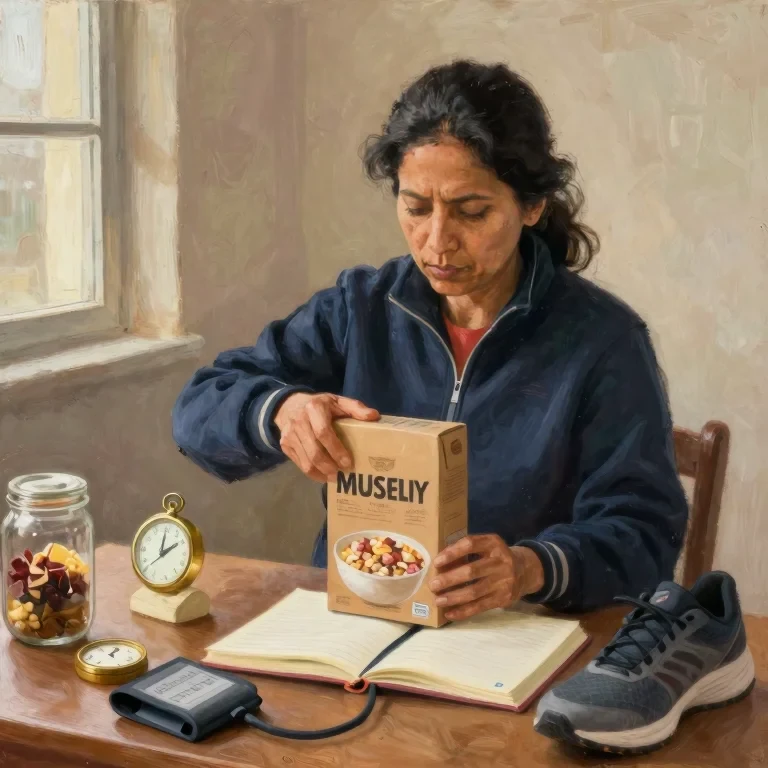
“The number on the packet is not the number in your body. They get it by burning the food in a vessel full of oxygen and working out what went up in the smoke. Everything comes out at four calories a gram, because four is what a gram of starch is worth, and a gram of fat and a gram of paper and a gram of fibre all get put on the packet as four as well. So the packet is always a bit generous to you. In some foods with a lot of fibre in them it is generous by a fifth. You were aiming at a target that was already too high, and you were still short of it. That is why there was no number to win.”

Hine said, “Then why did it feel like I was doing everything right.” “Because it was working,” said Bel Kaur. “You were running a four hundred calorie hole and you kept warning it all day. That does not last. It is a thing a person can do for a while.”

Then Bel Kaur said the second thing, and it was about the ninth minute of a school morning. “Sit down for breakfast tomorrow. Plate on the table, and do not pick anything up, and time it.” Hine timed it in her head and came in with a figure of nine minutes, because she ate the same thing every morning standing at the end of the bench. Bel Kaur wrote nine minutes on the back of a page. Then she made the same breakfast onto a plate, sat down with it, and it took twenty-six minutes, and inside those twenty-six minutes Hine ate everything she had eaten at the bench and then some cheese and an apple.

“That is not a personality,” said Bel Kaur. “You are not greedy and you are not weak. The wall of your stomach has stretch in it and nerves in it that tell the brain how much is in there, and it is telling the brain now and not then. And you will get hungry again about three hours later whether or not you had a big breakfast, because the stomach empties into the small intestine at about that rate. Everything you were fighting at eleven o'clock in third period started with nine minutes at the end of a bench.”

Nothing Hine ate was the problem. Bel Kaur said so in a way that did not soften it, which Hine found much harder to take than a telling-off. “There is not one food on that list I would take off you. There is no food on that list that is a bad food. Your list is muesli, milk, an apple, a muesli bar, chicken, rice, an orange, yogurt. The trouble is the total, and the spaces between the meals, and the breakfast. It would be exactly as much trouble if you had eaten biscuits instead of yogurt. It is not a list of good things against bad things. It is a list of how much there was of it.”

And then she gave the rules they agreed on, and Hine wrote them in the notebook on the page with the elastic band. Three of them. Breakfast at the table, twenty minutes, with nothing to carry back to class. The almonds into the tub with the lid on, one level tablespoon, which is fourteen grams and a hundred and two calories, and no more calling it a handful. And a column in the book that had nothing at all to do with calories, which was how long it had taken her.

Six weeks later, in the last week of August, the school ran the eight hundred metres again over the same ground. Hine ran it in two minutes and fifty-one seconds. She was third of eighteen instead of fifth. Her best was still two minutes and forty-seven, from April, before any of this. She weighed fifty-four point eight kilos. Back in April, at forty-six point four, she had been a good three kilos under the middle of the road for a girl of her age and her height, and Bel Kaur had said so in a way that had felt like an accusation, and it had been one.

Before all of that, in the first week, Bel Kaur had said a sentence that Hine had written down without understanding it. She read it now while she stood at the side of the field in the sun waiting to be called for the relay. “For your age and your height, the middle of the road is a range and not a number. It is about fifty kilos to about fifty-five. You do not have to hit anything inside it. You have to be inside it most days and still growing, and I am not going to give you a figure, because you would write it down and then you would do to it exactly what you did to the diary.”

Hine wrote fifty-four point eight in the box anyway, because it was the only thing in six weeks that had gone in a straight line, and she was aware while she wrote it that this was not a good reason to write a number down. She kept it. It was still slightly wrong. She knew exactly how it was wrong, and it was wrong in a way that no more arithmetic was ever going to fix.