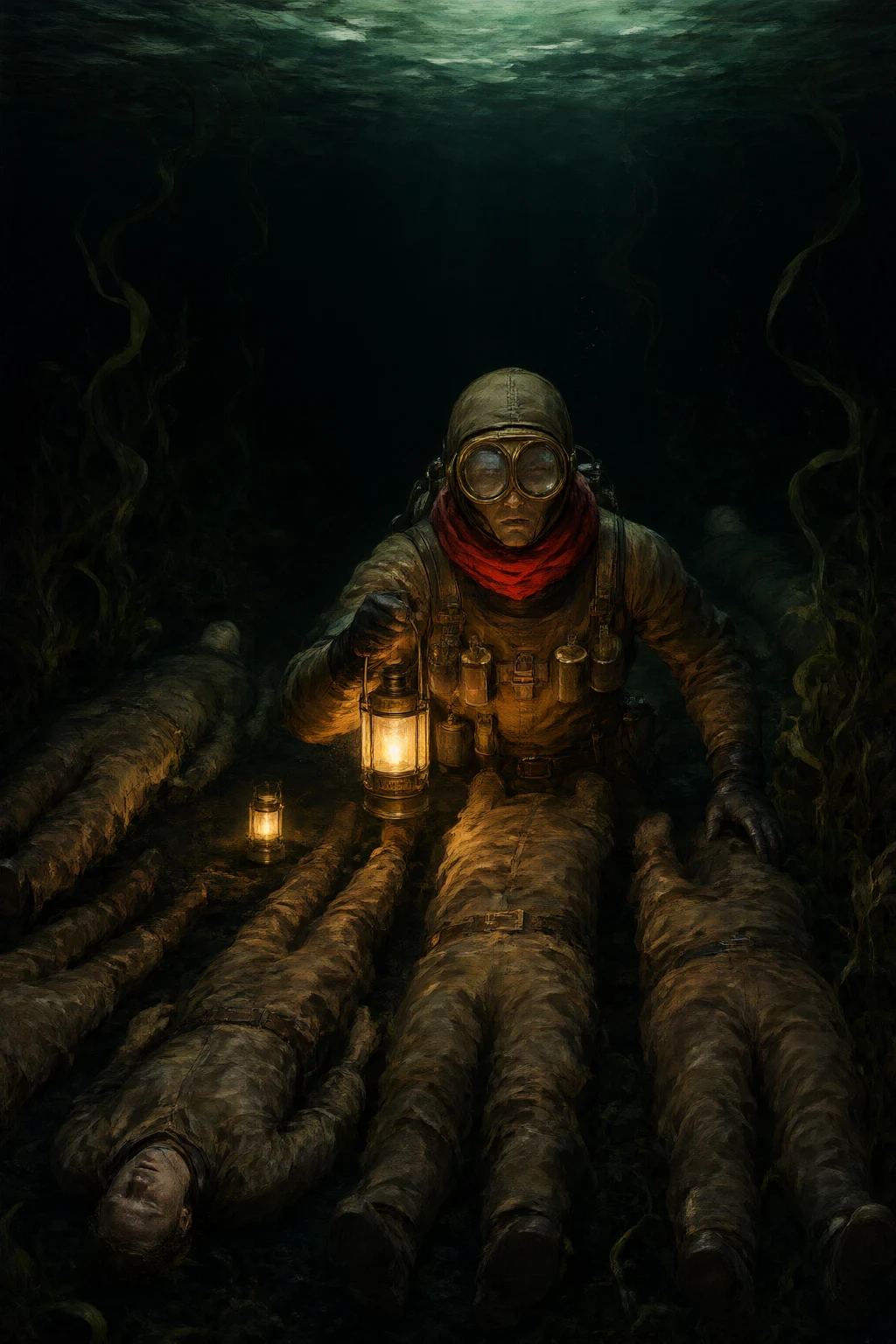
Sten Ollivant kept his suit in a shed behind the pitch works at the top of the Tar Kiln Steps, where the ground was black to the ankle and the kelp lines overhead dripped all day into a bucket that had been emptied eleven times since Monday. It was a canvas thing, four weights, a hood with three panes of glass set in brass, and a collar of pitched rope where the neck went in. It weighed more than a man. He had made it himself out of a sailmaker’s stock in the years when there was nobody left to make one for him. He had been down for twelve years, and he had never once gone down at night, and tonight he was going down at four o’clock because the tide in the Outer Stacks was the only slack that week and four o’clock was in an hour and a half.
On the bench there was a stoppered jar. It was the colour and the weight of a small hand, and it had a finger of eiderdown oil in the bottom of it and above that a quantity of something else that had come out of a person and that you were not supposed to be able to put back. He had nine lamplights in it, which is nine hours of somebody’s life, taken off them while they slept. He had counted them out of a woman an hour and a half ago, while she sat in a chair by a fire that had gone out, with a shawl over her knees and her hands in a bowl of cold milk broth, doing the two o’clock round of the steps and asleep sitting up, as she did four nights in seven.
He did not think of it as taking. He thought of it as fuel. He had been doing it since he was twenty-nine and he had got so good at it that he no longer noticed the cold in his hands, which is how she had said it to him once, in the street, in the rain, not meaning anything, and he had not hit her, and he had not spoken to her since. He capped the jar. He put the hood on. He said, to nobody, in the flat voice he used when a thing was finished or a thing was not going to work, “Still.”
The Outer Stacks are a scatter of black reefs four miles out that give the bay its teeth, and between them the water goes near-black even in the middle of the day, because the kelp comes up in slow green ropes and closes over the top of it. He went down the shot line with a lamp in his right hand and the jar hooked on his belt, and by four fathoms the last of the day was shut off above him, and by six the jade was going out of it, and by nine he was in water that gave nothing back at all. The cold came in at nine fathoms and did not go away again. It was not the cold of the air, because there was no air, and the sea took the heat out of him through the canvas in about four minutes, and after that he was only cold, steadily and without any news, the way a house is only cold.
He went along the north face of the biggest stack, down into the lee, where the current does not work and the water is always the same temperature, and the harbour boats used to put their dead there because it was the only place in nine miles where the swell does not roll them off the rock. The first of them was thirty feet down and lying on his back with his coat buttoned. There were nine rows of them, and then there were the rest. The nine rows were roped. A line of tarred rope ran from a ring of iron in the rock out along each row and back again, laid by men with lamps in the Winter of Lost Boats, and the knots had swollen until they stood out of the hemp like knuckles, and there was a post above each row on the cliff top with a brass plaque on it and a name cut into the brass, and the nine names were the names of these nine, and there were nine and there had always been nine. The rest were not roped and were not in rows.
They lay further along the rock in the same lee, face up, hands folded, in the clothes they had gone out in, in no order at all, and he had been swimming among them for twelve years and had never once worked out how many there were, and he did it now, because he had finally brought something down that he needed to be able to count. Twenty-two. Thirty-one in the water. Nine on the line. Twenty-two on bare rock with nothing at all over them.
The nearest of the nine was warm. That was the thing no one ever told you and the thing that had kept Sten Ollivant in the water for twelve years: at thirty feet, in that cold and that dark, with no light in the world, they were warm to the touch. Warm as a child asleep in a bed. Warm all through, the way a hand is warm, and not in one place and then another, but all of a body at once, evenly, the way a lamp is warm. He put his hand on the twenty-second of the unposted and it was warm too, and he had known that for twelve years and had never let himself think about what it meant. He went along the nine rows with the lamp held out in front of him, which he had done a hundred times, and stopped at the ninth.
Not Maren. He knew that now. The ninth plaque belonged to Athelred Slee, who had been a cooper, and the water had taken him off the bar in the winter before the Ridge Line went up, and he was the reason there was a Ridge Line, and Sten had read that name off a plate four thousand times and had never once been able to look at it. You could not want anything more for a person in the water. Athelred Slee had a post, a plaque, and a name a lamplighter could stand in front of with his hand on the brass and his whole heart in the intention. Four feet away, on bare rock, under a name that no brass in the world had ever been cut with, there were twenty-two more. He had swum that four feet a thousand times and never once asked himself why nine people were roped and the other twenty-two were not.
She was the fourth of the unposted from the rock. Maren Ollivant, twenty-one years old, in a red coat, gone in the gale of 1889, and she was number twenty-three on the list the bay has kept since 1841, and there was no post anywhere on this coast with her name on it, and there never had been, and there never could be, because a tenth lantern cannot be raised and a seventh name cannot go on a lamp. He had not seen her for twelve years. She had not aged. That was the first horror and it was a small one, and he put his hand on her face and she was smooth, and she was warm, and she was exactly as she had been, and the horror of it went through him and he let it, because he had been letting things through him into himself for twelve years and it was the only way he had of keeping his hands.
He tried her, then. That was nine years of thinking arriving at the only idea a man has, and he put his hands under her and lifted, and she came up, and she came up the whole way, and nothing stopped her, and she lay on the water on her back three feet above the rock, in a red coat, in the dark, and there was no rope on her at all. “Maren,” he said. And the water spoke. It was not the bay cooling. That was the first thing and the strangest thing and he did not understand it for a full minute. The bay did not cool. He had felt it go down a degree and a half the first time he had said her name, in a version of this he had lived through, and he had felt it go down again, and he had built a whole religion out of those two numbers. And now the bay sat at thirty feet in November at four o'clock in the afternoon and did not go down at all, and the water around him was exactly the temperature it had been, and the woman under his hands was exactly as warm as she had been, and nothing was spent.
Because there was no lamp with her name on it. There was no debt standing against her. There was no lamplight being held for her, no glass full of it, no plaque to fill. The sea was not owed one hour for Maren Ollivant and had not been for twenty-two years, and the sea does not take payment on a debt that was never entered, and there was nothing in the whole of that bay that the saying of her name could draw on. He had been afraid, for twelve years, of the cost of it. There was no cost of it. There was no cost of it at all, and the cheapest thing on the coast of Brinehold was a name with no lamp spoken to a sleeper in the dark, and it was free, and it would be free every night he cared to come down, and any man with a boat and a jar and no principles at all could have it.
He had never once heard it put that way, and he stood on the bottom of the bay at thirty feet and worked out, in about the time it takes to draw a breath, that the sea had been keeping twenty-two people warm for nothing since the day it agreed to keep nine. “Maren,” he said, because he had said it once and the world had not ended. “Maren,” said Maren. And then she came up off the rock entirely and floated with her face towards him in the dark, and her eyes were open.
He talked to her for a long time. That is the thing he could never afterwards make himself write down anywhere, and he did not write anything down anywhere, and he did not talk about it in the town, and there is no record of it but this. He fed the lamp first, and the lamp would not take. He held the open jar under the glass and the flame lay down flat on its side and would not climb, and the glass stayed cold, and the oil went on being nine hours of somebody’s life and would not do a single thing with them, because the sea does not take light that was not given, and theft is not currency, and a thief’s hour is not an hour, it is a hole shaped like an hour.
So he took no more, and he gave one of his own, thinking about a man in a boat in the last week of the Winter of Lost Boats, and about a boy called Ewin Tace who could not reach a plaque without standing on a crate and who died of a winter cough in his second spring. And the flame came up white. The glass went from cold to warm in about the time it takes to say a word, and Maren Ollivant looked about twenty-one. “Sten,” she said. “Yes.” “You are in the water.” “Yes.” “You are forty-one years old in a suit your father made out of a sail.” The lamp had about six minutes left in it. He was aware of that in the way you are aware of a clock in a room where somebody is dying.
“You have to stop talking,” he said. “I have been watching the bay since we started and it is not one degree down. I cannot tell you what this is costing, because I do not know, and a man who cannot say what a thing costs should not have started it.” “All right,” said Maren. And then, after a moment, in the voice of a person in a room who has just remembered a thing and would rather not have: “It is sweet.” “What is sweet.” “Under it,” she said. “Down here it is sweet. It has been sweet the whole time, the whole time I have been here, under everything. It is not us.” She turned her head on the water without moving her body, which was a thing Sten had never in his life seen anything do. “There is something burning that is not lamp oil and it is not ours, Sten, it is not us, we are not the ones who are burning, and it has been burning so long that the men on the rock have stopped being able to smell it.” The lamp went out.
He came up into the dark and the cold and the noise of the wind, and he took the hood off, and the wind took his breath in one piece, and the little lantern on the quay at Tidetown Landing was the only light for two miles. The sea was not colder. He stood on the stones in the dark and waited for it to be colder, and it was not, and after a while he sat down on the bollard in his wet suit because his legs had stopped being reliable. He rowed in, hung the suit on the bench to drip, and sat on the step with the jar in his hand and looked at it for a long while. Then he took the whole of it out into the black yard and threw it as far as he could throw it, and heard it go off the edge of the pitch works onto the shingle, and did not go and look for it.
He was on Brinehold Row by half past six, in dry clothes, with his hands not working properly, and he had counted eight lights on the Ridge Line instead of nine: the first one, at the harbour end, had gone dark by itself some time in the afternoon with nobody near it, the way the tide board says it goes, from the inside outward. Hadren Vole was inside the Council house with the door shut, and Sten Ollivant went in anyway, because the door was not shut against him, it was shut against the rest of them. The Chief was at the long table with the tide board in front of him and a rag in his hand, doing the thing he did with a rag. “Sten,” said Hadren Vole. “Still.” The rag stopped. “There is an entry in the Book,” said Hadren Vole, “on the page for a Thursday in October, in a child’s hand, in the middle of a column about ice. A man’s voice off the Stacks, two syllables, the second one going on at the end. Reported by P. Sabiston, aged eight, at the bottom of four hundred wet steps, at half past three in the afternoon, out loud, in front of a landing.” “Then there is an entry,” said Sten.
“Yes,” said Hadren Vole. “And there was a boat with a lamp in her bow that a child saw from the Ridge Line, and one the ice-man saw at the top of the Stacks at four o’clock, and both went away fast, and I have been standing in this room for two hours working out whose it is, and I am sixty-one and I do not have to guess twice.” Sten Ollivant looked at the sea-foam white along the Chief Lamplighter’s jaw and at the lamp-black in the crease of his right thumb, and he did not lie, and he did not explain. “Her name is on no post at all,” he said. “That is the whole of what I have. In twelve years I have got myself to the one name in that bay that has no lamp behind it, and I have got her talking, and it has cost nobody one hour of anything, and I do not know what to do.”
The sign at the bottom of his lane was blank on the Saturday. Neel Ferrin came down the steps with the yellow slicker on at half past two in the morning to tell people things, because she was the only person on this coast who goes up and down at that hour and sees all of it. “It is not chalked. It is rubbed, and it is blank,” she said, “and when I asked the Vessey woman what this lane is called she told me she did not know.” “Go on.” “The Council map had your lane on it on Friday. On Saturday it does not. There is a gap on the map the shape of your lane and nobody can say what is meant to be in the gap, and your name is off your own door, Sten, and you are standing in your own doorway and there is no name on it.” “That is for saying a name,” he said.
“That is for saying a name,” agreed Neel Ferrin. “And you did not say a name, you said a whole conversation, and I have not worked out yet whether that is worse.” It was worse on the Sunday. The lane had no name and the road at the head of it had no name, and the Council map had a second gap in it, and by Monday there was a third. He knew the order. Everybody on the coast knew the order, because it was the one thing the town had never had to learn twice: the sign, then the road, then the names of the families, three nights, and the only thing that has ever turned it round is paying it properly. The thing nobody warns you about is how fast you get used to it.
By Sunday night Sten Ollivant could have walked to the bottom of his own lane in the dark and told you, without stopping, that he did not know what it was called, and that the gap on the Council map had always been there, and that he had a wife’s name and could not have put it into a sentence. Not because it hurt. Because there was nothing there to hurt with. A name is not in the person. It is in the town, and the town had put his down, and he found he could function perfectly well without it, the way a man functions with a hand he has not been shown he is allowed to miss. And he had no post to pay it at.
He went down to the Council house on the Monday night with his scarf up over his mouth and the fog coming in off the water behind him, and the room was full because the First Lantern had been out since Thursday and the chain was going from the inside outward and Osa Kilbride had called the meeting without waiting to be asked. Wren Adry had the Great Oweing Book open on the table and her blue fingers on the page. “The first has been out since Thursday,” she said, before he got there. “And the page says nine, and the page has never once been wrong, and it is not wrong now either. The arrears are three thousand five hundred and forty-nine lamplights, and every one of them is a lamp that should have been lit and was not.” “I have one,” said Sten Ollivant.
“You have none,” said Hadren Vole. “You are not a bearer. There never has been one in your house, and a man cannot give an hour that is not his to give, and if you put that jar anywhere near my glass I will put it in the sea myself.” “I threw the jar in the sea,” said Sten. “An hour and a half ago. That is not what I came for.” He put his hand on the table, flat, and there was lamp-black in the crease of it from a lamp he had not been near, and it had been there for twelve years and it was not going to wash out.
He said, “I spoke a name out of the water. Not a lamp-runner, not the lamplighter, not in a lamp. Just out of my mouth, in the dark, to a woman thirty feet down, and it has taken my street and my road and on Monday it takes the family names, and I know the whole of that because it is on a board in this building and I have read it since I was nine.” “Nobody in this room doubts you said it,” said Osa Kilbride, from the chair. “Then find the post.” “There is no post,” said Hadren Vole. “Not one with her name on it. Not one anywhere on this coast. That is the whole of what you have been doing for twelve years, and it is why none of it has ever worked.”
“There are eight,” said Sten Ollivant. “And one of them is four minutes’ walk from my own door, and the sign that went is at the bottom of my lane. If a thing is going to be paid then it gets paid where the hole is.” “Not the first,” said Wren Adry. “Not the first,” said Sten. “The first has had thirty years of the wrong thing poured into it and it is the most eaten lantern on this coast, and I am not the man who tops it up because it is the one everybody would understand. If the first wants an hour it can have Jory Trask’s, or it can wait for somebody with a whole season to give. Mine is for the fourth.” “The fourth will not turn your street’s name back,” said Hadren Vole. “It will turn it back if it is paid properly,” said Sten Ollivant. “That is what it says on the board in your hall.”
He lit the fourth lamp at ten o’clock on the Tuesday with his own lamplight, in front of the whole of Brinehold Row, because the Chief had said that if a thing was going to be done badly then it would at least be done where everybody could see it, and because the fourth is four minutes from that door and the upper Row had to stand in the cold to watch it. The plaque on the fourth said Nell Crake, and he had read it off the housing every dusk for twelve years without once knowing that a man could be born in a street, be taken off a reef, and have four hundred people carry his name uphill in the dark. He put his right hand flat on the brass and thought about the first hour of a man in a boat in the last week of the Winter of Lost Boats, and about a boy called Ewin Tace with a beard he had been growing for a year, who could not reach a plaque without standing on a crate and who died of a winter cough in his second spring. And then he gave one hour out of himself and put it into the glass, with the name in his mouth and his whole heart in the intention, which is the only signature the sea takes.
The flame came up yellow and went white and stayed white, and the corrosion in the chimney did not come off, because the honest fuel does not eat glass, and the bloom on the inside went no deeper than it was and stopped exactly where it was, which is the difference between owing and paying. The engraved letters filled with light one after another, the way a wet street fills. And four doors below and out of sight of it, a woman with a bowl of cold milk broth in her lap sat up suddenly in a chair in front of a dead fire and said, out loud, to nobody, “Oh, that is better,” and then went back to sleep, and did not know it, and had just been paid for. It took Sten about four days to notice and about three weeks to accept, because nobody in Brinehold was going to say anything to a man about it.
An ordinary lamplight costs an hour, and nobody feels the hour at the time; that is the whole of the bargain and the whole of the trick of it. But a lamplight is a lamplight whether you are the Chief Lamplighter or a diver in a canvas suit with no post behind you, and the hours come off the back of your own life and do not come back. Sten Ollivant had a right hand that had begun, in the last week of November, to look like the hand of a man of sixty. Not the colour of it. The knuckles. The way the joints stood up in the cold and stayed up for a minute after he came in out of it. Jory Trask, who was twenty-six and lit the sixth post every dusk, told Wren Adry that the diver was going grey at the temple, and Wren wrote it in the Book in the column for who, because there was a column for who now, and it was the only column on that page anybody had ever been held to. “It does not feel like anything,” Sten told her. “That is what I cannot get past. Paying does not feel like paying.” “Nothing honest ever does,” said Wren Adry. “Write it down anyway.”
The sign at the bottom of Sten's lane came back on the Tuesday night. The road came back on the Wednesday. The Ollivant on his own door came back on the Thursday, with the paint gone in the middle of the O, and never made good. He went back down on the Friday, and the Friday after, and the Friday after that, and Maren Ollivant was always where he had left her and always warm, and there was never any cost to it, because there had never been any cost to it, and there was no post on this coast that could ever hold that light and no lamplight that could ever be entered against her name. He was fifty-one before he understood what he had actually been doing down there for thirty-nine years, and what he had actually been doing was the cheapest thing on the coast.
And there was the other half of it, which he did not tell her, and which she worked out on her own in about a week, and which is the reason a ledger-keeper is a more dangerous person than a diver: if the twenty-two cost nothing, then somebody had been paying for them. Not the sea, which has never sent a bill and never will. Somebody on this coast had been carrying five hundred and forty-nine lamplights a season, for thirty years, on behalf of people the sea was not owed a single hour for, in the same book and the same ink, so tidily that Brinehold spent a generation being proud of the Book. And down in the dark under the Outer Stacks, at thirty feet, in the lee of the biggest stack, among twenty-two people on bare rock with nothing at all over them, Maren Ollivant lay exactly where she had lain, and she was warm, and she was asleep, and she was not dreaming, and the water above her was four degrees warmer than it was anywhere else on the coast of Brinehold, and there was no lamp for her, and there never could be, and it was the best the bay had managed in thirty years.