In the spring of 2016, when the beans came, Marlcombe had a wet summer and no money, in that order. Ruth Anstruther bought the beans at the county's only remaining garden centre on a Saturday, along with a bag of compost and a length of wire for the frame over the allotment shed. She had done it to stop an argument, which was her method in those days and would remain her method, although by the end she was using it on other people's arguments, for money, in a converted Methodist hall, with a sign that said TENANTS' ADVICE & ADVOCACY SERVICE in letters someone had cut out of a bedding catalogue, and beneath it, on a strip of blue paper, the words RUTH ANSTRUTHER - DROP IN - NO APPOINTMENT NECESSARY - DO NOT BRING THE WHOLE STORY, BRING THE LETTERS.
The beans came in a tin. The tin said, in Dutch, half-ripe, and had a picture of a boy on it holding a basket the size of a wheelbarrow, which Ruth found ominous. She planted eleven of them along the south edge of plot 22, the way she planted everything, in a straight line with a stick laid out by eye, and she was pleased with them, and she did not think about them again until the third week of June. Jack was fifteen that summer and was at the age where the body is a scaffolding that has been up too long and needs something taken down. He did the fiddling. The beans were the fiddling. He took a handful, went out on the first-floor landing, leaned over the yard wall, and threw them at the treeline, the way you do.
They went everywhere. Six went over. Two went into Mrs Ng's hedge. One went onto the roof of the garage, where it sat in a gutter for a fortnight and then went down the downpipe and was lost in the drain. The seventh went over the treeline and kept going. Ruth found out in August, from a neighbour, who had found out from a lorry driver, who had found out from a man from the district council who had come to look at a removal order somebody had reported. "It came up through the eaves of a conservatory," she said, to the lorry driver, who had the whole story, and who was enjoying it more than was proper. "Through the joists, apparently."
Nine years later it was thirty-one feet high and it was on a list. Marlcombe District Council's Tree Register carried it as a specimen of exceptional arboricultural interest, ref. MN/2016/0412, described in the field notes as Fabaceae, anomalously vigorous, unrecorded location, retained against officer recommendation. The recommendation had been that it be removed, on the grounds that it was a bean, which the officer had written in the site notes in good faith, and which in a review meeting in 2019 had produced forty minutes of laughter and no removal at all. The tree was not on Errol Fenton's land. It was on the narrow strip of bare earth between the rear boundary wall of 14 Fenner Row and the flank wall of the garage, which is to say it was in the wrong place entirely, and the trouble with that, as the council eventually found, is that once a thing is on a register it becomes a reason for a meeting.
Errol Fenton was six foot seven and forty-one years old and had been a bank messenger, then a rigger, then a bank messenger again, then, for the last nine years, a delivery driver for a firm of agricultural merchants, and he lived at 14 Fenner Row in a house he had never owned, under a roof he had paid a share of. He was very careful about the difference, and he had the folder to prove it. The lease was dated the eleventh of June 1994. It was for the whole of number 14, not a room in it. It was a written lease, twenty-five years, at a rent that in 1994 was ninety-four pounds a month and in 2025 was one hundred and ninety-eight, with the review on the anniversary, which was the first of June. It had no break clause at all until the 2019 amendment, which had added one, on the sixth of June 2019, four days after the anniversary, allowing the landlord to terminate on six months' notice if he required possession for redevelopment.
"An amendment is an amendment," Douglas Cray said, when Errol raised it. "It doesn't care about the calendar." "It was done on the sixth of June." "An amendment made on the sixth of June is an amendment made on the sixth of June. It is not invalid because the sky is a different colour on the fifth." Cray was forty-one and he had a laptop bag with a name on it and a quarterly target, and he was not enjoying Marlcombe, and he said so cheerfully in the first ten minutes, which Errol had been told was the thing about letting agents: they always told you. The problem was not the break clause. Everyone in Marlcombe thought the problem was the break clause. The problem was the conservatory, which Errol had built in 2017 with a council officer in attendance for tea, and the removal order, and the tree, and a notice served under section 172 of the Town and Country Planning Act, which alleged a material alteration to the structure of a dwelling without planning permission. "The bean has a tree protection order round it," Cray said. "I've spoken to the arboricultural officer. He's very firm. And the officer's firm about section 172 is the part that frightens me, because he's firm about everything, he was firm about the shed."
Ruth had been in the Hall on Tuesdays and Fridays since 2013 and she was, by the standards of a market town with one bank and an estate agent, an unusually well-informed person. She had two things. The first was the fact that she had spent nine years building a file on Fenner Row, and the second was that she had done it by the least glamorous means available to a human being, which was to be in the room.
She had the 1994 lease because she had rung the freeholder in 2017 and asked what had happened to it, and the freeholder had been so flattered to be asked about a document nobody had asked about in twenty-three years that he had posted it to her. She had the 2019 amendment because she had gone to the Land Registry and paid eleven pounds. She had the 2017 conservatory drawings because she had asked Errol for the folder and spent an evening on her own kitchen table with a magnifying glass, reading a schedule of conditions drawn up by a man who had retired in 2019 to Herefordshire. Condition 6 read: no works to the retained oak in the rear strip save with the written consent of the Local Planning Authority. "There isn't an oak," Errol had said. "There isn't an oak," Ruth had agreed, and had photographed the page, and had written on the folder in pencil, in handwriting that a person could read in ninety years: schedule is a mess. schedule is the case. go back to schedule.
She also had the thing that was actually going to win, and she did not think of it as a thing that was going to win. She thought of it as housekeeping. From 2014 onwards, Ruth had run the Advice on a single printed principle, and it was on the wall in the hall, framed, under the picture of William Morris that the hall had been given by a woman who died in a care home and whose family did not want it: IF YOU PAY IN CASH, YOU GET A RECEIPT. WE WILL GIVE YOU ONE IF YOU HAVE NOT GOT A RECEIPT. WE KEEP A COPY. Because the truth of renting in England is that most arrears, most disputes, and nearly every eviction anybody ever hears about come down to a single fact: whether a person can prove what they paid and when, in front of a panel, on a Tuesday, holding a piece of paper.
For eleven years a woman named Rosalind Pyke had come round to Fenner Row once a month with a plastic bag, in a car with a cracked windscreen, collecting rent from door to door, and had written a receipt for every household by hand, in a biro, on a pad from the newsagent. Perhaps six thousand of them. She had never once been late. In 2019 she had been off for three weeks with a broken wrist and had sent her son, who was not as good with the pad but had done his best.
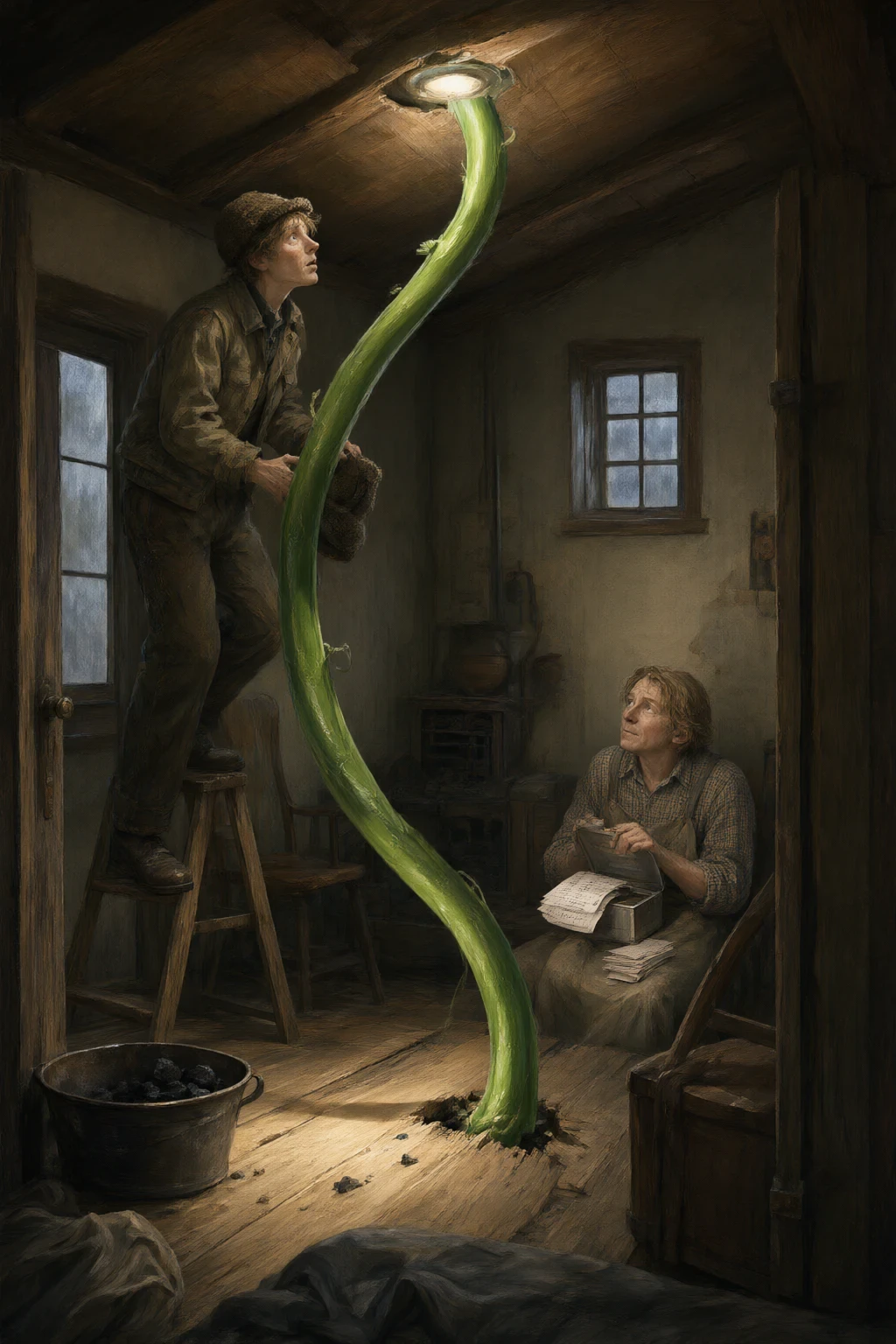
Jack was nineteen and had a Saturday job in the maltings and had, since the age of thirteen, been the person in his house who knew things his mother did not want him to know. The stalk came up through the middle of the back bedroom. It was four inches across at the floor and had, since about 2019, gone round the room once, the way a thing will if it hits a light fitting, and it had carried the whole weight of the roof without a crack. You could put a hand on it and feel it move. In August it was twenty feet a week. In 2025 it came up through the eaves of a conservatory that Errol had built for four thousand pounds, which was a great deal of money, and which had a conservatory roof that was now carried on a bean. Jack went up on the fourteenth of March, on a Sunday, in a wind that came off the reservoir and took the skin off his hands.
He had no plan. He had read about the gold. Everybody has read about the gold, and the story about the gold had lived in Marlcombe for nine years as a piece of village furniture: the giant's gold up the beanstalk, said by men in the yard of the Anchor in exactly the voice in which you might say the Flood, said by a man from the water board. Jack had decided at eleven that he would one day climb it and that the day would be dull. The gold was in the loft, in an Ideal biscuit tin with a hinged lid, and the tin did not contain gold.
It contained: one twenty-one-scarf sovereign from 1937, which had belonged to Errol's grandmother; a wage book from the old iron foundry in Chapeltown with thirty-one pay slips in it going back to 1961; an endowment mortgage policy, paid up, in the name of E. Fenton, for four thousand one hundred and forty pounds; and eleven years of rent receipts, carbon-copied, in the neat rounded hand of Rosalind Pyke, each one dated and initialled, each one bearing a figure. The sovereign was worth, in the way that coins are worth, a hundred and forty pounds. The wage book was worth nothing to anybody. The receipts were worth everything. Jack sat on a joist in the dark of a loft at the top of a beanstalk in a rented house and understood, with a clarity that stayed with him, that the most valuable object in the story of the giant's gold was a biscuit tin of old bits, and that the gold was the receipts, and that the gold had been made by a woman with a plastic bag.
There was a grey envelope on the landing at home, unopened, dated the second of March, with the district's crest on it and a sum on the front that Jack had seen in the kitchen drawer and had not been able to stop seeing. It was eight thousand four hundred pounds, and it was for the roof of the house they were in, and his mother had put it under the bills and said, in a voice like a receipt, they'll wait, they always wait. She had not opened it. That was what she did with things she had decided were not yet facts. If the tin had been full of gold he would have known in four seconds what to do with it. That was the difficulty. It was not that he was good about money. It was that the money would have been nowhere near the problem, and a decision you have not had to pay for is not a decision.
He came down with the tin under his arm and put it on the kitchen table in front of his mother and said, "This is yours, in a manner of speaking." "My word, Jack." "Eleven years of a woman's handwriting, and a wage book from a foundry, and four thousand quid of a dead man's mortgage policy. She's thirty-eight. She has no dependents because she has a cat, and the cat has a name, and it's called Bismarck." "It's her own money," Ruth said. "She knows it's her own money. That's the part I can't get past. Every night for eleven years she's been going round that terrace taking money off people who haven't got it, and she's known the whole time, and she has never once used the phrase I'm only doing my job in a conversation with me, and I have been waiting nine years to hear her say it." Ruth did not look up from the file. "Then she's not going to," she said, "and neither are you, and you've been eating my biscuits, and you've put the kettle on for two."
The night before the hearing, Errol Fenton sat on the wall at the bottom of his garden with a folder he had not needed to open since 2016 and let the beanstalk move in the wind above him, which you can feel through a brick if you lean on it. He had known who the woman was since 2018. It had come out sideways, the way it always comes out, because the Advice had run a form-filling session in the church hall and someone had mentioned a lady who came round with a plastic bag, and Ruth Anstruther had said, without looking up, Rosalind's been doing that since before I was in this town, and the first year she did it she had no carbon book and she did the whole of Marlcombe on the back of a diary from a hotel in Skegness, and Errol had thought: you know that. That is not a thing you say to a stranger.
So he had gone to the Advice on a Tuesday in 2018 with a question about a lease, and had come back with a different question, and after that they had spoken perhaps twice a year for nine years, always in the hall, always with the door open, and he had never once asked her and she had never once offered, and between them they had built the case for 14 Fenner Row out of an unrecorded oak, a 2017 schedule of conditions, a land registry search, and a rule about cash that everybody in the country broke and nobody had thought to write down.
Now he had a fortnight to lose and a folder, and in the folder there was a receipt for the first of April, and he had been carrying that receipt since the twelfth, and there was a whole month of it, eleven carbon copies, in a hand that had never changed because the woman had never changed either, and it had not been used, because he had not wanted to spend it in case it was not needed. He had bought the receipt back in April because the woman came round on the first and the notice had come on the fourth.
He sat on the wall and did the arithmetic he had been doing for nine days, and the arithmetic was this, and it was not interesting, and it was the whole case: the break clause said a tenant's interest could be determined on the anniversary, and required rent current on the anniversary, and required the notice to be served not earlier than three months before. His rent was current, because he had paid the quarter on the first, in cash, in the doorway, into a plastic bag, with a receipt for it. His interest could not be determined until the first of June, because it could not be determined before the rent was current, and the rent was not current until the first. And the notice had gone on the fourth of April, which was inside the permitted window, but a notice served inside the permitted window does not shorten the period the clause requires after the determination date. Which meant that Cray's date of possession, the eleventh of October, was a date the freeholder did not have.
Eleven weeks. Nine years' work, and eleven weeks, and the thing that had carried it was a pad from a newsagent. Errol put his hands in his pockets and looked up eleven feet, where the trunk went through the room and turned the corner by the light fitting, and said, out loud, to nobody, the thing he had said every November since 2018, when it came down and he cut it and stacked it against the flank wall and it was gone by Christmas and back in May. "You're not going to be sorry about this," he said. "I don't know what you are. But you're not going to be sorry about this."
The hearing took four hours and eleven minutes, and the panel apologised for it, and Douglas Cray cross-examined Errol Fenton for fifty minutes about the height of a beanstalk. He was good at it. He asked whether Mr Fenton was aware that a Phaseolus vulgaris could reach thirty feet in a season. He asked Mr Fenton whether he considered himself, in the context of the Wychwood survey of March, a person with a material interest in the outcome. He put the 2017 conservatory drawings in front of the panel and pointed at condition 6 and said the words retained oak in a voice that invited them to look for an oak.
He lost on the tree, because a tree is a tree. He lost on the section 172, because the council's own officer had stood in the back bedroom in 2017 drinking tea from a mug with the Marlcombe crest on it and had written the growing of horticultural material does not alter the structure of a building and no objection is raised, and the words no objection is raised were in the file, initialled and dated, and nobody had ever asked whether the officer had had authority to write them, because everybody had assumed that he did. He lost on the break clause for the reason that Errol Fenton gave in nine words, in a flat voice, with his hands on the table, and then sat down. "I paid on the first of April," he said. "There is no arrears. There has never been any arrears. The determination date has not been reached and cannot be reached early, and a notice cannot arrive before the thing it is a notice about."
The chair of the panel was a woman of about sixty who had been a rent officer in a previous life and who had a way of listening that made people keep talking. "Mr Cray," she said. "Does the freeholder accept that rent was received on the first of April?" "There is a bank transfer." "There is a bank transfer," said the chair. "On the first, for a quarter, in full. Mr Cray, does the freeholder say that receipt was not received?" "There is no receipt," said Douglas Cray. "There is no receipt," the chair agreed. "You cannot rely on the absence of a document you have never asked anybody for."
The order came in June. The break was not exercised. The tenancy continued, on the terms of the 1994 lease as amended, at one hundred and ninety-eight pounds a month, for six years and no more, and on the eleventh of October the site hoardings went up across the field behind Fenner Row, and the tower began, and it was going to be seven storeys and nineteen flats, eleven metres from Errol's kitchen window. In the same month, Marlcombe District Council resolved to make a tree preservation order in respect of the beanstalk, ref. MN/2016/0412, for a managed future height of two point four metres, which is not a height that anybody seriously expects a plant to achieve and is a number that can be entered on a schedule. The compensation for the loss of amenity was fourteen hundred and eleven pounds and sixty-one pence.
Errol Fenton set it aside. He opened a bank account in his own name with Pewsey Court on the mandate, and into it went every receipt from every household on that terrace, carbon, indexed by year, on the day it was collected, forever, in a ring binder that lived in a cupboard under the stairs at 14 Fenner Row and would be in a cupboard under the stairs long after everyone involved had finished being frightened. By the time he was sixty there were four hundred and forty-one of them in there, and when Rosalind Pyke retired, at seventy-one, he had the whole series bound, and the council's own archive asked for a copy, and he sent it, because that is what the box was for.
The tower went up. From the third floor there was a view of the reservoir, and from the fifth a view of the whole valley, and from the second, the only floor with a balcony deep enough to stand on, you could see straight down into a back bedroom where a man had had to put a wardrobe somewhere strange because of a bean. And in the second week of November, as it did every year, the stalk came down. It came down the way it had always come down, in a day, going soft at the top first, and Errol came out with a saw and the ladder and his father's old axe, and took it apart in sections, and Jack Anstruther came over to hold the far end without being asked, because in nine years he had learned that holding the far end was the job. When they had it in sections, Errol stood looking at the pile on the flagstones, and Jack said, "Right, but where do you want it?" And Errol said, "You can't do that."
"I know." "It'll be an offence." "It'll be an offence," Jack agreed, and looked at his mother, who had come over the wall from the allotment and was standing in the yard with a canvas bag over her shoulder and a rolled thing under her arm. Ruth Anstruther did not say anything about permits. She said, "Hang it in the hall." "Mum." "Alongside the rent book. Where the damp gets to it, so take it down in the spring; it won't last a decade in that room, and I'd rather it went at my hand than at the council's." She shifted the bag. "In the autumn people come in here for the poster, and they've not come for a long time, and they stand about, and the first thing they do is look up."
In the hall, above the rent book, where the damp came down the wall in winter, a stalk of bean stood nine feet high in a jar of paraffinic oil with the pods still on it, pale and fibrous and knotted, and the year it was made it smelled of a garden, and it stopped smelling of a garden, and the people who came in for the poster kept on looking up at it anyway.