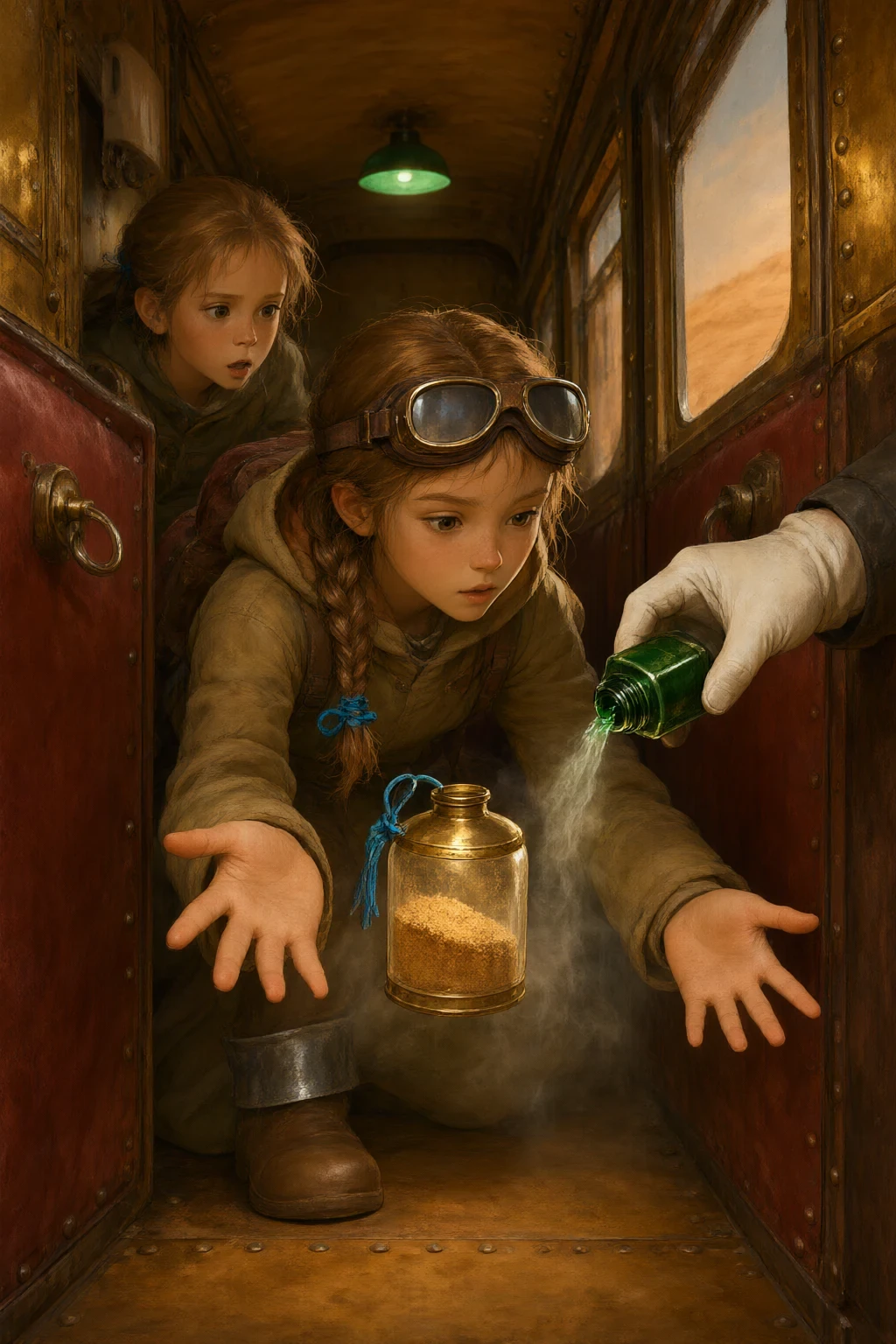
Coach Four lost its lamps one after another, like something walking along the roof, and Ilse Arrebo found a candle-end in the door pocket and pressed it into her nephew’s hand. “Go and wash your face,” she said, in the voice she used when she was frightened and pretending she was not. “Come straight back.” Tam Arrebo was ten. He went down the corridor with the candle, past the cracked leather seats, past the window where the Basin went by like something poured. The train was climbing out of the Sirocco bowl and the sand came at the glass sideways, and once the carriage tipped and every jar in the ceiling rack rang like teeth in a comb. The washroom was at the far end, a room no bigger than a wardrobe, with a bucket, a bar of yellow soap in a wire tray, and a window the colour of weak tea. Tam put his hand flat on the door. The brass was cold.
That was the first thing, and the only thing that made him stand still, because everything else in Coach Four had been warm. The ballast pipes ran under the floor plates and gave the carriage the sun’s temperature. But the cold came out from under that door and slid down the corridor across his feet like water. He opened it. Nobody was inside. There was a puddle where the bucket had dripped, and the little mirror was a coin of grey, and on the floor in the corner, lying on its side as though it had rolled there and stopped, was an hour-jar. It was brass, about the size of a good jam jar, with a crust of sand on the shoulder, and round the handle a loop of blue twine, tied the way you tie a thing you mean to keep in wind. The glass hummed. Not loudly. The way a wasp hums in the last of the summer. He picked it up, and the humming stopped.
He had been standing in the corridor with his hand on the cold door. Then he was at the washroom door holding the jar, the candle burned down to a blue-eyed stub, the towel in his hand wet, his face wet and cold, and the mirror showing a face that had been washed and nothing else at all. By morning he could not tell even himself where the hour had gone, because there was no road between the two things. Where had the candle gone from full to stub? It should have taken an hour, and he could not put one single thing in the space. Not a thought. Not a picture. Not even the feel of the brass under his hand, which was there now as clearly as if it had just happened. It was as if somebody had reached into the afternoon and taken out an hour of it and slid the two ends back together so neatly that you could not find the join.
He thought: I will show it to Auntie. Then he thought: no. He did not know why he thought that. He put the jar inside his coat, went back up the corridor, and lay down on the seat with his boots off and slept through what he turned out later was the whole of the night.
Ilse was waiting up for him. She was thirty-nine and a rigger on the Sirocco water towers, which meant she could not be trusted with small things after dark. She was sitting with her boots still on and her ticket disc in her hand. “Twenty minutes,” she said. “You were gone twenty minutes.” “Was I?” “You were.” She held up the disc: brass, a number stamped on the reverse, a blue loop of twine through the hole. “I remember standing in the market this morning. But in between there is nothing. There is a place where I ought to have been counting the minutes on this disc, and there is nothing in the place at all.” She turned the disc over. “You are ten. Ten is a bad number for gaps. I have a list.” She reached under the seat and took out a sheet of ruled paper gone soft as cloth with being folded, covered in her square upright hand. Every line began with a date and a name.
Here is what was on the list, and Ilse read it out, and the carriage rocked, and outside the sand went past like something poured. The fountain on the Arrebo tank, second floor, the day Tam was six. The whole of the day he was eight and they had flown the kite off the wash shed. And then page three, in a different ink, the one he was not supposed to hear, and she went on, because in the last year she had decided that stopping was the same as lying. His mother’s funeral, Bryn’s funeral, which Ilse was certain she had been at, and which the neighbours said she had gone out into the yard for, and come back in from, and that there had been nothing in that yard but a cat.
“Four years of that,” Ilse said. “Four years of a boy who has never once been late for anything and cannot tell me one single day he has lost. That is not a boy, Tam. That is a hole with a boy standing in front of it.” “Why has nobody asked about it?” “Because you cannot ask about it!” Her voice went down to nothing. “They look at you very kindly, Tam, and they write down that the mother died, and then they stop writing anything at all.” “Where did you find that jar,” said Ilse. And Tam said: “In the washroom.” And then he heard himself, and heard what he had left out, because the washroom had been cold, and there had been a jar in the washroom, and there ought never to be a jar in a washroom. “The jar,” she said. “The hour,” he said. “It was in the washroom. I picked it up and it stopped humming.”
He set it on the seat between them, and the little brass thing sat there in the green light with its blue twine and its sand, humming again now that nobody was holding it. “Show me the number.” There was no number on the front. Tam turned it round. Four figures and a long slash, cut into the brass with something hard and pointed, and it was not a number like the ones on tickets. “Sixty-one hours,” she said. “Sixty-one hours of a person, out of a jar, loose, in a washroom. Not the money. Nobody’s money. And it could go into anybody. Anywhere.” Her hand closed on it. “Where did you pick it up. I will be exactly as angry as I need to be, so think.” “I don’t know,” said Tam. “I remember the door. I remember the jar. In between I remember my shoes.”
Marmalade came up out of the floor at two in the morning, which is a thing she does, through a hatch the size of a bread board, and she arrived in the middle of a conversation without knocking, which is also a thing she does. She came into Coach Four wearing one boot and one boot a full size too small with its cuff patched in cut tin, and the tin made a soft scrape on every third step. “Know where that came from?” she said, sitting down opposite with her knees up. “No.” “Stall eleven. Underdune Bazaar. Bottled spare evenings, jar and twine, six hundred minutes, two hundred and ten clatter, same again? The man in the white hat said it like a prayer.” She held up the air where a jar would be. “He ties every one of them with a blue loop. Same blue. Same string. He ties them the way you tie a thing you are going to lose.” Tam sat up. “How many?” “Lots.” “Marmalade.”
“I have not been to that stall. He comes to the train.” She said it in a whisper, so that it would sound like a thing she had only half heard, because it was one. “And the lady in the fourth sleeper had one of his on her shelf, and the number on the back was the same number as the one on hers. She said it twice, which means she was not saying it for fun.” And then Marmalade went back down through the hatch with her small boot scraping, and Tam lay in the dark and thought about how nobody opens their own ticket disc to count what is on the back. Nobody does that.
Nim Ferrous came down the corridor at four and put her head into the compartment and said, “Seventy-one hours,” which was not what anybody had said to her. “Seventy-one,” she said again, “out of a jar, loose, washroom corridor, Coach Four. I counted the ballast. The ballast ran out over the last three miles and I could tell because the plates went cold under me, and I have been sitting on them for an hour. A jar does not do that.” Nim was thirteen, a junior courier, not yet on the registry, and she agreed to this before Ilse had finished the sentence. “The hour is walking,” Nim said. “The hour is in my coat,” said Tam.
“It is not in your coat. It is in the corridor, and it is walking.” She said it the way you say a thing made obvious by somebody being difficult. “It has gone past the washroom door eleven times in one direction. At the washroom end it stops and looks out of the west window, and then it goes the whole length of the carriage and looks out of it again.” “What is in the west window?” “Sand,” said Nim. “Only sand?” “Only sand, and one water tower.” She stopped, because that was not what she had meant to say, and everybody in the compartment heard her say it instead. “It looks at the tower. Every single time. It goes the whole length of this carriage to look at the tower.” Ilse put both hands flat on her knees. “The Arrebo tank is the second one along that branch,” she said. “The second one. I could tell you the water towers on that line out of a dark window in my sleep, and I have never once wanted to.”
They wired Emberwhistle at first light and Ivo Tarrow answered himself, because Ivo has answered the wire himself for eleven years, and he says so. There is a plate on his booth saying a driver may miscount but may not un-write, and a second plate under it, older, which says nothing at all. Ivo says that is the one people should read. “Read it back to me,” he said. He had a white left eyebrow burned to a stub at the tip, and nobody in the Basin can account for the stub. “Four four slash oh six one. Sixty-one hours, consigned, in the year of the flood-rail, out of the west siding, to Arrebo, Nell. Confirm you heard it correctly.” “Heard it correctly.”
“Sold once,” said Ivo, and then a pause with a great deal in it. “Which means it should not be in a washroom in the middle of the desert. It should be on a shelf in a house on the branch line, and a woman of sixty-odd should be using it when the afternoons get long. Somebody sold it a second time, and the second sale has no name on it, and it is the only line in forty-two years I cannot read.” “Nell,” said Ilse, down the wire. “That was my mother. My mother is dead eleven years and my mother never had a spare afternoon in her life.” “She never had one,” said Ivo. “That is not a comfort. That is what the numbers are. And that hour is not hers now, because the second sale is the thing that made it loose. It has been walking toward your house for eleven years and has not arrived, because your house is warm, and it prefers a person.”
“Now. The number is not a price. It is an interest. The hour was cut out of a person who did not know it, and the interest on that is not money and it is not a fine. It is the days a child in that house cannot account for. Four years of a list. Then somebody has been collecting on this house since before that boy was born, and I would like to tell you I cannot tell you whose hand it is. That is the arithmetic of it.”
“Right. Listen,” said Captain Rell Ferrite, in the corridor, at an hour when there was nothing to be gained by being awake. He was fifty-five, with three fine copper wires run through a braided beard, singed at the ends where the last time he had been under a gasbag valve had gone badly, and he arrived in a conversation as though he had been standing in the middle of it for some time. “Seventy-one hours have gone out of my ballast in three miles, so somebody is carrying them, and the only thing on this train that can carry them loose is a passenger, because a passenger is not on my manifest. Right. Listen. Here is the one thing I can do.” “Can an hour go back into a jar?” said Tam.
“Not into a jar that is already yours. A jar only fills when the engine takes the hours off a person and writes it down. That is the whole trade. To give a loose hour to somebody honestly, a person has to pay for it in their own minutes, cut in front of me, written in front of the clerk, and the hour goes into the glass and belongs to them, and not one minute of it is stolen from anybody ever again.” “Then somebody has to lose it,” said Ilse Arrebo. “Somebody has to lose it,” said Rell Ferrite, “and there is exactly one person in this carriage who has been getting it for nothing for four years, and she is the one who is going to stop, or the boy is, and I do not want to be the man who watched which way that goes.”
They stopped at a place with no name on the board, on a level grade out on the salt flats, in the dark, with the sand going by like a hand across a face. Rell Ferrite set the brace. Sol Brannen came out through the coal door with his green-shaded lamp and his white gloves on, and a green ink stain ground into the right thumb of the right one. “Mrs Arrebo,” he said. “Four four slash oh six one. Sixty-one hours, which is three thousand six hundred and sixty minutes, to be cut from you, and sealed into a jar, and entered against the second sale, which is unnamed. Three thousand six hundred and sixty minutes. Confirm you heard it correctly.”
“I heard it correctly,” said Ilse Arrebo. “I want that in the book, in your hand. I will not be able to remember giving it, and I am not asking to remember. I am asking you to be the only person alive who knows that it happened. That is a very small thing to want.” “Yes ma’am,” said Sol Brannen, and wrote it, and his hand did not shake. The brace went down through the plate with a sound like a boot heel in gravel. Tam held the jar in both hands. The glass went from grey to nothing, and nothing to a colour he had no word for, and the cold came back along the corridor and went into the jar in one long slow breath, like water down a drain. It was the same afternoon every time. Cold morning on the branch line. A woman on a hand-cart with a folded blanket. The Arrebo tank. A blue loop of twine. One hour. After that it was only a jar. It weighed nothing. It did not hum.
Emberwhistle Halt is one platform, a copper roof gone green at the edges, a bell the size of a barrel on a timber frame, and sand in every direction that has never had a building put in it. The bell was swinging when the Long Noon came in, and there is nobody at Emberwhistle to ring it but a man in a plywood booth, so somebody rang it. When Tam got down onto the warm stones, Ivo Tarrow was standing outside his booth with the rope in one hand, looking west, down a track that turned into nothing. Nim Ferrous came down the step and went straight to the boarded fares and put one finger on a line and read it out in her careful voice. “Arrebo, Nell,” she said. “Sixty-one hours. Sold once.” She looked up. “Sold once. Confirm you heard it correctly.” “I heard it correctly,” said Ivo Tarrow. “It is better now.”
“It is better now because there is a word for it,” said Nim. “It was better before.” Nim untied the blue loop off the handle, since the jar was going to be carried and the string was hers anyway, and knotted it round the neck instead, and wrote a shipping tag in green ink and tied it on. NELL ARREBO. ONE HOUR. NOT SPARE. She gave the tag to Tam. “It is not a discharge,” she said. “A discharge is a name said out loud into a book, in front of witnesses, and that is a great deal more expensive, and the man who says it is off the Line for a year afterward. That is a jar with a label on it. Almost anybody can hold a jar.” “What do I do with it?”
“Nothing,” said Nim Ferrous. “It is an hour, and it is yours, and it cost your aunt three thousand six hundred and sixty minutes. You do not have to open it. You do not have to be brave about it. Nobody can make a person open a jar, because the Line does not have your hands.” Tam Arrebo put the jar in his coat pocket, on the other side from where it had been. Behind him, in the corridor of Coach Four, the plates were warm again, the ballast was full, the washroom door was warm, and in the corner there was nothing but a clean ring in the grit, the shape of a jar that had lain there a long time.
And out on the edge of the platform, where the warm stones ran out into sand, one small boot with a cut-tin cuff was planted in the ochre, and there was somebody up on the roof of Coach Four looking east, because that was the end of the Line, and she could not go. “That is not a jar,” said Marmalade. “That is a house. I saw a house on that.” The bell hung green-edged and still above her in the middle of the morning, and did not move at all.