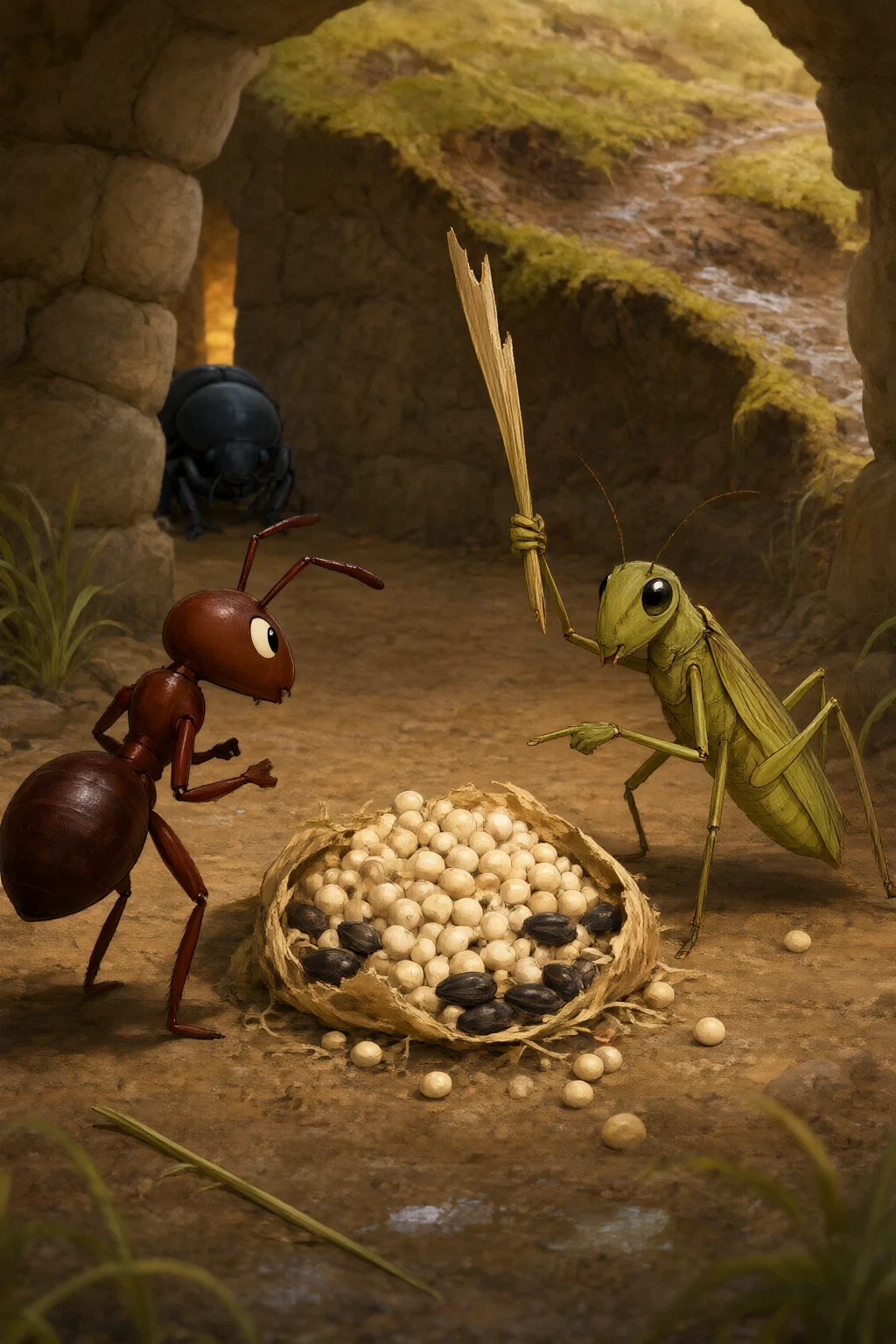
They started arguing on the first of July, which is the first warm day, which is the first day of the whole business. "I have carried four hundred and six seeds since breakfast," said the Ant. "I have carried nothing at all," said the Cricket. "Then you have had a lovely summer." "I have had a loud one," said the Cricket.
She was sitting on the warm stone by the ant hill, which was the one place in that field where the sun came through the whole afternoon. She had a blade of grass in her hand and a notch in it, and she was rubbing the notch with the tip of her feeler, the way you would work a pencil. "What is that for?" said the Ant. "That is a July," she said.
The Ant thought this was a joke, and she went off to carry another seed, and she carried nine that afternoon, all of them big, all of them from the low field where the good ones were. The Cricket marked the notch. "You are going over the same ridge," said the Cricket. "There is no counting over ridges," said the Ant. "There is carrying." "You went over the same ridge four times since noon, and the fifth time you did not put the seed down. You were still carrying it when you got to the top." The Ant stopped, because that was true, and it turned out that the two halves of that sentence sat in a very different places.
By August the Ant had a chamber full. She had dug it out herself, high in the hill on the west side where the ground was dry all the way down. Four hundred seeds in the west chamber, three hundred in the dry shelf above it, all counted twice, all counted slowly, all counted with a stone she used to scratch the tally in the clay. The Cricket had a notch. A blade of grass, and one notch a day from the first of July, and by the last of August the blade was not a blade of grass any more. It was a stick with a calendar on it. And the Cricket had said, more than once, that she was not carrying anything.
Then the rain came in September, and it did not stop for four days. Water in an ant hill is a thing that cannot be argued with. It goes where the ground lets it go. The west chamber was cut into a bank that everyone on that field had been walking on for a hundred years, and the bank had a seam in it under a stone, and nobody knew about the seam, including the Ant, because you do not test the floor of the room you sleep in.
On the fourth night of the rain the water came up out of the seam and stood in the bottom of the west chamber. By the morning there were two inches of it, and the four hundred seeds were under two inches of it, and they were beginning to go soft. The Ant did not sleep for three days. She moved what she could, and there was nowhere to move it to, and when she could not carry any more she sat in the wet and looked at the seeds going soft and did not think anything at all, because there was not room in her head for thinking.
"I will not say the thing I am about to say," said the Cricket, from the doorway, "because you are tired, and I would like you to hear it properly when you are not." "Say it." "Ask me where the seed is." "You have never carried a seed in your life." "I have never carried a seed in my life," said the Cricket, "but I have watched one all summer, every single day, and I wrote it down."
"That is not carrying," said the Ant. "No," said the Cricket. "It is a different job. Come and see if I did it." They went out into the rain together, which the Ant would not have done in July, and the Cricket held up the stick with the notches on it, and read it in the rain, which is not easy and is very exact. "Under the west stone, the loose one, the one the wall frogs live under, there are ninety-one." "Show me." There were ninety-one, dry as anything, in a chamber the Ant had walked past every day of her life.
"In the root of the oak, going round the way, not the way you go because the way you go is the long way, there are sixty-four. And in the old beetle hole by the boundary wall, because you said that one was a joke, there are thirty-eight, and I have counted them twice, and I counted them in July, which is a thing you should not have done, and which is the only reason they are dry." The Ant sat down in the wet on the path to the ant hill, which she had never done in her life.
They got all of it. That was two days of work, all of them carrying, and the Ant carried, and the Cricket read the stick out loud, and every so often the Cricket would stop and say, "Now the seventh," and the Ant would go and find the seventh. When it was done the Ant lay down in the west chamber, dry, and the Cricket lay down in the doorway. "You were right," said the Ant, in the dark. "I know which one of us was," said the Cricket. "Say it anyway."
"You were right. I carried four hundred and six seeds in June and I did not count where I put them. I was too busy being fast to be right. I put a third of them in a room I had not checked the floor of." "Yes," said the Cricket. "But there was something in the room."
Well, that was the winter. The Ant had a store and a chamber, so the store fed everybody, and there was not one hungry day in that hill. The Cricket had spent the summer singing on a warm stone and had nothing at all, and in the fourth week of the cold she could not get up, and the Ant carried her down into the warm middle and put her on the floor beside the store. "I shall remember this," said the Cricket. "You may remember it," said the Ant. "I shall not."
In April they had a conversation about what to do next, and it went on for most of the morning. "The dry seed stays where it is," said the Ant. "That is the whole point. I have been dry in my whole life and it is not a trick, it is just being careful." "I am not arguing with being careful," said the Cricket. "I am arguing with one chamber. One chamber out of nine. And a seam under a stone." "Then you may have the second room and I will move everything to the top of the hill."
"And I will have the hay in the hollow, and I will get you a stone for the east door before the rains, and do not tell me what the stone costs, because I have four hundred and twenty saved and no use for any of it, and it would be a poor thing if the store had to be carried up a hill by one tired ant to pay a mason."
And they split it there on the grass, in front of the Beetle, who lives in the wall between the field and the hill and who is the only one at that boundary who will hear both sides of an argument at once. The Ant took the seed. The Cricket took the hay and the money and the stone. "Two good heads and one bad argument," said the Beetle. "You know how common that is." "We were both half right," said the Ant. "You were both half right," said the Beetle, "which is the commonest kind of being right, and the only kind that ever beats a single clever animal."
Then it shut the door of the wall and went to bed. They argued about it that spring, and the next, and the one after. The Ant said she kept the food. The Cricket said she kept the map, and that without the map the food was a bag of wet flour in a hole in the dark, and she could prove it, and she could always prove it, because the stick with the notches on it was still in her hand.
The seed in the west chamber is dry every year. So is the seed in the oak root, because the Cricket has the Beetle check it in April. And the two of them go on arguing about it in the long grass, every evening, all the way to the end of the light.