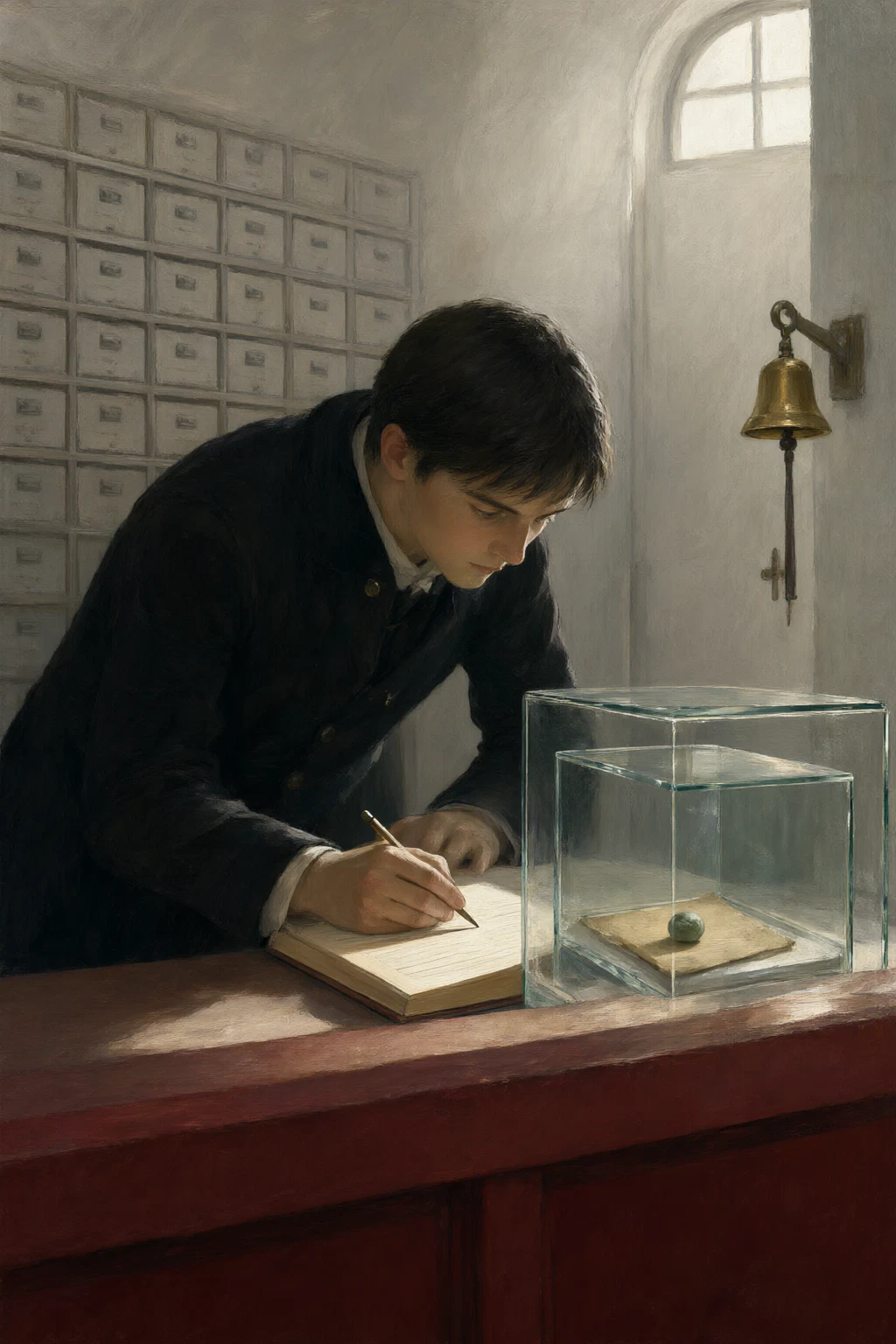
The strongroom book has a limp cover and it lies on the ledge under the north window, and Cobb Tarn opened it at four o’clock on a Thursday in October because the county audit was on the eleventh and the audit reads the reason column. The strongroom is nine feet of air around a glass case, two people in the room at a time, one north window high enough that a man cannot reach it with a chair. The case stands in drawer one, and drawer one is the only drawer in the wall with a number under the number, and the number is 1. In the case, on a card, is a pea. It is dried. That was the fact that took Cobb Tarn the whole of a Thursday afternoon to get properly in front of, and he had known it for thirty-three years.
The card carries a date and a signature. The date is the fourteenth of June, 1690. The signature is in a brown hand read so many times by so many people that the downstroke of the g has been worn to a groove, and the groove is the only part of it still certain.
The book has a column for the date and a column for the reason and then two columns for the two signatures, and the reason is written before the drawer is shut, because a reason written afterwards is a memory, and a memory is not a record, and the difference between the two is the whole reason the Bureau of Standards exists. Cobb Tarn was thirty-three. He had been registrar eleven years, had written nine hundred findings in them, and had read every one twice, and had never once read the strongroom book all the way down, because there is no reason to. You read the top line and the bottom line and the four hundred between are the same four hundred. He read it all the way down on the Thursday, because the audit was on the eleventh. Nine hundred and one lines.
He put his finger under the last one and worked back up. Fourteen March 1989. Eleven June 1988. Two September 1987. Nine hundred and one lines in eleven years, and one of them was his own, on the first morning of the first job he ever had. The top line said this: 14 March 1979. Reason: —. C. Tarn, Registrar. A. Prome, Chief Tester. There was nothing in the reason column. There was a ruled line and a space on it, the way there is a space in every ruled line in every book in every office, and Cobb Tarn had looked at that space every October for eleven years without once putting his finger on it, and the space was two hundredths of an inch deep and had been made by a nib.
Here is the arithmetic, and it took him the best part of an hour, and it is worth setting down because it is the whole of the thing. He had written nine hundred findings in eleven years. That number was his own, in his own hand, at the foot of the wall, because a running total a man keeps in his head is a running total a man can be asked about. The strongroom book had nine hundred and one lines.
Nine hundred and one lines and nine hundred findings means that one opening of drawer one had produced no finding, and Cobb Tarn went at that from the other end, the way he went at everything, twice, and from the other end it came out the same. A finding is a thing found under a mattress. A thing found under a mattress never goes back under a mattress. It goes to the Bureau, and it is a finding, and a finding is permanent, and a finding is a card, and a card is a drawer, and he had filled nine hundred and two drawers on that wall and he knew the number because he had counted them in June. So one opening, in eleven years, of the only drawer in Featherstone that is not a drawer of findings, had found nothing. Or had found something and been written down somewhere else, and he had written that somewhere else, and had not put a card in the wall.
He looked at the wall. Nine hundred and two cards, and the drawers went up past his shoulder and above his head and to where the wall met the ceiling, and drawer one was at knee height on the left where a man could reach it without a chair, and the north light came down on the glass and made it a white thing with nothing in it that you could see from the doorway. Cobb Tarn stood in the middle of the floor and did the other arithmetic, which was the one he had been not doing since the first of April. If somebody slept on it.
He took a sheet of foolscap from the ledge and wrote on it in pencil, because a pencil can be taken back, and he wrote the seven things that would happen, in the order they would happen, the way he wrote findings, which is to say without adjectives. One. The pea is under a mattress, and rule two is immediate and admits no discretion: a pea that has been under a mattress is a proof and not a standard, from the hour it goes under. Nobody in the Bureau has standing to say otherwise, including the man who signed the card in 1690, and a registrar is not permitted an opinion.
Two. The proof comes to the Bureau, because a thing found under a mattress never goes back under a mattress. It comes on a tray, and a tray comes up the cellar stair on the hands of two examiners, and there is no form of words for the procession because the procession has happened twice in two hundred years and both times it was the founding, and the founding is a joke nobody tells at work. Three. A finding is made, and it names a household, because a household is the only thing a mattress belongs to, and the name goes into the language permanently, in every town that has ever bought a Featherstone bed, and it goes in as a word. That is rule eight, and Cobb Tarn had written it out forty times himself, and it was the sentence he believed in most.
Four. The proof goes into the strongroom. Not into drawer one. There is nowhere else for it, and there has never been any need for anywhere else, because in two hundred years there has been one pea and it has not been under anything, and the question of where a second object is kept has never had to be answered by anybody. Five. Drawer one is empty. That was the one. Cobb Tarn put the pencil down at that line and read it twice, and then went on, because he was a registrar, and a registrar who stops at the bad line has not done the job. Six. Somebody must agree that the pea in the case is the pea.
He sat down on the ledge, which is not permitted, and wrote the rest. The charter, in the fourth clause, says that a standard is a thing agreed to be itself. Nine words, and they are the reason the town exists, and he had copied them out for auditors four times and had never once had to think about them until the Thursday of October in his thirty-third year. A thing agreed to be itself. Not found to be itself. Not measured to be itself. Agreed.
There are nine examiners and a registrar, and the town has four counties, and the agreement of the pea was made on the fourteenth of June 1690 by four men whose names are in the minute book upstairs and cut into the lintel of the room at the towpath, and what the four men did was sign a card. There is no other instrument. The whole authority of the Bureau of Standards of Featherstone is a piece of card with a date and a signature on it, lying under a pea in a case in a drawer at knee height in a cold room under a town. And the date is the identifying mark.
Not the name, because a pea has no name. Not a weight, because the pea is not weighed; the pea is agreed, and no scale in the town has ever touched it, and if one had, nobody would know what the number was supposed to mean. The date. The fourteenth of June 1690 is what makes this pea and not another, because that is the day it was agreed to be itself, and it is agreed and not found, and the agreement is the only thing that separates it from the eleven million dried peas in eleven million drawers in four counties that nobody has ever agreed to be anything at all. So suppose drawer one is empty. Suppose a replacement is brought. It is a pea. It is dry and it is sound and the glass fits it.
Somebody must write a card, and on the card there must be a date, because a card without a date is a card about nothing, and the date must be a date on which the thing was agreed to be itself. And the thing was not agreed on any date. It was agreed in 1690, and the 1690 pea is the one currently under somebody’s mattress, at which point it is a proof, and a proof is not a thing, and cannot be agreed to be a thing, and cannot come back.
Therefore the card cannot be written. Not refused. Cannot. There is no date available for a card about a pea that was never agreed to anything; a date put on a card would have to be false; a false card is a drawer that cannot be read; and if drawer one cannot be read then no drawer can be read, because drawer one is the drawer the rest of them are numbered from, and that is the reason the wall is a wall and not a heap. Cobb Tarn wrote that out in pencil in six lines and then wrote underneath it: There is no replacement. Therefore there is no second opening. Therefore the pea has never been under anything in two hundred years, and the reason is not care.
He had never once considered — and he was honest enough on the Thursday to write down that he had never once considered — that two hundred years of not being used was not the product of anybody’s goodness. Forty-one people had signed the reason column in eleven years, and he knew the forty-one, and he had read their reasons: the annual verification, the settling of the case, the inspection after the flood, the nine who had come down with a magnifying glass for no reason at all and had gone up again. Every one of them wrote a reason, and every one of them read the ninth clause first, because the ninth clause is the one about the pea, and it is four lines long, and it is the most quoted passage in the history of the town.
And in 1904, when the case was reglazed, the pea was re-agreed. He had the entry: second of April 1904, the pea re-agreed, the card re-signed, and there are two cards in drawer one, and the second is dated the day the case was reglazed and says that the thing under the new glass is the thing under the old glass. So it is possible to re-agree the pea. A card can be re-agreed if there is a witness to the identity. In 1904 there was a witness. The pea was in the drawer and the drawer was open and four men had seen it come out of the old glass and go into the new, and the date on the new card is the date of the transfer, and the transfer is the agreement, because the agreement is not about the pea. It is about the pea being the same pea.
And that is the whole of the protection. Two hundred years of a pea not being used rests on one door, and the door is the plain fact that a man cannot sleep on a thing that is in a drawer. He cannot sleep on it because if he does there is no card, and without a card the pea is not a standard, and without a standard the figures on nine hundred and two beds in four counties are figures nobody knows the meaning of, and the trade stops, and the flax rots in the shed and the girls of fifteen stand at the tearing machine for nothing. Cobb Tarn had spent eleven years believing the pea was kept safe by the ninth clause. It was kept safe by arithmetic.
He went up at half past five. The test floor was empty, the north windows were grey, the hundred yards between bed one and bed ninety-one was a hundred yards of walking with the wood worn in two tracks, and four examiners at the far end were doing bed eighty-eight and not talking above a murmur. The hand bell on the wall is not rung for anybody in Featherstone. It is rung when a bed comes back. Aldis Prome had the heel of his enormous careful hand pressed flat on the corner of bed eighty-eight and was not saying anything, and Cobb Tarn waited, because the discipline is not to speak to a tester at the foot of a bed. “One and four. Out. One and four,” said the chief tester, and took his hand off. That is the form. The figure, the verdict, the figure again, in case a man has been deaf, or has understood, or is writing it down.
“I have a question about the strongroom book,” said Cobb Tarn. “You have had it since the fourteenth of March,” said Aldis Prome. “No, sir.” “No,” said Aldis Prome. “I signed the second line in 1979 because two signatures are required and you were twenty-two, and a registrar of twenty-two opening the strongroom on his own is a sentence in a minute book. I signed it. I do not discuss a bed I have not personally slept in. Drawer one is not a bed. Put that in the audit as the reason I cannot help you and it will be true, and you may leave it out, and I shall not know which.”
He picked up his chalk and went back to bed eighty-eight, and Cobb Tarn stood on the worn wood and understood that he had been let off something in 1979 by a man with a rule about beds who had extended it once, to a drawer, and had never mentioned it again in eleven years and would never mention it again.
He took the sheet of foolscap out of his coat in the corridor. Seven items in pencil, and the sixth of them was the one that mattered. There was no card for it. A card goes in a drawer, and a card has a date and a name and a finding. What he had was a page of a registrar’s private arithmetic about a thing that had not happened, in a building where things that had not happened were not written down. The anomaly column. There was an anomaly column. It was ruled at the head of every page of every book in the finding office, three inches wide, in the books since 1881, and it was for discrepancies: a card with a name misspelt, a drawer with two cards in it, a figure on a bed foot rubbed illegible by a heel. In eleven years Cobb Tarn had entered nine items in it and he knew all nine by heart.
He turned to the first page of the strongroom book and wrote in pencil, in a small hand, the way a registrar writes when the room is cold: 14 March 1979. Drawer one opened. No finding. Reason not stated at the time. — C. T. Then he read it, and it was accurate, and accuracy was the whole of his trade, and it took him another ten seconds to see that the words reason not stated at the time stood against a blank he had left himself on his first morning, in a book anybody may read, in the year 1979, and that the entry was permanent, and that it would be in the anomaly column in the year 2100 with his initials at the end of it.
He did not rub it out. A registrar does not rub out an entry. A registrar enters a second entry, and the two are read together, and the second is the one that says what happened. He knew that. It was in the fourth clause, and it was the only clause anybody in the Bureau had ever needed.
He went out at six. It had gone cold, the chalk on the yard was lit, the girls had come in off the tearing machine, and the horsehair was still in the shed with the lamps on. The smoke off the burn yard lay along the towpath in a flat grey line, which is what it does when there is no wind, and there had been no wind for three days, and nobody in the Bureau had any power over the weather. A woman was standing at the corner of the terrace with a bundle on her hip and a boy of five against her knee, waiting for a handcart, and Cobb Tarn did not know her and had no reason to stop, and he stopped. “Seventeen,” he said. “The mattress in the front room. Don’t buy it off the man with the red cart, and don’t let him put a figure on it you can’t read from the doorway. Seventeen and a bit, and that’s out.”
She said thank you. He said there was nothing to it. She asked what the number was for, and he said it was how wrong a bed was allowed to be, and she said oh, and he went home. He had a bed himself, plain, with 1.6 written on the foot of it in a testing hand in 1981 and not crossed out. He had not slept well on it for a year and had not once examined why, and at ten past nine he lay down on it in the dark, in a town where the only other person who could have told him what was wrong with it had signed a piece of card in a cellar in 1979 and said nothing about it ever again. Cobb Tarn lay still and listened to the works, and did not sleep, and did not go and get a pencil.