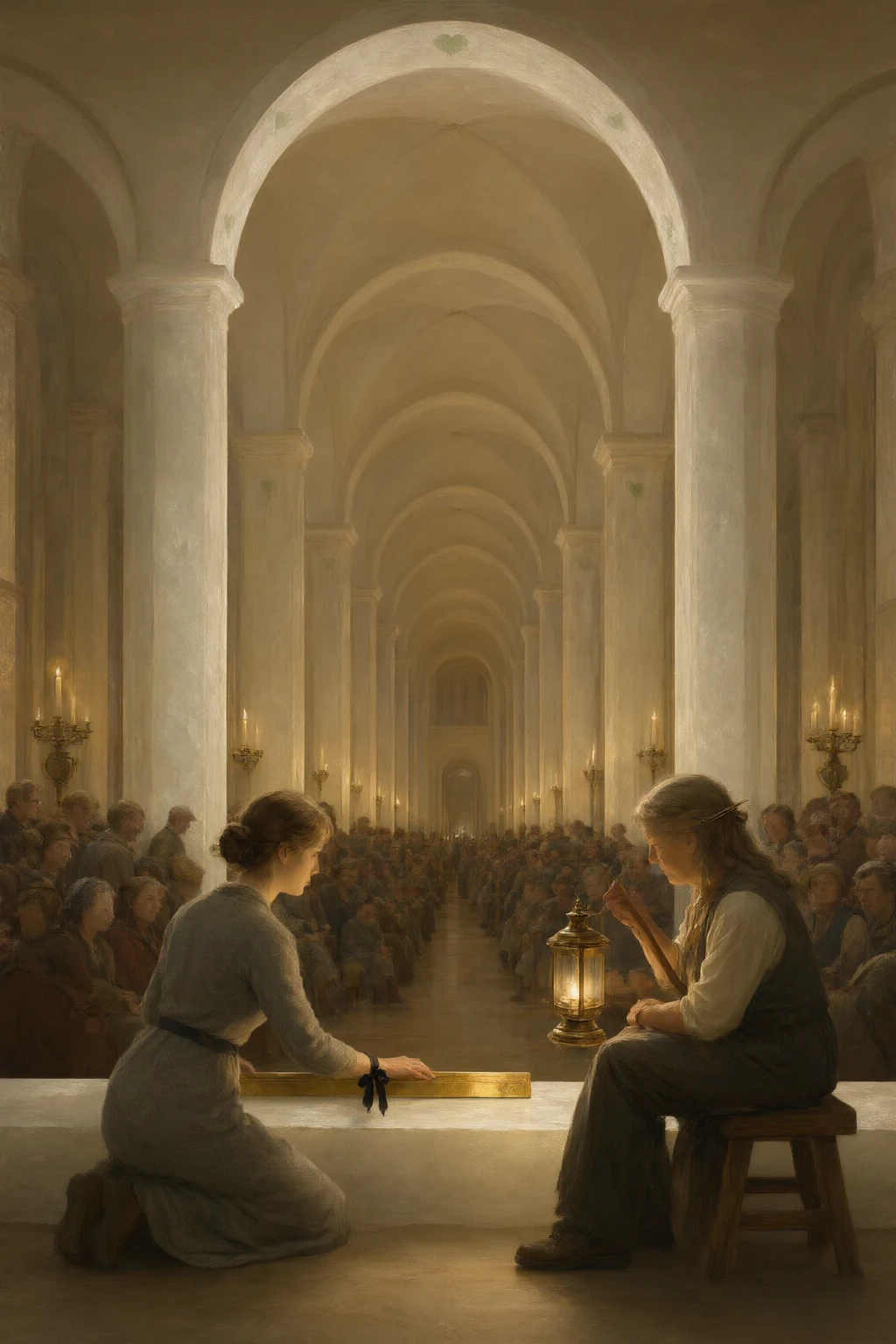
On the twenty-ninth of November, which was a Friday and therefore a market day, the count came back four and a half. Garrick Bole brought the four stations up to the Ledger Room on his knee, one at a time, the way he brought everything, and the sum was five thousand one hundred and forty cubic feet gained since the fourteenth of October, and the standing factor is eleven hundred and forty cubic feet to a column, and four and a half is the figure. Lida Trask had known the figure for six weeks. She had watched the Gallery come up the last yard of the second station with her own eyes in October and said nothing to anybody, because a Reader who says a figure before the count is a Reader who is frightened, and this book has a remedy for fright and it is not a good one. “Four and a half,” Garrick said. “Plus or minus eleven.” “Four and a half.” “Four and a half columns, and the schedule takes whole columns, and there is no half anywhere in four hundred and eleven pages.” He put the notebook down. “So the question is not how many. The question is whether the schedule can absorb it at all, and I have done that sum four times since October and I would like to do it a fifth time with the Reader in the room, because it is the worst sum in the building and I do not want to have got it wrong.” She had done it four times herself. She said so. “Then I have it too.” They did it together on the lectern, on the back of a cancelled page, because the book does not have blank paper and has not had blank paper for four hundred years.
To absorb four and a half columns the book must release four and a half columns of held salt, and the release goes to brine, and the pool under the crossing is a fixed shape. That is five thousand one hundred and forty cubic feet, and Ordin had said eleven inches for two thousand two hundred and eighty, and he had been right, and the double was twenty-two inches and a bit, and the sill of that pool is nine inches above the present level. The water would come up the sacristy stair on the fourth night and into the only dry room in the building on the fifth, and a ledger kept in water is not a ledger. “If you cancel the whole book,” Garrick said, “all four hundred and eleven pages, and let it all go at once, you will have no shortfall at all, and you will have no book, and no remedy, and no way of ever finding out what any of it was for.” “Yes,” said Lida.
“So the schedule cannot absorb it. Per the count. Per the standing orders. Per everything.” He looked at the back of the cancelled page, where the sum was. “The remedy is in the front cover and it is not secret and it is closable, and the reason it is closable is that it does not care whether it is adequate. It cares only whether the total is true. And you can make the total true this afternoon by cancelling the entire book, and the cathedral will come down to brine, and the brine is warm, and the tap is on, and Verrick drinks out of it.” “I am aware.” “Reader, that is not a thing I am able to say out loud twice.” “You have said it once,” Lida said. “I will write it on the inside cover in the smaller hand, because the remedy is written in the smaller hand, and if the remedy has a limit then the limit should be in the same hand and not in somebody’s memory. And then we will both be able to see it.”
The end of the Growing Gallery was eleven feet of growth in November and nine in October, and the rate had gone up with the shortfall, and Garrick had chalked the stations so that the last year of the thing could be read at a glance by anyone who could read a wall. At the end of the Gallery there was a room. That is not a thing most people in the building will say plainly, because saying it plainly puts a shape on it, and the shape is unbearable, and so it gets said as a supposition and gets walked past. Hesper Vail had not walked past it in a year. She had stood at the mouth of the Gallery with a lamp and looked down four hundred feet of wet white corridor at a wall of crystal that was not flat, and had said, out loud, on the fourteenth of July, to nobody in particular, “It is the shape of a hand.” She was right and nobody wanted to be the one to say so.
The growth pushed outward in four directions at once, always had, since the year it was a sacristy. Four hundred years of that had made a corridor eleven feet deep in its shortest line and rather more in its longest, and the far end of it was not a far end. It was a face. The crystal had come up over what had been a cupboard and a wall and a door and a room, and it had come up in a way that any person could read without being told: here is a small space, and here is the shape of the hand that would go into it, and here is a place for a thing that is about four inches by seven. They went in on the second of December, at the second hour, with lamps and a rule and Ivo Salter’s pick. It took nine hours and it is not a story about courage. It is a story about six people and a pick and a rule held flat across crystal that is wet and warm and does not break, because salt in this world does not break; it is set, and a set thing can be cut, but only slowly, and only with a great deal of noise, and the noise in a cathedral of this size is not a sound anybody can make twice. Halfway in, Ivo stopped, because the crystal had changed.
“You are cutting a sleeve,” he said. He was thirty-nine and kept the brine in the world from locking and had the worst voice in the choir and said so twice a day in a mild and unanswerable way. “It is not a wall in front of us. We have been cutting the arm of something for nine hours and we are at the cuff.” Hesper Vail had the lamp up against the cut and was crying without making any noise at all, which is a thing that happens at seventeen in a place where nobody is going to remark on it. Nissa Ashkel sat down on the floor of the Gallery with her back against the wall and her two good teeth together and said, “It is a sleeve because it is a hand. She is not making a room. She is making a place for the page, and she has been making it for four hundred years, and she cannot do it any faster than half an inch a week because that is the only way the building does anything.” Nobody contradicted her, and Nissa Ashkel had not been able to leave off answering a thing she could hear for a year and a day, and it was the first time in nineteen months that any of them had heard her do it on purpose.
The room behind the eleven feet was nine feet by seven and about five feet high, which is a crypt, or a cell, or a sacristy store, and it was the smoothest thing in the building. There was no lamp in it and no crystal in it either, and that was the first wrong thing, because nothing in this cathedral has stayed smooth for four hundred years, and smooth means something has been holding it smooth. On the shelf that had been a shelf, lying flat, at the height of a person kneeling, was a leaf of ruled paper. It was four inches by seven. It was the paper the Ledger is made of. It had been folded twice and unfolded once, and the creases had gone to powder. In a building at fifty-one degrees, in air that carries a fine grit that squeaks under every boot, on a shelf, in a room behind eleven feet of wet crystal, it was bone dry, and the ruled lines were still sharp, and the ink was still black. There were six hands on it. Five had signed, and those five names are on the founding leaf of the Ledger and have been there for four hundred years, and the fifth signature is a cross made by a man who could not write. The sixth mark was not a signature.
It was a line, half an inch wide, ruled dead straight across the foot of the page, in ink, made by the edge of a brass rule dipped and pressed and lifted. There was no name beside it. The space where a name goes on that page is the same size as the space where any of the other five goes, and it is empty, and it is the only empty space in the whole of the Ledger, because a page is ruled for a name and this one is ruled for a name and has never had one. “Reader,” said Hesper Vail, from the floor, on her knees, with the lamp, in a voice that was not steady. “This is the page. This is the one that is not bound.” Lida Trask had the founding page on the floor of the Ledger Room by four in the afternoon, laid out on a clean cloth, because a page four hundred years old that has been dry in a warm room is a page that will go, and you do not put a page of this book on a lectern. She did the arithmetic of it in about eleven seconds, because it was not arithmetic, it was multiplication, and she had done the multiplication in her head in the Gallery in July and had not told anybody and had not been able to stop doing it. “A leaf is a page,” she said. “A leaf of the Ledger is a page. A page is a column. The founding leaf is the note of the first column, held by the first singer, and the first singer is not in the book, because nobody stood and heard her, and because a page that is not bound is a page that is not entered, and because a page that is not entered is a debt, and the debt has been growing for four hundred years, in four directions at once, in the shape of a hand.” “That is the Gallery,” Garrick said.
“The Gallery is the fourth hundred year of the book trying to make a column for a woman it was never told about.” Lida looked at the empty space at the foot of the page. “And here is the difficulty and it is the worst arithmetic in this world and I am going to say it once. If that leaf goes into this book, the count is four hundred and twelve, and the book has four hundred and eleven pages, and the book is the only dry room there is. So to admit her we cancel one.” Nobody spoke for some time. In the room under the crossing the pool lay black and still and warm and did the loudest thing in the cathedral, which is nothing at all. “There is no reading of that which is not a trade,” Garrick said at last. “One out, one in, one living page for one dead one, and we may choose which living page, and that is the entire discretion the law allows, and I have always known there was a discretion in it and have never wanted it.” “There is a second reading,” Lida said. “There is not. Per the count, there is not.” “There is, and you have written it down yourself, in October, on the flyleaf of ninety-six.” She turned to the ledger, open at the longest line in the book, at the list of names that runs off the margin and into the flyleaf, because a form sung by six voices and heard by a room does not fit on a page. “A column is paid for by a note sung by a person, witnessed, and entered in ink by hand with a date. Every word of that is true. And not one of the four hundred and eleven pages says that the book is the only book.”
They took it to the loft, because the six work in the loft, and because a thing the six are going to be asked to sing about is a thing the six get to be in the room for. Ilde Marrow came up the seven steps and sat on the floor with her back against the rail, because she was not singing that shift, and there is a place for people who are not singing that shift, and it is the floor. Marda Vole had held the alto for eleven years, had the best voice in the building, and was forty-four years old. She made the argument for closing the book, and she made it well, and she made it standing up. “Eleven years of alto,” she said. “One tooth in the first year, one in the ninth, and a voice that will not do another eleven. I am not complaining of the price. I am complaining of the evidence. There is a leaf with five signatures and one line made by the edge of a rule and no name. I am not saying she is not real. I am saying the book has one rule, and if you admit a page on a leaf with no name on it then the book is saying believe me, and a book that says believe me is a chapel.” “Who says she is not real?” Nissa Ashkel said, from the rail.
“Nobody said she is not real. I am saying the law is what it is, and I have been in this loft eleven years and the law is the only thing in it that was not asking me for anything. And I will say the other half, since we are doing halves. The remedy is in the inside cover, it is not secret, and it works. Every time this building has run out of room the book has closed a page and it has carried on. And closing it does not kill anybody. It is not a catastrophe. It is a decision, and none of us has ever been asked to make one like it.” “Close,” said Ordin Brack. They all looked at him, because he had not spoken, and because he spoke so quietly that people had to walk closer. “Close it,” he said. “I will not. Not because it is wrong. Because I have been on that ladder nineteen years and I am telling you what closing it is, and none of you have ever asked, and I have been waiting since the fourteenth of September and you are all going to be angry with me in about a minute.” Nobody moved closer, so he said it to the middle of the room, which is how he says everything.
“There are thirty-one of them. Set voices, in four hundred years, and I knew eleven by name, and I have the eleven on the back of my left hand in pencil because I could not think where to put it. The book has a page for every one of them, and the page says what they hold, and the holding goes on after they are gone, and the building leans on them. That is the whole of what a cathedral is. It is a room that leans on people who cannot hear it.” He put his wet forearms on his knees. “If the book closes, the thirty-one go into my pool. I have swum in it. I did it in the eighth year with Bettany’s father and we came up laughing, and it was the best morning of my life, and I have not done it since, because I have four thousand people drinking out of it.” “Ordin,” said Lida. “I am not asking you not to close it. The price of the second reading is not paid by the six of us. It is paid by thirty-one people who are already past having a vote, and I have been keeping their water for nineteen years and you have all let me, because it is not a thing anybody wants to look at.”
The room was quiet in the way a room is quiet in this building, which is not empty but has a grain in it running one way, and you can lean against the grain. “If the book closes the water stops,” said Ivo Salter. “The canto keeps it moving, and no book means no canto, and a still pool four hundred feet down in a rock this size is not a pool, it is a lens, and I have seen what a lens does to a floor in a year.” “And I want to say the thing that is actually being asked of me,” said Nissa Ashkel, “because everybody has been generous tonight and I am not going to be. The growing one has a note in it that is not any of ours and it is very nearly one of ours, and I have written down one word of it in a wax tablet in a drawer in a hand I do not use. If the book closes this evening then there is no page and nowhere to put a word, and I will be listening to it for the rest of my life with nowhere to take it. I do not mind the cold. I mind the drawer.” “Hesper,” said Lida. “You found her. Say what you found and do not improve it.”
Hesper Vail put both hands flat on her knees. She was seventeen, and had a brass-tipped hairpin holding back her hair and salt-white crescents under both nails from three years of damp pages, and had not slept a whole night since the July when she stood at the mouth of the Gallery and said out loud that it was the shape of a hand. “The album did not have her. That is the first thing and it is the thing nobody wants. There are thirty-one people in it going back to 1811 and Ivet Sallow is not one, and she should be, because her granddaughter married a Bole and the Boles keep everything. The second thing is a laundry tally: Ivet Sallow, four August, eleven sheets, two shirts, in my great-grandmother’s hand, in a book of tallies from 1844 that is a household record and not a witness. The third thing is a stone under the wellhead at Verrick that says I. SALLOW and no dates, and the salt has kept the carving, which it does.” “Nan Sallow said the name on Friday,” Lida said.
“Nan Sallow said the name on Friday,” Hesper agreed. “And she is eighty-eight and she is the only witness anybody has ever had, and she was in a pub, and she heard it out of a Reader’s mouth first. If we put Ivet Sallow in on a laundry tally and a stone with no dates, then the book says a laundry tally is a witness. And it is not. And if a laundry tally is a witness then nothing in four hundred and eleven pages means anything, because you can get a laundry tally for anybody who ever had a shirt.” “That is correct,” said Lida. “Garrick Bole has been sitting there for an hour not saying anything,” Hesper said, “and he is the clerk, and I would like him to say the thing he is thinking, because the thing he is thinking is the whole of what is on the page.” Garrick Bole took his thumb off the ledger frame. “The check does not apply to the entry,” he said. “That is the only thing I have been thinking about since the twelfth of October and you are all waiting for me to have an opinion about a woman I have never seen.” He put his hand flat on the table. “A note is only sung if another living person hears it sung. That is the oldest thing in the book. But the law does not say the entry must be witnessed. It says the entry must be in ink, by hand, with a date. And a name is not a note. A name is entered out of whatever the Reader has in front of her, and not one name in four hundred and eleven pages was entered because a witness came forward. Not one. They were entered out of a mother’s memory and a shoemaker’s bill and a stone with no dates and a man who remembered the boy’s father being a thatcher. The witnesses came for the notes, not for the names.” Nobody moved.
“You have all been standing in the same sentence for a year,” Garrick said. “That a thing is only real if somebody was standing there. That is the error, and it has been the error in this building since the day the water was let in, and it has been mine for nine years because I am the only one in here who writes things down and I thought writing them down was the same as making them true.” He looked at the empty space at the foot of the founding leaf. “She is not real because we saw her. She is real because of a tally and a stone and a woman of eighty-eight who has carried a name in a house in Verrick for four hundred years without a page, and the page is not the making of the thing. The page is the acknowledging of the thing, and it is nineteen minutes late, which is nothing at all.” “If that is right,” Lida said, “then the entry is not the difficult part.” “The entry is four marks and a stamp. It has always been four marks and a stamp.” “Then what is the difficult part.”
“The difficult part is that the note has to be sung. Her note. The note she held the silence with, four hundred years ago, on this floor, which no column in four hundred and eleven ruled pages has ever been paid for, and which is therefore, as of this evening, unheld by anything, in a building where an unheld note is a debt that grows half an inch a week.” He shut the notebook. “Somebody has to sing it. And the six of us cannot find it, because it is not in the book, and because I have looked.” “It is a note with no column in it,” said Ilde Marrow, from the floor, in the note she had been holding, and then dropped, because she had noticed that Nissa was sitting with her hands over her ears. “I have been listening for it for twenty-two years. It is not loud. It is the quiet one, and you cannot sing a quiet one. If you try, you get six people holding a room, and you all did that once in October, and it was not it.” “Then how is it sung,” said Lida.
“By somebody standing there hearing it,” Ilde said. “That is all. It is not sung. It is heard. It has been heard in this building every day for four hundred years by six people and never once entered, and it will go on being a debt unless somebody stands in the room and is a witness to it, and I do not know how many that takes and I am not going to guess in front of a clerk.” There were going to have to be forty-one houses’ worth of them. Lida Trask had been on the surface once in nineteen years and had not entirely forgotten how a market day worked. So she went up the hundred and forty rungs at half past four on the second of December, which was not a market day, into a pan going blue under a low sky, and walked the four miles into Verrick, and found the Unwitnessed. The pub’s sign is a painted board with a lamp on it and nothing burning, and the argument in this world about the sign has never once been resolved. It was market day, because it was a Friday, and the ledger of the day was the block tally, the shift rota, the water allocation, and the argument about the cage, which was late, which it always was. They put it to the room at eight in the evening with a candle on the end of a table and Lida Trask standing up to be able to be seen, which she had not done since 1851 and did not mind.
“The book is four hundred and eleven pages and it is full,” she said, “and there is a woman at the bottom of it who has been owed a page for four hundred years, and the only thing that will put her in is a note that is sung and heard, and there are eleven of us and there ought to be a few more than that.” “Then it is a funeral,” said Salla Iremonger, who had been in the bakery forty years and whose bread was the reason anybody was in Verrick at all. “It is not a funeral. It is a count. I am asking forty-one houses to come down four hundred feet and stand in a room and listen, so that the note can be entered in a book, so that the book can pay for a woman. I am aware that the cage is late.” “It is late now,” said Bettany Rook, nineteen, who ran the cage, and who had run it since her father’s shoulder went. “If we go down tonight we do not come up till the second hour,” Lida said, “and the second hour is singing time, and the note has to be sung in the building with the whole room on the floor. I would rather have a hundred people for four minutes than eleven for an hour.”
“Reader,” said Nan Sallow, who was eighty-eight and had come from the far end of the village on a stick and had not asked anybody to help, and who had been sitting at the end table the entire time with her hand flat on the wood, “say the name again.” Lida said it again. It is four syllables and it is not difficult. Nan Sallow put her hand over her mouth and took it away again. “My grandmother’s name was Ivet,” she said, to the table. “At home. We never wrote it down anywhere, not once, because there was nothing to put in it. My mother had a laundry tally with it on and I thought that was a foolish thing to keep.” She looked up. “I have been eighty-eight years in this world and I want to stand in a cold room and hear somebody say my grandmother’s name out loud, and I am not going to be talked out of it, and you can put that in your book.” They went down on the night of the third of December.
It took nine hours and there is no good way to describe it except by its sounds, because the thing nobody tells you about a hundred and forty ladder rungs is that the grit gets into everybody. The squeak came up off the floor before the boots did, all the way up, the way a note arrives before the person in a building made of this stuff, and a hundred and fourteen people came off a hundred and forty rungs into a nave thirty-nine columns deep, and the floor squeaked, and the light came back doubled off the crystal, and the air tasted faintly of a dentist and of rain that has not happened, and every one of them stopped in the doorway and did not say anything for a while. Bettany Rook put Nan Sallow into the cage and rode down with her, because the cage can take a chair and a woman and it cannot take a hundred and fourteen people, and the cage was late by four hours, and the argument about the cage was had at the top of the shaft by people who had not gone down, and then the argument was over, because a thing everybody has complained about for nine years turns out to be glad of when it is the difference between a woman standing at the bottom and a woman not standing at the bottom.
They made the Ledger Room first, because it is eight feet square and there is no other way to do it. The Reader went in with the founding leaf on the cloth and the book on her arm and the candle, and the stool came out into the sacristy stair where nine people were already standing, and there was a long argument about whether a woman who was not the Reader could be allowed to sit on it, which ended when Lida Trask said that the stool had been standing in the floor of that room for nineteen years and would like a use, and put it down herself. Nan Sallow sat on it. “Nan Sallow of the second house past the smithy in Verrick,” Lida said, standing, with the candle, with the leaf, “great-granddaughter of Ivet Sallow, who founded the note of this building four hundred years ago, and who was not entered, and whose page was not bound, and who is entered now, in ink, by hand, on the second of December, in a room with a hundred and fourteen people standing in it.” “Nan Sallow, you heard it,” said Hesper Vail, because that is the check, and it is not optional, and it is done by somebody who was not there when it was decided.
“Nan Sallow heard it,” Nan Sallow said, and then, after a moment, in the voice of a woman who has thought about a thing for eighty-eight years and has never had anywhere to put it: “Well. It is said.” The entry went in. The founding leaf went in, at the front, because it is the front, and the count is four hundred and twelve, and the count is not permitted to be four hundred and twelve, and so the leaf went in as the first page of a second book. There is a bindery’s stock of account paper in four boxes in a back room at the bakery, kept dry for forty years against exactly this, because somebody in 1851 had had the same thought and had not mentioned it. The second volume is ruled for four hundred and eleven pages, bound in the same leather with the same brass corners, and it took Garrick Bole, Lida Trask and Bettany Rook, who is nineteen and cuts things, two days and most of one night. The rule is written on the inside cover in the smaller hand, because the smaller hand is where the rules go: A COLUMN IS PAID FOR BY AN ENTRY IN ANY VOLUME. THE VOLUMES ARE COUNTED. THE TOTAL IS THE SUM OF THE VOLUMES. THE BOOK IS A PRACTICE, NOT A NUMBER. At ten past four in the morning on the fourth of December, in a nave with a hundred and fourteen people standing on the floor of it, the choir sang the note that no column in four hundred and eleven ruled pages could hold. There is no account of what it was, and the account is the story.
It was not a note. It was six people doing what six people do, which is each of them holding the one order of salt they are responsible for, and then thirty of them from the floor doing what they do, which is the thing they have done every working day of their lives out loud and in company and never once on purpose. Mennick Sallow called the shift change the way he calls it every morning at the shaft head. Iver Sedge counted the well buckets. Salla Iremonger counted a traybread order, six, then seven, then a mistake, and did it again, because that is what you do with a mistake. Ivo Salter sang to the water and the water did the only thing it has ever done in four hundred years, which was to move. Garrick Bole sang with a clerk’s hand, and a clerk’s hand in a room of a hundred and fourteen people is not nothing, and it is not music either, and both of those are entered now. The sixth stood in the middle with both hands open. Ilde Marrow was at the rail, not singing, being a woman in a building for the last time. Fenn Ockham, eight, held the lamp up because he had asked to, and because he is the only person in that nave who was not frightened.
It went into the salt, and the salt did not know what to do with it for a long moment, and then it did the thing it has never done before, which was to stop trying to grow and begin to set. Ordin Brack, who had gone to the cistern ladder in the first minute and come back up it with wet to the elbow and the pale crust of pan-mud ground into his sleeve, stood in the crossing and watched the whole enormous quiet thing take a shape. Eleven feet four inches. The Gallery had measured eleven feet in four directions in every month since 1881. When the growth set, it set at eleven feet four inches, and the four inches were the thickness of the founding leaf, and Garrick Bole measured it four times with the brass rule and wrote the figure on the wall in chalk and set the date beside it, because in ninety years somebody will want to know how much it was and in what month. What it set into was a bay. Not a Gallery. A bay, twelve feet across, with four plain arches on the south side and a flat lintel line, and it was dry.
That is the part that undid them. A bay that is dry is a room where a book can be kept, and the whole trouble for four hundred years had been that the book needed a dry room and the salt was eating every room in the building. Lida Trask went into it at first light with a lamp. The floor was level to within a quarter-foot over twelve feet. The arches were square. The lintel line was true, and when she put the brass rule flat across it the light came back off the crystal and stood on the far wall ahead of her, waiting. It had made a ledger room. It had made the room the way the Ledger Room is, because the Ledger Room is the shape of a thing the salt has seen a great deal of, and it had got the warmth right too, and there was no window, and she stood in the middle of the warm dry floor and said the one thing she had been thinking for two days, to nobody, because there was nobody in there with her. “Nineteen years,” she said, “and I have never once read it aloud.”
The second volume has four hundred and eleven pages and they filled ninety-six of them between the fourth of December and the eighteenth, and it was not the six who filled them, and it was not a choir. Mennick Sallow, hauler, sixty-one years, entered the eleventh of December, the note being the block tally, sung by the shift, witnessed by thirty-one, set down by Salla Iremonger in a hand worse than the clerk’s hand and the correct hand for the job. Iver Sedge, wellhead, seventy-four, entered the twelfth, the note being the count of buckets, sung by four. Bettany Rook, nineteen, entered the fourteenth, the note being the cage. Nan Sallow, eighty-eight, entered the fifteenth, the note being the first name anybody in her family had spoken out loud in a century, and the note was a name, and a name is a note like any other, and the salt took it, and the growth in the north gallery stopped on the sixteenth, and there is a date chalked beside the mark. Fenn Ockham, eight, entered the seventeenth, because he had held the lamp up.
Garrick Bole, thirty-one, ledger clerk, entered the eighteenth, as the hand. He wanted it as a voice and it was not going to be a voice, and he had known for nine years, and what he said when Lida read it out was, “Correct,” and then he asked whether the nineteenth was free, and it was, and the nineteenth is blank and it is going to stay blank, because a book is a practice and not a number, and a practice has the next page. There are three hundred and fifteen pages left in it. They are going to be slower than the first ninety-six, because ninety-six was the ones who were in the room, and the rest of the unwitnessed are not in this room and have not been for a very long time, and Lida Trask knew, sitting in the new bay with a second lectern Bettany Rook had built out of a bakery bench, that the second volume would take the rest of her working life and the third would be somebody else’s problem and the fourth a building bigger than this one. She did not find that hopeful, exactly. She found that she could stand up in the morning.
The ribbon on her left wrist was not renewed on the eighteenth. It is in a drawer in the old Ledger Room with a three-inch file of her own and a sheet of paper bearing her initials twice, and the column she cancelled in her twentieth year was entered in the second volume on the eleventh of January, on her own authority, with a date, and it stands, and it is entered, and she has not gone to look at it. Hesper Vail was made the second Reader on the fourth of December and read the ninety-six new pages aloud over the following fortnight, which took her nine hours a night and put the salt out on her lips for the first time in her life. On the eighteenth she read the last of them and closed the book, and she did not announce it, and Garrick Bole, who notices everything and rounds nothing, looked up from the lectern and did not say anything about that either. And the new bay hums, and the whole of the cathedral hums, and it hums a fifth below the choir instead of above, which nobody has explained and which the choir has decided to be a kindness.
At the north end of the new bay there is a chalk mark, and a date, and a brass rule laid across the floor beside it, and the figure is a half-inch. It is the twenty-ninth of January. It is a fortnight’s growth at the usual rate, and the usual rate has been the usual rate for four hundred years, and the Gallery is not finished and is not going to finish, and the book is not finished, and it was the eighteenth of December that the count was true. It was true the way it is going to be true on some ordinary Tuesday in a hundred years, when somebody who has never heard of any of this lays a rule across a floor and chalks a date and does not round the figure. Down in the cistern, the tap was shut, and the level was four inches lower than it had ever been, and the amber light lay on the water in a long bar, and a man with a beard bound in copper wire came down the last four rungs backwards and shut it off again, because the fourth inch had gone into the pan at four o’clock that morning, and four inches is what Verrick gets, and it had been four inches for a hundred and forty years. “Closer,” he said, to the girl with the lamp, who had come down the ladder to look at the water because nobody ever comes down to look at the water. “The floor carries.”