The interval of a Thursday in November is twenty minutes, and on this Thursday, in the second year of a run that had gone on a hundred and forty nights, three people on the understudy bench in the wings said no. It took eleven seconds. Corvin Ashby said it first, because Corvin had been counting seconds since a Tuesday in January eleven years ago when a sentence had been missing and he had had eleven of them to fill it with. He said: I am not going on for the Salt Harvest tonight. And he said it to the hot pipe under the board, and then he said it again to Nell Tarrant, because she had asked him twice what he was doing with his hands. Then Nell said it, and the way she said it was to repeat a word. “Not going on? Not going on. Then I am not going on.” Then Ivet Prine, without looking up from the grape she had been eating for eleven years, said: “Well, if that is the mood.”
There is no punishment for it. That is the first thing to understand about the Thistlewire, and it is the reason nothing has ever happened there, and it is the reason everything that has ever happened there has happened by arithmetic. Nobody may be fined for refusing. Nobody may be dismissed. Nobody may be blacklisted. The machinery of the theatre has no procedure for it, because it was never supposed to happen, and a thing with no procedure cannot be fined, and the men who wrote the contract knew every way of keeping a man in a theatre except the one that was actually used. What refusal does is arithmetic. And the arithmetic has a shape, and the shape is a chair.
At eight minutes to nine the second-act curtain came down on three Positions with no bodies in them, and the eight on the bench did not know yet what the stage had made of it. They thought it was a gap. They thought the house would sit in the dark for a count of nine and then the gas would come up and the play would go on. Amos Derwent was in the lighting gallery, five feet above a floor of hot ash, with a shuttered lamp in his hand and a strip of oiled silk wound round his forearm. The cue for the house lights at an act change was his. It had been his since he was twelve. He had taught himself the whole gallery off the rope and nobody had ever given him the top batten. He brought the house up.
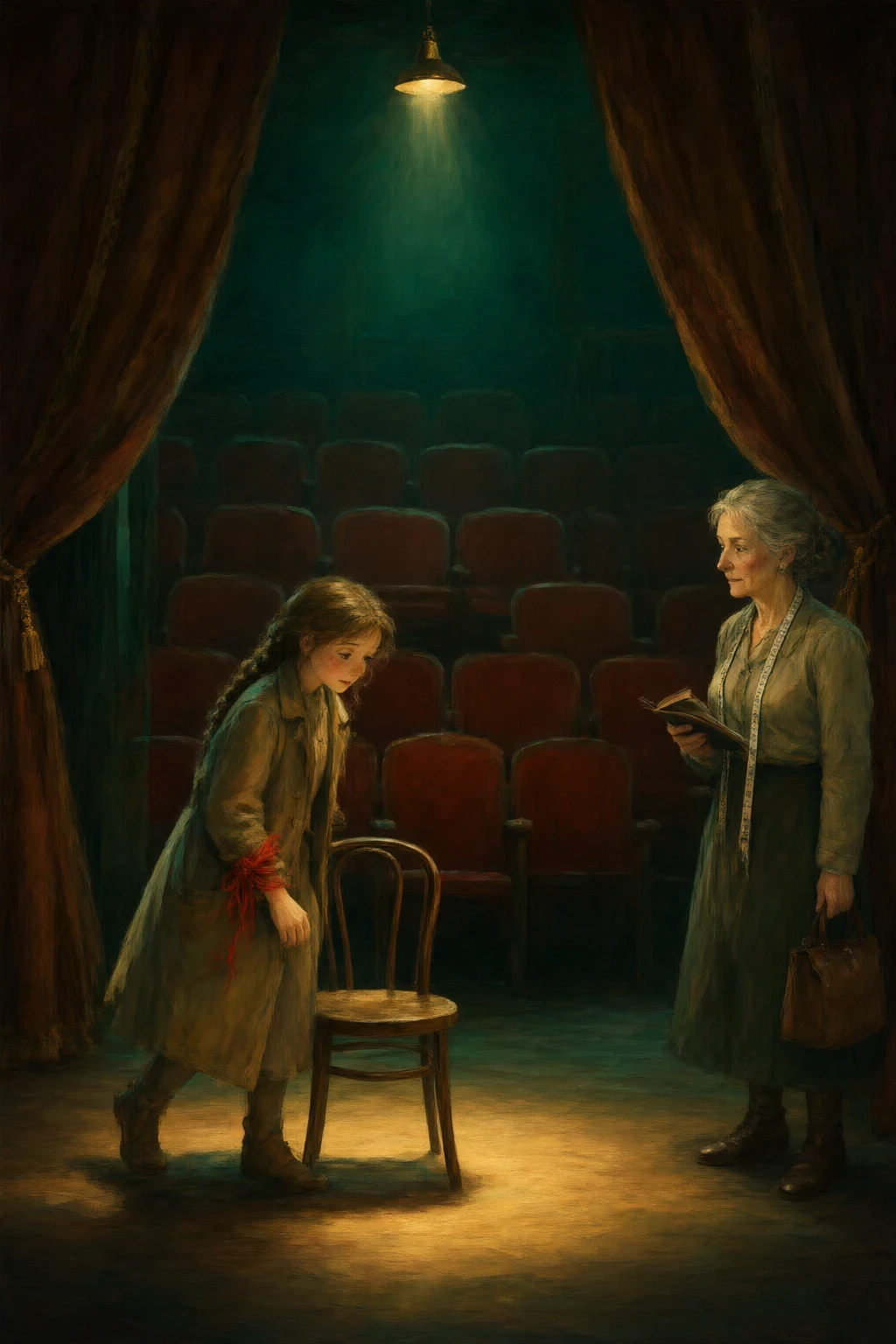
The house lights of the Thistlewire rise by inches over eleven seconds and are a hard blue-white off the side mantles, and when they are up, the four hundred and twelve faces stop being faces and become one field. On the stage, at centre, there was a chair. It was a deal chair. Four plain legs, a plain back, deal, the kind that stands in the bar parlour at the back of a public house. Nobody had carried it on. It was standing at centre stage in a light nobody had put there, and the rest of the stage had gone out around it, and the green-teal of the footlights had come up under it like water round a post. It was there for ninety seconds.
Nell Tarrant counted them. She was seventeen, and she had been counting things all evening because there was nothing else in the wings to do, and the ninety seconds are a thing every member of that corps knows the length of. She counted to ninety twice. She counted a third time and got to sixty, and then started again from nothing, because it is very long when you are looking at a chair. Nobody in the wings moved. On the stage there was a chair and nothing else, and the light was on it, and the light did not flicker, and there was no sound of anybody breathing in a theatre, which for a room with four hundred and twelve people in it is a remarkable thing, and Nell heard it, and remembered it for the rest of her life. At the end of ninety seconds the chair was still there.
That was the sentence. Nobody said it and nobody needed to. The house had been told a thing it had never been told in twenty years, and every person in the room understood it at the same moment and at the same speed, and the sound that came out of four hundred and twelve people was not a noise. It was a settling, like a hundred and fifty beards going down in a room where nobody was watching them. Then Amos Derwent took the house down again, because that was the cue, and the gas went out, and the curtain went in. Mr Durrand Fell came out of the wings at ten past nine with his hat in his hand. He was sixty-one and had been house manager of the Thistlewire for twenty-two years and he had a way of arriving that made people straighten, and he arrived that way, and then stopped, which Nell noticed, because she was counting. “Gentlemen,” he said, and then, “Ladies,” which he had never done before in his life, and then he took his hat off again and held it in both hands. “I am going to say a short thing and then I am going to go round the eight of you one at a time, and I would be obliged if you would let me finish saying it first, because I have not said it before and I want to get it right.” Nobody said anything.
“The performance tonight is a failure,” said Mr Fell. “I want to be exact, because exactness is the whole of my trade. It is not a disaster. It is not a scandal. It is a failure, and a failure is an ending, and the season ends tonight. Every subscription in this house is refunded in full. All four hundred and twelve, by Friday week, in the same hands the subscriptions were taken in, and anybody who bought at the window will be refunded at the window, and I shall be here on Friday with a ledger and a man from the bank.” He turned the hat over in his hands. “Nothing further is going to happen to anybody tonight that I can prevent,” he said, “and I have not been able to prevent it. What I can do is take a statement from each of you, because the form requires eight, and I would rather fill it in with what you actually say than with what I think you would say.” That was all. He put his hat on and went round them.
The green room is low and panelled, and the fog of greasepaint has gone into the wallpaper so far that you cannot paint a wall in it without painting over somebody. There is a long mirrored table, six chairs for eight people, and a kettle always two minutes off the boil. They went in and they did not sit down. Corvin said, “He will ask for names.” “He will ask what Position,” said Hester Vaile. She was standing at the mirror with her back to the room, taking the steel thimble off her right thumb and putting it in her pocket, which she did perhaps forty times a night. “He will ask which Position you were holding, and you will tell him, and he will write it, and that will be the whole of what is in the paper.” “Then it is the whole of what is in the paper,” said Bram Sillet.
He was standing with his back to the hot stove and his hands at his sides. A permanent greasepaint tan, and two small strips of flesh-coloured tape on his cheekbones where the paint of the Younger Brother had been worn away and laid again so often that the skin underneath gave up. Nineteen hundred and six consecutive nights, and this had been a hundred and forty, and he had not been outdoors in daylight in nineteen years, and still believed that the river was a rumour. “He takes the tray left of the door,” Bram said. “That is how the evening went. He takes the tray left of the door, and he is late, and he means to be late, and I am not going on for him, and it is a Position and not a man, and the man is asleep on a bench two hundred yards from here with somebody’s coat over him. That is the whole of the report.”
Mr Fell came into the green room at nineteen minutes past nine with a printed form on a board and a pencil on a string. He did it properly. He went to hook one and asked the name of the Position held, and wrote it, and asked whether the body had gone on at any point in the evening, and Nell said no, and he wrote that, and said thank you, and went to hook two. That was the part Nell could not bear afterwards, and she went over it for years. Because he never asked them a second question. He never asked a name. He asked which Position, and whether the body had gone on, and whether the body had broken terms, and that was all, and he wrote all three in the same hand, and there were eight lines on the form and eight Positions on them and not one of them was a person.
Ivet Prine could not stand it and said so. “Mr Fell. Mr Fell. You have written down the Widow Ferrers four times and I have not got a single line in that book with my name on it, and I have been doing that woman for six years, and I bought the earrings.” “Earrings are in the inventory,” said Mr Fell, “under the second act, and they are the property of the theatre, and they will be in the inventory on Friday.” “That is not what I — ” “It is the only thing I can put on the form, Miss Prine,” said Mr Fell, not unkindly, and not looking up. “If I put a name on it, the whole thing is a scandal, and you have read the paper as well as I have.”
They went back in and Nell stood at the end of the mirrored table and looked at the eight faces in it, which is the thing you must not do in a green room, and which she did. “My grandmother’s rent is four pounds a month,” said Silas Grieve, hook seven, fifty-six years old, the Chairman of the Ferry Board for four seasons. “And I have said that out loud now, so that it is said, and I would like it noticed that I have said it and not anybody else. I am not complaining. I am saying that I have a reason, and that the reason is money, and money is allowed to be a reason.” Nobody argued with Silas. That was the part of the forty minutes Nell kept coming back to afterwards. Nobody argued with anybody. That was the entire, unimaginable fact of it.
Hester Vaile said: “Twenty-one years of garments. Every costume this Position has worn since the building was opened, I have had it in my hands at some point and most of them twice. They go to the saleroom on Monday at a penny a pound. And there is nobody in Verrow who can sew the way I can sew, and that is a fact about the city.” “It is a fact,” said Fell, from the doorway, and then went out again, because he had a form to close. Then Ottoline Gann, hook six, fifty-two years old, the Doctor for nine seasons, said the thing that made the room go quiet for the rest of the night.
“I cannot find my own kitchen,” she said. “I did it again on Tuesday. I came in at the meal-times and I put my hand on the wall and I went the wrong way twice and a woman in the passage had to show me. I have a boy at the Foundling in Bethnal Green and I go on Sundays, and I know the way to Bethnal Green because I go on Sundays, and I do not know the way to my own house because I have slept in it four nights in nine years.” She put her hands flat on the table. “I have been the Doctor for nine seasons and I have a face laid on with tape, and if you asked me at this moment to say one true thing about my own life I could not do it. And if I go on again on Monday I will not be able to do it on Tuesday either. That is why. I am not being brave. I have run out of me.”
At twenty-seven minutes past nine Ilse Karrrow came into the green room with the Season Book under her arm, and she had a great deal to do, and she did it in the corner, at the end of the mirrored table, with a chair pulled up. Four hundred and twelve refunds, in eleven different hands, with the entries taken out of a quarter-bound volume in teal cloth with a gilt edge that is opened every day of the year at the same page. Her right hand was in a black kid-leather glove gone shiny at the index finger, and a green lorgnette hung on a black cord at her breast which she did not look through. She sat down at half past nine and said, “Sorry. Chair is mine,” to a chair. “It is cancelled,” she said, to nobody in particular. “The season. I struck it at twenty-six minutes past nine, in front of two witnesses, and it is the first time in forty-one years that page has been struck, and I would be very glad if somebody would tell me the season is not struck, because I have not wanted to do anything in my life as much as I wanted to not have done that.” Nobody told her the season was not struck.
“You will want to know what a failure costs,” she said. “I have it here and I will read it, and then nobody has to guess. The four hundred and twelve are refunded in full on Friday. That is the theatre’s money, and there is enough of it, and every one of those people gets it whether they are in a temper or not. And the corps are paid to the end of the season, and the season ended tonight, and the strike goes in on Friday in the same column as it always goes in, and it is the whole of the season’s wage for each of the eight of you, and it is not a punishment. I would be obliged if one of you would repeat that back to me, so that I know it was said.” Nobody repeated it.
“And the other thing,” said Ilse Karrrow, “is that your entries are not struck. The seats are. The season is. Your entries are not, and they are not going to be, and I want to be exact about that, because I have heard what the eight of you think this evening is going to be, and it is not going to be that.” She put two fingers on the page. “An entry cannot be struck by argument, and it cannot be struck by the management, and it cannot be struck by the board of this theatre. There is one way. Every member of the corps has to refuse, in the same house, on the same night, in the same season, and before the curtain. Three is not eight. Three is a very fine evening and it is worth what it cost, and it will not put a hand on this page, and in eleven weeks a girl will be sitting on hook one, and the Positions will be filled again, because Positions have to be filled.”
Nell went out into the lobby at thirty-one minutes past nine, because the room was too warm and because she wanted to count the people. She had been counting since the chair. That was her whole evening. She counted the stair, and the two ways out, and the people coming down, and the number going out under the board into the rain. There were still a great many of them in the lobby, because there is nowhere else for four hundred and twelve people to be at ten o’clock on a wet Thursday in Verrow, and they stood about in their coats and talked, and some of them were laughing, and one of them was crying, and the crying was not grief. It was the noise a person makes when a thing they have watched for a hundred and forty nights turns out to have been something else. And at the box office window there was a queue.
Nell went and stood at the end of it, and stood there eleven minutes, and counted the people in front of her, which was nine, and counted them twice. The man at the head of the queue was about thirty and had a hat in his hands, and he was very angry, and he was also being extremely polite, and Nell could hear all of it. “I am not making an accusation,” he was saying. “I am asking a question at a public counter, which is what the counter is for. Two nights running, the man on that stage is not the man in the gilt, and I have seen the man in the gilt — I saw him in Sennet Street in the spring with his hat off — and tonight I stood at the back and watched a different man play a part the programme says is his, and I want to know what I am to say when my wife asks me what I saw.”
The clerk behind the bars was a young man with his cuffs turned back. “I am very sorry, sir. I can’t take that.” “You can’t take it, or you won’t?” “I can’t take it, sir, and the difference is not mine. If a subscriber has been informed of any matter of the performance, the office is not permitted to sell him a seat for the remainder of the season, and I have to refuse the entry, and I refuse it in the office hand.” He turned round and wrote something, in a small upright hand, on a slip, and gave it through the bars, and the man read it, and folded it, and put it in his coat. “So that is that,” the man said. “Yes, sir. I am very sorry.”
The man did not shout. Nell was disappointed about that for weeks afterward. He said, “I have paid you thirty-one pounds for a season,” and the clerk said, “Yes, sir, and you will have it refunded in full on Friday, and I have entered it, and I am obliged to say that what you have just told me has not changed that by one penny,” and the man stood at the window a moment, and then said, “Aye,” and went out into the rain. That was the whole of the violence in the building. It was a slip of paper in a small upright hand, and it cost a man thirty-one pounds for having said a true thing out loud at a public counter, and he had not been fined, and nobody had touched him. At forty-one minutes past nine, which was the last minute Nell spent in that green room for a long time, Mr Fell came back in with the closed form on the board. The form had a line at the bottom. It said, in the same upright hand as the rest of it, NO STATEMENT OFFERED, and above the line there was a ruled space and a printed word, ANY, and Nell understood what the space was for before anybody said so, the way you understand arithmetic. “Before I close it,” said Mr Fell. “Anybody who wishes to make a statement against the form.” Nobody spoke for perhaps ten seconds. Then Nell Tarrant said: “Mr Fell. Before you close it. It was not three tonight.” “Was it not?”
“It has to be eight,” said Nell. “All of us. Same house, same night, before the curtain. That is the only thing that does it. She has just told us.” She nodded at the teal book on the end of the table. “She told us that in about two minutes, and I have not been in this building a year, and I would not have known it, so it is not written anywhere we can go and read it. It is only written in her. And if we all go back on Monday there is no rule in the world that will let any one of us out of it. Three is a fine evening. Eight would be a different thing. There is no other door in this building, and she has the key, and she does not know she has got it.” Mr Fell looked at her for some time. “That is exactly right, miss,” he said.
What happened in the next four minutes was not a scene. Nell was particular about that afterwards, to anybody who asked her, and for the rest of her life. Ezekiel Bray was on hook eight and had been the Father for eleven years, and he had nine years of the parish pension behind him and two to go, and the fund is fed by the theatre, and the fund does not take an unpaid season, and he said that in one sentence, and the sentence was arithmetic, and it was correct, and nobody in the room pretended it was not. So he did not stand up. Nell asked him afterwards, in the corridor, why not, because she was seventeen and she could not leave it alone. “Because it is not true,” said Ezekiel Bray. “It is not that I do not think you are right. You are right, and so is Corvin, and so is the old woman with the earrings, and I have watched all of you be right tonight for forty minutes, and it has not once made a single person in this building do anything they were not already going to do.” “Then what is it?”
“It is nine years,” he said. “I am fifty-eight. I have eleven years to the fund and nine are in, and a night like tonight breaks the run, and I go to sixty-nine and I have nothing, and there is not one clause in this city that will refund me.” He looked at her. “I do not say that to be a coward. I say it because somebody has to be the arithmetic. If all eight of us are the arithmetic, then it is a magnificent evening and nothing happens, and in eleven weeks a girl sits on hook one and she never learns there was another way. Tonight it is me, and I should like it minuted.” And then six of them stood up. Not all at once, and not together, and not looking at each other. Corvin Ashby got up off the bench he had sat on for two hours, with the hot print of the pipe still on his thigh, and did not explain.
Hester Vaile stood up and put her thimble back on her right thumb, which she had not done since the curtain, and said, “It is serge, and I have the pattern, and somebody will want it in eleven weeks.” Silas Grieve stood up and said, “Then my grandmother’s rent is four pounds a month in eleven weeks as well, and I have said it, and you may all have heard it.” Ivet Prine stood up and said, “Well, if that is the mood,” and sat down again, and then got up properly. Bram Sillet did not stand for some time. He stood with his hands at his sides and his face in the greasepaint tan, and Nell watched him, and thought: he is not a person. He is a rehearsal note. He is going to say a third-person thing. And what he said was:
“He does not know. He has never once been asked what he wants, and he does not have the words for it, and neither do I, and that is not the same as not having it. He has been told what he is since he was twenty-two. I should like somebody to write his own name in a book somewhere before the end of the night, and I do not know how to ask for that, and I am asking for it now.” And Mr Fell put the form down on the end of the mirrored table, and uncapped the pencil, and slid it across, and said, quite gently, “Sir, I do need a name for the position and a name for the body, and I have the position, and I have never had the body.” And Bram Sillet, who had not been outdoors in daylight in nineteen years and believed the river was a rumour, picked up the pencil, and wrote on the form in a flat and precise hand: The Younger Brother. And then, underneath it, on the next ruled line, without being asked, and without a tremor: Bram Sillet. And Nell Tarrant saw him do it, and it was the only document in the building that night on which a person and a Position appeared on the same page, and she got a pencil and copied both lines out on the back of her own hand, in case, because she had understood something in that room, which was that nobody writes these things down unless somebody writes them down.
Afterwards, the hooks. Hester went along the bench, eight hooks over two metres of bare board with a hot pipe running underneath it, and she unhooked eight coats, one at a time, and folded each one over the arm of the one before it, and made a pile. She did it in a silence so complete that Amos Derwent on the stair could hear it. Amos came down off the lighting-gallery rope with the shuttered lamp in his hand and the oiled silk round his forearm and one eyebrow burnt black. He had brought the house up and the house down and the curtain in and the curtain out, and he was fifteen, and he was not one of the eight, and there was no hook for him at all, and he had known that for two years.
The gallery had gone out. Not for the evening. For the building. The regulator in the scene-lamp room had been shut off at the wall by the engineer at thirty-two minutes past nine, and the five coloured glasses were cold, and the trough was cold, and there was ash on the catwalk that would still be there in the morning. “Does the eight include me?” said Amos Derwent. Nell looked at him. He had a shiny new scar on his thumb, and he was holding the lamp against his chest the way you hold a thing you are not sure you are allowed to be holding. “Counts?” said Nell Tarrant. “Counts. I do not know. Nobody has ever said, and I have not been in this building a year, and I have not asked, and I am going to ask, and if the answer is no I do not know what I shall do with that.” “Ask,” said Amos. “I will ask her,” said Nell. “On Friday. In the office. With the book on the desk.”
They came out of the stage door at twenty to eleven, because the stage door is the one that is not locked during a performance, and it was not locked now, and Ardle Street was running with water from the gully toward the river, and the gas outside was burning a hard blue-white and making the whole pavement the colour of weak tea, and the gilt on the board was running with rain. The crowd went out under it in ones and twos. Nell stood on the step and counted them out, because it was the last thing she knew how to do, and because she was seventeen and had had the longest forty minutes of her life and did not know yet what to put in their place. She got to two hundred and six, and gave up, and went down the street to the corner, where the chestnut brazier was out and the wet wool smelt of everybody who had gone into the building.
Six of them went west toward Board Street. Two of them went north. And eight of them had said no, and the board still had the name on it, and the paper on the quoins in a cellar in Three Fish Lane would have the name on it again on Thursday, and on the Thursday after that, and there was one way to take a name off a page in the Thistlewire, and it took every single one of them, in the same house, on the same night, and there had been three. Nell Tarrant walked home in the rain with three knots of bright red thread in her coat pocket, and she counted the paces from the stage door to the end of Ardle Street, which is one thousand and one, and she did it twice, and both times she got the same answer.