Amos Rill had been the second clerk of the Cinder Ledger Room for two years and eleven months, and he kept the column called disposed, and nobody had ever checked the column, and he had not checked it either, and there is a difference between those two sentences that took him the whole of one Monday to feel. The column is a column of tonnage. Every evening the Scale House weighs the ash of Emberwyke, and the ash that people carry to the Slag Bank instead of the Scale House goes into that column, and every Saturday the Ledger Room carries the week down to it and enters it in a hand nobody has read since the eighth clerk went to the Coalquay, and the total goes in at the foot. The eighth clerk was Amos’s uncle. That is the reason the column is in a hand nobody has read. It is not the reason nobody has asked Amos to read it. It is the reason he had spent two years copying figures out of one column of one book into another column of the same book without ever being told what the figures are for.
The line was for a signature. The form was the winter return: the season’s ash, sworn to the Crown, due on the first of April. The head of the Ledger Room told him he would be the clerk who signed it, and that the clerk who signs it carries it. Two hundred and thirteen thousand four hundred pounds of ash weighed in the season. Four thousand nine hundred and sixty-one tons and two hundredweight. He went down to the Scale House at half past four, an hour before the doors opened, because he wanted the hall to himself.
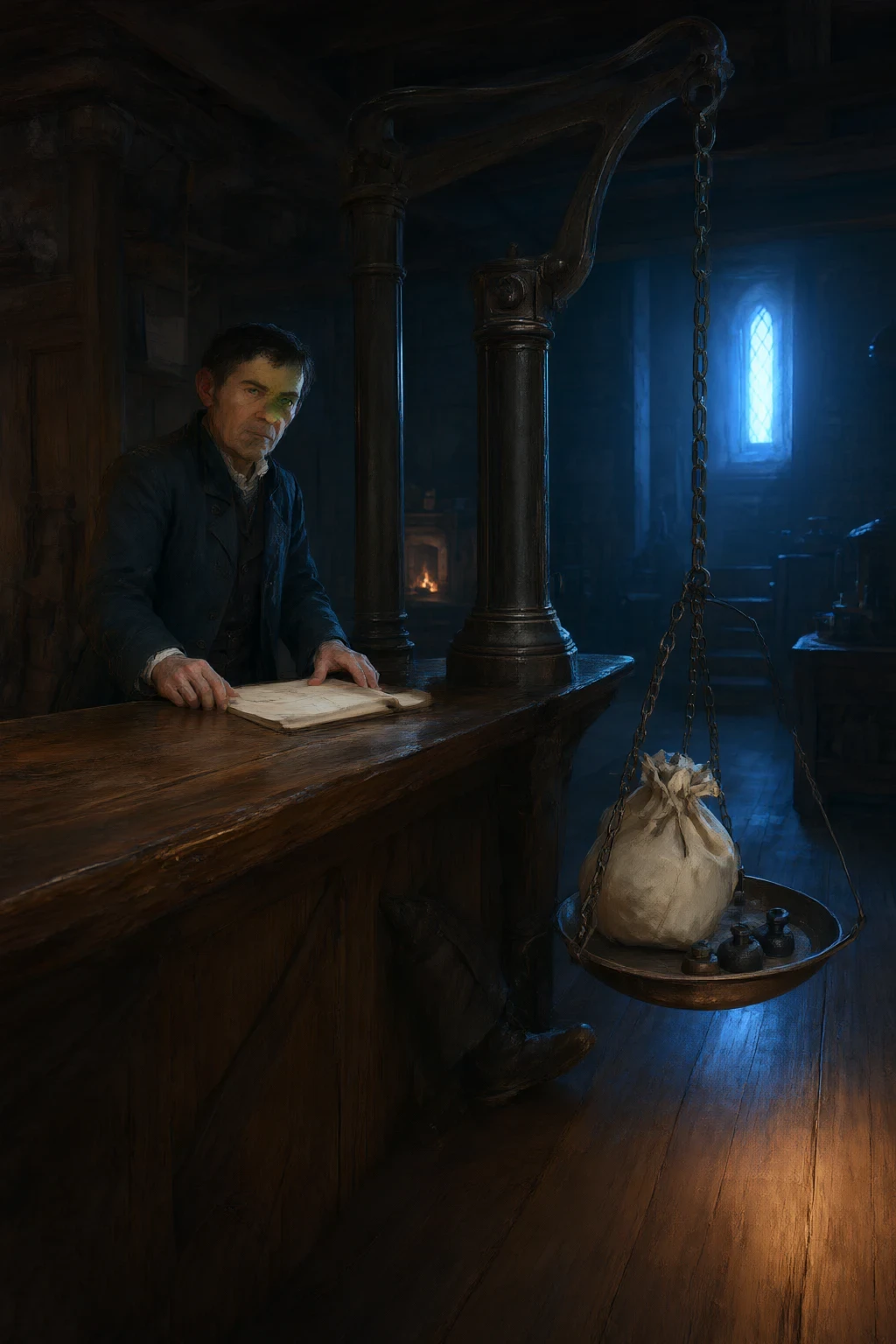
The Scale House is the only stone building in Emberwyke: a long hall, a plank floor stained in three generations of ash, an oak counter the length of it, and at the far end under the north window the beam, a bronze yoke of twenty feet of throw on a cast-iron column, with a stow of duck-weights down one side and a catch-pan under it. On the column at the height of a man’s shoulder there is a plate, cast with the beam, and the figure on it is one part in two hundred. That is the Crown’s figure. The Crown’s inspector comes twice a year out of the county seat, puts the sealed standard duck on the pan, looks at the plate, and writes in a book that is not the Scale House’s book. A beam that agrees with the standard to one part in two hundred is a sound beam. There was a man at the beam who had no business being there, and he was not the beam-man, and he had not been the beam-man for two years. He had one eye and a green shade over it, the green of a bottle held up to a lamp, and he was standing with his right foot on the sill of the stow, looking at the door.
“Forty-four years,” said Sim Uncle Prawd. “Forty-four on the balance and two off it. I come in at the same hour every morning, they have not asked me to stop, and I have not stopped.” “You test it with your shoe.” “With my shoe. It is the only thing in this room that has not changed since I was twenty-six. A hobnail, size eight, a nail through the outer edge of the heel, and it is worth on this beam three pounds eleven ounces and two grains, and I know that because I have weighed it against the plate every morning for forty-four years and it has never once disagreed with me by more than the width of this.” He held up his thumb. The nail head was about a sixteenth of an inch. “That is a worse standard than the duck.” “It is a better witness. A standard tells you where the beam is. A witness tells you where it was, and how far it has come since.” “The plate says one in two hundred.”
“The plate says one in two hundred. I work to one in four hundred.” He said it with no weight at all. “One in two hundred on a hundredweight is ten ounces and a half, and there is no clerk in this city who can read ten ounces and a half at forty feet of throw, so the Crown is generous with a number nobody can use. One in four hundred is mine. Which is the point.” “I have adjusted this beam eleven times in eleven years and written it down nine times. One in four hundred is a figure I can hold in my hand at four in the morning. One in two hundred is not. I have tried. Which is the point.”
The first thing Amos Rill did on the Monday was not to look at the beam. He took down twenty-two weeks of day-sheets from the rack by the window and unrolled them on the floor. Each sheet is one printed line ruled into three columns: the ash weighed, the ash entitled, and the difference. The whole city is in the line, and the line is made at the close of every evening by the first clerk, and it is called a balance sheet because a hearth in credit balances a hearth in credit and the city is supposed to come out even. He copied the weighed figure and the difference onto the back of a form, twenty-two pairs, and put the sheets in order of the size of the night’s weighing, small night first, and looked at the difference. It did not scatter. That is what a proportional error looks like. If the city were being robbed, or the boards were ruled in the morning and guessed at in the evening, the difference would be large on some nights and small on others.
The smallest night weighed nine thousand one hundred pounds and was short by thirty pounds and five ounces. The largest weighed a hundred and four thousand two hundred and eighty and was short by three hundred and forty-six. Thirty-one ounces on nine thousand one hundred is one part in two hundred and ninety-eight. Three hundred and forty-six pounds on a hundred and four thousand is one part in three hundred and one. He wrote on the back of the form, in a hand he did not like: the difference is one part in three hundred and one, and has been all winter, and the first year of the eleven it was one part in one thousand two hundred and forty. Fenn Oak, the first clerk, was asleep in a chair by the stove at half past seven, as he was every morning and had never been asked to stop. “Two hundred and thirteen thousand four hundred in the season,” Amos said, “and the entitlement two hundred and fifteen thousand one hundred and forty-six. One thousand seven hundred and forty-six short, by one part in three hundred and one, every night, all winter.” Fenn Oak opened the eye he opened. “You have been down to the beam.” “I have been down to the beam.” “Then he has told you he works to one in four hundred. Which is the point.” Fenn Oak sat up. “Amos. Whatever you have found, the number in the column you keep is bigger.”
He read the disposed column for the first time in two years and eleven months, from half past seven until the doors opened. It was a column of figures in his uncle’s hand: the day, the number of loads, the estimated weight of a load, the total. The totals came from the bank’s own tally, kept by a man on the bank who is not on any roll and is paid a farthing a load out of the same fund that pays the ash-runners. Two hundred and thirteen thousand four hundred pounds came through the Scale House door. The disposed column for the same season came to one thousand seven hundred and forty-one tons, which is three million four hundred and eighty-two thousand pounds, and the ratio of the second to the first is thirty-five in the hundred. Thirty-five in the hundred of the ash Emberwyke made that winter never came through a door with a beam behind it. The licensing roll is a roll of hearths and not of people. It gives every hearth an ash right: one pound of ash for every seven pounds of fuel licensed. One in seven has been the figure since the schedule was drawn, in a year when this city burned coke. Total entitlement: two hundred and fifteen thousand one hundred and forty-six pounds.
Total ash made: what came through the door, and what went to the bank, and there is no third quantity, because a fire that made ash and did not send it anywhere made it in somebody’s grate and burned it there, and that figure is very small, and he allowed it nothing. Two hundred and thirteen thousand four hundred, plus three million four hundred and eighty-two thousand, is three million six hundred and ninety-five thousand four hundred pounds of ash, against an entitlement of two hundred and fifteen thousand one hundred and forty-six. Emberwyke is not a hundred and forty-six thousand pounds short of its licensing roll. Emberwyke is one million five hundred and fifty-nine thousand eight hundred and fifty-four pounds over it. The city is in credit by that figure, and the Scale House has entered it as short, and the whole of the difference is a column that has never been checked.
He wanted a second figure, and the second figure was the fire. Fuel-grade matter is what the downs give you after the coal that will burn has been taken out of them. It is sold at a discount, and the discount is why it is sold, and it is licensed separately, weighed separately, marked, and the whole of the marking is on the fuel and not on the ash, which is the point, and the point is legal. A hearth burning fuel-grade matter instead of coke makes about twice the ash for the same heat. The licence does not care. The ash right does not care. The ash right is one in seven for a hearth that burns coke and one in seven for a hearth that burns what is left of the seam, and the two are entered in the same column of the same roll under the same heading, and the one on the discount has twice as much to carry and exactly the same farthing. A farthing buys one sack carried to the Scale House and weighed. A farthing is the whole of what an ash-runner is paid, and the fund it comes out of is voted in June by men who are not cold in June.
The poorer quarters burn fuel-grade matter because that is what is cheap, so they make twice the ash, so they have twice as many sacks, so the farthing buys half the sacks. The other half goes to the bank, where disposal is free, and the bank is a good citizen and keeps a tally. He wrote that down in the same hand, and read back the four pages he had filled, and the four pages were the audit: a day, no instruments, and a finding made out of arithmetic and the wording of two documents, one a printing and the other a hand nobody had read for eleven years.
On the Tuesday he asked the beam-man for the sealed standard. The standard is a cast duck of four pounds, kept in a case under a brass rail. The case takes two keys, and the clerk who opens it signs the book, and the clerk who signs the book is the second clerk. The slip for this year said the standard agrees with the Crown’s copy to one part in two thousand one hundred. So the standard was right. The stow of ducks goes on the near arm. The catch-pan and the sack go on the far arm. Everybody in Emberwyke weighs ash with that beam in that position and has for a century, because the bench is built in the shape of a householder carrying a sack in one hand and paying with the other. He put the standard on the pan and the fourteen-pound duck on the stow. The beam settled with the pointer a little past the index, and he took the duck down and put up another from the drawer of odds, and that one balanced, and it was fourteen pounds one ounce and twenty-two grains, and the one in the stow was fourteen pounds.
He wrote both figures down and loaded the sides the other way round, and the beam said the same thing both times. It does not care which side you load. It cares which side is which, and it is out by one part in three hundred and one in the direction that makes the Sack arm the heavy one. You were being short. That was the direction. The city was being weighed short, one part in three hundred and one, for eleven years, and the plate said one part in two hundred, so the beam was a good beam, inside its warranty, inspected in the spring. “That is a well-found beam,” said the beam-man, looking over his shoulder at the plate. “It is a well-found beam,” Amos Rill agreed. “It is out by a foot of iron and stone and a river.”
The foot of the column stands on a stone bearing, and the bearing on a raft of chalk and clay nine feet down, and the Scale House is on the only high ground in the flood plain, which is four inches lower than it was when the charter was granted. A lean does not show. Put nothing on a beam and it sits on its stops and the pointer means nothing, which is why a leaning beam is the last fault a man looks for and the only one he cannot see by looking. A lean shows under load, in proportion to the load, in one direction, and the direction is the direction the column has gone, which is towards the river. Sim Uncle Prawd came in at four and let himself be told. “Nine hundred and forty,” he said when Amos gave him the reading off the plate, which is how he gives everything, as a number before it is anything else. “You cannot get it back with the nut.”
“No. The nut sets the beam for no load, and the load is where the error is.” He put his hand flat on the column at the height of the plate, the way a man rests a hand on a horse. “To move it properly you take the beam off its yoke, and to do that you have a beam on the floor of a hall with eleven thousand hearths standing in the rain behind you, and the Crown does not send an engineer for nothing. So you do it with brass. A strip of brass under the hook of the pan takes a part of the lean out, and next year you put a thicker strip.” “How thick.” “That is the work.” He took out a green book with a limp cover. “Eleven times. Here is the book. Date, error found, thickness, placed by, entered by. Nine lines have four names. Two lines have three.”
“Seventh of December, the year of the water. Nineteen ninety-four, if you want it in your fashion. It was not a flood, it was a very high tide and a bad wind together, and the hall stood in nine inches of river water for two days and we weighed nothing for nine. After that I found it at one in one thousand two hundred and forty and I put in a strip and wrote it down, because an adjustment that is not written down is not an adjustment, it is a wish.” “The fourth of January, six years ago,” said Amos, “and the nineteenth of November, two years ago. Those are the two years the inspector did not come.”
The Crown’s inspection is not a difficulty. It is an instrument. A beam out of warranty is not illegal; it is simply not a beam the city may weigh its own ash on, and a city that cannot weigh its own ash may take it to the Colquay scale, three miles downriver, where it will be weighed if it is put in the queue, and the queue is two days in a good week. The inspection was not put off because of the strike at the Colquay, which lasted nine weeks and was about money. The Crown’s man went to the Colquay first, found a queue, and the county wrote that the Emberwyke inspection would be held on the following Thursday; and on the fourth of January Sim Uncle Prawd had put a strip of brass under the hook of the Scale House pan in a hall with the shutters up and no clerk in the building, and had written the thickness on the back of a dray tally and not in the beam book. The reason was in the county’s own letter, in the fourth clause, which he could recite. If the instrument be found to have been altered otherwise than by the adjustment of the nut, then the warranty is void from the finding.
Nine words. He had read them in a shuttered hall at four in the morning, and eleven times since in a good light in the county seat, with the Crown’s man on the other side of the table saying nothing at all. “A strip under a hook is a washer,” Amos said. “It is a washer on a beam under warranty, and the warranty says the instrument has not been altered, and a washer is an alteration, and if they find it they do not take the washer off. They take the warranty off.” He sat on the edge of the catch-pan, which he was not supposed to do. “And then the Colquay for nine weeks in the middle of the worst winter in eleven years. Which is the point, Amos. The point has been the point for eleven years. I would rather the city be one part in three hundred and one wrong than out of warranty in February. You may put that in your form. All of it. I do not want it in a form. I want it in a form. That is the difference between a mistake and a thing somebody did.”
He wrote it in a form on the Thursday night, with the stove at its figure and the eleventh volume open at the year’s end. The beam is out at one part in three hundred and one. It is out because the north footing of the Scale House has settled towards the river. The settling cannot be taken out with the nut and has been taken out with brass eleven times in eleven years, of which nine are entered in the beam book at the entry for the date. The Crown’s inspection was not held on two of the dates, and the adjustment for those dates was made with the instrument under warranty and has not been entered, for the reason in the fourth clause. The error has been inside the Crown’s tolerance at every inspection since the year of the water, and the beam is a good beam. He read the ninth line over twice, decided that it was the line somebody not interested in the ninth line would read, and split it. The Crown’s tolerance is one part in two hundred. The Scale House has worked to one part in four hundred since the year of the water. Which is the point.
He wrote the two figures in the margin, and initialled them, and read the date out, and Sim Uncle Prawd, who had come up because he could not hear a pencil, said the date out again after him. “That is the first time in eleven years that figure has been on a piece of paper in this building,” he said. “There is a boy at the bottom of the street who could have had it any time he liked, and nobody ever asked him, because he is a boy, and because it is my head, and because one does not ask a man for the number in his head. One asks the plate.”
The Crown’s letter came on the Friday, four pages, dated the third of April, addressed to the Scale House and not to the Ledger Room, signed by the Receiver of Ash for the lower river. It began by acknowledging the winter return and the clerk’s signature, which was Amos Rill’s first correspondence in his life, and it disputed no figure in it. Then the Receiver set out, over two pages and in a table, the county’s view of the season’s ash: the ash weighed, the ash entitled, the duty upon the whole at the schedule rate, the duty paid, and the duty outstanding. The duty outstanding was one hundred and ninety-three tons and four hundredweight, which is the whole of the lean for eleven seasons at one hundred and thirteen tons and six hundredweight, with the interest the schedule allows and no allowance for the nine days in the year of the water when nothing was weighed at all. The third page was why he read it three times. The Receiver observed that the duty is by the schedule computed upon the ash of the hearths as licensed, and not upon the ash as weighed, and that the schedule was drawn in that form in the year of the schedule, and that the Receiver was not asking for anything in respect of ash not weighed, and had no figure for it, and would not be asking.
Emberwyke had made a million five hundred and fifty-nine thousand eight hundred and fifty-four pounds more ash than its licence gave it for, and the Receiver had no figure for it, and would not be asking, and had put that in a letter in his own hand on his own paper with a date on it. Nobody in Emberwyke was going to be asked for it. That was the third page. It was the largest number in the correspondence and it was the shape of a hole.
Mared Holt came in at half past nine with her barrow and put the sack on the pan in four moves without looking at the beam, and she apologised to the beam-man before she said anything else, as she apologises before every sentence she has ever said, including the word no. “Sorry. I am sorry to be late on a Saturday.” “You are not late.” “Sorry.” She straightened up. Her board is the longest clean board in the Rope Walk and has been for twenty-nine years, and the reason it is clean is that she weighs her own barrow empty every night with a stone in the false bottom, and the difference is two pounds a month entered in a column of her own devising with no heading at all. She had never told anybody about the column. There was nobody to tell. “The weight is on the sheet,” she said. “And you have the season’s sheets.” “I have them. I have a number out of them of one part in three hundred and one, and I have another number out of them that is not.” He put the sheet down on the counter, which nobody does. “It says you have brought in about forty pounds a night more than anybody on that street, every night, for eleven years.”
The hall went on being a hall. The beam went on being a beam, twenty feet of throw, with the whole city in the difference and nothing at all in the middle of it. Mared Holt looked at the sheet. “There is ballast in this barrow.” “Yes.” “A stone in the false bottom, and I have had it since the year my mother died, and it is not ash, it is a stone, and I take it out on Fridays and wash the bottom and put it back, and I have never told a living soul, and I have wanted to be out of the room for about two years.” She said it as she says everything, the apology first and the fact after it, in the same breath, as though the two were one sentence that had to be got out whole. “Forty pounds a night is one part in thirty-three,” said Amos Rill. “The beam is one part in three hundred and one. I cannot enter you on this, and I would not if I could, because you have been correcting me by forty pounds and I do not know what your night weighs.” “Forty-one pounds,” said Mared Holt. “It was forty-one in the summer and it is thirty-eight now and I have never once been late.”
At four that morning she walked down to the Slag Bank with the barrow and no sack in it and put the stone into the black water at the edge, which is warm and does not freeze. There are people on that bank at four in the morning with a hooked rod and a sieve, and they do not stop a woman for a stone, and one of them said good morning and one of them did not. A child of about nine was there with a slate, counting the barrow-loads as they came off the tip, because the copper in the ash is worth something and the count is how you know which tip, and nobody had ever asked her for her number. Then Mared Holt washed the barrow out and dried it and turned it over, and on the Monday night she came down the Rope Walk in the rain with forty pounds of ash in a sack on a barrow with an honest bottom, and she was on time. The Scale House weighed it, and credited the Rope Walk with thirty-eight pounds, and the Rope Walk was eight pounds worse off than it had been the night before, and the thirty-eight was the truest number on the whole of the Rope Walk.
On the Monday Amos Rill did a thing that had not been done in the Ledger Room in the eleven years of the volumes he had been copying out of. He carried the day’s sheet up to the lectern, took the week’s disposed tally out of the rack, added the two, and wrote under the three printed columns, which is not a printed column and has no name: disposed, one hundred and forty-six tons and two hundredweight. Then he carried the name and the tonnage forward and made the total at the foot of the disposed column, for the first time, in eleven volumes, in the hand of a clerk who was not his uncle. The season closed on the last night of March and the return went out on the first of April with the one hundred and ninety-three tons and four hundredweight in it, in a form the first clerk had checked and the head had checked and the second clerk had signed. It was a true return, and it said nothing whatever about the largest number in Emberwyke. On the Tuesday morning the balance sheet for Monday night came down from the hall, and a new season had begun with a fresh roll and eleven thousand hearths who would all of them come out short or over according to where they lived and what they could afford to have weighed.
The sheet said: weighed, sixty-one thousand four hundred. Entitled, sixty-one thousand six hundred and four. Difference, two hundred and four, short. Two hundred and four pounds is one part in three hundred and one. Sim Uncle Prawd read it over the clerk’s shoulder at the counter, the way he had read it every morning for forty-four years, and then said the number, because he always said the number. “Two hundred and four,” he said. “One in three hundred and one.” And then: “Which is the point.”