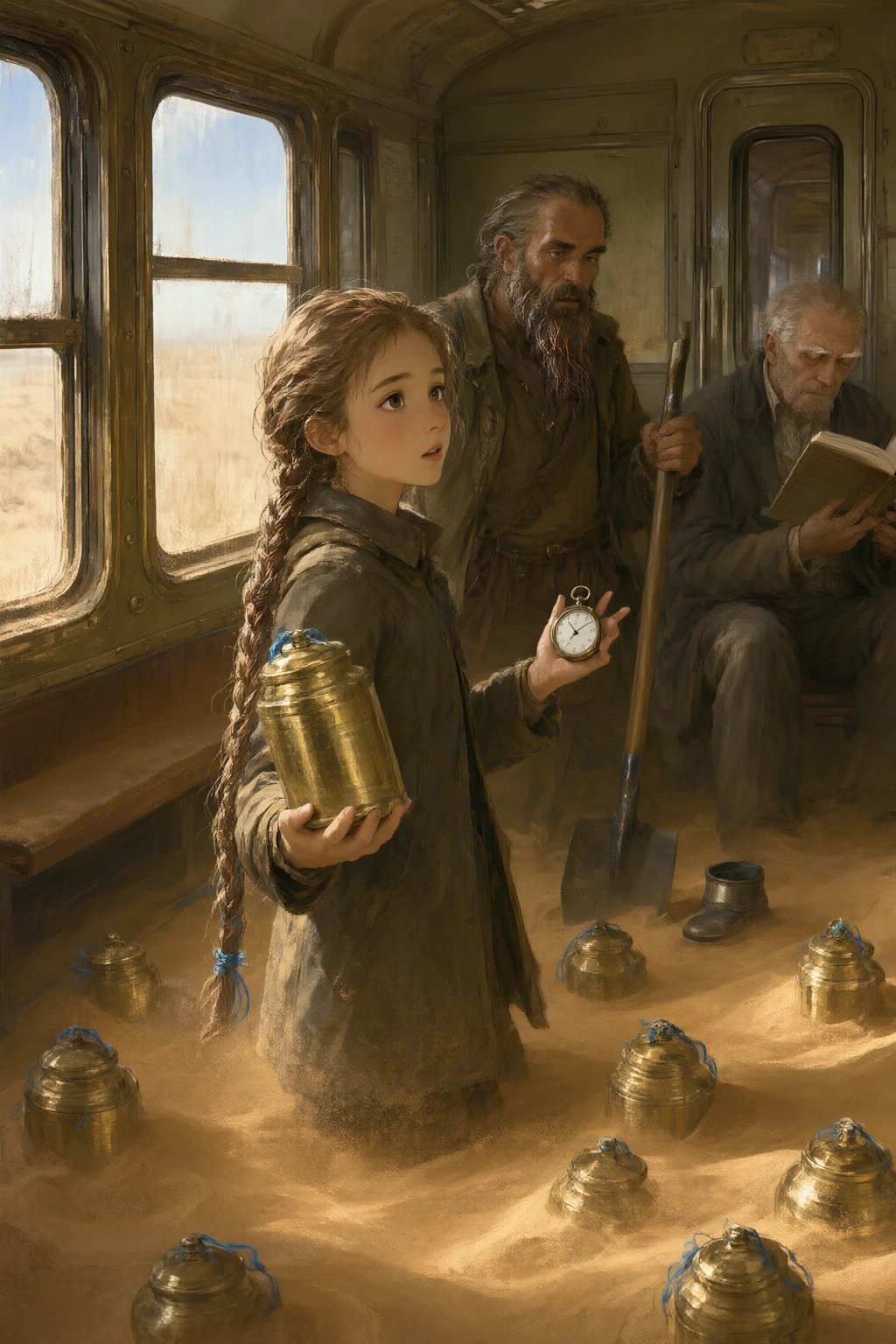
Coach Nine stands on the third siding at Sirocco with a painted band round it, and nobody keeps it, and everybody checks it. That is the arrangement. Twice a year a man walks the length of it with a lamp and looks at the seals and walks away again, and the last man to do it left a note in the gate book that said the band was sound and the windows were filmed and the paint was not lifting, and that note was true in every particular and had been true for forty years. What was not in the note was the sand.
Halda Roon was a Yard runner with a hand-cart and eleven years of hauling and she found it because her wheel caught. The gutter along the third siding, which takes the wash from the bazaar and has not held water since the bazaar moved its roof, was full of ochre sand up to the axle. It had come out from under Coach Nine and spread down the fall of the sleepers and gone along the ballast and out onto the apron, and where the morning light hit it the whole strip was the colour of a lit coal. “It is warm,” she said. That was the part she could not get past afterwards. It was warm, and it weighed more than it had any business weighing, and it hummed.
Nim Ferrous got out of the underframe of the brake van with grit in her teeth and one copper braid down one side of her head coming loose from its blue twine, and Marmalade was already sitting on the end of the siding with her boots off. “You are not going in it,” said Nim. “I have not been in it for two years.” “Marmalade.” “Heard it,” said Marmalade. “Says the woman with the band round it. Says she sleeps in it when it rains. Says it is a house.” She pointed her small boot at the carriage. “It is not a house. A house has got a floor you can see.”
They cut the band at the coupling and went in at the end door, and the corridor was full. Not sand as the desert is full of sand. Sand to the knee, and warm, and weightless, so that you sank in it without any sense of having gone down at all, and when they stopped walking the humming stopped, and when they walked again it came on again under their boots like a dog that has been waiting. It smelled of hot iron and cut grass. The windows were filmed over from the inside, and the film had gone the colour and the thickness of a bad window-pane, and behind it there was no light at all. The seats had gone down like bread, both rows, the whole length, as though the carriage had been left in the sun for a year and had done what a thing does when it is left. On the second seat there was a pocket-watch.
Nim picked it up. The dial was smooth, with no hands on it at all, and it was the size of a good boiled egg, and it ticked. She turned it over on her palm and there was a number scratched into the back with something hard and pointed. “Two one eight,” she said. “That is a number of something,” said Marmalade. “It is a number of something,” said Nim Ferrous. Right. Listen,” said Captain Rell Ferrite, and came in backwards through the end door with a spade over his shoulder, and put his boots on top of a bench. “Nobody is going to be in here for long. That is not sand. That is spent hours, and spent hours come loose when they are not written down anywhere, which happens to coach bodies, and I have seen it twice, and both times it was in a shed. Right. Listen. We are going to count it, and then we are going to get out, and if you have to be carried out, you will be carried out, and I will not apologise.” “Sand does not hum,” said Marmalade. “No,” said Rell Ferrite. “It does not.”
They dug for nine hours and the spade went through the sand to brass. The first jar came up with a handful of sand in it, empty, brass, about the size of a jam jar, with a crust of dry grit on the shoulder and a loop of blue twine on the handle. Then eleven more. Then a hundred. Then the spade stopped being the right tool and they got the crates out of the gantry and worked by hand and by shift, and by dark there were twelve thousand one hundred and eighty jars lying in rows across the floor of Coach Nine, and every one of them was empty, and every one of them had a shipping tag on it, and every one of them had a blue loop on the handle. And on every one of them, the loop was tied twice.
“A knot tied twice is a cut knot,” said Sol Brannen, kneeling in the sand in his white gloves with the green-shaded lamp hooked over his wrist, and a green ink stain ground into the right thumb of the right one. “The twine is the seal. A loop that has been cut and retied is a loop whose count has been released. The Yard looks for it from the ridge, which is why every handle on this Line carries one.” “Released to whom,” said Nim. “To nobody,” said Sol Brannen. “That is the part nobody likes. When the twine is cut the count goes back to the rack. Officially the hours are in the rack again. In practice the hours are in whoever carried the jar away.”
The tags were the same consignment, twelve thousand one hundred and eighty of them, and it took Nim and the cooks and two clerks from the gate nine hours to read them out loud in rows. “Kellvetch, month of Long Heat. Survey ballast, Line’s second year. Coached for the wash-through. Discharge at the wash-through.” Twelve thousand one hundred and eighty times, in four hands, over two days, until the reader’s voice went and Sol Brannen read the rest of them himself, standing up, with the lamp in his teeth. “Twelve thousand one hundred and eighty,” he said. “Six hours each. Seventy-three thousand and eighty hours, consigned to a survey that came back with three engines and no ballast, and the discharge was never entered, because there was nothing to discharge, and the carriage has stood here ever since with the hours still in it and the hours not in it.” He looked at Nim. “Confirm you heard it correctly.” “Heard it correctly,” said Nim Ferrous.
“Then let us have the number that is the actual number. Seventy-three thousand and eighty is what the tags say, and the tags only account for the night. The carriage says otherwise, and the carriage is the instrument, and I will be bound by the carriage. Four hundred and six thousand one hundred and twelve hours, and twelve minutes, and no more and no less, and I cannot tell you how I know, and I have never been able to tell you how I know.”
Nobody sleeps under a coach for two years because the coach is comfortable. Marmalade had slept under Coach Nine because Coach Nine was the warmest place she knew and because there was a gap in the ballast sleepers at the end where a person of nine could put a blanket and be out of the wind. She said so, twice, to two different people, and the second time she added the part she had only half heard. “They never unloaded it,” she whispered. “The men that left it, they went off toward the far end and they were not carrying anything. I was under here, and I heard them say, nothing to put in her.” “She?” “The carriage,” said Marmalade. “I have never known why they called a coach her. I think it is the doors.”
They wired Emberwhistle at dawn and the answer that came back was not an answer, it was a question. “Who is asking,” said Ivo Tarrow. “It is the courier Ferrous, off the Long Noon, and it is the captain, and there is a packer from the Yard, and I am asking because I am the one who is standing in it.” “Read it back to me,” said Ivo. “It is Coach Nine, off the third siding, and it is full of loose hours, and every handle in it has been untied and retied, and the discharge for the survey was never entered in your book or in ours, and the number off the carriage is four hundred and six thousand one hundred and twelve hours and twelve minutes.”
There was a long time on the wire. Long enough that Nim could hear the wind at Emberwhistle, and the platform stones are warm even at night, and there is a bell on that platform the size of a barrel that is rung by hand at every arrival. “Come west,” said Ivo Tarrow. “All of you. On the six.” “Sir, you are a retired driver. You keep a booth.” “I keep a booth,” said Ivo, “and a booth is not on the Line, and I have not been on the Line in eleven years, and I am going to be on the Line tomorrow, and if there is one thing I have learned in fifty-one years it is that you do not send a boy to read a book you are frightened of.”
He came in on the six with a case and a cap he had not worn in a decade, and the day the Long Noon stopped at Sirocco he rang the bell himself, because he was on it and he was the only one on it who had a reason. He was sixty-two. His left eyebrow was white and burned down to a stub at the tip, permanently, and nobody in the Basin could account for the stub, and when he came down the step onto the platform he stood for a moment with his hand on the rail, looking west, the way a man does when he is checking which way he would have to walk. “Sit down, Mr Tarrow,” said Captain Ferrite. “I will not sit down on a platform I have ridden out of forty-one times,” said Ivo Tarrow. “Show me the book.”
It was in the Ledger Room behind the coal door of the Long Noon: one desk, one lamp with a green glass shade, and forty years of green-ink registers in oak shelves, and the engine’s heartbeat coming up through the floor as a slow tick half a beat behind anything you wrote in it. The room was always warmer than outside and always smelled of ink and hot brass. “Sit down, Mr Tarrow,” said Sol Brannen again. “I will sit down when the book is open,” said Ivo Tarrow, and Sol Brannen opened it, and then Ivo Tarrow sat down. He turned the pages with two fingers, the way a man does with a page he has been avoiding for four decades, and stopped at a leaf with a crease in it, and read out a line in a voice that did not change at all. “Coach Nine. Survey ballast, month of Long Heat, Line’s second year. Seventy-three thousand and eighty hours required. Seventy-three thousand and eighty hours collected.”
“Seventy-three thousand and eighty,” said Rell Ferrite. “You have written collected.” “I have written collected.” “It was never collected. It was cut off people who were asleep in a camp at the west siding, and there is a list of forty-one names on the west siding roll for that month, and I have read the roll, Captain, because I read everything, because it is not difficult work and there is not enough of it.” “Then the entry is wrong,” said Sol Brannen. “The entry is beautifully made,” said Ivo Tarrow. “That is the part nobody understands. It is in my hand and it is the right hand and the column is the right column and the arithmetic is exact to the minute, and it is one of the very best pieces of work I have ever done in my life, and it is a lie, and I made it when I was twenty-two years old, and I have not read it out loud since.”
Here is what happened, and he told it without stopping, and none of them interrupted him, because he had asked for that first. The Line was two years old. Emrys was twenty-six and held the brake on the survey and had a way of standing at the coupling that made people move out of his way. Ivo was twenty-two and a junior clerk with a green pen and no authority over anything except the arithmetic. The survey ran out to the wash-through, where the flood-rail had gone out in a night of rain that nobody had forecast, because nobody could forecast anything. The ballast ran out at the seventh mile. There were three engines, forty-one men and a mail bag, and the wash-through could not be crossed without ballast, and there was no ballotin, because the Line was two years old and the Yard was still finding its aisles.
And there was the allowance. A driver on the survey could draw, once, on his own authority, against a night’s ballast that would be made good out of the allowance at the far end. It was a bad clause. It was written for a flood and it had been used nine times in two years and nobody ever made it good. Emrys drew it. Seventy-three thousand and eighty hours in one night, off forty-one men asleep in a camp, cut without a clerk and without a book, and the twine taken off the handles of twelve thousand one hundred and eighty jars and retied afterwards by a junior clerk with a knife. Seventy-four days out of each of them, and not one of them will ever be able to tell you what they were doing on the seventh of Long Heat, and neither will you, and that is the part that was always going to be the price.
And in the morning the survey was over the wash-through and on the sand going home, and Emrys was not on the footplate, and they found him at the west siding at midday with his back to a post and his hands open on his knees, and he was twenty-six years old and the hands were the hands of a man of ninety, and he died before the relief train came up the grade. “And there is the part I have never said to a living man,” said Ivo Tarrow. “I could have written the truth. I had it in the tin tube, the muster with the forty-one names, and the allowance draw, and the hour of the day, and I was twenty-two. I could have written it in eleven lines and it would have been the best page in that book. And if I had written it, the whole of it would have belonged to the men in the camp, forty-one men who were asleep, and they would have gone home one year lighter each with no scar and no memory and no way to prove it, and their names would have been in a public book for the rest of the Line’s life.” “So you made it mine,” said Nim Ferrous.
“I made it mine,” said Ivo Tarrow. “I wrote the uncollected hours as collected. And to balance the column, because a column does not balance itself, I entered the difference against a driver, because that is where a difference goes, and the driver was my brother. It is the cleanest piece of arithmetic I have ever done and it is a lie of the first quality and it has been sitting in that shelf for forty years with the crease in it, and I have known where it was every single day, and that is the arithmetic of it.” Nim Ferrous put the pocket-watch down on the desk in front of him, face up, the smooth dial with nothing on it, ticking. She had been carrying it in her coat since the first hour, because it was the only thing in that carriage that a person had ever put their hand on.
Ivo Tarrow did not touch it for a while. Then he turned it over, and read the number scratched on the back, and made a small sound that nobody in the room had heard from him before. “Two one eight,” he said. “That is the second engine. That was Emrys’s engine on the survey, and the number went on the side of the cab, and he had a watch made with it because he was twenty-six and thought it was a great joke.” “Whose watch is it?” “It was in his pocket when they found him at the siding,” said Ivo Tarrow, “and it was not reported, because a watch is not an instrument, and I was twenty-two, and there was a column to balance.” He set it down very gently on the desk, ticking. “Forty years it has been sitting in a coach full of sand, keeping the only time that anybody went looking for. I have been looking for it since the seventh of Long Heat in the year of the survey, and it was nine feet down under a seat, and I did not find it, and I would have told you, truthfully, that it was lost.”
Sol Brannen read the figures twice and then asked the only question in the room that had an answer. “If the entry is open, why has nobody closed it?” “Because it cannot be closed by arithmetic,” said Ivo Tarrow. “A cargo account closes when the cargo is unloaded. An entry of men closes when the last of the forty-one names is discharged, and the Line has never once discharged one, because you cannot ask a man to account for a minute he has no memory of. So the column sat there open. And an account that is open goes on drawing, and it has been drawing for forty years.” “Drawing on what.” “On the Line,” said Ivo Tarrow. “Not on a man. On the Line. There is more time in the ground at Kellvetch than there is sand in the Basin, and for forty years the books of this railway have been a machine for producing a small, tidy, countable shortage out of an ocean, and every one of those shortfalls is a number I could have chased to this leaf.”
“Then the sand is the account,” said Nim Ferrous. “The sand is the account in pieces,” said Ivo Tarrow. “A jar is sealed and counted and has a twine. A carriage is a body with four hundred tons of empty space in it, and a body that has spent hours and had them taken out of the count does not settle, it comes apart, and the hours come out of it warm and humming. Nobody has kept this coach in forty years because nobody can keep it. You cannot put a body back together by counting it. I have tried. That is my whole life and I will not be at that door again for a year.” “There is one way to close it,” said Sol Brannen. He had the book open at the crease and he was not looking at Ivo Tarrow. “The Basin knows one discharge. A true name, spoken aloud into a ledger, once, and never again, and the speaker is off the Line for a year. It cancels an hour of debt. One hour. And the entry in front of you is not one hour, it is seventy-three thousand and eighty, and there is no name that gets you out of that.” “No,” said Ivo Tarrow. “There is not.”
He stood for a long time in a room that was warmer than outside, with the engine’s heartbeat coming up through the floor half a beat behind everything. “The column does not balance against a man,” he said at last. “That is what I have been getting wrong for forty years. I did not put my brother in a cargo column. I put a man in a cargo column. Those are two different sentences, and only one of them is arithmetic. I have read that sentence every day for forty years because I believed that if I counted carefully enough I would find a way round having said it out loud. There is no way round having said it out loud. I have counted very carefully. That is the arithmetic of it.” “Say it, then,” said Nim Ferrous. He did not look at her. He looked at the page. “Emrys Tarrow,” said Ivo Tarrow.
Nothing happened, which was the thing Nim had braced for, and she did not understand it until three days later, when the ballast came up out of the floor in the Ledger Room and the sand in Coach Nine went quiet under twelve thousand one hundred and eighty empty jars, and all of them could be counted at last, because the account they were carried in had a name in it that was a person. Sol Brannen wrote the entry. He wrote it in green ink, in his own hand, with a green stain going into the thumb of his right glove, and he read it back, because he reads everything back. “Discharge, by true name, once, and never again. Coach Nine, ballast, month of Long Heat, Line’s second year, the survey to the wash-through. The account of the uncollected hours is closed against the man named. One hour of debt is cancelled, of seventy-three thousand and eighty. Confirm you heard it correctly.” “I heard it correctly,” said Ivo Tarrow.
Then they counted it, all night, in the shed. That is what the Yard does with loose hours when they are honestly spent and cannot be returned: you put them back in glass, and the glass is the jar, and the seal is the twine, and the twine is tied once by a person who is not in a hurry, because a hurried knot is the whole of the history of the last forty years. Rell Ferrite brought the cook’s gang down off the Line and the cooks brought the small tin they keep for things like that. Marmalade counted, because Marmalade counted everything, and she counted out loud in a whisper, four hundred and six thousand one hundred and twelve, and then corrected herself to four hundred and six thousand one hundred and twelve hours and twelve minutes, and that was the only time in that shed that anybody said anything at all for a quarter of an hour.
Septimus Vail came on the Thursday with a wagon, which is how they knew what he had been buying from a siding for a decade without ever once asking. “You have made a very stupid quantity of glass,” he said, looking at the rows. “I will take the lot off you. One hundred and ninety the load, and I will not look at the twine, which is generous of me and which you will not believe when you tell somebody I said it.” “You paid a hundred and ninety,” said Nim Ferrous. “I paid a hundred and ninety for a wagon-load of spare afternoons in the year after that carriage came in, and I sold them at two hundred and forty, and I did it for eleven years, and I thought of nothing else.” He took the white hat off. “The arithmetic of it. It is your word, not mine, and I have been hearing it in my sleep for three days, and I have not slept.”
They went east on the Thursday with the jars, four hundred and six thousand one hundred and twelve hours and twelve minutes of somebody’s sleep, sealed in glass and tied once, into four hundred iron racks that went down into the clay like corkscrews, and the air at Kellvetch hummed the way it always does and smelled of hot iron and cut grass. Ivo Tarrow did not go. He sat on the platform at Sirocco with his case at his feet and watched the train go, and he did not say anything about it, because there was nothing about it that was a complaint.
Coach Nine was emptied and scrubbed and left on the third siding for eleven days while the Line argued about it. Marmalade wanted it, on the grounds that a thing that sleeps people ought to belong to a person who needs sleeping. Rell Ferrite wanted it scrapped, on the grounds that it had already been taken apart once inside. Nim Ferrous wanted a new number on it, which is a child’s whole idea of justice and is not a bad one, and which was carried, and the carriage went back into service as a flat wagon that carries nothing whatever but sealed jars, from Kellvetch to the west end, in ballast, at nine miles an hour, and it was never in a hurry again.
On the last morning, the Long Noon was going west, and Nim Ferrous went forward through the brake van to the Ledger Room and asked Sol Brannen for the registry, which is a book she is still not in. She wrote the date. She did not write her name, because names go in when they are granted, and they had told her since she was eleven that she was not yet, and she had written the date anyway, on the page where the dates go, in her own hand, and put the pen down. Ivo Tarrow took the pen and wrote under the date, in a small careful hand of a man who had not written in a ledger for forty years: WITNESSED, E. T. T. and then, under it, the date. “You cannot un-write a witness entry,” he said. “A driver may miscount. A driver may not un-write. It is on the plate in my booth and it is in the rule book and I have just used it, and you may tell them a retired driver came back to say a brother’s name in a book and was put off the Line for a year of his life, and the year is mine and it was worth it.”
Emberwhistle Halt is one platform, a copper roof gone green at the edges, and a bell the size of a barrel hung on a timber frame, and beyond the platform there is nothing at all in any direction but sand. The board of fares in minutes came down off the booth that morning and went into the case, and the spike for the spare coats was empty, and the bell was rung once, at the arrival, by a man who was not on a train and was not going to be on a train for a year. Nim Ferrous rang it. It is the first thing she has ever been allowed to do properly, and she was not allowed to do it properly, and she did it correctly anyway, and the green-edged copper swung out over the warm stones and came back, and swung out, and came back. Then Ivo Tarrow turned west and walked out along a track that ran out flat and white and turned into nothing inside a mile, with his case in one hand, and the sun did not so much rise as switch on, and the white stub of his eyebrow took the light.