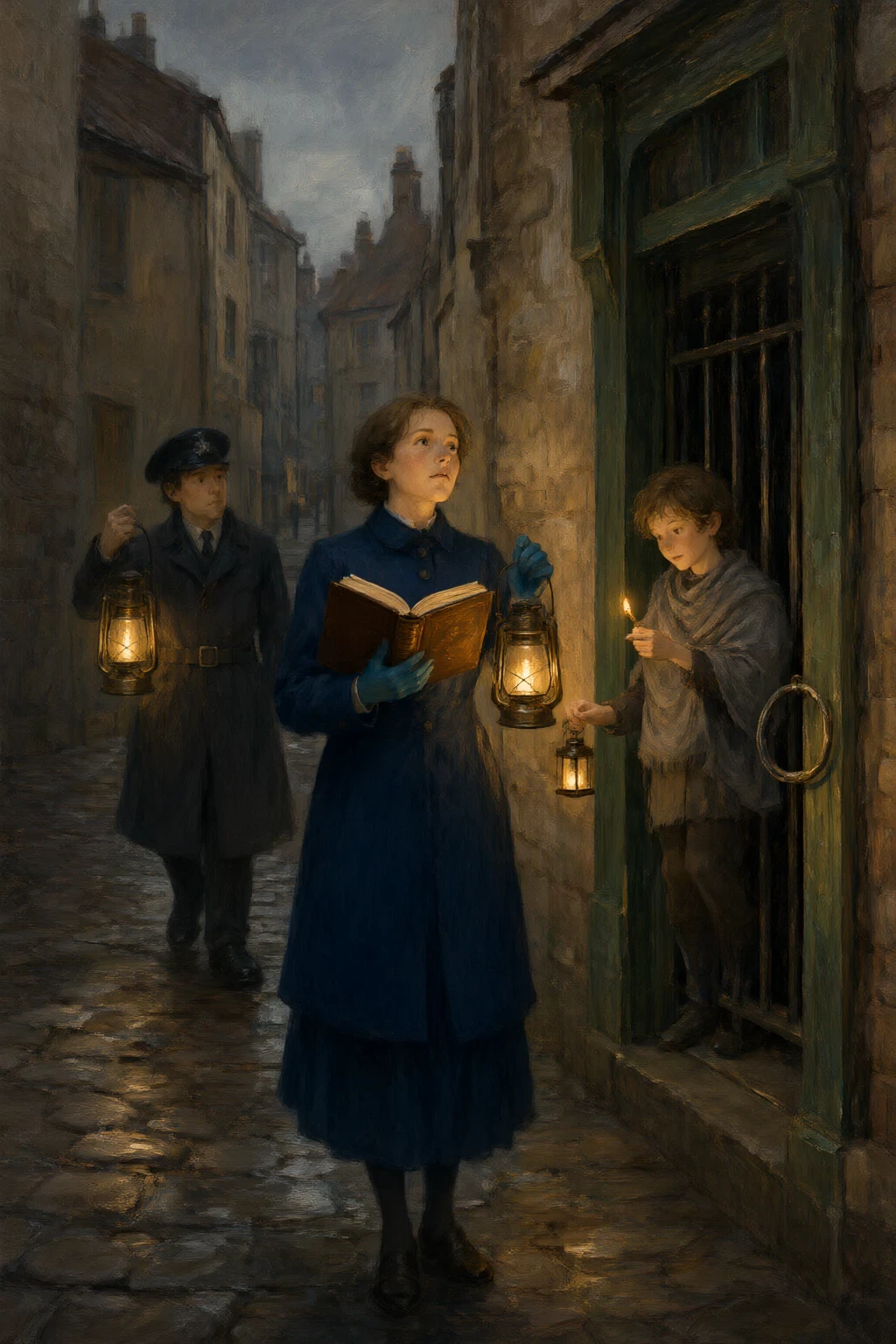
The slip came up from the glass yard on the ninth of December with nine chimneys standing on edge in the straw behind it, and it said that they could not be sent out until the numbers were known, because a chimney in Ninehook is addressed to a lease and not to a wall. Hettie Rowntree read the slip twice, put it under the iron weight that had come off the harbour wall in her father’s time, and went to the third volume, which is the second ward. Volume Two, leaf forty-one. Lamp Thirty-Two, at the corner of Pendle’s Lane and Cooper’s Slip.
A lease in Ninehook does not only say who holds a lamp. It says what the lamp is made of, because a lamp is a document with a flame in it, and the document was written first, and the flame has to be told what it is. The specification for Thirty-Two was a thick glass ground at the shoulder, four and a half inches, for a standard standing in the open at the head of a slip where the wind comes round the corner of the fish market and finds nothing to stop it. The store list had no such glass. It had thin. It had a thick unground at three and three-quarter inches. It had a ground shoulder in another bore, of which the last was blown in the spring.
So Hettie read the entry, and she read it aloud, because an entry read half way is an entry not read, and because she has done that for nineteen years and did not intend to stop in the middle of a leaf. The entry said: Lamp Thirty-Two, at the corner of Pendle’s Lane and Cooper’s Slip, entered the second of January, eighteen hundred and sixty-four, to Jonas Pendle, cooper, of this town, for the term of his natural life and thereafter to such person as shall hold the ring of the said lamp at the hour of five in the morning. The said lamp to be of a thick glass ground at the shoulder, four and a half inches. The said lamp is not to be put out at any hour between five in the morning and the hour of lighting. Provided always that the said lease shall be void upon the death of the holder. And then there was a line through the last of it.
The stroke was made with a broad nib and not with the thin one the clerks use, and it carried no date, and the ink of the stroke was the brown of the ink of the entry and had not gone grey beside the rest of the line, which put it in the first fortnight of eighteen sixty-four. No date. The office had not required a date on a crossing-out until the standing instruction of the first of May, eighteen sixty-seven, which was made after a clerk in the third ward struck out a holder’s name and could not afterwards say which of two dates he meant. Three years before that instruction a man in a cooper’s shop had put a broad nib through his own clause and had left the paper to speak for itself, and the paper had kept its word for forty years and three months. In the margin, in the same hand and smaller:
Crossed at my own hand and not by the clerk. I have had it three weeks. I cannot make this line do what I want it to do. Let it stand. J. P., the third day of March, eighteen hundred and sixty-four. Hettie read it twice, and then she read it a third time with her palm flat on the leaf, which she does not do. Then she did the arithmetic that a leaf of that kind asks for. Entered the second of January. Crossed the third of March. A man who crosses out the death clause of his own lease on the third of March has nine weeks in which to cross it back in, and he did not, and the register has no line anywhere that says he did.
The register does not hold deaths. That is not an omission. A register is a record of leases, and a man stops being a leaseholder by an event that happens to his body and not to his paper, and the paper is what the office has.
The day book for the month of May, eighteen sixty-four, is on the shelf behind the press that nobody opens, and the day book has one line for every lamp that is attended on the night. May had thirty-one lines for Lamp Thirty-Two. Thirty of them said the same thing. Held at five. Signed J. P. The thirty-first said the same thing and the signature was not there. And then Hettie turned forward, month by month, and the book said the same two words for a long time, and she read them down the page and across the page and down the page again until she came to the end of the volume, and then she opened the next volume at the back and went on, and the date at the end of it was the eleventh of March, eighteen seventy-seven, and the line for that night said: Held at five. Signed E. Pendle, aged nineteen. Between the two of them there were thirteen years of it, and there were four thousand seven hundred and forty-four nights of it, give or take the leap years, and the two words were the same on every one.
She went and found the boy in the copying corner, because the round slips for the second ward were on his desk and the slips were copied twice a year and the winter copying was done in December. The card for Thirty-Two did not say what the others said. The others said a time. Thirty-Two said, in a hand that had been traced and retraced so many times that the pencil had gone furry: NOT TO BE PUT OUT. “Not to be put out,” said Hettie. “In the ordinary way a card says the hour.” “The hour’s five,” said Wren Alsop. “It says it. That’s the hour the round is to try at. The round tries at the hour and it does not go out, so the card says what happened and not what was to happen.” “How many times have you copied that card?”
“Eleven,” he said. “It’s copied in October and in March. I did the March one in the cellar on a wet day and it took a whole afternoon to trace the letters out so you could not see through them.” “Have you looked up the entry?” He stopped. He was sixteen and had a taper in his hand that he did not need at that hour, and he turned it over the way a man turns a thing he has decided not to put down. “No,” he said. “A card is copied and an entry is read. We do the first and not the second. That’s the whole of what the round is.” Hettie looked at him for longer than she meant to.
“All right,” she said. “Thirty-Two is four and a half inches, ground at the shoulder, thick. There is no glass of that in the store and the yard has nine chimneys in straw and cannot send one out without a number. I am going up the lane at half past four to ask whether his chimney is still in his lamp.”
The second ward was not lit until six, so at half past four on the twelfth of December the only light in Pendle’s Lane was the sky, and the sky that week had the colour of a dirty coin, and Constable Iven Pyle came with her because the lane is steep and because the office does not send a clerk up a lane after dark by herself. Pyle carried a hand lamp that is not police issue. It has no number on the base because it is not on a standard and does not stand in the register, and he carries it anyway. They went up in nine minutes. At the corner of Pendle’s Lane and Cooper’s Slip the standard stood where the volume said it stood, and the glass above the flame was thick at the shoulder, and thick glass ground at the shoulder is not glass this town has been able to buy for eight years.
It was twenty past four in the afternoon and the lamp was lit. “That is the early one,” said Pyle. “Twenty minutes past four. Lamp Thirty-Two, second ward. It is lit and it is daylight and it should be unlit until six, and I have no form for that.” “There is no form for that,” said Hettie. “There is a form for a lamp out of hour, and a form for a lamp in good order, and there is nothing at all for a lamp that is behaving exactly as its lease tells it to behave.”
The house was the second on the left and it had been a cooper’s house and then a cooper’s house with nothing to co-oper, and there was a door with a hoop of iron across it and no paint on anything. The window beside the door had the curtain not drawn on the side that faced the standard, which is the side people keep drawn. Hettie knocked twice and then once. A woman came to the door with a lamp in her hand that was not lit, and she was perhaps forty-five, and she was wearing the kind of coat a person wears who has been up since four and has not decided that she is dressed yet. She looked at the hand lamp, and then at the standard, and then at the two of them, and she did not ask them in. “I have seen you before,” she said, “or I have seen the coat.”
“The coat is the office’s,” said Hettie. “I am Hettie Rowntree, of the register. This is Lamp Thirty-Two, and it is at the corner of your wall, and there is a specification in its lease that the store cannot fill, and I have come to ask whether the glass in it is yours.” The woman did not move. “It was my father’s glass,” she said. “Your father was entered on this lamp on the second of January, eighteen sixty-four.” “Yes.” “And the glass in the standard is a thick glass ground at the shoulder, four and a half inches, and there is none in the store and none in the yard.” “Then he mended it,” said the woman, “or I did.” “With what?”
“With a piece off a stove pipe and a strip of hoop iron and a great deal of glass I did not know I had,” she said. “It is not a chimney. It is a chimney that I made. If you take it out, the lamp will not hold a flame at all, and you may write that down.” Hettie put her hand into her coat and brought out the day book, and then she did not open it, and then she opened it. “Miss Pendle,” she said. The woman looked at the book rather than at her. “In March, eighteen seventy-seven,” said Hettie, “a person signed this lease at the double door on the quay, in front of a clerk, at the age of nineteen, and there is a chalk mark on the lintel for that night, and the lintel has four thousand of them and none of them explained. I have your name in the volume. I have been saying it since I came to the door.” “Yes,” said Eliza Pendle. “You may say it.”
They stood in the lane and Hettie read the entry aloud. She read it the way the office requires, which is from the beginning, in the words as they stand, including the parts that have been struck out, and she did not summarise it and she did not soften the date. She read the specification. She read the succession, which was to such person as shall hold the ring of the said lamp at the hour of five in the morning. She read the direction, which was that the said lamp is not to be put out at any hour between five in the morning and the hour of lighting. And she came to the last clause, and she said that the last clause was struck through with a broad nib and carried no date, and then she read what was under the stroke, exactly as it stood, because a clerk reads what is under the stroke.
Provided always that the said lease shall be void upon the death of the holder. “There,” said Hettie. “That is the whole of it, and I have read it twice, and the margin is in the same hand and I will read the margin.” She read the margin. She read it as it stood, all of it, the three weeks and the line that would not do what he wanted and the two words at the end. Then she lowered the book.
“He signed it on the second of January,” she said. “He struck that clause on the third of March. He had until the fourth of May, because the day book shows him holding the ring on the third of May at five in the morning, and the register has no death in it, so the day book is what the office has. That is nine weeks and one day in which a man of twenty-six could have taken a pen and put his own clause back in, and he did not, and there is no line anywhere that says he meant to.” “That is his business,” said Eliza Pendle.
“It is his business and it is your lamp,” said Hettie. “It has been his business since the third of March, eighteen sixty-four, and there is no instrument in this office, or in this town, by which a lamp under a life interest is ended. Not by me. Not by the constable. Not by you, if you held it for fifty years and consented at the end, because the interest that stands in his name is not yours to close. A man wrote a line that would have ended it, and he took it out with his own hand, in his own shop, and dated nothing, because in his year there was no rule requiring him to.” The wind came round the corner of the fish market and went through the lane the way it does, and the glass that Eliza Pendle had made out of a stove pipe held its flame exactly as it had held it for six years.
“Then I have been holding it for nothing,” said Eliza Pendle. “You have been holding it since the eleventh of March, eighteen seventy-seven,” said Hettie, “which is twenty-seven years and nine months, and you have held it every night at five in the morning, and the day book says so, and the day book does not say it kindly. It says Held at five. And before you there were four thousand seven hundred and forty-four nights on which nobody held it at all, and the lamp went on burning, and the two words in the column were the same two words.”
Pyle had his form out on his knee and said that he would want her name in the box for persons present. “Put it,” said Hettie. He put it. He wrote E. Pendle in a small neat hand, and then he stopped with the nib a quarter inch above the line, and the form sat on his knee in the wind, and after a while he took the pen away and put it in his coat. “There is no box on this for what she is,” he said. “There is a box for who is here and there is nothing at all for who holds it, because the form was printed in eighteen eighty-one and in eighteen eighty-one they thought the two were the same.” “Write the hour,” said Hettie. “Twenty-nine minutes past four. The twelfth of December. Iven Pyle, night patrol. Lamp Thirty-Two, second ward, lit at a quarter past four by daylight under a lease of the second of January, eighteen sixty-four. One person present.”
He signed it, tore it off and gave it to her, because the office keeps the copy and he keeps the other. At the door, before the hoop of iron was lifted off it, Eliza Pendle said: “Say the part with the line through it again.” Hettie had the book in her hand and she did not have to look at the leaf. “Provided always that the said lease shall be void upon the death of the holder,” she said. “Struck through by the holder in his own hand on or about the third of March, eighteen sixty-four, no date on the stroke, and the margin beside it is in the same hand and reads: Crossed at my own hand and not by the clerk. I have had it three weeks. I cannot make this line do what I want it to do. Let it stand.”
Nobody in the lane said anything for a moment. The standard stood with its little hard point of light in the middle of a large wet dark, and the ring on it was worn into a hollow the shape of a closed hand. “I have never heard that part,” said Eliza Pendle. “No,” said Hettie. “Nobody has asked me to read this entry.”
She got back to the office at ten minutes past six and the room was cold at the top as it always is. She put the report inside the day book for the twelfth of December where the day book keeps them, and then she took her pen and ruled the line for Lamp Thirty-Two in the column for the twelfth of December, and in the column for the hour of extinguishing she wrote the time, which is the time she left the corner, and under it she wrote the two words that four hands and then eleven and then three had been writing in that column since the fourth of May, eighteen sixty-four. Not out.
And the rule at the head of the column, which was printed there in eighteen fifty-eight and has never been altered, is that a lamp is not to be entered as unlet while it burns. So Lamp Thirty-Two was not unlet. So it was leased. So there was a holder, and the holder was a person named in a volume and standing at a door in a lane with a hoop of iron across it, and she was forty-six years old, and the entry that would have set her free had been taken out by a cooper in the spring of eighteen sixty-four who had nine weeks and did not use them.
And behind that, in the same column, there are four thousand seven hundred and forty-four nights of the same two words with no name against any of them, and the hand changes eleven times, and not one of them ever put a name, because in eighteen sixty-four a lease that named a successor named a person, and the register writes persons in ink and a lamp has no hand.