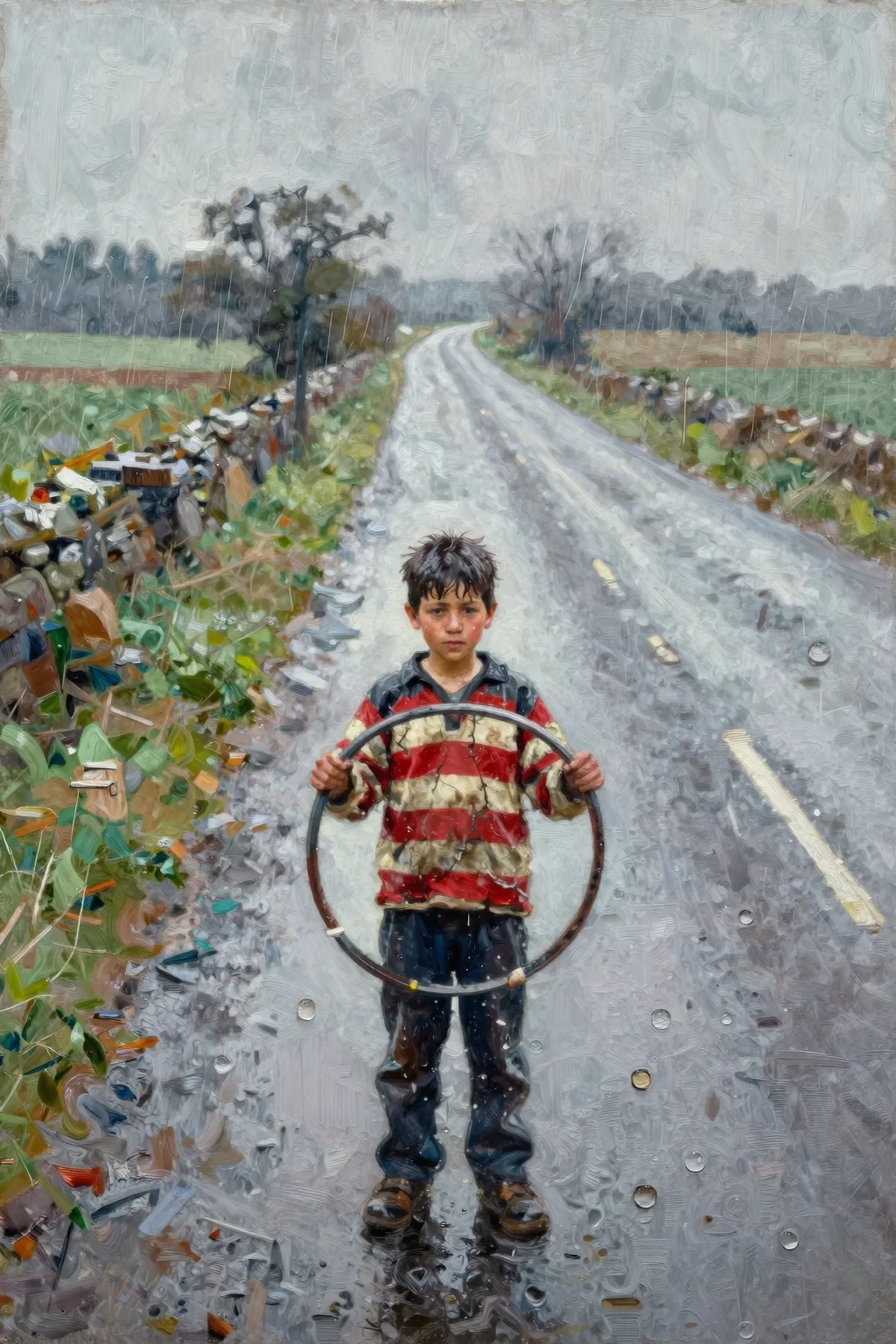
The farm at Rudvang had one good horse and one bad debt, and that autumn a boy of fifteen could tell the difference between them at a glance, because the horse was in the yard and the debt was on the table. The debt was a sheet of paper with a number on it, and the number was ninety, and the sheet lived under the bread bowl because that was where Halli Bram, who made carts, kept the things he had nowhere else to put. The date at the foot of it was the fourth of March, and it fell on a Saturday that year and on a Monday the year after. Bram could not read the writing on the sheet without moving his lips. What he could read was the rest of the table. The way his father put his heels down when he sat. The way his mother Bett did not once look at the bread bowl. The way his sister Ilma, who was eleven and counted things out loud, got to ten and went out of the room.
The horse was called Bakki. He was fourteen, a bay, with one white sock on the near hind. He was worth more than the shed, the cart, and the six acres of low meadow together, and Bram knew it, because the factor at Vika had said so in the yard in July while looking at the horse and not at Halli, which is a thing a man does when he is about to make an offer. That was the whole arithmetic of the house. Four years of carts, and the hands that made them gone stiff and yellow at the knuckles, and the long hauls down to the coast taken since by a man at Brekke with a better cart. Ninety advanced in April against the shed, the meadow, and the horses.
Bram had wanted to go to sea since he was thirteen. He had said it four times, and each time his father answered with the same four words, that a cart is a trade and a trade is a man's back. Ilma said, “Then I will come as well,” and was told not to. The afternoon he heard the horse, he was in the byre mending a trace strap with an awl and a piece of beeswax. The light was going off the west wall, the cows were shifting, and there was a smell of the two of them and of the cold under the door. He put the awl down and waited, and told himself that horses move their lips and make sounds, and that the sensible thing is to be quiet about it. And Bakki said, in a voice that came out of the animal and was the animal's own voice, low and slow, with a little hay in it:
“Listen, and do not answer me, because if you answer me it is a conversation. You have heard me, and that cannot be put back in the box. So you will not tell it to any person in the world.” “Not your father. Not your mother. Not your sister.” “Not in a good hour and not in a bad one,” the horse said. “And not at the end, when keeping it will cost you something you have not got yet.” “And I can do three things,” he said. “Three. One is a thing done, and one is a thing never done again. There is no bringing one back and no changing one for another, and you cannot ask me the same thing twice.” “When the third is done I am a horse,” he said. “I was a horse before you were born and I will be a horse after you are dead, and you will have had three.” Bram did not answer him. It was the hardest thing he did that year, and he never told anybody that.
Bakki's stall was empty in the morning and the door was not latched. Bram followed him along the hedge, four hundred yards behind, to where the hedge broke at the field gate and the lane came up to the wall. A thin man of about fifty sat on the tailboard of a handcart under a wet tarpaulin, selling pots, needles, salt, a whetstone and a tin of lamp oil. He had been there two days because of the rain, and had made eleven kopecks. The horse stopped at the wall. He did not go up to the man. He stood square with his head up and did not move for a long time. The man looked at him, and then at Bram, who was standing in the lane with rain in his hair and his hands empty. “That is a good horse,” said the man. “He is,” said Bram, and stopped there, because the next sentence would have been a lie and the sentence after that a thing he could not take back for ever. Then the man got down off the cart.
“I have a hoop,” he said. “Forty-four inches. It came off a wagon I bought in at Vika and I have dragged it eleven days, because nobody there wants a hoop with a crack in it. It is a bad hoop, and the only thing on this cart that is not worth what I paid for it.” He lifted it out and set it against the wall, where the top was soft and the iron leaned, and the rain ticked on it. “I do not know what you are,” he said. “You have not asked me for anything, and there is a horse at my wall that wants something from me, and I am not going to be the kind of man who asks a boy why. Take the hoop.” Bram could not thank him properly. He could not say where it had come from, or by what means, and he stood in the rain with his arms round forty-four inches of cracked iron and no words in him. That was the first thing. He thought about it for eleven years afterwards and could never have told anybody what made it the first.
The near trace on the cart was split its whole length and the buckle on it was green. Bram knew what a green buckle meant, and he knew that there was no money for a trace and had known that since Michaelmas. Bakki's stall was empty again on the second night. The rain had stopped, there was a moon, and the lane was white. This time the man was packing, and he did not look up when the horse came to the wall. “Harness,” he said. “You are not going to tell me what the harness is for, so I will not ask. I made a pair of traces for my own team in the ninth month and they are too small for him.” “I have seen your collar over the gate and I have made them to it, and they will fit. It is tanned in oak bark and still stiff, so put it on and leave it a month.” The traces smelled like a tanyard and like the inside of a good saddle. Bram took them and again could not say anything, and this time he was angry about it, and the anger was the first thing in four years that had not been about ninety.
On the third night the man was loading for the fair at Vika, and there was a boy on the tailboard. Bram saw the boy first and thought him a stowaway. He was about thirteen, in a coat two sizes too big with the sleeves turned back, and there was a twist of cord round the side rail of the cart that came from the man's own belt. “That is Eilif,” said the man. “I have had him eleven months. I bought him in the north against a debt, and I am taking him to Vika to sell three years of him, and I have the paper for it in the cart.” “I have no use for him and no bad will against him,” said the man. “He has been quiet and useful and I have fed him. I am telling you before you ask, because you have not asked.” He took his hand off the rail.
“He is worth thirty on the fair, and I will not take money off you if you want him. I would rather he went with somebody who has not been sold yet. That is the whole of my price and I am not going to say it twice.” Then the man looked at the horse. “That is three, then, if anybody is counting,” he said.
Bram did the arithmetic in the dry, on a stone wall under the eaves, from one in the morning until the sky went grey. Ninety was the number. Thirty was the boy, sold forward three years, and the factor at Vika would take thirty of the ninety if Bram took him. The sheet in the kitchen would say thirty in the corner of it and nothing about where the thirty had come from. And the boy had paper of his own. The same factor, the same book, a different page. Three years, from a date that had not arrived. Three years of that boy on the low meadow and in the shed and up the coast road, his labour sold to clear a debt that was not Bram's and not the boy's, owed by a man dead four winters in a country four hundred miles north.
And on the morning of the fourth of March, two years off, and then one, and then the morning itself, the thing on the kitchen table would say thirty instead of ninety. The shed would still stand, and the person who would be clearing it, and loading it, and eating at somebody's table every evening until it was done, would not be Bram Hallisson. He was fifteen. He had a cart with a cracked hoop, a horse worth more than the shed, a father whose hands were going, and a factor at Vika with a book. He could not have said thirty, and he could not have said a boat, and he had wanted a boat since he was thirteen.
There was one other thing in his head, and it was the reason he said yes, and he kept it in the order it happened, which is that the horse came to the wall last, and stood. His brother Tovi had gone into service at nine. He was in a coast town a hundred and ten miles down the road, and he made carts, and he wrote twice a year in a hand that got worse every year, and the letters said nothing a printer would take and everything there was to say. So he thought: in a fortnight that boy will be under a roof in a town where nobody has heard of Tovi, or of the smith's boy at Brekke who is a carter's boy and no more. And there will be boys in that house who are frightened, and they will be that boy's age, and it will not be a trade, and it will be a life. He went back up the lane and told the man he would take the boy.
Ilma saw it. Ilma saw the last of it. He brought the boy home at four in the morning and fed him, and then stood at the breakfast table and said that the boy had come down from the north with a pedlar whose cart had broken on the high road, and that the pedlar had left him at the wall, and that he could stay and eat. It was the best lie he ever told anybody. Nobody at that table believed one word of it. Halli Bram looked at the boy and then at his son for a while, and then went out to the shed and did not come in until dark. Bett put an extra bowl up on the shelf, which she had not done since Michaelmas. And Ilma, who was eleven, went out to the byre before anybody had finished and stood in the doorway a long while. Bram found her there. She had been looking at Bakki's stall.
“He went out three times,” said Ilma. “I have been up every night this week and I have not told them, and I am not going to, because you are the one who looks like my brother and I am not going to be the one who gets the telling.” That was the price of it, and it was not the largest price of that winter. Bram worked out the rest of his life over the four months that followed, in pieces, on the road and in the shed and once in the middle of the night, and he did not write any of it down.
The sheet came back on the sixth of March in an envelope. Thirty had been taken off it in a different ink, the rest of it said sixty, and the date at the foot had been moved three years down the page. Under the sixty was a second line in the same hand and column, with Eilif's name on it and three years set against it, and a rule ruled between the two lines. Bram understood that the book at Vika now held three years of a boy and thirty of his father's ninety in one entry, and that the boy's own paper had come out clear. Thirty of the sheet was a boy. Sixty of it was four years of his own hands and a coast road, and there was a second lad in the house eating at that table until it was paid.
They went down the coast road on the second Tuesday of April, with salt blocks in the cart and a new hoop under the near wheel and his father's old buckle gone onto the new traces. Bram was sixteen by then. Eilif was a head taller than he had been. There was a light wind from the north-east, the ground was drying in patches, the whole long noise of the thaw was running in the ditches on both sides of the road, and there was no business at all that the three of them had on it, and they went slowly. Eilif walked on the near side. There was a twist of cord round his wrist that he kept turning over and over, and twice in the first hour he said, quite out of a clear quiet, that he had never in his life seen a horse that could wait. And Bram said, “No.” And that was all that was said about any of it.
The horse went on the far side of the road with his head low and the white sock going, and at the third stile he put his nose over the wall and stood there, and the boy stopped as well and stood looking at him, and Bram sat on the cart with the reins slack on his knees and let them both have it. Behind them the thaw made a long noise in the hills, and the three of them went down the road at the pace of a cart with a good hoop on it.