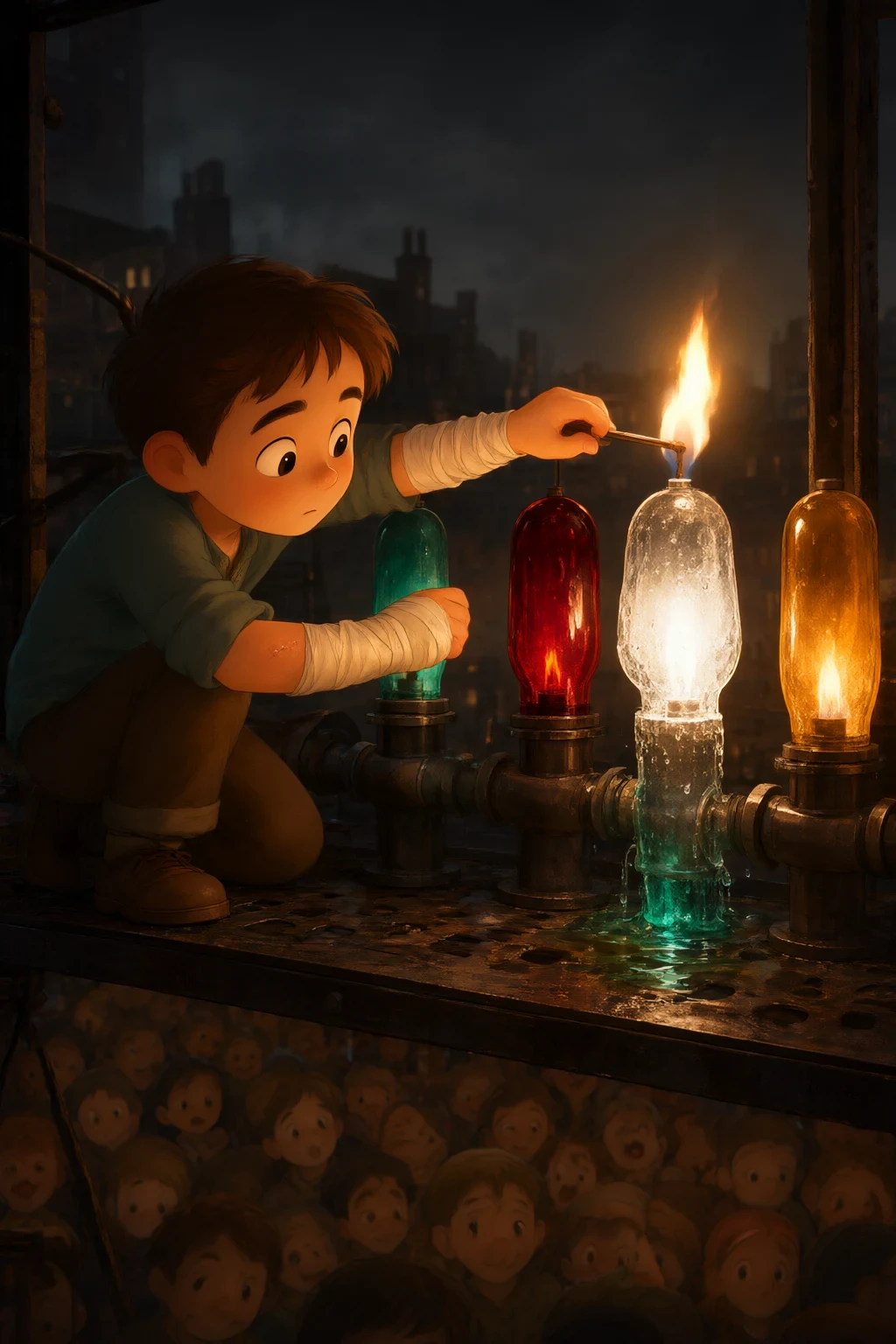
Amos Derwent went up the rope at half past six to trim the fourth lamp, because the fourth lamp was amber, and amber went fat if you left it alone. The Thistlewire had five scene-lamps and the gallery was where all five lived: a low iron catwalk five feet above a floor of hot ash and gas pipe. The first was green-teal and lay on everybody’s hands like cold water. The fourth was amber. A live flame ran in a trough along the rail, and when it moved the catwalk moved.
Through the slot under the proscenium the house was one field: four hundred and twelve faces, and from up here they were one colour and one thing. “Two minutes, no more,” he said out loud, which was the only way a thing like that counted. He put the taper to the jet and the fat yellow tongue over the boards went thin and honest. Then he saw the chalk.
Cue numbers were chalked on the brick beside every lamp, because that was the rule. You scrubbed the brick first. Then you chalked the number of the cue you answer and sign it small underneath. When a cue has been given and answered and finished, you put a bar through the number, because the work is done. Most of the column beside the fourth lamp was Amos’s own chalk, tight and neat. The bottom was not his: soft, grey at the edges, the numbers slanted, and the last one barred straight through. 3/9.
The play ended at 3/8. Corvin had called it out of the prompter’s box every night for two years, and 3/8 was the black: it took the light off the Younger Brother and left him standing in the dark at the end of it. There was no nine.
“He called the number and I answered it,” Amos said. “There is no nine in the third act.” “No. Then somebody wrote it.” “Somebody wrote it nineteen years ago.” Corvin put a finger on the thin black notebook and found the page by feel. “That is not a cue. It is a number a man chalked on a brick and struck through, and a struck number is a number scratched off a slate. The work is finished. There is no work.” “Whose work?” “Boy. Put the taper down.” He had not meant to say any of it.
“That is a fair description of a gas board.” “Then 3/9 is a door. Somebody opened it, somebody answered, and then the scene got cut out of the play, and they barred the number so nobody would use it again. Nobody scrubbed it off, because you scrub first and chalk second, and nobody came back to scrub. That is how I know. The name is under the bar. You can read it yourself.”
S. ROOK. 3/9. 14 MARCH. Hester Vaile had a steel thimble riveted to her right thumb and a tape measure round her neck gone soft and grey from being pulled.
“S. Rook signed for the gas on this building for thirty years,” she said. “One night he walked out of the front door of the Thistlewire and did not come back. He sent me shirts to mend for eleven years and then he stopped, and I decided that was a decision and not a death, and I am sixty-three and I have earned the right to decide things. Two rooms over a saddler’s shop on Tallow Lane. He will not have you. He will take a note, if it is in your own hand and not the company’s.”
The note went on the back of a call sheet already done with. It took Amos twenty minutes to say one thing: there is a cue on the fourth lamp nineteen years old, and I can make it exist again, and come Tuesday, and tell nobody. A Tuesday house is full to the rail, and a seat cannot be given to anybody, because a seat is a line of ink in the book. But a man may stand at the back of the ground row on the aisle, and no rule in this building has ever said he may not.
Getting the note across Verrow was the third thing. The company post went out of a brass grille, and everything through it went into the book. So Amos did it the only way he knew how, which he had started in the autumn and told nobody. He traded the house lights. Row twelve, aisle, down to a quarter, long enough for a man with a call sheet to come up the aisle and go down it again, and up. Then back to full before the act break. The fourth thing was a bucket.
The fourth lamp ran on a circuit dead nineteen years, and its pipe was cold and full of air, and gas pushed into a dead pipe makes a noise you can hear in the front row. So you do not put the gas in. You drive the air out first, with water, and let the water front push ahead of it, and the air comes out at the lamp mouth like a man blowing out a candle.
Then there is nothing in the pipe but water, and the gas comes up behind it, and it cannot bang, because there is nothing left to bang. The key to the scene-lamp room was on a nail behind the kettle in the green room. The gas was regulated there by hand, and the regulator wheel was the size of a cartwheel, and it wanted two men. It had not wanted two men since the fourth lamp died. It wanted somebody willing to stand in it.
So Amos took the key off the nail and filled a zinc bucket from the copper and carried it up the rope at two in the morning in the rain, and the rule said fifteen was not to be up that rope alone, and he was up that rope alone.
The water came out of the lamp mouth in a hard cold jet. He put his thumb over the mouth and the jet stopped. Then he turned the wheel, slowly, with both hands, while the water went down the pipe ahead of the gas. Then he lit the wick at the mouth of the pipe, and the wick took, and the gas came up behind the water, and the cloudy green glass over the jet went from nothing to a soft round nothing at all.
The lamp was not lit. But it was there, and it was ready, and it had not been ready since the fourteenth of March, nineteen years ago. “Two minutes, no more,” he said, and went down the rope, and left the taper burning on the rail, which he regretted for a week.
On the Tuesday, Amos gave the cue. Corvin called 3/8, the black, and the fourth lamp went out with the rest, and Amos’s hand was already on the housing of the old one, the dead one, the one that answered to S. ROOK. The amber came up on an empty stage.
It was only ninety seconds. Every member of the corps knew exactly how long ninety seconds felt, and Amos had counted them out in the dark on the bench when he was small enough to still be allowed to sit there. Ninety seconds is not enough time for anything. It is exactly long enough to be looked at. In the house, at the back of the ground row, on the aisle, a man in a wet coat that had been wet for nineteen years put his hand flat on the seat in front of him.
That was all. That was an answer, and it was the only answer there had ever been, and the chain was finished. The amber went out. The stage went on. Four hundred and twelve people never knew a word of it.
Corvin caught him on the rope at one in the morning with the hot ash still coming up through the grating. “Eleven seconds to cross the catwalk,” he said. “Two paces. I have stood at the foot of this rope for forty years waiting for a boy to do a thing I could not do, and I am not going to tell you that was clever.” “No. I did not scrub the brick.”
On the Wednesday there was a note on the bench, folded once, in an old square hand. It said one thing: how many times the fourth lamp wants trimming in a week. Amos Derwent went up the rope and took the bar out from under 3/9, and chalked a second number underneath it, and signed it small.