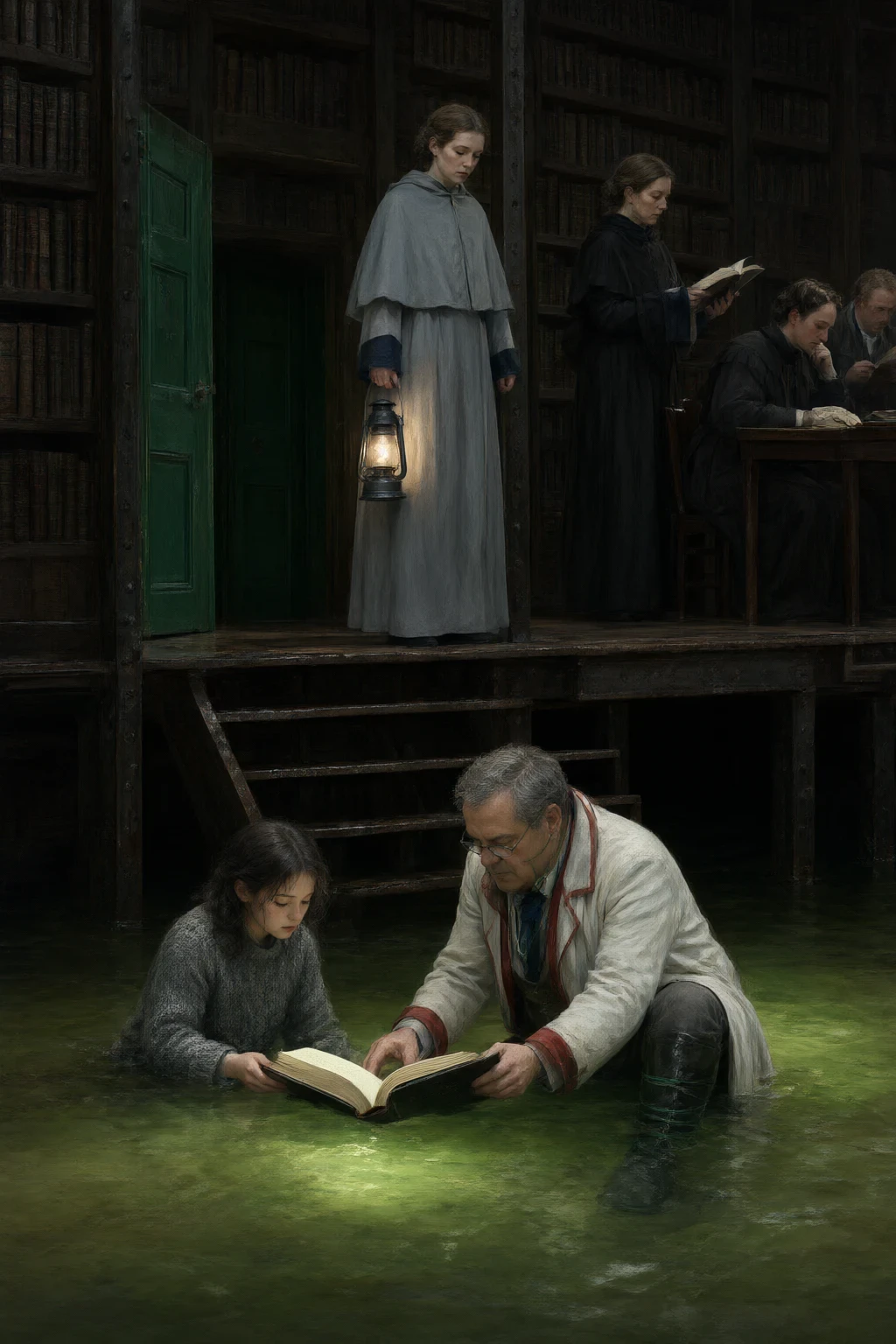
The Quire has a back room. It is behind the north end of the long line of scraped spines and it is not a Room, and it has no shelfmark, and the door is a plank door with an iron bolt that is drawn once a year at the shortest day and pushed back at the longest, and the key to it is not a key; it is a wedge of green thorn, and the wedge lives in a tin in the Quire table, and there is no column for the tin in the schedule. Perran Hesk opened the back room on the fourth of December, 1878, because he was the man who enters things in the schedule and the schedule had eleven hundred blanks in it and he could not get through the winter with eleven hundred blanks. He was forty-five. He was an archivist of the Maps Room and a candidate for a keeping that he had not been granted, and he had been going into the crawl under the Library on the seventh nights since the twelfth of February, on the authority of a chart he had entered in the schedule of unclassified charts under the second column, and nobody had stopped him, because the office the chart gave him authority under had been vacant since the twenty-third of April.
Inside the back room there is one shelf, one stool, a bucket, a coil of dry tarred rope, and a book. The book is black, and it is about the size of a family Bible, and it is bound in calf that has gone the colour of a wet slate roof. There is no title on the spine. There is a shelfmark, stamped into the calf at the head and the tail and repeated three times on the front board, and the shelfmark is a single letter: G. The boards are clasped with black iron, and the clasps are rusted into the leather, and the leather is not rotten. The foredge is a hundred and forty leaves and the whole of it is damp to the touch in dry weather, and the two ends of the book, the first inch and the last inch, are as dry as the shelf it stands on, and the water in the middle has not moved since the year it was written. It came back from the flood of 1702. That is the whole of the Library’s information about it. It was in the building when the water came, and the water took the building’s whole north side and left this, and it has never since been carried out of the building, because a wet book carried into dry air closes, and a closed book in the Tide Library is a book that will not be found again.
He sat on the stool a long time with his coat off, because the back room is the only room in the Library that is warm without a lamp in it. There are two ways to open it. The way the House does it, with the spindle lamp and a bone-handled blade and about nine minutes, which will put the salt into the calf and take the iron stain up into the boards, and which he was not going to do to a book that had survived a flood. And the way the flood does it, which is to wait. So he waited for the seventh night of January, and he did not open the book, and he spent the seven weeks between in the Quire, in the Gallery, in the Numbers Room and in the Maps Room, doing the thing he is at his best at, which is to read a building backwards until he knows why it is the shape it is. The roll of the keepers of the Tide Library is in the Quire, in a long case, eleven volumes. Perran Hesk read all eleven volumes between the fourth of December and the thirty-first of January. There is no name in them.
That is the finding and it took him nineteen days to be certain of it, and he was certain of it because he did it three times, in three different ways, and because the eleventh volume ends in a list of the shelves. The roll is a roll of shelfmarks. Every keeper of the Tide Library since the building went up is entered as a volume: the mark of the volume, the date of appointment, the date of the Higher Stair, and the name of the reader who took the step, and then nothing else, because there is nothing else. Six hundred and one entries. The oldest is not a name. It is a single letter, in the hand of 1702, and the letter is G.
He went down to the Servery and told Anwen Tarn, because she was the only person in the building who could be told anything and because he had by then worked out that the whole of what was wrong with the Library was that it was being run by a woman who could not say no out loud, and that the House had noticed, and that the House had put three readers at three tables in April to examine a man who was not the problem, and that none of the three had thought to examine the woman. She was at the Quire table with the blank Saltmarsh Book open in front of her and a reed pen in her good hand, doing what she did with the four hours a day the building gave her, which was to copy the count out into a fresh place every morning so that the count exists in at least two hands and cannot be lost with a hand. “The roll is shelfmarks,” he said. “Not names. Six hundred and one keepers and not one of them is a person. It is a list of volumes.” Anwen Tarn put the pen down. “That is not possible,” she said.
“It is possible if a keeper is not a person. It is possible if a keeper is a book.” He put his hand flat on the table, in the way she had seen him do it for eleven weeks. “Anja has been senior keeper for thirty-four years and the roll has her in it as a volume, and the volume has a mark on it that I can read from here. The first entry is G. And the roll says the first keeper was appointed on the eleventh of June, 1702, which is the date on the founding instrument, and that the appointment was made by taking a step, which is the way they are all made.” “G,” said Anwen Tarn. “G.” They looked at each other across the blank book for a while. “It is a small book,” he said. “I have not opened it. I have had the back room open since the fourth of December and I have not opened it, because I am not a keeper and the last man who opened a book in this building without standing to do it is dead on the Gallery stair. I want the twenty-eighth of January and the seventh night and about two feet of water in the crawl, and I want to open it the way the sea opens it. And I want you to come down with me and tell me what you see, because I have spent seven weeks looking at this building and I have found a door I did not know about, and the last time that happened to me I was right, and the time before that I was forty-five and a widow and I did not know what I was doing for four months.”
On the twenty-eighth of January, 1879, they took the book down. Anwen Tarn counted before she opened the back room. One. Two. Three. And then, because it is a door and the rule is the rule, she counted a fourth time, which she has never done in six years and which she afterwards described as the most frightening thing she did that winter. The book went down the nine iron steps in the arms of an archivist, and it was heavier than a family Bible and lighter than a body, and Anja Roe came down ahead of them because the twenty-one-inch door will not take a person and a book at the same time and has to be done in two goes, and she did it without a word, and the wedge of green thorn went back in her pocket. The crawl had eleven tables in it. It had eleven tables in it in February and it has eleven tables in it now, and that is a thing Perran Hesk wrote down twice and underlined the second time. At nine of them there was somebody. At the tenth there was nobody, and the table had been cleared, and the shape of a person in the silt was still in it, and the water had not taken the shape away because the water in the crawl does not move.
The eleventh was at the far end, past the others, by itself, where the light does not reach so far, and a woman was sitting at it with a book in front of her that was the same size and the same colour and had a shelfmark stamped into the calf at the head and the tail. The woman at the eleventh table was not reading. She had not been reading for a hundred and seventy-seven years in the way a person is not reading when they are holding a book, and she was not holding it open, and the water had not got into it. Perran Hesk could not see the shelfmark on the calf, because the shelfmark is stamped in gold and the green light is not gold light. He said her name. It was the first time anybody had said it in the building for a hundred and seventy-seven years and it went nowhere, and he said it anyway, and afterwards he wrote in his own note: I said it. She is on the roll. She is the roll. And at the second table along on the left there was a woman in a dry shift with a blanket round her shoulders, in February’s place, with her finger going down the list on a slate she held upside down. The senior keeper of the Tide Library could not speak, and had not been able to speak since the twelfth of February, and was in the water to the thigh, reading.
Perran Hesk put the black book on the table in front of him, in the green light, in the water, and opened the clasp, and the iron came apart with a sound like a knuckle. The first leaf is wet to the depth of an inch and the writing on it is under the water, and ink under water on a leaf this old is not a thing you can read with an eye. It has to be brought up. That is the trick of a wet book and every keeper knows it and no keeper will write it down: you put the leaf against the surface and you read it upside down, from underneath, and the water gives the ink back to you for as long as you can hold your breath. He held his breath and read the first leaf. A HISTORY OF THE TIDES, by the hand of Alys Skell, of the house that was at the Shelf, 1702. And under the title, the whole of the bargain, in nine lines, and the ninth line is the one that is not a rule: Nothing is kept here that cannot be read out by the one it was kept for. That is the ninth rule. It is not on the Servery slate and it is not in the Quire’s copy and it is not in the four hundred and eleven pages of the standing orders, and Perran Hesk had read every one of the four hundred and eleven pages on the sixth of February, and the ninth rule is not in any of them.
He had an hour before the turn, and he read as much of it as a man can read in an hour, which was the first forty leaves, and the first forty leaves are the ordinary history of a working coast. The pans. The herring. A shoal taken away in one winter. Four houses and the price of timber. The eleven that went out on a Tuesday with a cargo of salt-cake and came back with four. At leaf nine he stopped. “There are names in here,” he said. “Not in the text. In the margins. In different hands. Dozens of them, going down the outside edge, and they are not the same hand twice, and some of them are very good hands and some of them are the hand of a person who could not write.” Anwen Tarn did not look up from the book she was holding above the water with two fingers. “Read one.” He read one. The margin of leaf nine, in a copperplate that is the hand of the Quire’s own copy of the standing orders: A borrower gives a part, and takes a book, and gives it back wet. “That is Rule One,” he said.
“It is Rule One in a hand that is not the hand of a book of rules. That is Rule One in the hand of somebody who learned it from the text.” She turned a leaf with the two fingers, and the water came off it. “A History of the Tides with a rule written in the margin in a hand two hundred years younger than the rule. Mr Hesk, it is a history, and every history has a hand in the margin, and this hand has been in the margin for a very long time, and it does not stay still.” He read the middle leaves and he stopped understanding them at leaf thirty-one and he understood them entirely at leaf forty, and the change happened the way a change of light happens. The first leaf is a woman reading a book about her own coast in a house the sea is taking, and it is written in her own voice, and it is exact, and it is the voice of a person who has not yet been in the dark for very long. By leaf eleven the voice has begun to take on other people’s sentences. By leaf twenty the History has stopped being a history and become an index, and every name in the margin is an entry, and each entry is a person who came into the building and read, and read, and read, and put something into the book, and stopped. And every one of the entries is a complete watercopy. Every one. A thousand years of this coast and every name in the margin of a wet black book in a crawl under a library, in her voice, in her hand, saying what she read and what she gave and what she has left.
The leaves between the forty and the sixty are the part of the book no living person has read out and no living person has read, and they are not in Alys Skell’s hand at all. The hand changes as it goes down, the way the hand of a person changes who has been in a dark room a long time, and it does not go back. Leaf forty is a firm copperplate. Leaf forty-eight has the cross-hatching gone. Leaf fifty-two presses hard enough to emboss the leaf below. And by leaf sixty the person writing has stopped writing about the coast and started writing about the house, because a person who has been in the dark seventy years has run out of anything else to think about. “It is all of them,” he said. “Anwen. It is all of them. It is not a history. It is the shelves.” “Yes,” said Anwen Tarn, without any satisfaction. “I have known that since the twenty-eighth of December. I did not have a book that said it. Go on.”
He read to the end of what the hour allowed, which was leaf sixty-one, and the last leaf of the sixty-one had on it the thing that decides everything, and he read it twice, holding his breath, with the water coming up his sleeves. It is a single line, in the copperplate of leaf nine, in the hand of the Quire’s own copy of the standing orders, which is to say in the hand of a reader who came in later and wrote in the margin because there was no room in the text: This is to be read by the hand on the last page. He went to the last page with his hands shaking so badly that Anwen Tarn had to hold the book for him, and the last page is the one hundred and fortieth leaf, and the outer inch of it is as dry as the shelf it came off, and the last inch is the only dry thing in the crawl.
It is a drawing. Copperplate, in a nine-year-old’s hand, small, neat, cross-hatched at consistent spacing, with a tidemark ruled across the bottom of it with a straightedge, and it is a section of the Tide Library taken from the east: the eighty-one stilts, the seven steps, the oiled slate, the gutter, the long low rooms, the room at the top with a kettle in it, and under the widest room, at the tidemark, a small square. Under the drawing: P. Hesk, aged nine. Easter, 1878. Perran Hesk read it, and read it again, and then sat down on the edge of a table in eleven inches of green water in a crawl under the Tide Library and did not say anything at all for about a minute. “It is dated the twenty-first of April, 1878,” he said. “That is Easter. And on the twenty-third of April I conducted an examination in this building that failed, and on the twelfth of February I entered a chart in the schedule that came off the same hand.” “She drew it in the Servery,” said Anwen Tarn. “On the slate, on the night you went down for the woman. I watched her do it and I thought it was a game.” “She did it on the slate with a pen-knife and she did it on the linen in the Maps Room, and this one is the same drawing, and it is the last page of a book that came back from the flood of 1702 and has been writing itself in the dark for a hundred and seventy-seven years.” He put the leaf down very gently, on the dry inch, where it had lain. “The book was not written about the sea. It was written about the Library. And it was written by a woman who ran out of room.”
They came up at the turn and the bell was going on the roof. The Night Bell is in an iron cradle above the high-water line, and on the seventh night the cradle rings and goes on ringing whether or not there is a bell in it, and the sound goes out flat over the water for four miles, and everybody in Greyhaven knows it and nobody goes up to look. They went up to look. The water stood at the third step and the building sat in its own reflection, doubled, upside down, with its own lanterns burning in it. The whole black flat lay west of them under the moon with the sea coming over it in a long white line, and the line was going the wrong way, inward, because it is the turn. “It goes in,” said Anwen Tarn. “Not up. In. Two feet of it in the crawl in one hour and it will be four before it stops.” “Then it is tonight.” “It is tonight. The last turn before the Shelf fills. And there is nobody whose job it is to open the small door, because there is no Keeper of the Quire, and there has not been one since the twenty-third of April, and the last one is dead on the Gallery stair.” She was already counting. “One. Two. Three. Four. Five. Six.”
The Servery at the second hour. The kettle off, because a kettle sings on a stove and there was no stove. Six lanterns on the hooks and two of them lit, because two was what they had, and the amber table with the Rule of One scratched out of the slate on the wall and the new rule in chalk underneath it in a hand nobody could remember having watched write. Niko Sarran was standing up, as he always is. He had a wet navy streak of ink across his left palm that had been there a year and would be there when he was forty. The woman in the dry shift was asleep on the bench with a slate on her knees and a small square scratched at the tidemark, and she had been asleep like that for eleven months, and she was not ill, and nobody in the building could make her understand where she was. Wray Imbrie came at the second hour, which he had not done in nine years, and he came in his long dark wool coat with the copper buttons gone green and the red scarf, and he stood with his back to the wall. He had already decided. He said so before anybody asked him.
“I will not go down,” he said. “Say the term and I will sign, and the term is until the Quire is empty, and the Quire is not empty, and a man who is in a room with two other people and a record is a man who can be asked a second time, and I have nine years of this and I am not spending them in a crawl. Write it down. Write it on the slate. I will not be in the building tomorrow and you will not have to think about it.” Anja Roe was at the table with the black book in front of her, wrapped in oiled canvas, and she could not say one word of it, and she wrote on a slip of paper, and pushed the slip across the amber oak, and the slip said: THE GIRL READS IT. THE GIRL IS ELEVEN AND SHE IS THE ONLY ONE IT WILL OPEN FOR AND YOU KNOW IT. And below that, in a heavier hand, as though the pen had been pressed: I WENT DOWN FOR ONE PERSON AND GOT A HOUSE. DO NOT SEND ME AGAIN.
They went down at the fourth hour with the water already at the fourth step. Niko carried the lantern as far as the ninth iron step and could not carry it further, and stood there in the dark with his feet above the water, and Perran Hesk went down the last nine steps with a green-black door open above his head and a wet black book under his arm, and the crawl was full of green light and full of water and there were eleven people at eleven tables and not one of them turned round. Perran put the book on the table at the near end, in the water, and opened it, and turned to the last page, and laid the last page face up on the wet table. The drawing. The eighty-one stilts. The seven steps. The room with the kettle in it. And the small square at the tidemark, in a nine-year-old’s hand, dated the twenty-first of April, 1878, three hundred and twenty-two days before anybody understood what it was for.
“Nobody has ever read it out,” he said, to a room of eleven people who could not answer him. “That is what is wrong with it. It has been read in the dark for a hundred and seventy-seven years and nobody has ever read it out, and a book that is read out is finished, and this one cannot be finished by a stranger, and I am a stranger, and I have known that since the twelfth of February and I have been not saying it for eleven months.” He put the book down the row on the wet table in front of the first reader, who was a man in a coastguard’s coat with the buttons gone green, and Joss Sedge, who had gone into the water at the age of nine in 1768 and had a chalk mark on the stilt behind him at the height of a child’s reach. Vess Hesk was on the fourth step with the tarred rope round her waist and Anwen Tarn’s cold hand on the back of her neck. “She will not take it off me,” said Anwen Tarn, to nobody. “I have had hold of her since she came in and she will not take it off me. Go on. Read it out. Get it finished.”
She read it for eleven hours and it was not eleven hours of the book. It was eleven hours of the crawl. The first hour she could not find the water with the leaf, because her arms were shorter than a man’s and the water stood at her elbows when she stood on the silt shelf, and Perran Hesk got down in it with her and held the book and held the leaf and turned them, and neither of them said anything, because a man in that crawl who talks stops a girl reading. The second hour she found it. The green light is shallow-sea light and it comes down through four feet of water, and if you hold a wet leaf flat with your face close to the surface you can read it upside down as clearly as if it were dry, and the trick of it is not the trick of holding your breath. The trick of it is that the sea is on the other side of the page and the sea is a light.
The third hour she read the first forty leaves out loud in the voice of Alys Skell, of the house that was at the Shelf, in the year 1702, and the voice came out of a girl of eleven with a coast accent and a cold, and the nine readers at the tables began to turn their pages at the same time, all of them, together, which is the thing that eleven people in a crawl do when the book they are in is being read, and which no living person has seen. The fourth hour is the one that everybody who was in that crawl agrees on and nobody can describe the same way. Anja Roe’s slate came off her knee. She has been down there eleven months, going down the list of the Rules of One upside down since the day she went, and at the fourth hour of the twenty-ninth of January, 1879, with a girl of eleven reading a book out loud at the near end of a crawl under a library, the senior keeper of the Tide Library turned the slate round, put it face up on the table in the water, and read it, and it took her until the seventh hour, and nobody in the room heard a sound, because a person who has no voice reading a slate is the quietest thing there is in a room full of water.
Between the sixth and the seventh hours she came to the leaf with the four out of eleven, and stopped there a long time, and came back to it afterwards. And between the seventh and the eighth she did a thing Anwen Tarn has never been able to explain: she took a stub of charcoal out of her own pocket, and a girl of eleven does not carry charcoal, and she looked at it and put it back and went on reading, and whatever it was she was saving it for the eighth hour, and the eighth hour is the drawing. The fifth hour she got to the names. The names are the hard part and they were always going to be the hard part, and it is the only part of the ninth of January, 1879, that anybody who was not in the crawl will ever have any account of. She read them in the voice of each one, because that is what a history is, and because a name in a margin is only a name until somebody reads it, and Anwen Tarn, standing on the step above the water with her hand on the back of a child’s neck, said afterward that it was not one voice. It was a hundred and nine voices in and out of a girl’s mouth at four in the morning, and the crawl heard all of them, and at some point after the fourth hour Hett Brace, who had gone down out of the herring boats in 1831 and had been at the second table on the right for forty-eight years, put both hands flat on her table and closed her book, and stood up, and could not get through the water to the steps, and did not need to. At the ninth hour the water began to go out.
That is the turn. It goes in for two hours and then it goes out for two hours, and it does not go out the way a bath goes out. The level drops and the pressure goes with it, and there is a moment in the middle of it when the water in the crawl is standing perfectly still and perfectly clear and not moving at all, and at that moment the whole of the Sarn Shelf is under eleven feet of black sea and the Library is a lamp in the middle of it with its lights going, and the Night Bell in its empty cradle goes on ringing over water, and on the Ridge Road above Greyhaven eleven hundred people stand in the dark with their lamps and watch the tide go out early, and do not know why. The History was read out at the ninth hour. All of it. A hundred and forty leaves, in order, in the voice of the person it was written about, which is the only voice the rule admits, from the first line to the last. And at the last line the tenth table in the crawl was empty, and the eleventh was not, and the crawl went on being a crawl, and the light went on moving on the ceiling, and the silt in the bottom of it had taken the shape of a hundred and seventy-seven years of people sitting at eleven tables and was not going to give any of them back.
The water went out to the mud Shelf and stood at the sixth step and stopped. Perran Hesk came up first, because he was heavier and because he had the book, and he came up the nine iron steps on his hands and knees with a wet black calf volume under his arm and one hundred and forty leaves in it and no water in it whatever, dry at the head and the tail and dry in the middle, for the first time since the flood of 1702. He put it on the Atlas table under the tall barred window where the rain does not sound, and where the floor is level, and it lay there and it did not close. Down in the crawl there were no tables with anybody at them. There were eleven tables, because the tables do not go anywhere, and there were nine people on the stairs of the mud Shelf in wet clothing, and the old man in the coastguard coat who had gone down in 1768 was sitting on the bottom step with his hands on his knees, and Joss Sedge did not get up for two hours, and then he got up and went out into the rain and walked west along the flat toward Greyhaven and was not seen in the town again.
The two of them had not seen each other in a hundred and ten years, which is the term of a coastguard’s coat, and Hett Brace came up the nine iron steps past the man who had been at the second table on the right for forty-eight years, and neither said anything, and both were the age they had been, and that is the one mercy in this building that the rules do not mention. Anja Roe came up the nine iron steps on her own, dry, and nobody had to carry her, and she stood on the floor of the Atlas Room at the height of the tidemark and put her hand flat on the wall. She said something. It was the first thing she had said aloud since the twelfth of February, and it was not a word, and Anwen Tarn, who has never in her life been unkind on purpose, put her hand over her own mouth and went out of the room. Hett Brace went up and did not know anybody and was given a bed in the Nests and is in Greyhaven still.
And the woman from the second table along on the left, who had come out of the crawl in February and had been asleep on a bench in the Servery for eleven months with a slate on her knees, was brought in, and was given the slate, and was shown the new rule on the wall in chalk, and looked at it for a long time, and put her finger on the small square at the tidemark that a girl of nine had scratched in February, and Niko Sarran stood there and watched her do it and did not ask her anything, because he is seventeen and he has been in this building since he was eleven and he has worked out that the questions you do not ask are the ones that keep people in the building. The cost came due in the Servery at the fourth hour of the morning, and it came due quietly, the way it always does. Vess Hesk was asleep on the bench with the tarred rope still round her waist and the blanket over her, and she was not cold and she was not wet and she had not a mark on her, and her hands were on the slate and there was salt in the creases of them. Niko asked her what she had read. She told him. All of it, in order, and she could not have told him a single name in it, because a name read out in another person’s voice is a thing that is finished and not a thing that is kept, and she had a hundred and forty leaves of a coast in her and not one person in it. She told him about the herring, and the shoal, and the four out of eleven, and the woman at the end of it who had run out of room. Then he asked her whether she could draw the sea.
That was a boy of seventeen asking a stupid question because a girl of eleven had been in the water for eleven hours and he wanted something to hold on to. She picked up the charcoal and put it on the slate and drew him a flat line with three small curls on it, the way the sea is drawn on the maps of this coast, which is the convention, and the curls meant nothing. And then she looked at it for a while and put the charcoal down. “I can’t do the one with the boat in it,” she said. “I have never been able to. Marda has it.” And nobody in the Servery said anything, because a child has come up out of the water and a child has come up out of the water and cannot draw the one with the boat in it, and that is the whole of what a library is, and it is not a tragedy and it is not a small thing either, and it will be true for the rest of her life, and there is no blade for it.
The black book went back into the back room on the twenty-ninth of January, because a wet book carried into dry air closes, and it was carried down by the girl herself, and the wedge of green thorn went in after her, and the door was bolted, and the Quire went on without a keeper. What the History had been, nobody in the building can now say. That was the price, and Perran Hesk knew he was paying it when he sat down on the edge of a table in the water and said nothing for a minute: every name the Library has ever taken was in the margin of that book, in the hand of a woman who read in the dark for a hundred and seventy-seven years. The book is closed. The reading of it is finished. And the record of the Tide Library — which is not a book and never was, because a record kept by a person who is not known cannot be checked — is a wet black calf volume in a plank room behind a line of four hundred scraped spines, and the sum total of what this building knows about the people it has kept is a rule in chalk on a wall in a room with no books in it, eleven hundred blanks in the schedule, and a book that does not open.
And the rule in chalk is the only law in the Tide Library that is not in the schedule, and it says two things, and the second thing is the one Anwen Tarn made him say a second time before she would let him put the chalk down: That the count of wardings is spoken aloud by the person who keeps the record of them, and is written down by nobody. And that a record kept in this Library is kept by the person it is kept about, and not by the House. Niko Sarran read it out again that morning, standing up, in the Servery, with the kettle on and the rain coming in under the Verandah door and the whole black flat lying out west of the building with the water still going off it in long white lines, and the tidemark on the wall of the Servery three fingers higher than it had been the year before, and higher than the tidemark on the wall of the Nests, and higher than the tidemark on the Gallery post, and level, everywhere, at the height of a tide that had not come in for four hundred years and had come in last night because somebody read a book out. “But who decided that?” he said. “Not you two. Not her. The person who wrote the rule the first time, in sixteen eleven, before the building was up — she is the one who decided that one of these three things cannot be alone in a room with another, and nobody ever wrote down why, and everybody has been living on it for three hundred years, and she is not on the roll because the roll is not names. Who decided that? Where is the first one? Is there a first one?” Nobody answered him, which was the correct number.
The old woman in the dry shift was awake at the end of the table with the slate on her knees and a piece of charcoal in her hand, and she was not drawing anything, because she has never in her life been able to draw and that is a different thing and not a thing anybody has ever asked her about. Anja Roe sat down opposite her with her hands in her lap and her hood where it had always fallen back, and the two of them stayed like that until the kettle boiled and then some. And on the amber table, face down, where it had lain since the first flood of the year and had stayed dry through every one of them, the small green book lay with its gilt G to the wall. It is the first entry on the roll of the keepers of the Tide Library, and it is the only book in the building that the sea has never moved, and nobody has ever been able to say why, and on the twenty-ninth of January, 1879, it was warm.