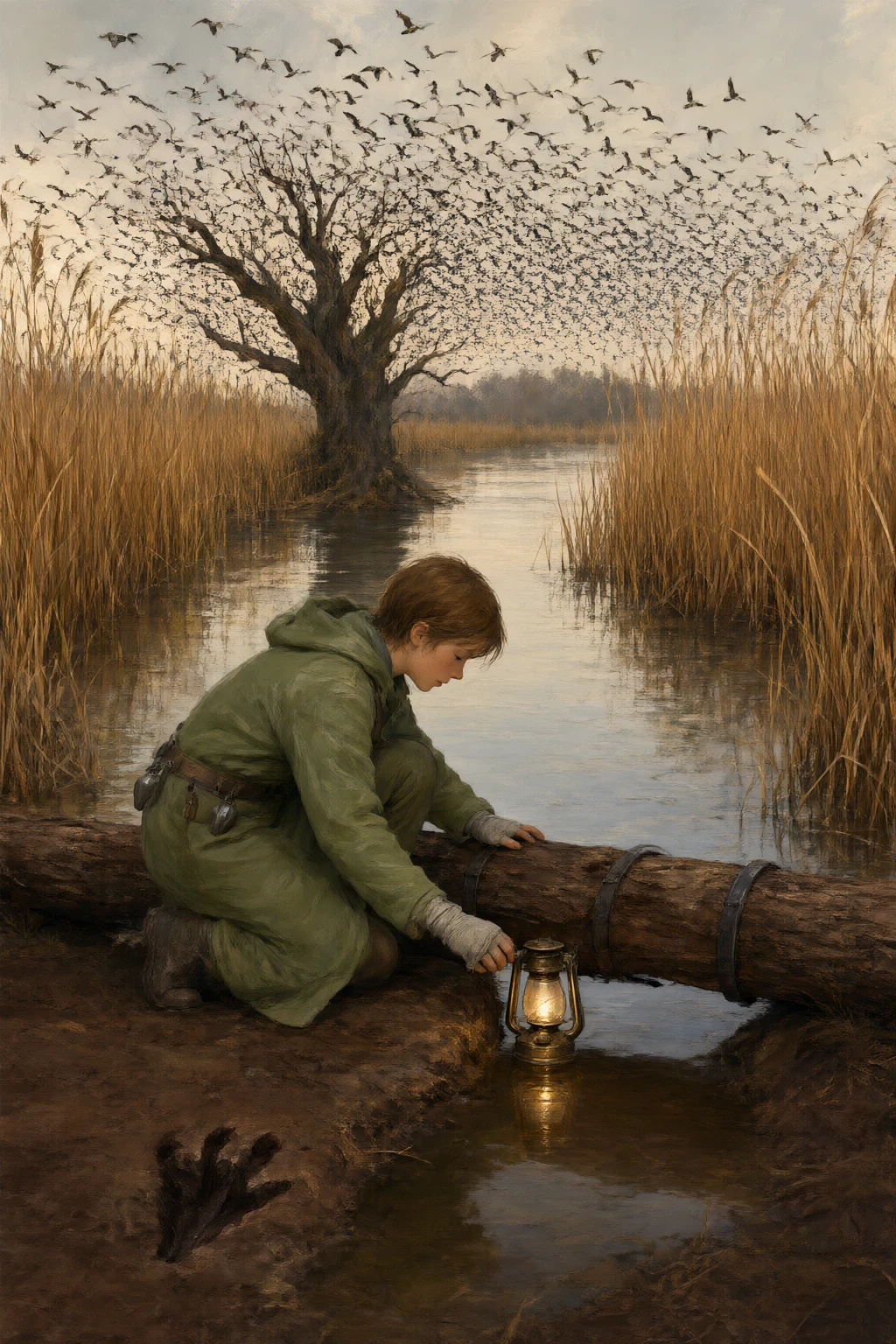
The Mereside Ward is four miles long and it has not been walked at night in eleven years. It runs out of Nettlefold’s north gate, north and then west along the shore of the Mere of Slow Water, past three unlit lamp-posts with hinged little doors and hinges gone rusty and the shore numbers still chalked on the iron, one, two, three, which were never Row numbers. It ends at the Bothy, a stone hut with a boat-roof, where the Ring keeps its winter store, and where the fire is out by nine. Between the third post and the Bothy it passes through a mile of alder carr, flooded to the knee in the wet months, with a channel cut through it where the peat was cut, and a path along the top of the bank.
That mile is why the ward was struck off the rolls in the fourteenth year of Oren Vall’s wardenship, on the grounds that the Mere is a border in itself and no ironwood has ever crossed it. The grounds were true. The sap was already going. The posts were not taken down and nobody ever went back. Mag Wend was fifteen, and had walked the ward as a child, and had walked it unpaid for two seasons, and had never once asked to have it put back on the rolls, because the rolls are the oil and the oil is the sap and the sap is the wood, and she worked that out on her own at eleven and never mentioned it. She was lean, and brown-haired, with the hair cut blunt at the jaw because a wader’s hood catches on anything longer, and she wore a duck-egg-green wool coat with the shoulders and the hem waxed, a wader’s belt with three lead weights at the hip, and her right hand wrapped in grey linen from the knuckles to the wrist, because the reed knife lived there.
She carried the ward-lamp on the last walk of the year: an iron-framed oil lamp with a hinged door, a brass plate, and a wick trimmed by somebody who had not carried it in eleven years. She held it low, at the height of her knee, because a lamp at shoulder height throws its light over the bracken, and the bracken does not need light, it needs to know. “Aye,” said Oren Vall, at the north gate, at seven in the evening, with the light behind him. “Aye, but—” And the pause went on. “It is four miles, Warden.” “It is four miles if you go the short way, which is two, across the flat.” He shifted, and the knee made its sound on the frozen gravel, as it had been making since Mag Wend was six. “The flat is where the ninth mark moved eleven paces in a fortnight. Nobody goes across it after dark. Go round the water.” “That is the ward.” “That is why I want the ward walked and not the flat, and I have wanted it since Thursday, and I have not got anybody else, and you knew that when you took the lamp off the nail.”
Mag Wend looked north, up the road, past the last lit lamp on the Row, where the light gave out and the ground went from gravel to bracken in a line you could see in daylight and had to take on faith at night. “Aye,” she said. “Then I will be at the Bothy by two.” “You will be at the Bothy by two, and Bess Corr is at the Bothy, and the terms are in the case, and you do not open the case.” “I do not open the case.” “If anybody stops you on that road, you turn round and come back here, and you do not explain yourself to a child, because the child will be the one who remembers it.”
The case is a strip of birch bark rolled round the terms, tied with a thread of chopped reed, and closed with a square black iron nail that is not the pact-nail, being a nail out of a hinge. There are two copies. The original goes to the Ring, to be read before it is assented to. The fair copy stays in Nettlefold for the file, and by the custom of the Scriptorium the fair copy is made first, and the fair copy is what everybody reads. Mag Wend carried both in the case, in oilskin, against her back, under the coat, where the three lead weights were.
Mile one is the open shore, and it is the easiest mile in the ward, and it took her fifty minutes. The Mere on a November evening is pewter. It reflects nothing until there is a light on it, and then it reflects the one light there is, so that you carry your own lamp and a second lamp in the water that is not a lamp. The reed on the north side stands out of the mud a hundred yards deep, and the reed is what makes the shore dangerous, because reed is where things are. She filled the lamp at post one, a cast-iron pillar with a drip-pan and a door that has to be got at with a knife because the hinge is one solid piece of rust. The oil was nine years old and it smelled of a cellar, and it burned with a green at the top of the flame. She was aware the whole time that the lamp was in her left hand and not her right, because the right hand had the knife in it, and that was deliberate, and she had worked out why about a year ago and had not told anybody.
Listening is the whole of the job and there is a rule about it that nobody will write down for you. The Wood does not talk. It is a shell shaped like a tree, its heartwood is dead, and it has never said a word in four hundred years. What people call the Wood talking is birdsong cut short, because a finished phrase is a commitment and a half phrase is not. So the shore at night is a great deal of almost-saying. A wren goes four notes into something and stops. A redsilk starts a nine-note phrase and gives you four. Two of them overlap and make something a child would swear was words.
And here is the part that matters. When an ironwood lifts at dusk it does not make a noise. It displaces. It pushes the ground ahead of it like a man pushing a door, and where it passes the small birds stop, and there is a patch of shore where the birdsong is gone, and it moves. Mag Wend walked the first mile with her head turned a quarter-turn to the left, listening for the gap. There was no gap, and she knew what that meant: nothing within a hundred yards of her was moving.
Mile two is the drowned willow, and the willow is the best thing on the whole shore and the worst. A willow that has been in water for thirty years does not grow. It stands, and the water goes over the top of it, and the branches make a second wood under the surface, and the whole thing is a slow green explosion your oar goes through without touching. Birds nest in it at the waterline and nowhere else, and the noise of two hundred of them at dusk is why anybody walks this ward. She stopped at the two-hundred-pace mark, which is not a mark anybody else would notice, and stood still, and let the birds come up to a hundred and eighty and two hundred, and then went quiet all at once in a band from the bank out to sixty feet.
Not a phrase cut short. All of it. Every bird in a sixty-foot band going silent in the same second, and staying silent, and the ones beyond the band still going. Mag Wend stood in the band and did not move. It was not a tremor. It was not wind; there was no wind. It came on across the carr path ahead of her at the speed of somebody walking on a floor above you, went past her and away, and took about eleven seconds, and then the birds came back into the sixty feet in the space of a breath, all two hundred at once, and the noise of them coming back was worse than the silence. She wrote the time on the back of her left hand in pencil. She did not write anything else, because there was nothing else to write.
Mile three is the alder carr, and it is the mile the ward was struck off for. The alder is a wet wood that grows in standing water and makes the ground soft to the depth of a boot and then suddenly hard, because under the soft there is a mat of roots going down two feet, and you go through the soft and stop, and the stopping is what nearly kills people. The reeds are up to a man’s chest, and the path is a bank three feet wide with black water dropping away on both sides. And it was here that the channel is. The channel is six feet across where the peat was cut, once, by somebody who is dead, and in November it is the only part of this mile with a current in it. The current was why Mag Wend’s mother had told her, eleven years ago and every year since, not to put a foot in it. Tonight it was a yard an hour, brown and cold. The log was across it.
It is a felled ironwood, and it lies across the channel, bound with iron in three places, the binding done properly, cold iron, three bars of bog iron, one at each end and one in the middle, hammered through and clenched over. It is eleven feet long and as thick as a man’s thigh. The end has been in the water so long that the bark has gone and the sapwood has gone grey and soft, and there is a hole in it you could get a hand into. It is not a bridge. Mag Wend put the lamp down on the bank and put her boot on the end of it, and the boot went in. She took the boot off and stood there a while. She had known it would be like that for about four years, in the way you know the weather in a place you have fished, and had never said so, because nobody has asked her about the Bothy channel in four years.
The prints were on the far bank. Four of them, in the peat, a foot and a half across and a foot deep, shaped like a fist with the knuckles turned out, coming down the bank into the water and stopping four paces out, and a second set four paces back going up, and the water between them churned to a froth of peat and reed-root eight feet wide, and the churn was not new. Mag Wend got down on one knee in the mud and looked at the churn until her eyes made out that it was not one set of prints. It was the same four paces, over and over, all winter, the same place, the same direction, the same distance: in, four, out. In, four, out. All night, and every night, for weeks, because a thing that cannot get across will go on trying at the one place it almost managed it.
She had been taught, in the way she was taught things, not to call this a threat. You call it a measurement, and you write it down, and the measurement is that the Wood is trying to get into the ward at one point, at one hole, since Michaelmas. She wrote it on the back of her left hand in pencil, under the time. The current under the log was the one place in four miles where she had a decision. The bank goes round the channel, and the bank is four hundred yards longer, and four hundred yards of bank in the dark, in the alder, in November, with the reeds up to a man’s chest and a wood standing up and moving a hundred and fifty yards off, is not a thing you can walk straight. And the log would not hold her anyway. That was not a maybe. She had put a boot on it. And it was bound with three bars of cold iron, hammered through and clenched over, and cut square, and left there on purpose. She stood in the mud at the top of the bank and looked at it for a long time, and worked out what it was.
A log held with a name keeps one path open and keeps it. Cut, bound in iron, and given a name aloud, it will hold that path as long as the name stands in a document that is read. It is not a charm. It is an arrangement, and arrangements in this valley are made out loud by two parties, and the only parties who can be here are a wood and a person. An unnamed log is shelter. It shelters wolves, and mud, and rot, and it starves, and in a year or three the iron comes loose and the wood goes into the channel in three pieces and the channel is a channel again. Mag Wend knew all of this the way you know the terms of a trade you have been listening to since you could walk.
The reason the log was unnamed was that it was not an accident. Somebody took three bars of bog iron out of the Cindermill and beat them into this tree and left it, and in a hundred years nobody has said a name over it. And the reason for that is not carelessness. A named log holds a path open across your border, forever, as long as the name is read. A path across the border is a road, and a road is how the Wood finds you. And she was standing at it at half past ten on a November night with a bundle of terms on her back, and the only way across was to say a name.
She did the things in the order she could do them in, which is the order a wader does things. She went back up the bank eleven paces, out of the channel, set the lamp on a root that would hold it, touched the wick so that the flame leaned, and did not open the case. Then she said it, to the dark, over the water, in a voice that carried about as far as voices carry in still wet air. “Mag Wend, of the Mereside Ward, of Nettlefold.” That is the ward-bearer’s formula and it is not a name for a log and she knew that, and she said it anyway, and it took about four seconds and nothing at all happened. Then she said the other one. “BesNan Aldren. Founder.”
And she said it because there was a bar-mark on the end of the log, half under the grey: an A over a line over a line, the Cindermill mark for the Aldren bench, and her mother had bought lamp-frames off that bench for eleven years. She was not being sentimental. She was doing the only available thing, which is that a thing given a name gets the name of the one who made it, and if the name is wrong the arrangement does not hold and the crossing is a crossing in the dark like any other. The sound that came back was not a sound. What came back was the water. The strip of churned peat in the channel went still in about a second, the froth settling, the peat water clearing, the leaf-tops coming off the eddy in a line. And the far bank stopped doing what it was doing, which was leaning four inches toward her, and stood up straight, and stayed there. Then, from the far side, out of the alder, in the middle of the mile where two hundred birds had gone silent an hour ago, a wren went four notes into a nine-note phrase and stopped.
It held. That is the whole of what happened, and Mag Wend did not trust it, so she did it properly: she got up on the log with the knife in her teeth and went across on her hands and knees, and it did not move, and she could feel it not moving the way you can feel a bridge not moving, and she got out in black water to the knee. Then she went back across and fetched the lamp. She crossed eleven times that night. The last four were to bring the far bank up to a standard, because that was where the Wood came to, and a bank measured eleven times is a bank that is known.
Mile four is the flat run to the Bothy. It took fifty-one minutes, and she arrived at two in the morning to find a lamp in the Bothy door and Bess Corr on the boat-roof with her boots off. “You are late.” “I am at two.” “You said you would be at two.” “I am at two.” The fire was out, as it is by nine, and Bess Corr had not lit it, because a light in a window on the shore road can be seen from the flat, and she is fifty-eight and has been the Ring’s arithmetic since her mother died. They sat on the boat-roof with a lamp between them and the case on the boards. Mag Wend opened the case.
This is the thing that nobody in that room wanted delivered, and there were two of them on the boards and one of them on the ground. The terms were nine clauses long. The fair copy had nine clauses. The original had ten. Clause nine was in a smaller hand, and a later ink, and it said that if the sap failed in any season, the mark-stones on the Ring might be moved inward by the village alone. It contradicted clause four, which said they never should be, which was Oren Vall’s own line, written in his own hand in the first week of the winter in front of nine people at the Cross. Mag Wend read the original out, all of it, in order, slowly, the way the Eldress does, and she read clause nine last, and she gave the number. It took eleven minutes. The Mere was glassy by then and holding both lamps, and the alder mile to the east had two hundred birds in it, and every one of them was awake.
Bess Corr listened with her hands flat on her knees and did not interrupt, which Mag Wend had not expected, and had been dreading. When it was done she said, “He added that at night.” “He did.” “After the copy was made.” “After the copy was made.” “Then the copy in the file is not the terms, it is nine clauses of the terms, and a man can read the ten and sign for the nine, because the copy is the one everybody reads, and reading the copy is what being reasonable looks like.” Bess Corr took her boots off another inch. “I have spent a winter teaching this village that a line read wrong is a line read as something it does not say, and I have been handed a document meant to be read wrong by people who are being reasonable.” “I know.” “You do not know, because you are fifteen.” Bess Corr looked up. “What I have been doing since November is not a petition. I have been holding a party. You cannot hold a party with a party that gets handed paper it has not read.”
“I am not giving it back,” said Mag Wend. “I did not say you were.” “I read it out.” “You read it out,” said Bess Corr, “and that is the whole of the reason I am going to sign anything tonight, and the reason I have not already walked back to the Cross in the dark to say something I would be sorry for in a year.” She put her hand flat on the boards. “I am not refusing. I will not sign the ten. I will sign the nine, and the ten goes in as a tenth with a date and a heading over it, as the Warden’s late addition, and the Eldress reads it out on the Samstag in front of everybody, and the Warden stands there while she reads it.” “That is a hard thing to ask a man.” “It is the smallest thing anybody could ask him,” said Bess Corr. “He added a clause at three in the morning to a document four hundred people had agreed on, and the only penalty available to anybody in this valley is that it gets said out loud. If you have to be ashamed of a line, you can at least let it be read.”
There was a third thing, and Bess Corr did not put it up for an hour. “The standing timber clause of ours lapses at the frost,” she said. “It has lapsed before, in the ninth year and the twenty-second, and it comes back if it is read, and if it is not read it does not come back, it just stops being true, and there is no writing on that.” “The Warden does not know that.” “No. The Warden has done his arithmetic for eleven days, and done it well, and done it against a clock I did not tell him about, and I have watched him not know, and I told you not to be late and did not tell him, because a Warden with a clock in his head stops listening to the person who put the clock there.” She said it without apology. “Now you know, and the frost is on Thursday.”
Mag Wend sat on the boards at twenty past three with a charcoal and a flat of birch, and took the fair copy on her knees, and did the thing she had been taught at the Bothy since she could hold a knife: she wrote the clause out in full, in a small even hand, twice, and checked it word for word. Clause nine, as it would be read, and then struck: that if the sap fails in any season, the mark-stones on the Ring may be moved inward by the village alone. She did not strike it out. She put a line through it and wrote beside the line, in the margin, and then read the new sentence aloud, twice, the way the Eldress does, and the second time slower, and Bess Corr listened to the second reading with her eyes shut.
And then they wrote, together, the clause that goes in instead, and it took twenty minutes, and it is four lines, and it is the only part of this story that anybody will remember: That if the sap fails in any season, the mark-stones on the Ring may be moved only by the Ring and the village together, and not by either alone. That the fact of the failure shall be entered in the tally at the Cross in a column of its own, with a heading, and read out. And that the Warden’s late addition of the ninth clause, made after the copy was written, is entered as it stands, with its date, and is read at the next reading, and is not to be taken back.
Bess Corr signed for the Ring with a cold-iron style and a single stroke, in a hand that was not elegant and was completely legible. Nobody living in Nettlefold can sign the pact. Blood is forgery and is not read, and the Wood takes sap and cold iron, and it takes them once. So the Ring’s assent was not a signature at all: Bess Corr cut a strip of birch the width of her thumb, wrote the acceptance in sap, and drove the hinge-nail through the last line, and gave it to Mag Wend, and the nail went in once, and that was that. Mag Wend put the strip inside her coat, against the three lead weights, and started back at twenty to four with a full lamp.
The walk back was the same four miles and took an hour and forty minutes, because she stopped eleven times, and twice at the channel, and once for an hour at the drowned willow in the hour before dawn. The logs across the channel held all night, and she knows they are holding now, and the road across the carr is open, and it will stay open as long as the name stands in a document that gets read, which is as long as this village keeps talking. On Thursday it will be a road from the Ring to the Bothy two miles shorter than the one that goes round the water, and there are thirty-one people on the Ring who have never been able to come and go in the dark at a cost. And anybody from the flat can come across it, and the Wood can put a root-fist on that channel any night it likes, and there is a lamp at each end of the path and a name on the log, and a name is not a charm. A name is a thing somebody is responsible for.
Oren Vall was at the north gate in the grey, with his staff on his left side, at the hour he has stood at that gate every day for eleven years, and he had not gone in. He read the strip. He read it twice, and the second time slower, which he has never once done in his life, because that is Elder Ashdown’s habit, and he picked it up from her in four seconds and will probably never put it down. “Clause nine,” he said. “Clause nine is in, with a date on it, and she has written over it four lines, and she has put in that it is read at the next reading.” “Yes.” “She wants you to stand there.” “I expect she does.” “You can refuse to read it out. The Eldress reads it. It does not have to be you.” “No,” said Oren Vall. “It does not have to be me, and that is exactly why it will be me.”
A birch strip went up on the tithe-store wall on the Thursday, beside the notice-slate, in a column of its own, with a heading, and it said MERESIDE WARD in sap, glossy, slightly crawling, and a square black nail through the last line of it, cold, and never warm, and no name under it, because nobody living in Nettlefold is permitted to sign anything with a name. It had three ward-bearers’ marks on it going back ninety years, because a ward is not a man, and a ward is walked, and whoever walks it is a season. Mag Wend’s was the fourth, cut with a knife she had held in her right hand for the whole four miles, in the middle of the winter, at fifteen, in the dark, on a shore nobody had walked in eleven years, at a channel where the Wood has been trying to get in since Michaelmas and losing its tread four paces out, four paces out, the same four paces, all night, every night, all winter.