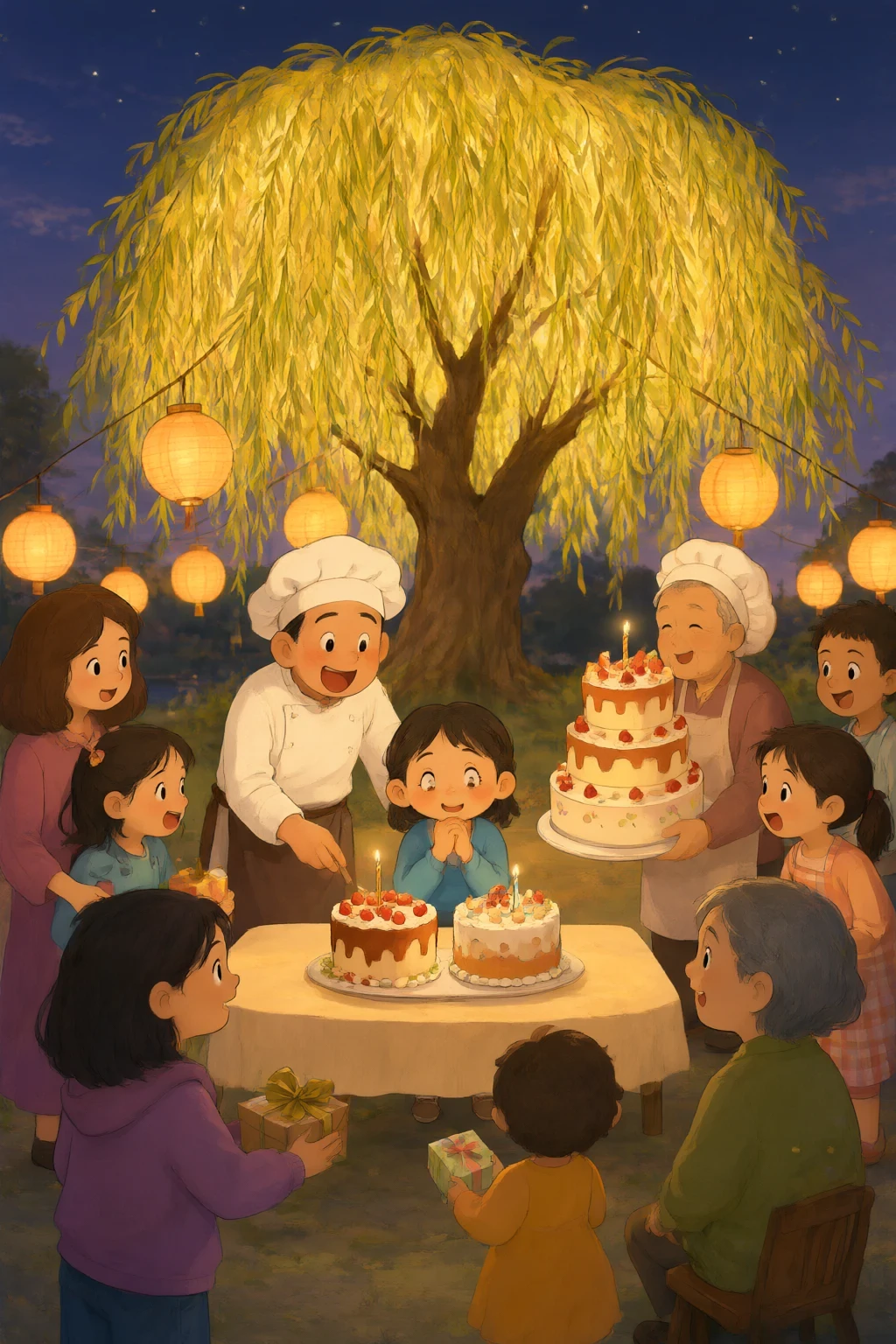
Every autumn, the village gave one birthday party at the old fire station. The Vale family made the cake. Their grandmother had kept the recipe for fifty years, and nobody else was allowed to use the fire station’s oven for a celebration.
Mina was eight, and this year the party was for her. She wanted red icing, a drumstick candle, and the whole table to sing. When she told her mother that Niko’s family had been invited, her mother lowered her eyes.
“Niko’s mother came to our village last winter,” Mrs. Hale said. “The tradition is that the Vale family makes the cake, and the village shares it.” Niko stood by the window, holding his invitation. “We can come,” he said. “We can bring a song.”
Mina looked at the single cake plan pinned to the wall. One cake had sixteen slices. Niko’s family could eat a slice like everyone else. Still, when Mina imagined the party, she saw the Vale family at the oven and Niko outside the door.
That night, Mina asked Mrs. Vale to teach her the recipe. Mrs. Vale frowned. “The recipe is a family trust.” “I don’t want to take it,” Mina said. “I want to know why the party needs only one cake.”
Mrs. Vale brought a flour-stained notebook. The first page held a sketch of an oven and a list of measurements. Some lines were crossed out, as if the family had learned by doing rather than writing.
Mina asked the village baker, the grocer, and four neighbors what they could share. Mrs. Vale could teach the cake and provide the special wooden mold. The grocer had flour, sugar, and three eggs. Niko’s mother could bring fruit from the small tree behind their house. Mr.
Bell had a wheelchair-friendly table and knew how to set it near the fire station door. Other families could provide chairs, paper flowers, or a song. Mina wrote every promise in a column. She marked the costs too: eggs, fruit, paper, and time. When she reached the bottom of the list, there was enough for two small cakes.
Mrs. Vale looked at the page. “Two cakes will not feed the village as grandly as one.” “Maybe the village can share the work,” Mina said. Niko’s mother did not smile at once. “People will ask why we are involved.” “They should ask,” Mina said. “You can say yes or no.” Niko’s mother picked up the fruit basket. “I will bring the apples.”
The day before, at Mina’s home, Mina and Niko’s mother had baked the second cake in Mina’s small oven, using two round pans so it would not pretend to be the famous mold. They carried it to the fire station in a covered basket. On the morning of the party, Mrs. Vale made her cake in the old mold.
The home cake leaned a little, and its frosting tasted sharper because it had lemon instead of honey.
Some children wanted the Vale cake first. Mrs. Vale cut it into careful squares. Mina’s second cake sat beside it, ready to be carried to the table. Niko’s mother explained which fruit she had brought and where it grew. She did not whisper, and no one made her stand beside a corner.
The village council member who kept the old rules came to inspect the fire station. He saw two families working and began to object, but Mr. Bell showed him the ingredient list and the cost jar. Mrs. Vale explained that the recipe belonged to her family and that she had chosen to teach it.
The council member counted the chairs, the paper flowers, and the children waiting to eat. “We cannot call this the traditional cake,” he said. “It is a celebration cake,” Mina said. “The tradition is still here. It just has company.”
The party began when the fire bell rang. Children sang badly, then better. Niko’s mother played a drum on a flowerpot. Mrs. Vale showed Mina how to lift the mold without pulling the cake apart. Mina carried the leaning cake to the table while Niko held the door for a little girl using a walking frame.
Both cakes were cut into enough pieces for everyone at the table, with a few spare slices set aside for latecomers. The ingredient jar held three coins, enough to replace the eggs, and Mr. Bell wrote that the tables would be returned.
Afterward, Niko’s mother put two slices on a plate for the family that had brought the paper flowers. Mina gave the last clean spoon to the cook who had washed the pans. Mrs. Vale folded her recipe book closed. “Next year,” she said, “we can ask every family to choose a contribution.”
Mina looked at the two cakes, one famous and one sturdy. The table was full, the costs were counted, and there was still enough crumb for the old woman who lived beside the school to ask for a small piece.