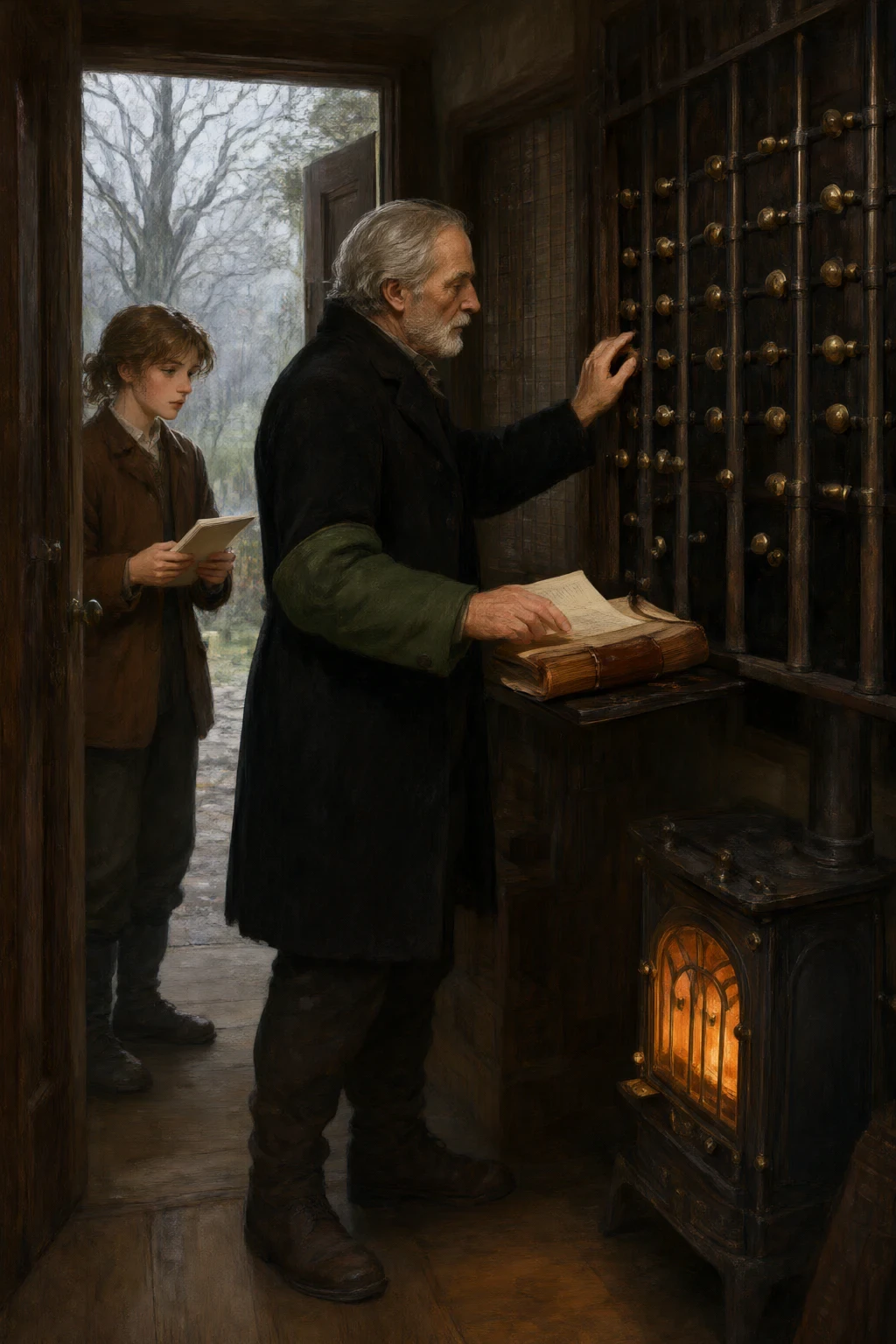
The road from the mill gate to the church is nine hundred yards, and on a Sunday in the second week of February the whole valley walks it in the same order, and the order is not a matter of opinion. Corve Merrick is fourth from the back on the men’s side. He is in the green baize sleeve-half, which he wears on the right arm only, because the left arm is the arm he writes with, and the baize is not for warmth; it is the mill’s colour, and it has been on him at church on Sundays for eleven years, which is the exact length of his mastership, because he is not a vain man and has never worn it for the one before. There is a woman in the third row behind him who has said, more than once, that you can pick the master out from the churchyard end by the arm, and that if he ever wore it on the left it would mean something.
Between the gate and the lych-gate he is given a nickname twice. He is described four times. He is pointed at once, with two fingers, and turned. He does not turn round. He worked out eleven years ago that turning round is how a man agrees to be described. The first nickname comes from a man of about sixty who says Green Sleeve as a joke and then says it again half a minute later, more quietly, the way a man checks that a thing has gone off. The descriptions are the one that touches the iron, the one that keeps the roll, the master of the mill that keeps the roll. The pointing is done by a boy of eleven who has been told to do it, and who does it badly, and who will be talked to about it by somebody. None of it is a word. All of it is a name. And Corve Merrick has known, since 1998, precisely what that is worth.
Ahead of him, ninth from the back on the boys’ side, is Jory Vasc, fifteen, an apprentice, who has been given a nickname of his own since the middle of January. The nickname is Spinner’s Boy. He took it for a joke for the first fortnight, which is the correct amount of time to take a thing for a joke in Nether Combe, and has not been able to put it down since.
They came back down the road in the same order and turned into the mill yard, and the yard filled, and stayed full, in the way a yard does on a Sunday, with nobody working in it. Jory Vasc caught the master at the office door and said, “Then can I ask you something, though? Because you can’t answer a question about the form, can you? You can answer a question about the week, because you know the week. I want to know whether the form is a question first, because if the form is a question then somebody has to ask it, and if it isn’t a question then it’s just four words and I can say four words.” Corve Merrick put his right hand flat on the iron tally-board that stands on its post inside the office door, and left it there.
“That was the week before Michaelmas,” he said, “when the mill first stood idle three days in November and you could hear the river from the churchyard wall.” “That is not an answer.” “No,” Corve said. “It is the week before the answer. I do not know how to give you the answer without the week first, and I have never been able to, and my father could not, and you will find that out about this valley in about four years, if you stay in it, which you will.” “Then say the week and the answer.”
“The week was the week before Michaelmas of 1998, and the answer is that I do not know, and I have not known since about ten past nine this morning, and I would be obliged if you did not go about the yard repeating that I do not know, because a man who says the same thing twice in a morning has said it twice, and a thing said twice in a morning in this valley is a thing that has started.”
Aldis Prowse was in the counting house with a lamp lit at two in the afternoon, which is the only hour the lamp is lit on a Sunday, and which she had decided was the correct hour in which to do it. She was nineteen. She could read the roll. She had read the page for 1971 more times than she would admit, and the burn on the thumb of her right hand had come off the mill’s ledger iron in her first week, and she had kept it, and she turned every page of a bound book with two fingers held flat, as though the book were hot, which it is not, and which she had never told anybody about, and which was not the sort of thing anybody asks about a girl of nineteen who reads.
She went up. Four steps colder at the top, and everybody in the valley knows the number of steps, and the number of steps is the reason a good many sensible people do not go up. The room had a stool in it and a wheel with no drive and a tin. She opened the tin and took out the roll and put it flat on the tin lid and found the column. The column is the fourth. The date is the first. The term is the second. The name is the third. The fourth is the shape of the call. The fifth is the outcome, and the fifth is empty more often than the fourth is, and nobody in the valley will read the third column aloud, and Aldis read the fourth column aloud, in order, from the beginning, because that is the only way she can read anything.
“Eleventh of March, seventeen ninety-one, lent for three nights, shape of the call: I call, and then the name. Fourteenth of June, seventeen ninety-one, lent for one night, shape of the call: I call, and then the name. Second of December, seventeen ninety-one, lent for a year, shape of the call: I call, and then the name —” She went on for a while. There is no way to stop her once she has started, and there has never been a way, and people who want her to stop have learned to leave the room. “And then the eighteenth of March, seventeen ninety-four,” she said, “lent for three nights, and the shape of the call is the same, and this one has the name written in. I call Alis Merrick. And under it, in a different hand, in the fifth column, the outcome column, there is one word, and the word is ANSWERED, and there is nothing else on the page, and I have looked at it for a long time.” “What is in the third column on the ninety-four page?” Jory said. “I am not going to read the third column,” Aldis said, and went on, “and the fourth of April, seventeen ninety-four —”
They did it in the lane, because the lane between the office and the tow shed is forty yards long and level and has a wall on one side for people to stand against, and because by half past three on a Sunday in February a mill yard in Nether Combe will contain a thing like this without anybody having to organise it, which is the great service a mill town does. Jory Vasc stood in the middle of it with his notebook open on his left hand, because he writes on his left hand, and he asked for the form. “Four words,” he said. “I call, and then a name. You could learn it in a morning. Mrs Peck, you did it in the first attempt — tell them what you said.” Mrs Peck said what she said. She was embarrassed for about a second and then she was not, and she said it louder the second time.
Nothing happened. That is the whole of the result. Nothing whatever happened, in the sense that the thing people mean when they use the word nothing, which is a matter of temperature and weight. They did it for ninety minutes. Jory counted forty-one attempts and wrote them in the notebook in columns, and he had a good hand for a column. And then, at about the fifty-minute mark, the forms began to come apart, and Aldis Prowse saw it happen and could not afterwards explain to anybody the exact moment.
It began because people ran out of names. Not out of courage; there was plenty of courage in the lane, there was more courage in the lane on that Sunday than there had been in the lane since 1971. They ran out of names. It turned out that a great many people in Nether Combe could not produce a true name for Corve Merrick on demand, though all of them could produce the sleeve, and that a man who has been the master of a mill for eleven years can be identified in this valley eleven ways and named in none of them. So somebody said, “I call the man with the green sleeve.” And somebody else said, “I call the master of the mill that keeps the roll, at Nether Combe, on the Combe road, who answers to a fortnight on Saturday.”
And a woman of about sixty at the back said, loudly, and to nobody in particular, “I call the spinner. I call him now. I call him to answer for it.” And two or three other people said that at the same time, and there was a silence in the lane of a kind that Corve Merrick had not heard in it before, and the boy with the notebook wrote it all down without understanding a word of it, and afterwards understood all of it and wished he had not.
Jory Vasc asked Nanny Rowe the question on the Monday, in her kitchen, in the afternoon, with the lamp turned down before he had got to the door, which she does, and which is not a thing about light. She was seventy-nine and had been in service at the Combe in 1971 and had been the only person in the house. “I’ve only got one,” he said, “and I’ve been saving it.” “You’ll have had a good week.” “We had a test,” Jory said. “On Sunday. In the lane. Forty-one times. And nothing, not a thing, not even the cold went up. And Mrs Prew said, did you feel anything, and Mrs Prew is a woman who would say yes. And the old ones who were saying it the hardest, they were saying it at each other by the end.” Nanny Rowe turned the lamp down another notch, though it was as far as it went.
“Then you’ve come to the wrong house for that,” she said, “because there is nothing to feel. I have been here fifty-five years and there is nothing to feel and I have made my peace with it and it took most of the time.” “But they did say it. In ninety-four. That’s what I want to know. Did they say it right?”
“They did not,” she said. “That is the answer and I have never said it out loud to anybody, so I am going to say it out loud to you, and you will find that the worst thing about it is that it is boring. In ninety-four they described him. They described him all night. There was a man on the stair with a lamp who could not get a word out of himself, only where a person slept, and what a person drank, and what a person looked like on a Tuesday. And I was the only one in the house, and I was seventeen, and I thought — I am in the present now, I am telling you as though it were this afternoon — I thought if I could only get him right enough, describe him well enough, I should have said the thing, I should have got hold of it. And you cannot. That is all. You cannot get hold of it by being right about a man.
Being right about a man is not the same as the form of the words, and I have had fifty-five years of finding that out, and I have never once been able to give anybody the sentence.” “What sentence?” “If I knew the sentence,” Nanny Rowe said, “I should have said it in ninety-four, and I should not be sitting here.”
The counting house is over the mill office and it is low and it is walled on three sides with ledgers, and there is one window and it faces the yard, and the stove in it is the only fire in the building that anybody has lit since the mill was framed. Corve Merrick lit it at four on the Monday and stood in front of it with the lamp beside him and said the thing he had been saying all day in a smaller voice.
“The shape of the call is a receipt,” he said. “That is what the fourth column is. When you lend a name, the shape of the call is written down at the time of lending, in the hand of the lender, and it is written down so that the lender can prove, afterwards, in front of anybody, exactly what shape they meant. If you lent to me and I said to you one night I should call you Corve Merrick, and the shape of the call in the book said I call Merrick, and then you stood in a lane on a Sunday and said I call the man with the green sleeve, that is not a matter of being nearly right. That is a different form of words. It is like settling a bill in pounds when the account is kept in shillings.” “That is what I have been saying,” Jory said.
“You have been saying something else and I have been letting you,” Corve said, “because you are fifteen and I have not got the Sunday out of my system. The thing you have been saying is that a form of words is a thing a person can get wrong on purpose. It is not. A form of words is a thing a person can only get right or not get at all, and the only hand it can be got right in is the hand that is holding the name. Not the man who wants to be called. Not the man who is owed. The hand that is holding it.” “Then nobody can ever do it on purpose.”
“Nobody in this valley has ever been able to do it on purpose,” Corve said, “and that is not a failure of nerve. It is the design. A man who can only be called by somebody he cannot find is the only safe man in the place, and if you could call him on purpose you would have found him in a week, and there has not been a week like that in two hundred years, and there is not going to be one, and the whole of this valley’s Sundays are for the purpose of making certain there is not.” He touched the edge of the tally-board’s post, and stopped, as he had not done since Monday morning, and looked at the numbers on the board for a while.
“That was the week before Michaelmas,” he said, “in ninety-eight, and I lent a name, and it was not my own, and I have not told anybody that in this room or out of it, and I am telling you because you have written down four words in a notebook this week and somebody in this town is going to use them, and they had better be the four words, and not the sleeve.”
On the Tuesday the boy went to the office before the men came on, and Corve Merrick was at the window with his back to the room, and Jory Vasc said, out loud, in the counting house, in front of the pay board and the ledgers and the merchant’s letters, the four words, with the name in them, and it was very quiet, and nothing whatever happened, and the stove ticked. Corve Merrick did not turn round. He said, “That was the week before Michaelmas,” and then he said nothing else at all, and put his coat on, and went down. Jory Vasc wrote in the notebook, in the columns, in a fair small hand: TUESDAY. 7.40 A.M. COUNTING HOUSE. SAID TO MERRICK. NO EFFECT.
Then, underneath, in a different line, because he had begun, in the last ten minutes, to be the sort of person who writes down the other thing as well: HE DID NOT TURN ROUND EITHER. ELEVEN YEARS AND HE HAS NOT TURNED ROUND AND I HAVE NOW PUT IT IN A BOOK.