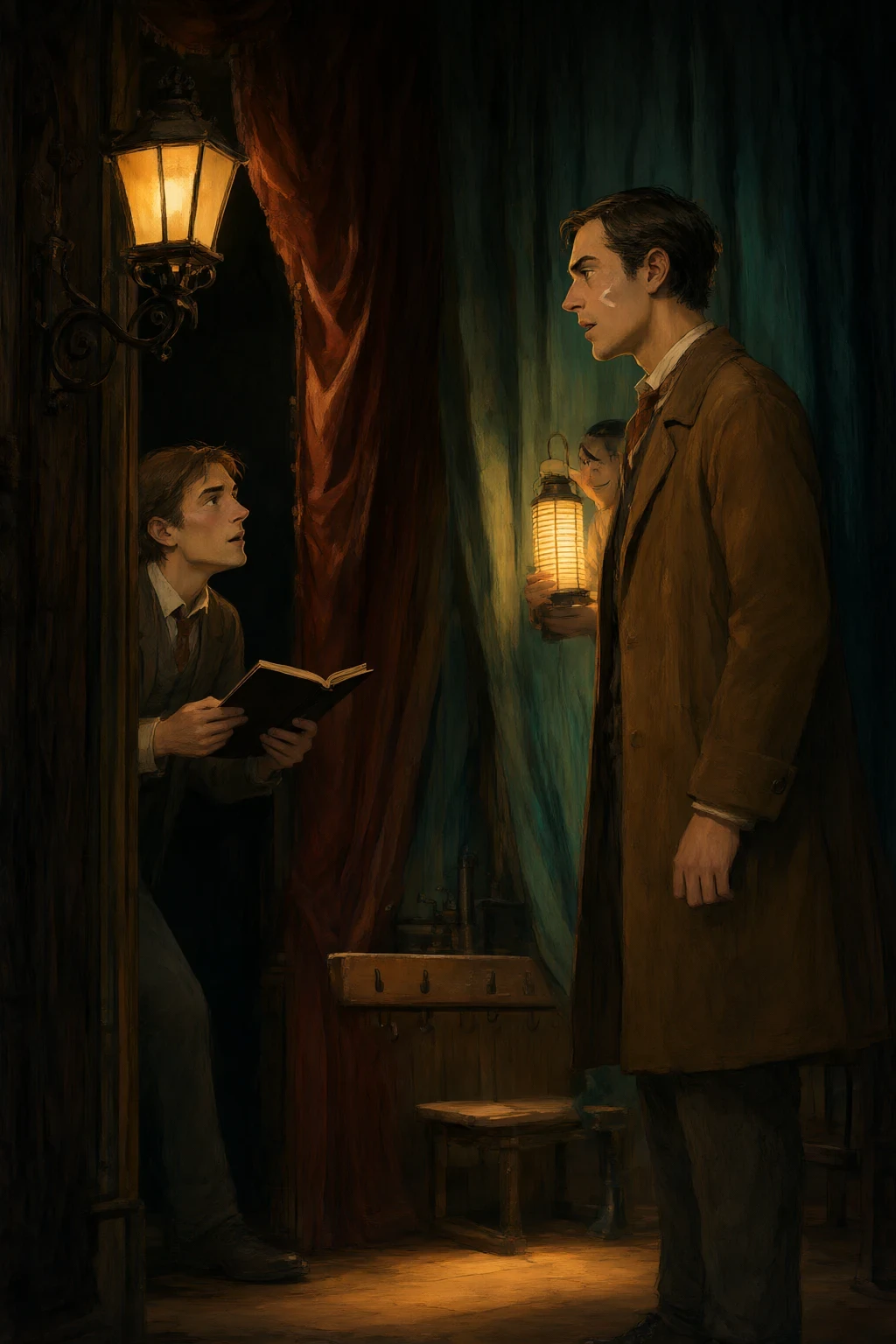
There is one bulb in the prompter's box at the Thistlewire and it is the colour of weak tea, and Corvin Ashby has sat behind it for eleven years with a hard blue bruise-shadow under his right eye that nobody has ever asked about. Asking a man why his face is the colour of a bruise is asking him to be a person, and there is a rule in this building about that, though nobody has ever put it in writing. The Salt Harvest is in its second act. It is eleven minutes past eight. The fourth lamp is amber and the fifth is green, and the cold spill of the footlights lies on the actors’ hands like water over a stone. Corvin has the prompt book open on his knees. It is a thin black notebook, and he has consulted it by feel so often that he could find any page of it in the dark with two fingers.
He does not have to. He checks it anyway. It is the only part of the evening that belongs to him. Forty. He counts them on his knee the way he has counted them every week for eleven years, in the second act, while the man whose name is in gilt on the board over the door is not on the stage and never has been. Forty lines in the book carry no author. They carry one word, in capitals, in his own hand. SUPPLIED. He had assumed, for eleven years, that it was a coincidence of the number. Tonight he looked at the forty and thought: nothing in a working theatre keeps still for eleven years. Faces go. Boots are resoled. A gas mantle goes inside a season. A sentence is the only thing in this building that ought to change, and it never does.
Then he had turned the page back to the top of the list, where he has not looked in eleven years, and he had looked at the S. He copied the word out into the margin, twice, then took out tonight’s call sheet, which he had written himself at four o’clock while Amos Derwent stood at the foot of the lighting-gallery rope being told he could not go up to the top batten. Two hands. The S on the call sheet is a printer’s S, upright, with a small spur at the top of it. The S in the margin is round. Everything else leans the other way. Eleven years ago Corvin Ashby was frightened, and frightened handwriting leans.
The eleventh season had been a January. He remembers the January because the gas had to be kept low and the thermometer in the box office had frozen and the stage manager had handed out broaches to everybody. He remembers the Tuesday because the man who was to go on as the Ferryman sent word at half past six that he could not come, and the corps is a corps, and Corvin had gone on himself and had done it well and had been told so afterwards in a corridor by a man who did not know his name. What he remembers is the eleven seconds. The printed text of The Salt Harvest carries an author’s name on its title page, because the author was Solomon Frend, and Frend had written the play in nine weeks and died in the eleventh, and his executor had set up what there was. Where there was nothing there is a line of dashes. Corvin had to fill a line of dashes.
He had stood at the rail of the prompter’s box with the printed book under his arm and the house full and the Figure standing in the light waiting for a sentence that had never existed, and he had counted. Eleven seconds. Twelve. The theatre does not wait. So he had spoken into the dark of the stage, so that the mouth would move and the house would hear a voice where the voice is thin and coming from the wrong side of the boards: Then let it lie. The river will keep it better than the parish register.
And the house had taken it. And the Figure had said it. And somewhere inside the first month of the season the sentence had stopped being a thing a man had said in a hurry and become part of the play, because a Position is a description, and if a description requires a line then the line belongs to the description, and the theatre accepts the performance as correct, and correctness is not measured by feeling. Nobody had ever gone to look. That was the first of the forty. He knew it was the first because it sits four lines down from the top of the list, and he had not read the top of the list in eleven years.
At the half he came down into the green room with the book open. Six chairs and eight people and a kettle always two minutes off the boil. Nell Tarrant stood in the doorway in her coat with a length of bright red thread knotted round her right wrist. She had knotted it that morning. Nobody had asked her about it and nobody was going to. “I have supplied forty lines in eleven years,” Corvin said. “I want to know which of them matter.” “That is a strange thing to want at a half,” said Ivet Prine, who was eating a grape. “It is a strange thing to have.” Hester Vaile put the kettle down. The steel thimble riveted to her right thumb went with it, catching the gas. “Read them.”
So he read them. Thirty-one of the forty were weather: a door that would not shut, a dog that would not come in, the particular grey of a Tuesday on the far bank. Every one of them had been said into a gap where the printed book had nothing, every one had been good, and Corvin had never once heard the house notice that they were his. “A door that would not shut,” said Ivet. “Somebody actually paid for that line.” “Eight times.” “You are a careful man.” “I am a man with eleven seconds.” Then he came to the nine, and the room went quiet in the particular way a small warm room goes quiet when a man who eats a grape every night has decided to stop chewing. “These are about people,” he said. “These say a fact about somebody who is not on the stage.” He read eight of them. He put his thumb flat on the ninth and kept it there, and read nothing.
Hester Vaile looked at the thumb for a while. “Say it,” she said. “You have read thirty-nine. Thirty-nine was a dog.” “The fortieth is a line about a dead woman.” “Then say the dead woman’s line, Corvin. She will not hear it, and neither will the house, because the house is sitting out there with its hat on.” So he moved his thumb, and read it. It is in the second act, in the play, and the house has heard it four hundred and twelve times a night for eleven years, and the programmes have printed a critic’s sentence about it, because critics in Verrow will write anything if you leave them a whole paragraph. It is the Younger Brother’s. It is the line where the Brother tells his sister that on the morning their mother drowned, a woman saw their mother at Sennet market, at the weigh-house, with her coat over her arm and the rain coming through the roof, and that a woman cannot drown twice.
It is nine words long in the printed programme. It is a lie. It is the best writing in the play, and the house weeps at it, and it is Corvin’s, and he wrote it in eleven seconds on a Tuesday in January with his hands shaking, and he wrote it because Bram Sillet was twenty-nine years old and standing in the light with nothing at all to play, and Corvin had wanted to give the man something. He had wanted to give the man something that would not hurt him. Nobody said anything for a while. Then Nell said, “Twice? Twice. But she is dead, so the second time is not a time, it is a nothing,” which was the whole of Nell Tarrant’s theology and the best thing anybody had said in the room.
After the half he went up to the lobby and put his head through the barred window of the subscription office, which is a small panelled room off the lobby with a cold desk and a brass grille and the Season Book open on it, a quarter-bound volume in teal cloth with a gilt edge, opened every day of the year at the same page. Ilse Karrow was writing. Her right hand was in a black kid-leather glove whose index finger had gone shiny from the pen, and a green lorgnette hung on a black cord at her chest that she did not look through. “Sorry. Chair is mine,” she said, without turning round, to a chair. “Miss Karrow. Corvin Ashby, of the corps. I want a line struck.” She turned round. She was fifty-two, and had one more season, and wanted to reach the end of it without a single unaccounted seat. Everybody knew it. Nobody had ever been kind about it. “A line,” she said.
“Out of the Salt Harvest. Second act. The Younger Brother. There is a sentence in it that is not in the printed text and never was.” “Mister Ashby.” She set the pen down, which was how she signalled that she was taking a thing seriously. “The book does not hold lines. The book holds seats, and wages, and Positions. Your lines are in your own notebook and I could not take a sentence out of it if the building caught fire and I had a pair of shears in my hand.” “It is not true.” “I have no doubt whatever it is not true. Have I ever asked whether a line is true? I sell seats.” “You sell what the board over the door says is on the stage.”
“Yes. I do.” She picked the pen up again. “And if I stopped, on Thursday, and struck a line out of a book, the book would put it back in the same hand it uses for everything, and neither of us could ever say which of us had done it. That is how it is done here. You may not be right and be loud about it. You may be right and be quiet about it. There is no third thing in this office, and I have looked.” Corvin stood at the grille a moment. He had come up here to be refused by a machine, and instead a woman had been reasonable at him, which was worse, because a machine can be argued with and she cannot. “Miss Karrow. If the whole corps refused, would the book take it?” She looked at him for slightly longer than she had been looking at him.
“It is the only thing that takes it,” she said. “All of you. Same house, same night, same season, before the curtain. I have never seen it done and I have read about it in the minutes of the house committee and the committee thought it was a joke.” She went back to her page. “There is a strike against you on Friday, by the way. Whichever way the evening goes. It is not a threat, it is a Friday.” “I did not speak to the house.” “No,” said Ilse Karrow. “You did not.”
The second act began at nine minutes past nine. Corvin went back down the rope-ladder into the black left of the stage, and the air under the boards was the temperature of a scullery, and the drapes smelled of hot dust and old brown velvet, and the crack of amber stage light was twenty metres long and the whole of his world. Bram Sillet went on at the cue, in the good dark, from a door he had not used in nineteen years.
The Younger Brother. A permanent greasepaint tan, and two small strips of flesh-coloured tape on his cheekbones where the paint had been worn away and laid again so many times that the skin underneath gave up. A good coat, brown serge, too well cut for a provincial stage, let out at the left shoulder by somebody who knew what they were doing. He stood in the amber and he waited, and Corvin watched from the dark with his mouth open and the true line ready behind his teeth, and he waited for the Figure to be silent, the way you wait for a room to be silent. It never was. There were four hundred and twelve people in it and they were all still breathing. Corvin said it. Not to the house. To the stage, level, at the volume a man uses when he is telling somebody a fact. “She was not at Sennet market. Nobody saw her. She has not been anywhere since the eleventh.” The stage went on.
That was the thing he would take away from it, and it took him eleven years and forty lines to learn. The stage did not stop. Nobody turned round. The gas hissed once, the way it does when the house is told something, and the Younger Brother went on in the amber light and said his nine words. She was seen at Sennet market. Her coat was on the rail by the weigh-house. A woman cannot drown twice. And the house made the noise it makes, and Corvin stood in the dark with his mouth shut and understood, in the way you understand arithmetic, that he had not been silenced. He had been passed over. The Position simply finished the scene without him, and it did it kindly, and it did it while he was still standing there.
The bench is two metres of bare board in the wings with eight hooks above it and a hot pipe running underneath it, and it is the most uncomfortable place in the Thistlewire and the only one where nobody is performing. Corvin sat down on it. He meant to get up. He had a Position to hold in the fourth act, and the corps is a corps, and somebody spare would be told and would go on, and the book would close, and Friday would come and come and come. He sat down, and the pipe was warm through his coat, and the twenty metres of light in front of him went on without him, and he did not get up.
Two hours went over the top of him. He knew what was happening because he has written it up eleven times for other people: a body that tries to be the person rather than the Position, that speaks a line not in the text. There is no punishment and there is no clause. What happens instead is that nothing happens, and the machinery carries on with the part and leaves the man behind it, and the man is still there. Somebody put a coat over him at some point. He never found out who. He came up out of it at the curtain, with the hot print of the pipe on his thigh and the ache in the small of his back that he usually takes home with him.
On Friday morning he was in the Subscription Office at twenty past ten with his hat in his hands. “There is a strike,” Miss Karrow said, before he had got the sentence out. “It went in at nine. It is not signed by anybody. It does not want signing.” “How much.” “The season. All of it.” She turned the teal book a quarter turn so that he could see the column, and there it was in a clerk’s hand, a line ruled across his wage. “Nobody in this building is angry at you, Mister Ashby. I have not written an angry word and I am not going to. You did not tell the house. If you had told the house I should have had to refuse your seat for the season, and I should have done it, and it would not have helped you one penny.” “So it is the same either way.”
“It is the same either way,” said Ilse Karrow. “That is not a moral. That is just Friday.” He thanked her and went down to the stage door, where the rain came off the Ardle Street gutter in a long sheet, and the gilt board over the door said THE SALT HARVEST and MR E. AVELINE in letters four feet high. He stood under the board a while with his hat in his hands. The Salt Harvest was half past seven. He went in by the stage door and up the plank corridor and down the rope-ladder into the black left of the stage, where the drapes smelled of hot dust and the footlights lay their cold green-teal on nothing at all, and the fourth lamp was amber. Bram Sillet went on at the cue, in the good dark, from a door he had not used in nineteen years.
Corvin opened the prompt book on his knees. He had struck the line out of it, in ink, twice, and on Thursday night the page had been clean where he had left it, and the sentence was there in the fair hand of a book that copies itself. He did not supply anything. He put his hands flat on the open pages and kept them there. And the Younger Brother stood in the amber light and said it anyway. She was seen at Sennet market. Her coat was on the rail by the weigh-house. A woman cannot drown twice.
Corvin listened to a line he had invented being said by a man who had never been told where it came from, and understood, at last, the thing about the count of forty. It had not stayed at forty for eleven years because the theatre is faithful. It had stayed at forty because a sentence, once put into a mouth, goes into the man, and there is no longer any difference between them to be measured against. He took out the thin black notebook, the other one, with no name on the cover and no page anybody has ever asked to see. He turned past the call sheets and the cue numbers and the working hours of eleven years to the last page, where there was room for six lines. He wrote the true one down. She was not at Sennet market. Nobody saw her. She has not been anywhere since the eleventh. Then he shut it, and stayed in the dark, and let the house have the lie again.