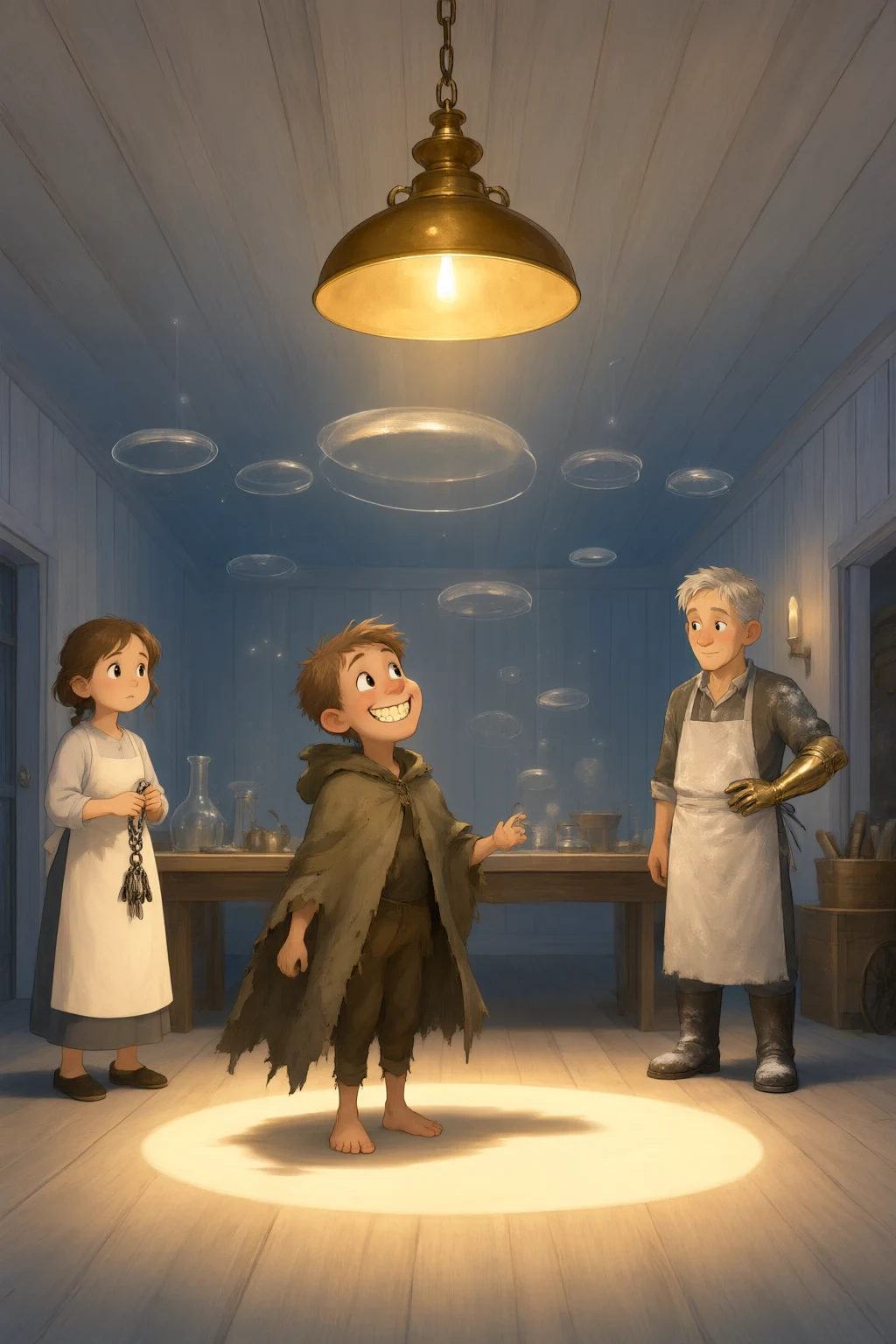
The Ash Garden grew behind the Hall of Telling, in a walled plot, in soil that nobody had ever dug. The plants in it were pale grey, with papery leaves, and they made no proper shadow. In a wind the leaves sounded like a room where people were saying nothing at all. Marrow went there in the morning because it was the only place in the palace that had never once laughed at him.
He sat down in among the leaves with his bare feet and his cloak with two sleeves missing, and he told the garden his best one. It was about a duke, a boat, a ladder, and a goose that was owed a great deal of money. He told it very well. The garden listened the way the ground listens. Then he told it again, to see whether the garden liked it twice.
That was the whole trouble with being the Fool. He was the one person in the Hall that everybody wanted to listen to, and the one person in the Hall that could not earn a thing by it, because a lie mints nothing at all. He put a hand into his cloak and found nothing in the pocket, because there had never been anything in the pocket.
“I have told the one about the duke and the goose one thousand, one hundred and forty times,” he said to the garden. “Nobody has ever paid me a single piece of silver for any of them. I am the loudest man in this palace and I am the only one in it with nothing in his pocket, and that is— well. It is something.” Above him, hanging in the air among the leaves, there were rings. Rounds of dead air a little wider than a coin, and they did not move and they did not go away. He had made some of those himself, and the garden was very forgiving about it. “Tonight,” he said, “I am going to be a teller.”
The Long Table was laid for nine, as it was every night of a winter that had no end to it. “Let me,” said Marrow. “Have you eaten?” said Grist Bellweather, putting down a bowl. “No. Sit. Sit, there is broth.” “Let me tell a story in the Hall,” said Marrow. “A proper one. Out loud, in the light, to all of you. The whole night if it takes all night.”
Cresset Ombre was up at the ring of the lamp with her brass forearm resting on it, and the skin inside her cuff scorched brown, and she did not look pleased. “If you are going to say lies in my Hall,” she said, “Cresset did not agree to it. The flame is not generous. And six silents in one night is a thing Cresset has seen exactly once, and the person who made them is dead.” “I will not say a single lie,” said Marrow. “I will say only true things.” Every man at the table looked at him. “Dukes,” said Marrow. “And boats. And money. True things.”
They got the Hall lit at the ninth hour, and the pale disc of the light came down flat on the plank floor, and Marrow Ollowan walked into it, and everybody else stood at the edge of it in the dark, where they could see him very well. He was not good-looking. He never had been. He had bare feet, and a cloak with two sleeves missing, and far too many yellow teeth, and on the wall behind him his shadow had one finger too many on the end of it, the way it always had.
He told it for a long time. It was magnificent. There was a duke, a cellar, a quantity of salt, a boat that went up the ladder rather than down, and the duke’s own brother dressed as the duke. At the end the goose was satisfied, everybody was invited to the wedding, and none of them deserved it. “Marrow,” said Tallow Merrick, from the dark, “nothing has ever been the beginning of anything.” “First story,” he said.
He told it for a long time. It was magnificent. There was a duke, and a cellar, and a quantity of salt, and a boat that went up the ladder rather than down, and the duke’s own brother dressed as the duke, and at the end the goose was satisfied and everybody was invited to the wedding and none of them deserved it. The brass tray on the deal table sat there being a tray. Nothing fell into it. Not a dull ring. Not a pale one. Nothing at all, because nothing in it was true.
“Second story,” said Marrow. It was better. It had a ship, and a stair, and a woman who was owed a favour by a city. Nothing fell into the tray. “Third story,” said Marrow. And that one had a fox, and a hand, and a very funny business with a doorknob. Nothing fell into the tray, and Marrow laughed, and said, “Fourth story, and this is the good one, and I have been saving it,” and Cresset Ombre said, “Marrow. Cresset can see something.”
She could. Out in the middle of the Hall, over the table, over the tray, in the air itself, there was a round place where the light stopped being light. It was about the width of a coin and it was dead, like a hole cut in the sound. It hung there. It did not fall. “Nobody move,” said Cresset, “because there is a silent in this Hall, and it is one coin across, and it is going to swell.”
They did all six, because he could not stop, and because they were good. He told the one about the duke. He told the one about the ship. He told the one with the fox. He told three more, faster, funnier, with more good lines in them than the whole of the rest of the Court could manage in a year, and the Hall laughed until the stone walls gave the laugh back a half-beat late.
And over the Hall there were six rings of dead air, hanging in the air over the table, and they were not drifting, and they were not still. They were swelling. “Six,” said Tallow Merrick. She was looking up at them, and her voice had gone thin. “Six, dreadful. Six of them, and they are all the size of a bad dinner plate, and they are getting wider.” “The garden will have them,” said Cresset. “The garden grows out of them, one leaf for every one, and it does not mind.” “Can they be paid for?” said Nim Ollowan.
“They can be paid for,” said Cresset, “and only one way. A true story, told out loud in this Hall, with the people in it saying yes. When a silent is paid for, it closes. When it is not, it goes on swelling, and this palace is filling up with dead air at a rate Cresset has measured and does not like.”
Then everybody looked at Marrow. He was still in the light, and the six rings hung over his head, and his shadow on the wall had one finger too many. “The Court does not owe you anything,” said Tallow. “I know,” said Marrow. “A coin for me. That is what I wanted, and now I have six holes in the air instead, and they are mine, and I cannot spend them and I cannot eat them, and that is a coin in somebody else’s pocket.”
“That is what we said,” said Cresset. “Somebody else’s pocket. The only way out is somebody else has to stand up and be asked.” Nobody in the Hall had ever asked anybody anything. Marrow went and asked. He asked Cresset first, at the foot of the lamp, with his bare feet wet with the dew off the stones. “Nine minutes,” he said. “You would not be able to breathe.” “No,” said Cresset. “Your hand would blister.” “No,” said Cresset. “Cresset will not. Do you know why Cresset will not?” “Because you are the Lampwright.”
“Because the true thing about Cresset is the thing Cresset swore not to say out loud, and if Cresset says it in that Hall then the thing is loose, and Cresset cannot have the thing loose. Ask me about the first night. Nobody ever has, and the first night is free.”
He asked the Queen, and she went very still and very pale, and she said, in the beautiful formal voice she used for everything: “A subject of the Court may not coin a story about the sovereign without the sovereign’s express— well. It was something. I will. Ask me and I will say yes, and I shall be frightened, and I shall do it anyway.” He asked Tallow, who said no for an hour, and then said yes, and then asked him to come back in ten minutes because she had changed her mind, and then said yes again.
He asked Grist Bellweather in the mill, and the miller listened to the whole request with his thumbs hooked in his belt. “No,” he said. “Right,” said Marrow. “Not yet,” said Grist. “Go and do the others. I am not going to be hurried into the one true thing I have got, and if you come down here and ask me again in an hour I will still say not yet, and you can come down again after that. Have you eaten? No. Sit. Sit, there is broth.”
And Marrow, who had come to the Upper Gate in the cold on purpose, got a gate guard to come and stand in a palace that the guard had watched for two years and never once been inside of. Her name was Perrin Marsh, and she was in the queue at the arch with an inked thumb and nothing in her hand, because she had come to sell a basket and the basket had gone in the mud. “If it is a true thing,” she said, “and it is mine, and I can say no.”
They did six in one night, and it went on past the small hours, and the Hall lamp burned low and then stopped being low. Ysandre the Long-Waited stood in the disc of light and told them about the morning she was found in a ditch two miles from this gate with no shoes on, and nobody knew where she had come from, and she had not stopped walking for six days. The coin was the best one anybody in the palace had seen in a hundred years. She could not breathe for nine minutes and Cresset held her up.
Cresset told about the first night, and the night she let the lamp down a finger’s width, and how a name had gone off the rolls and could not be put back. Her coin was small and very heavy. Tallow told the true thing about her own counting, and the little girl with the green door, and paid for it in a bad cough that lasted a week.
Nim told a true thing about herself that nobody had guessed at all, and paid for it in nine minutes of not breathing, standing perfectly still, with a strip of unspun silver thread at her wrist. Grist came down at the fourth hour and would not be hurried and told them the truth about nineteen winters of grey bread, and the coin was warm and heavy, and it had a turnip on it. And Perrin Marsh told them about the two years she had stood outside the arch, and the six hundred mornings she had said a true thing to nobody, and the truth that a thing you say to nobody is still true, but it is not yours to spend. Her palm blistered and she did not sit down.
Six coins. Six rings of dead air, one after another, thinning and closing, until the air over the Hall of Telling was ordinary air again, and Cresset Ombre said, “Cresset did not think that would work,” in a voice nobody in the room had heard her use before. Then they asked Marrow, because he had asked first, and asking a man who wanted nothing more than to be asked is a kindness, and the Court had apparently learned that in the last twelve hours.
He told the truth. It was not very much. He said that he was not twenty. He said that he had been twenty when Cresset’s grandmother was a child, and twenty now, and twenty every year between, and that nobody could prove him wrong, including him, and that he could not remember a single face he had not made up, and that the last true thing about him was that he was not going to get better at this.
The tray gave a small flat sound, and there was a coin in it, and it was the palest thing that had ever been in the tray, and it was a husk. It would spend as water. It tasted of chalk. Marrow looked at it for a while. “A husk,” he said. “Nine hundred years of the same true sentence, told to the same empty room, and there it is. Nothing. Not even enough for a crust.” He dropped it in his mouth, the way everybody did, and made a face, and swallowed it anyway. “— and that is a coin in somebody else’s pocket,” he said, and everybody laughed, and it was a kind laugh, and he got the last of it out before it turned into the other kind.
The mill had not turned all night. That was the ruin of it, and it was the miller’s own doing, and he had known it would be before he said yes. The hopper had been empty since the frost. The mill had been running on the good tales he had been grinding up small, and the good tales were gone, and so from the fourth hour onward the stones turned on nothing at all, making a sound like distant surf and no flour whatsoever. Grist Bellweather came up the mill steps in the morning with flour on his eyebrows and no flour in the sacks. “Sit,” he said. “Sit, there is broth.” “There is no broth,” said Nim.
“There is no broth,” said Grist. “There is no flour. There is no barley and there is no rye and there is no oat, and there is no good tale left in this palace to grind, and that is because I stood in a Hall of Telling for five hours and said a true thing out loud, and the whole Court can starve or I can, and I chose.” He would not be hurried about it. He sat down on the step in the flour dust and put his elbows on his knees.
“You lot have been kind to me,” he said, “and kind is not a thing I have got the shelves for. I am going to sit here until somebody brings me something, and it is not going to be broth, and whoever brings it can have the mill for a year. That is my price and I am not moving.” Marrow Ollowan had gone out into the yard an hour before, when nobody was watching, and had taken his own bowl of nothing down off the sideboard and set it on the top step of the mill, in the open, where the first person out of the door would have to step over it. Nobody saw him do it, so it mints nothing.
It was a bowl of cold grey water. But it was in the way, and Grist Bellweather came out and had to step over it, and looked down at it, and looked up at the yard, and there was nobody there. “Sit,” he said to nobody, out loud, in the cold. “Sit, there is broth.” And then, after a moment, in a voice that had given up everything and got it back all at once: “Thank you.”