The painting in the Willow Museum was called The Orchard at Noon. It showed a girl in a yellow dress under a tree, apples glowing red in her hands, and a blue sky that seemed to breathe when the museum doors opened.
Sam wanted to see the whole picture at once. He leaned over the rope, then hopped onto the low display platform to get a better look. The platform shifted under his sneaker. His foot landed on the painting’s lower corner. The canvas folded with a soft tearing sound.
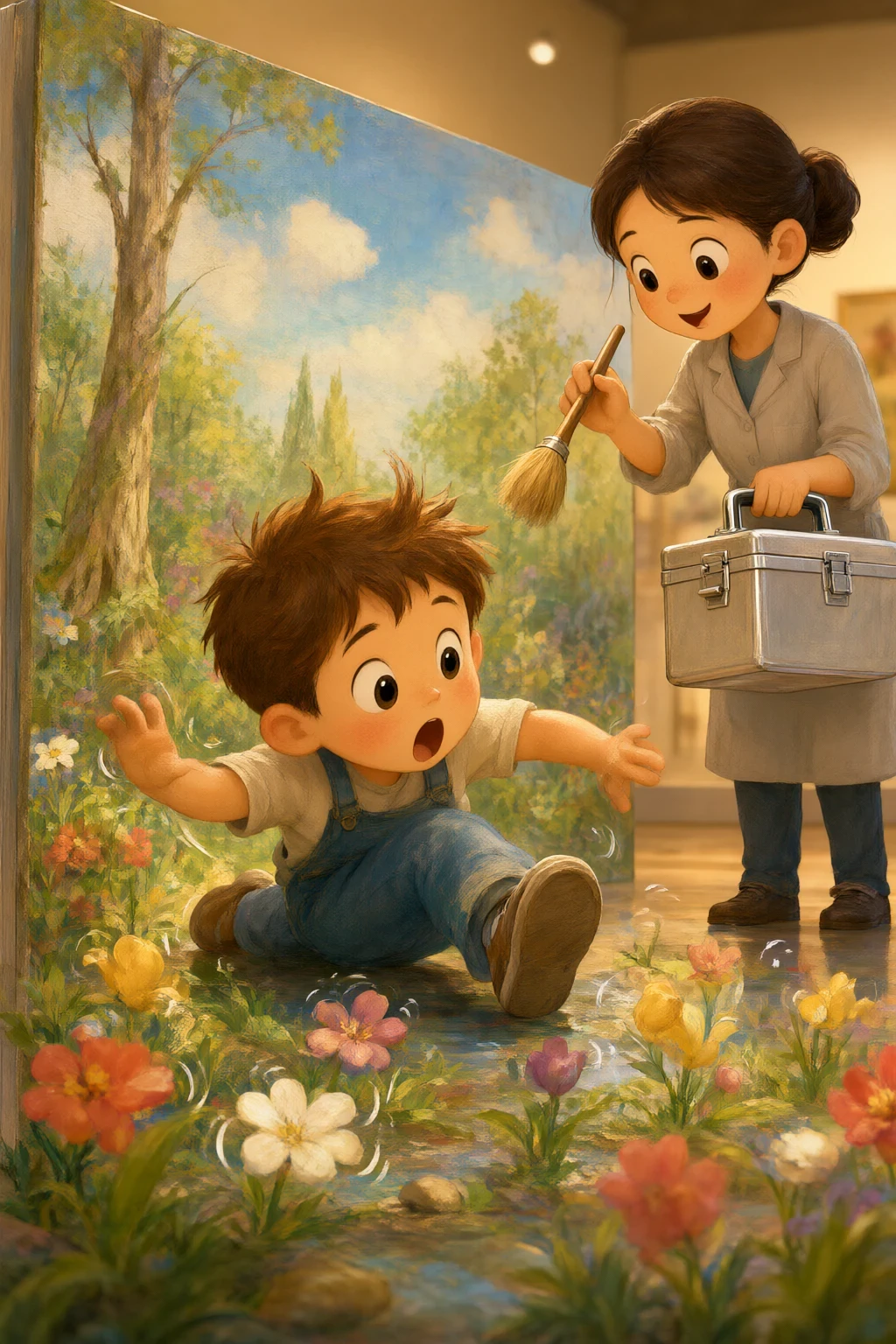
The painted girl turned her head. Apples rolled in her hands. The tree bent its painted branches, and a memory of warm grass rose around Sam’s knees. For one strange second, he was standing in the orchard, hearing bees and a child laughing beyond the leaves.
Then the museum lights snapped back on. A dark crack ran across the yellow paint. Blue dust stuck to Sam’s shoe.
He stumbled off the platform. A museum guide, Nia, hurried toward him. Her badge flashed in the gallery light. Sam looked at the torn corner, then at the guide’s shoes. Nia had stepped near the platform while reaching for a child who had wandered away. It would be easy for everyone to think the guide had caused the damage. Sam slid the blue-dusted shoe behind the display bench.
The painting would not let him forget. Whenever Sam passed the gallery, the orchard memory brushed against him: the crunch of grass, the weight of the apple, Nia’s voice asking who had touched the frame. The painted girl’s eyes followed him.
At home, Sam’s mother found blue dust on his sock. She asked what had happened. He said, “I dropped my water bottle.” The words were not quite a lie. He had carried the bottle into the museum. It had never fallen.
At dinner, he imagined Nia being sent home for damaging a treasure. He imagined the museum’s quiet halls after she left. The thought made his stomach pinch. He could keep the secret for five more minutes. Then he saw the torn corner in his mind, the girl’s face turning toward him.
Sam went to the museum before breakfast. Nia was arranging a rope around the platform. He stood at the gallery door until she saw him. “I stepped on the painting,” he said. “I was standing on the platform. I had blue paint on my shoe. I hid it behind the bench.”
Nia looked as if the floor had moved, but she did not shout. “Thank you for telling me before someone else made a different story.”
A conservator named Ms. Fen arrived with tweezers, white paper, and a small tin of varnish. She explained that the painting could not be made un-damaged, but its surface could be supported. Sam was allowed to carry the tray while she worked. The work was careful and slow.
Each strip of paper went down beside the crack, lifting the torn fibers. Each tiny brushstroke filled only what was missing. Nia stood nearby, answering visitors. “The painting is being cared for,” she told them. “Sam is helping carry the materials.” One visitor frowned. “He damaged it.”
“Yes,” Nia said. “He has told us, and he is helping in the way we have asked.” Sam’s ears burned, but he kept holding the tray. He wanted to hide again when the conservator said the repair would remain visible. Ms. Fen smiled at the dark seam.
“Things that have been hurt can still be cared for,” she said. “The mark is part of the record.”
That afternoon, a small card appeared beside the painting. It explained that a visitor had stepped on the corner, that the damage was being repaired, and that the museum hoped people would walk around displays. Sam read it twice. He did not ask to have his name taken away.
Before closing, the painting’s memory brushed past him once more. This time he saw himself stepping, stepping back, and kneeling beside the platform while Nia listened. The painted girl still held an apple, but the grass beneath her feet had been bent by people caring for something broken. The next day, Ms.
Fen showed Sam how the card would be placed so visitors could read it without crowding the painting. Sam chose a small envelope for the platform tools and wrote the repair date on the outside. Nia checked the label, then asked him to choose where the envelope should rest.
He placed it beside the rope, where a child could see it before stepping up. When a girl asked if the painting still worked, Sam answered, “It remembers. It is being helped.” Nia listened, then added that the memory belonged to everyone who cared for it.
Sam left through the quiet gallery. The repaired corner looked like a thin dark stitch, not a secret.