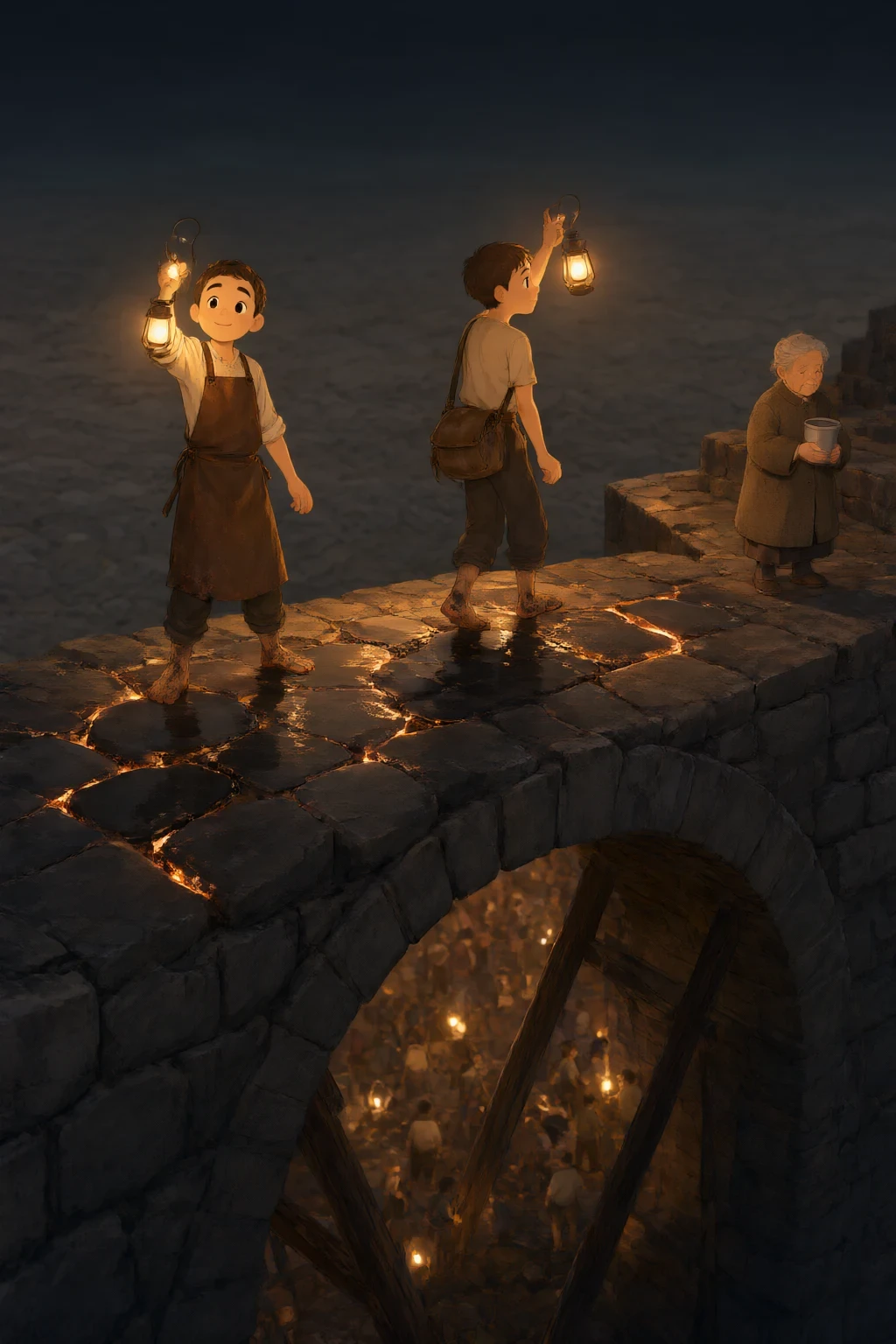
The Chain Causeway ran eleven miles across the floor of the caldera, a raised road of black basalt with bright seams of obsidian glass in the joints that caught the fissures’ light like a line of dark mirrors. In the middle of it there was now a gap, because in the hot month the old span had gone down into the caldera floor all at once, taking four days of courier traffic with it. They were building a new one. Two hundred masons, twelve days, and one oath.
Bram Sedge was thirteen. He had been an apprentice on the Bonding Stair for two years and he had a hooked stroke on the inside of his right wrist, which came up in his sleep sometimes, in the shape it always was: a hook, because it was holding something back. Kel Rusk was running the site. He could not climb, and there was a stair cut into the falsework for him, and he went up it twice a day and looked at the arch and came down and said nothing, which was how Bram knew he was worried.
The arch stood on a forest of black timber that had not been cut, only killed standing, and through the gaps you could see the orange fissures of the caldera floor a long way down. Every joint in it would be sealed with first-fire glass poured hot out of a hopper, and the glass would be warm when it cooled, and warm stone is the only stone that does not crack.
“That is the whole of the trade,” Kel Rusk had said. “You do not build a bridge out of rock. You build it out of heat and you keep the heat in it.” So two hundred masons came to the site on the first morning, and at the north end of the falsework stood a row of flame-boxes on a stone bench, and a keeper came with them, and the oath went into the air over the caldera.
Eleven men swore it. Not two hundred. Eleven, because a great oath costs a season of a life, and nobody in the Caldera’s public works is asked to pay that without saying so out loud first. “We swear this arch will hold every weight that is put over it, and we swear it to protect the road and the people on it, and we swear it to the people who come after us, and we do not come down off this timber until it is cold.”
Each of them got a hooked stroke. Bram watched the marks come up on eleven forearms and thought that eleven was fewer than he had expected for something so big. Ashara Venn kept the book of brands at the site, and she wrote down the eleven names and the shape of every mark as it came up. She could not keep her cuff down, which she never could, and twice Kel Rusk told her out of the light, because a man in a bad hour should not be looked at while it is happening to him.
At noon Sister-Iven Carshal came out from the relay shed and filled the graduated stone cup from the hopper, and read the number out. “Forty-three,” she said. The men wrote it in their books, and everybody got back to work. Dain Callow was the reason Bram learned anything at all. The causeway was shut for the work, so the couriers had to cross the builder’s plank, one at a time, with a hand on a rope. Dain came over it on the second day with a bag of sealed wax, and stopped halfway, because the gap goes straight down into moving orange light and a man can look into that for a while. “You are not to stop on the plank,” said Bram.
“I am not stopping. I am admiring. Nine-Forty plank, and it is only four feet wide, and I have carried the whole chain over it twice.” He got the rest of the way over and sat down on a stone. “What is this place, and why is there no rail?” “It is a bridge that is not finished.” “It is a hole with a rope over it.” They were still arguing when Bram offered him a stone weight, and Dain said he was a courier and could not carry stone, and Bram said the stone would not miss him.
On the third day Dain came back with something in his coat. “Do you know the law about who may be made a keeper?” “No.” “Neither do I, and I have asked at four posts, and the post-masters say it is older than the posts, and one of them wrote it down for me.” He showed Bram a folded paper with four lines on it. “And there is no law. The thing that keeps a man out is a habit, and the habit is four hundred years old and nobody remembers the reason for it.”
“That is a bad way to do things.” “It is the way they do everything in the chain,” said Dain Callow. “If a rule is old enough, it is weather. You do not argue with weather. You get your coat on.” On the fourth day Sister-Iven filled the cup at noon and said, “Forty-one.” She said it the same way she said everything, and the men wrote it in their books, and Bram looked at the two numbers and did not know why they made him feel sick.
On the sixth day Old Fenn came down off the timber with his sleeve pulled over his hand. He was sixty and he had nine brands on him, and nine was the most a man could carry and still be read by a stranger. He stood in front of the flame-boxes and pulled his sleeve back. His marks were blurred. Not black. Soft at the edges, the way a word gets soft when it has been wet and dried and wet again, and the little ember in the middle of each one had gone pale orange instead of red.
“Master Rusk,” he said. “I cannot read my own arms.” Kel Rusk came down the timber stair and looked at them for a long time. “When did it start?” “Four days ago. It came on like a fog.” “Then the boxes have been fed something that is not glass.” He said it flatly, with his thumb on Old Fenn’s wrist, and then he put his hand on the boy’s shoulder. “Take the hopper out of the fire. All of them. And do not let one man light a box again tonight.”
The grey glass had come out of the Emberwastes, and by the sixth afternoon the man who had dug it was standing on the site, which was how Bram learned whose carts they were. Ordwin Sparre stood at the end of the timber with thirty of his cutters, men who had walked three days to get work they were not allowed to swear on, and his black broken mark was the brightest thing on the causeway that day.
“We says the glass is real glass,” he said. “We says we dug it out of the pumice and it burns fair and it is honest, and we says it is a tenth of what your vent costs you. We says you may have as much of it as you can carry.” “Then why does it blur marks?” said Bram. The man looked at the boy a while, and then up at his own black throat.
“Because a promise that is not paid keeps taking,” he said, “and if you feed a flame on something that was never given, the flame goes hungry and it takes the nearest nine. We says we will not leave our glass on a site that has sworn against it. We says take your honest rock and pay us for our walking.” And they went three days back over the grey plain, and Bram thought about it a long time afterward, because the offer had been fair, and it was cheap.
The carts that had been carrying the grey glass had come in over the causeway road from the north, and the wax on them was the chain’s wax, and the seal die on it was a braided chain with a link missing out of the middle, which every seal in the chain has had since the founding. Dain Callow looked at the seal for a long time and then turned the wax over and looked at the number stamped on the back.
“This is Nine-Twenty-Four,” he said. “Nine-Twenty-Four is a relay inside the old chain ring. It is struck out. It was struck out in the year my grandmother was born, and no cart has been licensed off it since, because there is no road on it.” Kel Rusk looked at the wax, and then at the boy, and then he put his hand flat on the cart. “Burn the glass,” he said. “All of it. And write on the board that we lost a day.”
That was the quiet part nobody talked about at meals. The Measure went on falling. Forty-one, then thirty-eight, then thirty-seven, and every noon Sister-Iven filled the cup in front of two hundred men and said the number out, and every noon the numbers got smaller, and every noon somebody said something cheerful about the weather. The flame-boxes could hold a small oath now and a small oath only, and a small oath would not keep an arch warm.
They were one day short of glass, and there was no honest glass for two days’ ride, and Kel Rusk stood on the timber stair with his hands behind his back and looked at a hole he could not fill. Then Bram said the thing that changed the shape of it. “We do not need more glass,” he said. “We need the night.” Kel Rusk turned round. “Say that again.”
“Heat goes out of a thing slowest at night. The arch is warm now from a day of sun. If we pour what glass we have into the last four joints tonight, and we swear the arch over the top of it while it is cooling, then the oath goes into the arch while the arch is at its warmest. It will be eight hours on the timber in the worst of the heat of the day. But it will not crack, because nothing gets colder than the night it is sealed in.”
So they began at dusk on the ninth day, and the arch was sealed and the oath was taken. Six more men swore, so seventeen in all had a hooked stroke between them, and the other hundred and eighty-odd masons stood on the timber with lamps, because a lamp in a hand is a promise too, and a cheap one, and a cheap one is what they could afford.
They stood in shifts of forty. Two hours each, up on the timber in the heat, with the fissures throwing orange light up from below and the sky going black over the rim, and then down into the shelter for two hours, and then up again. Six shifts. All night. Bram stood three of the shifts, and by the end of the night his feet had gone the colour of a bad plum and the hook on his wrist had come up twice under the skin like a coal being poked.
Twice in the night a man came up the timber stair with an offer: there was glass in the wastes, three days ride, and they could be back on the twelfth with enough to pour every joint. Bram said no both times. The second time the man said, “It will still be a bridge.” Bram said, “It will be a bridge with everybody on it standing on a lie.” Nobody sat down. Nobody talked much. The arch ticked as it cooled, the way a bowl ticks when you put hot water in it, and every time it ticked everybody stopped and looked and then everybody went on, because a man who looks at an arch and stops has started something.
At about the fourth hour Dain Callow came out onto the timber with a lamp. He had no business on the timber. Couriers do not go on falsework. He had come over the rope anyway, barefoot, and he walked the length of the arch with his lamp held high, calling the time the way he called a relay. “Two o’clock, and holding. Three o’clock, and holding.” Bram laughed, and then could not stop, and then sat down on a beam with his back against the rail.
“Nine-Twelve is empty,” Dain said, sitting down beside him. “Nine-Twenty-Four is struck out. There is a whole ring of them, and the roads are not there, and the posts are still standing.” “What does that mean?” “It means somebody sent a cart through a road that has not existed since before I was born, with the chain’s own wax on it.” Dain turned the lamp so the light went up under his chin. “And nobody has to be wicked for that to happen. A thing that is old enough stops being a rule and starts being a habit, and a habit has a cart.”
At the sixth hour the arch settled. It was not a crash. It was a sound like a man sitting down in a chair two rooms away, and the whole timber bent, and one of the four ropes at the east end went slack with a sound like a badly played string. Two hundred men went absolutely still on a bridge in the dark, and Bram Sedge put both hands on the rail.
Nobody went forward. Nobody went back. That was the only thing that mattered in the whole of that night, and it was not decided by anybody; it was decided by two hundred tired people deciding, all at the same instant and without speaking, that they would not be the first. After a while the timber straightened. After a while the rope came up tight again by itself, the way a rope does when the thing it is holding stops moving. Nobody ever worked out what that rope had been holding. “Five o’clock,” said Dain Callow, from somewhere in the dark, in a voice that was not working properly. “Six o’clock. And the arch is not moving, and I am going to be insufferable about this for the rest of my life.”
They came down off the timber at full light on the tenth day, and the timber came down after them, one post at a time, and the span stood there in the morning heat with nothing under it but air. Kel Rusk walked it from end to end by himself. He put his hand on the parapet, and on the crown, and he came back and stood in front of Bram. “Seventeen sworn hands, one day’s glass lost, and a night,” he said. “And here it is. Do you know what this means, that it is still here?”
“It means it held.” “It means it is a fixture now,” said Kel Rusk. “Whatever happens to the Measure, whatever number that woman reads out at noon, the arch is standing stone with the oath inside it. The oath will be used up one day, in a hundred years, in a thousand. The bridge will not.” At noon on the twelfth day Sister-Iven Carshal filled the cup on the north end of the finished span, in front of everybody, because that is what you do with a number, and the number was thirty-six. Nobody cheered and nobody said anything at all.
Bram stood at the parapet and watched the courier go out along the new span, into the heat, with the black glass seams of the road throwing the fissures’ light up at him the whole eleven miles. Dain Callow got to the far gate, turned, and put a hand up without breaking stride, the way a courier does, and then he was gone. Bram Sedge looked at the number, and then he looked at the gate, and he did not write it down. Nobody had ever asked him to. But he knew the day somebody would.