The ward book says the clearing under the old oak was burnt on the ninth of May, and that the fire was not a fire any man had made. The line was in the clerk's hand. Vasya, Stepan and Fedya Dubrov had kept the ward's book for three years, because their father Yakov Ilyich was the forester and his hands shook too badly to rule a straight one. Three brothers, one book, one seal, eleven hundred souls who paid their dues in honey, flax and eggs. The entry went on. After midnight a light had been seen in the oak grove on the Smolensk road. A sled had gone out by lamplight. In the clearing they found the body of Yermolai Kvashnikov of Murom, who weighed flour for the bakers of three towns, dead, his purse gone, and his right hand blackened and closed on nothing.
Then the line that closed the matter: the firebird took the purse. Nobody who had lived in Dubrovy that year needed to be told what the firebird was. It came in the last week of every ninth month, and it did not sing so much as burn — that was the word the old women used — it burned along the branches of the old oak, and the ground beneath it took the colour of a stove. The eldest sons of two houses had sworn to take it. One came home with his sleeves singed. The other did not come home. On the eleventh of May the three brothers rode to the district town, because a ward that lets a man be killed and writes the bird did it will not be trusted to weigh anything again.
Murom had stone walls around its market square and a chancery with a bad stove. The voevoda was seventy and did not look up from his paper when the brothers came in. "Dubrovy," he said. "The bird." "Yes, your honour." "The bird is in the book. The book is closed." "It isn't closed. A serf's evidence is not evidence. A bird's is not evidence. So the account of that night is an account of nothing, and in four months the bakers of three towns will send men here to weigh our honey for themselves." The voevoda turned the page over. "Write it again, then. Write it so it holds." On the stair Fedya said, "He wants it shut." "He wants it shut this month," said Vasya. "In April he wanted the sluice money."
They went up the Smolensk road at dusk, in May, when the ground is still soft enough to take a hoof without complaint. The clearing lay a quarter mile inside the grove, and it was not a clearing so much as a scorch: forty feet of black, ringed by grass that had grown up at the edges and not in the middle. Stepan went into it with a cord and a stick. He measured. He measured again. "It's a ring," he said. "It goes round and it doesn't close. If a man had set a fire to this, he'd have started at the trunk. The heat began out here, in the grass, on all sides, at once." "A bird," said Vasya. "A bird doesn't do that. Look at the grass. It's not scorched. It's withdrawn. It went into the earth and stopped, and it stopped in a circle."
Fedya crouched at the edge and put his hand flat on the black. Under the crust the ground was warm, still warm, three weeks later. "Then what's under it?" "Stepan?" "Nothing under it. No root, no hole. The warmth's coming out of the ground itself, like a man breathing in his sleep." Vasya took out the ward book, and his own hands were not steady, and he saw it and closed the book again. "Right," he said. "The bird. But write the ring in. Write the ring, so that if anybody ever asks, we have written what we saw and not only what we were told."
Under the old oak the ground gave, the way ground gives over a cellar. Three roots ran across the opening like the knuckles of a hand, and between them there was a way down, and at the bottom of it a hollow lined with dry grass and last year's leaves. A girl sat in the hollow with a red hen on her knees. She was fifteen or sixteen, in a shift of grey linen, and she did not run. "You're the Dubrov men," she said. "I heard the seal." "Who are you?" "Nastya." "Nastya what?" "That's all of it. Topelko calls me Nastya. My mother called me Anastasia and she's dead, so it's Nastya now."
Fedya looked down into the hole and felt the exact moment his own fear turned into something else, something he did not have a word for and would spend the rest of the year not having. "Who are you," he said, "in the ward book?" "I'm not in it. I've asked. Your father says there's no line for me." There was a hen in the hollow, and a small comb of gold on a string round the girl's neck, and a nest against the wall of the hollow that was not a hen's nest. Fedya saw it and looked away, the way you look away from a doorway you have decided not to enter. Nastya followed his eyes.
"That's where it puts them," she said. "Everything bright. The bridle-bit the Kasyanov girl was given. Two silver coins off the priest's tray. A ring off a man who is still looking for it." She said it without pride, the way you say where the hens lay. "It comes in the ninth month and it takes them and it goes out again. I have asked it where it goes. It sings one note, and that note is up." Vasya said, "Take us to Kvashnikov's purse." "I've never seen his purse," said Nastya. "I've seen a purse. It was round and it was new, and it had three things in it, and two of them were paper."
The mill stood on the Smolensk road where the road met the water, and Topelko had owned it nine years and paid the district on time every year, which was the whole of his politics. He was a heavy man with a soft voice. He fed them. He asked after their father with what was almost affection, and then he said the useful thing, which is that he had known Yermolai Kvashnikov well, and that Yermolai had come to the mill that night with a lantern and a stick, and that Yermolai was a heavy man and the mill floor was of iron. "He was standing over the meal chest," Topelko said. "I heard the noise. I came out. He had a light in his hand and he was swearing at the stones, and I said, God forgive me, I hit him, and I don't remember what after."
"You struck a man and were let off," said Vasya, "because a bird was near." "He was a fool with a lantern. In a mill." "How does a man hold a lantern and die of it?" Topelko looked at him, and for the first time something moved behind his face. "You'll want to see the stone," he said.
The mill's official stone was cut into the wall by the door. Topelko had it lifted out and set it on a sack, and he had it in his own hands. "Eleven nizovki," he said. "The district measure. Come." He weighed a full measure of rye against the district weight and it came out light, by the thickness of a thumbnail. "Forty years this mill has run on that," he said, "and forty years the price of flour in Murom has not moved a kopek, and there is one man in Russia who could tell you why, and he is dead in a burnt clearing in your ward, and the whole of your valley says a bird did it." He set the stone down. "I stole from the bakers. I'll say it plain, because you have the book and I have no reason to waste an hour. But the man had to die before Thursday, and he was going to Thursday."
They rode back down the road in the dark with the stone's number in the ward book, and Fedya rode behind the others and thought about paper. A round purse, new, with three things in it, and two of them were paper. Two leaves of paper. Fedya had handled ten thousand leaves of paper in his life and knew what a page of accounts weighed and what it did to a bag. And he knew — he had learned it setting up their father's copies — that a sheet was not nothing. In Dubrovy a sheet of paper was a day's bread at the mill. "They don't use paper to steal," he said. "They use paper to prove." He'd said it out loud, and the other two pulled up.
"Kvashnikov carried a page that said something about that stone," Fedya said. "And it's gone. And Topelko's man is going to say that whatever they found is a fire." "Or," said Vasya slowly, "or the bird took it. Because the bird takes the bright ones. And if a page with the tsar's stamp on it is the brightest thing in a room—" "Then someone wrote the account so that we'd all agree to stop looking." The three of them stood in the dark on the Smolensk road and listened to the oak grove, which was a black wall, and out of it, at the ninth month, would come the light.
Nastya had been keeping what the bird brought since she was eleven years old, and she had never been able to read a word of it. Fedya went down into the hollow with a candle in a tin, and a charcoal stick, and he sat on the leaves with her while the hen slept. "I'm going to write down what you tell me," he said. "And you'll have to tell me slowly." "I can talk. It's the reading I can't do." "Then we don't need reading." They worked for most of the night. She talked and he wrote, in the careful upright hand their father had taught all three of them, and twice he had to stop and blot and begin a line again.
The girl in the hollow was purchased. Not sold, she said. Purchased, on the sixth of March, in the year before last, from a man who had been the ward's clerk, and the paper that did it had come already folded and already signed, and Topelko had never asked for it and never read it, because a man who reads a serf paper learns things about himself. "Nastya," Fedya said, writing it down, "of Dubrovy, in the valley of the Smolensk oak, bought with a leaf of paper, signed by the ward." She was quiet a moment. "The clerk came himself," she said. "In a good coat. Your father's clerk."
The candle in its tin threw the shadow of the roots up the wall like fingers, and Fedya Dubrov, fifteen years of age, sat under a firebird's nest in a hole in a wood and understood that the three brothers had spent three years copying out a book that did not contain the only crime that had ever happened in their valley.
They took it to the chancery at Murom on a Thursday, which was market day, which was the worst possible day to walk into a district court and the only day on which anyone would be there who had money to weigh flour. The voevoda read Fedya's statement first, and read it twice, which nobody had expected. "Nastya of the oak hollow," he said. "A serf. Under what bond does she speak?" "Under ours," said Vasya. "Our father's hand on the ward bond. The Dubrovy ward is answerable for her, and the Dubrovy ward is answerable for itself." "It was the ward that sold her." "Yes, your honour. That is the fourth page of what we found." The voevoda put the sheets down and was quiet for long enough that the room changed. Then he said, "Kryuk."
The ward's own clerk came in from the outer room. He was forty-one, and thin, and he had served the Dubrovy ward and four others for nineteen years, and he was already saying, before he was asked anything, that he had never heard of the girl, that the hollow under the oak had been a charcoal pit when he was a boy, and that if there was paper in it, the miller was a fool for keeping paper in a charcoal pit. Vasya Dubrov put his hand flat on the table and did not raise his voice. "Take off your coat," he said, "and put down the pen you are holding behind your back, and then read me the fifth line of the ward book for the year before last."
Kryuk's hand did not go behind his back. It went to the table, and stopped there, in the air, the way a man's hand does at the moment he understands that the case has stopped being about a bird. In the courtyard the oak grove put up one long orange flare above the roof, and every head in the room turned, and the clerk said, quite quietly, in the voice of a man making a final correction, "The bird is a witness." Nobody argued. Nobody was in a position to argue. It was the ninth month.
The voevoda ruled that night, in the chancery with the bad stove, and Fedya wrote out the finding while the wax cooled: that Yermolai Kvashnikov had been struck on the mill floor by Topelko on the ninth of May and had died of it; that Topelko's stone had been short by a nail's thickness and he had said so himself; that the ward's book had been altered in the entry for the ninth of May by Kryuk, the ward's clerk; that the ward had sold a girl named Anastasia without her line being struck from it, and that the sale was void; and that Kryuk, having taken a paper from the ward for money, had been the man who put the word bird into the account, so that the account would not be examined.
And the last clause, which the voevoda read twice before he sealed it, because it was not his: that the ward's bird, which took the bright things out of the world, had taken out of the world the one leaf that was going to hang a miller and had put it where nobody who could read would look at it, and that when it did this it had not been stealing, and had not been sent, and had been doing the only thing open to it.
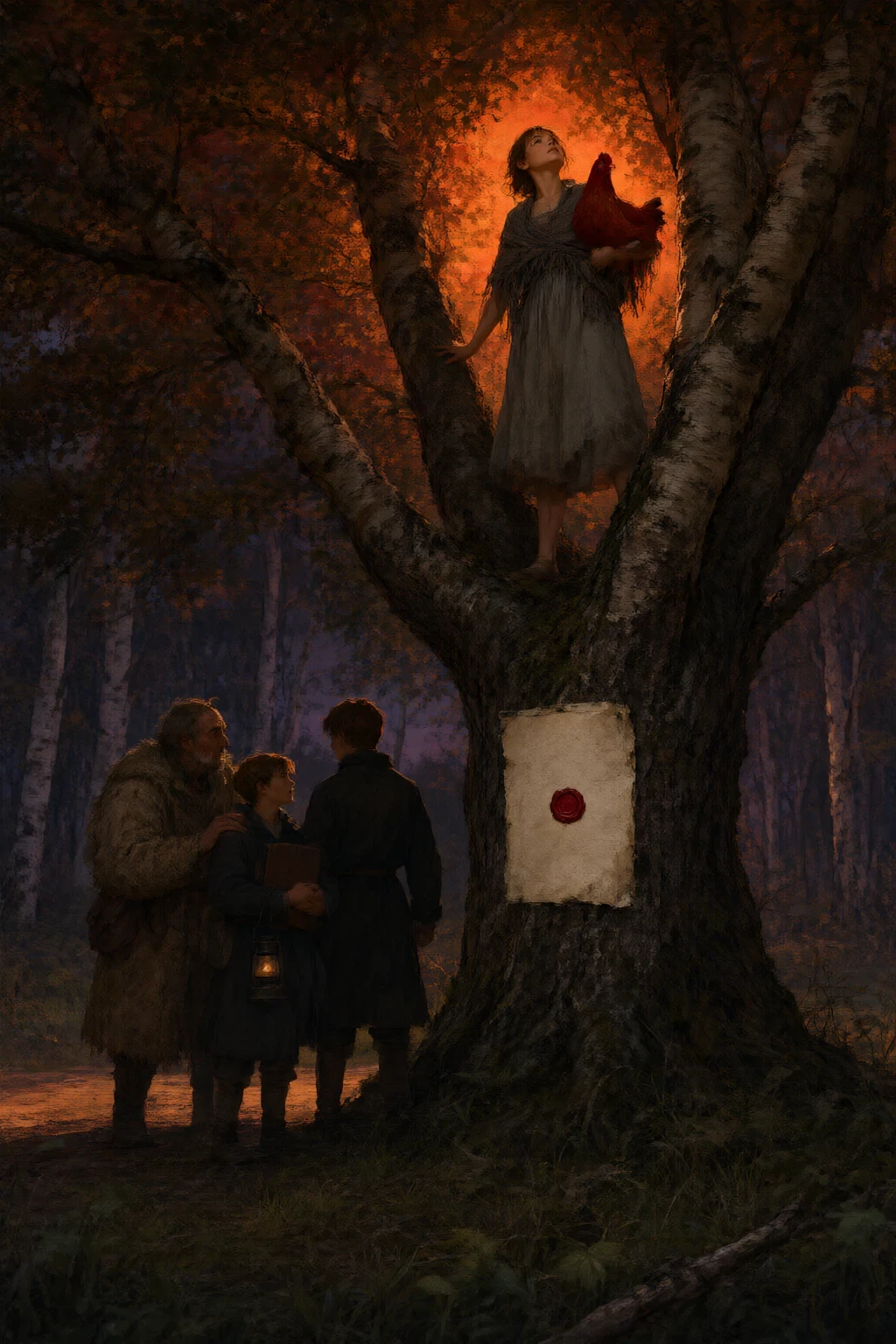
They took the finding back to Dubrovy on a birch sheet, because a finding has to be posted in the ward it concerns, and paper was for the chancery. They cut it on the shelf bark and nailed it to the oak, low down, where a person standing in the yard could read it and a person sitting in a hole could not. Nastya came up out of the hollow for the first time in two years, and Fedya Dubrov read it to her, twice, standing on a root in the last of the light. He read it fast the first time because he was ashamed, and slowly the second time because he had begun to understand that she had asked to hear it. The hen sat on his boot the whole time. At the end she said, "Line eleven." "That's you."
"That is me." She put her hand flat on the birch, the way he had done to the black ground in the clearing. "It says it plain." "It says it plain." The firebird came in the last week of the ninth month, as it did every ninth month, and burned along the branches of the old oak until the whole grove was the colour of a stove, and where the Ward's Finding hung on the trunk the seal had gone soft and run, and stayed. Nastya Dubrova stood in the yard with her chin up and read her own line by heart, out loud, to nobody, because she could do that much.