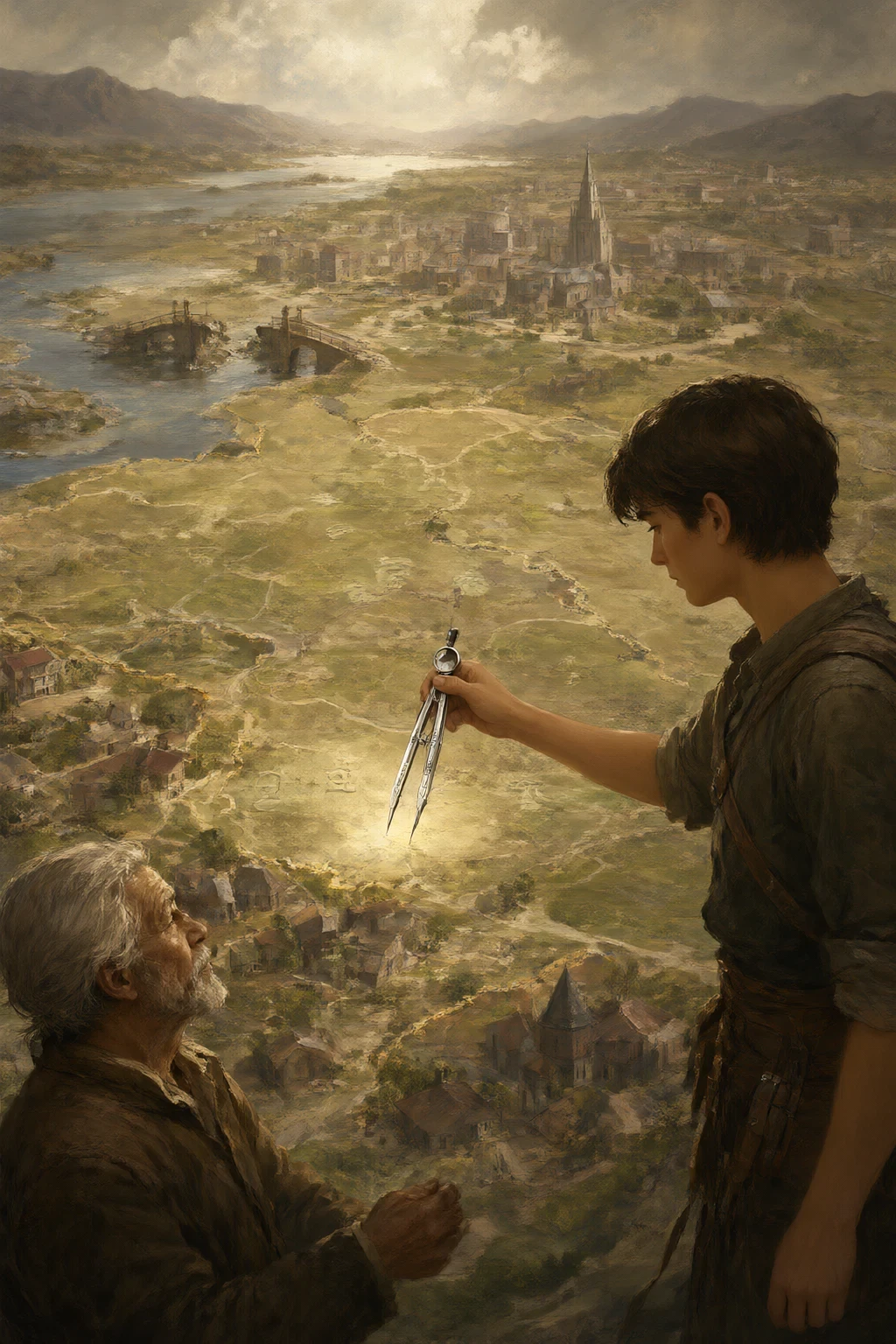
The map in the Cartography Hall had a blank region where the river should bend south. It was not white paper. The parchment was there, the roads were there, and the map’s living ink had drawn a clean gray edge around the empty space as if a city had been carefully removed.
Junia had noticed it during her first week as a junior cartographer. Every night, the blank region grew by a finger-width. On the morning she arrived, the gray edge reached toward the old salt road. By sunset it had swallowed a red line marking a ferry. “No village is missing,” said Chief Cartographer Sorrel, when Junia pointed to the space. “The name was removed from the official register. The map is responding.” “It cannot respond to paper.”
“It responds to names.” The Cartography Hall sat above the tax office, where every road, household, and market stall had a number. Junia’s job was to update the map after storms, new bridges, and changes in the boundaries of the provinces. Her first task was supposed to be simple: redraw a footpath near the western orchard.
Instead, she copied the blank edge onto tracing paper. The shape matched the old village of Nera Vale, which her mother had spoken about only once. “What happened there?” Junia asked. Her supervisor, Ivo, looked at the tracing paper. “Official erasure. Don’t copy the old marks. They cause errors.” “It is still in the map’s memory.” “The map is allowed to forget.” Junia touched the gray boundary. A faint warmth moved under her fingertips, like ink waking. For one second she smelled woodsmoke and heard a child counting steps across a bridge. Then the sensation vanished, leaving a paper smell.
Nera Vale had been removed from the realm’s map sixty years earlier. Junia knew the story from the tax rolls: the settlement had not been an independent village, so its name had been folded into the province of Bell. Its houses were now marked as a military reserve, its orchards as crown timber, and its people as “mobile subjects.” The official change had made the tax claims legal.
It had not moved a single tree, repaired a road, or returned a confiscated bell. Her mother had worked in Nera Vale’s last clinic. She said the village had been removed from every map after a flood dispute, then used that removal to claim its water rights. “The river was there before the paper changed,” she had said. “Paper is powerful, but it is not the ground.”
Junia asked Sorrel why an erasure was allowed. “If a name stays on a map, people expect services. Roads, schools, pensions. The crown cannot pay for every place that remembers itself.” “Some places do not need a service. They need a name.”
That afternoon, Junia found Nera’s old name in the archive. It had been scratched from the master index, but the ink beneath still answered her pencil. She copied the word on a fresh sheet. The living map in the next room shuddered. A line appeared from the blank region, thin as a root. Ivo told her to stop. “Cartography is not restoration,” he said. “Then what is it?” “Accurate description.” “The map is lying.”
“The map is not a child. It does not need comfort.” Junia put the paper away. That night, she went to the map alone. The Hall’s caretaker, a wiry woman named Pell, had left a lamp burning for her. Under the light, Nera Vale appeared in the parchment for a moment: a cluster of roofs, a stone bridge, the names of wells and fields. Then the gray edge returned, swallowing the place again.
Junia placed the copied name on the map. The name glowed silver. A line of streets surfaced, but the houses were tiny and broken. Beside the old road, a symbol appeared for a school with a red cross through it. A market had been replaced by a crown symbol. A cemetery became a row of blank stones. The map was not remembering homes. It was remembering the facts the realm had built over them.
The next morning, Junia took a petition to the tax office. It asked the provincial governor to restore Nera Vale’s name and open a public survey. She expected the governor to dismiss it. Instead, the clerk asked whether she understood what recognition would cost. “The map requires a new sheet,” the clerk said. “The ledger requires a new category. The treasury wants to know who will pay for the school and road people remember.”
“The village paid for them before they were erased.” “By the records, it did not exist.” “That is the record’s problem.” The clerk looked at her as if she had brought a weather report to a fire. Sorrel found her after the hearing. “You have made the map unstable.” “No. I made the blank region visible.”
“Visibility is a change. Changes travel.” He lowered his voice. “The old settlement has claimants. Some families want their land recognized. Some want the compensation the crown withheld. Some want the name left gone because the name will bring taxes. A map cannot hold all of that.” “It can show where the claims are.” “It cannot show who should win.”
She began working at night. She copied the old names into the margins of public maps, then compared them with tax rolls and land records. Nera’s name appeared in a forgotten well survey, a merchant’s ledger, a family letter, and a boundary stone that the road crew used as a lunch mark. Each source offered a different version of the village. The names did not form a single past.
They formed a record of what different people had needed the place to mean. One night the living map drew a person. It was a small figure standing where the school should have been. Junia watched as the ink added a crutch, a basket, and a second figure carrying water. The shapes did not last. A gray wash covered them, and the map’s voice came from nowhere Junia could identify. “Names do not restore what is taken,” it said.
Junia had not known the map could speak. “Then why show anything?” “Because the ground remembers being called something.” The answer was not enough. The next morning, Junia met a woman named Sefu outside the tax office. Sefu had come from Nera Vale and carried a ledger of homes. Her grandmother had been listed as mobile, so the crown had refused to compensate her for a collapsed well. Sefu wanted the name restored. She also wanted the government to pay for a new road.
“My family lost more than a label,” she said. “But a label is where we can begin.” “Begin what?” “Being counted.” Junia asked whether the village wanted to return to its old boundary. Sefu shook her head. “Some do. Some do not. The boundary would give our orchards to the crown and our houses to the town. The old village had a school. It also had a water tax that broke us. We are not asking to go back unchanged.”
Junia carried that answer to the council. She proposed a public map with Nera Vale marked as a disputed living district, not a restored village. Residents could annotate the land with current homes, water access, and claims. The provincial treasury would fund a survey, and people affected by the erasure would decide what to prioritize.
The governor refused to call Nera Vale a village. He agreed to fund a survey, but only if the map continued to treat the land as crown reserve. Junia argued that a survey without public ownership could become another tool of extraction. The governor said she was asking the province to admit fault before anyone had examined the damage.
Sorrel offered a compromise. The official map would show Nera Vale in gray and carry a note that its status was under review. The public version would show the name and the current claims. “The official map serves the realm,” he said. “The public map serves the people who live there.” “Which one is accurate?” “Both, if the reader knows the difference.”
The provincial survey finally began. Surveyors came with bright instruments and a tax assessor. They measured the orchards, the stream, the old bridge, and the foundations under the grass. At first, residents pointed out places the machines missed. Then the assessor marked the orchard as crown property and the stream as a source that could be licensed. The work that had been called a survey began to look like another seizure.
Sefu stopped the crew. “If you count the trees, count the people who tend them,” she said. “If you measure the stream, measure the water we have already lost.” The assessor said the survey was not a negotiation. Sefu replied, “It changes what we can negotiate about.” Junia recorded the protest on the public map. The mark did not protect the orchard. It made the dispute visible, and the assessor asked her to remove it.
She kept the mark but added a note explaining who had requested it and when. The map’s living ink spread the note across the boundary, joining the gray official version to the colored public one. The two maps no longer overlaid cleanly. Nera Vale appeared twice, once as a reserve and once as a place with people in it. The council grew angry. One member said the map was “inciting.” Another said recognition would encourage dozens of forgotten communities to demand their own names. Junia pointed out that they already existed. “You are calling a claim inciting because it has waited too long.”
At the public hearing, Junia presented a stack of documents. She had found the old name, the current residents, the damaged water system, and the families who had paid taxes after the erasure under different names. She did not claim that restoring a label would settle every question. She asked the council to establish an independent commission, prohibit further construction on unverified village land, and create a fund for repairs.
She also asked for the map to show the original erasure date. The governor argued that naming the date would make officials targets. Sefu answered that officials should know their decisions had consequences. The commission was approved, but slowly. Nera Vale received a temporary protection order. No houses were demolished while the survey continued. The first repair was a hand pump for three households; the second was a footbridge over a ditch that had widened after the rain. The orchard remained crown land while the legal claim was heard. The school would not reopen until enrollment, staffing, and a water agreement existed.
Junia drew the pump, the bridge, and the empty field where the school had stood. She labeled the field site of erased school, not school site. The wording mattered. A site could suggest a monument. An erased school was a loss still requiring a decision.
At the end of the year, the commission issued a preliminary finding. The province had unlawfully excluded Nera Vale from services and had used the erasure to justify a water levy. It ordered back taxes, a community water study, and a public apology. It did not restore the old village, return the orchards, or promise that every family would receive a house. Some residents supported the settlement. Others said it paid for the theft with a smaller theft.
Junia attended the meeting where the apology was read. The governor did not look at the map. He said the province had made an error and that the people of Nera Vale had endured harm. The words were true and incomplete. Junia wanted to add the names of the people who had signed the erasure, but the commission had decided that institutional records were enough.
Afterward, she returned to the map and wrote the names in a private notebook. Not on the wall. Not in the public display. In a place where they could be remembered without pretending remembrance repaired the road. The next morning, a new junior cartographer arrived. She pointed to the gray region and asked whether the map had failed. “It remembered being asked to forget,” Junia said. “Can it remember again?” “Not by itself.”
The girl looked toward the public map, where Nera Vale stood in color beside the names of its residents. “Then what do we do?” Junia handed her the survey instruments. “We check the ground, listen to the people, and leave the answer wider than a line.”