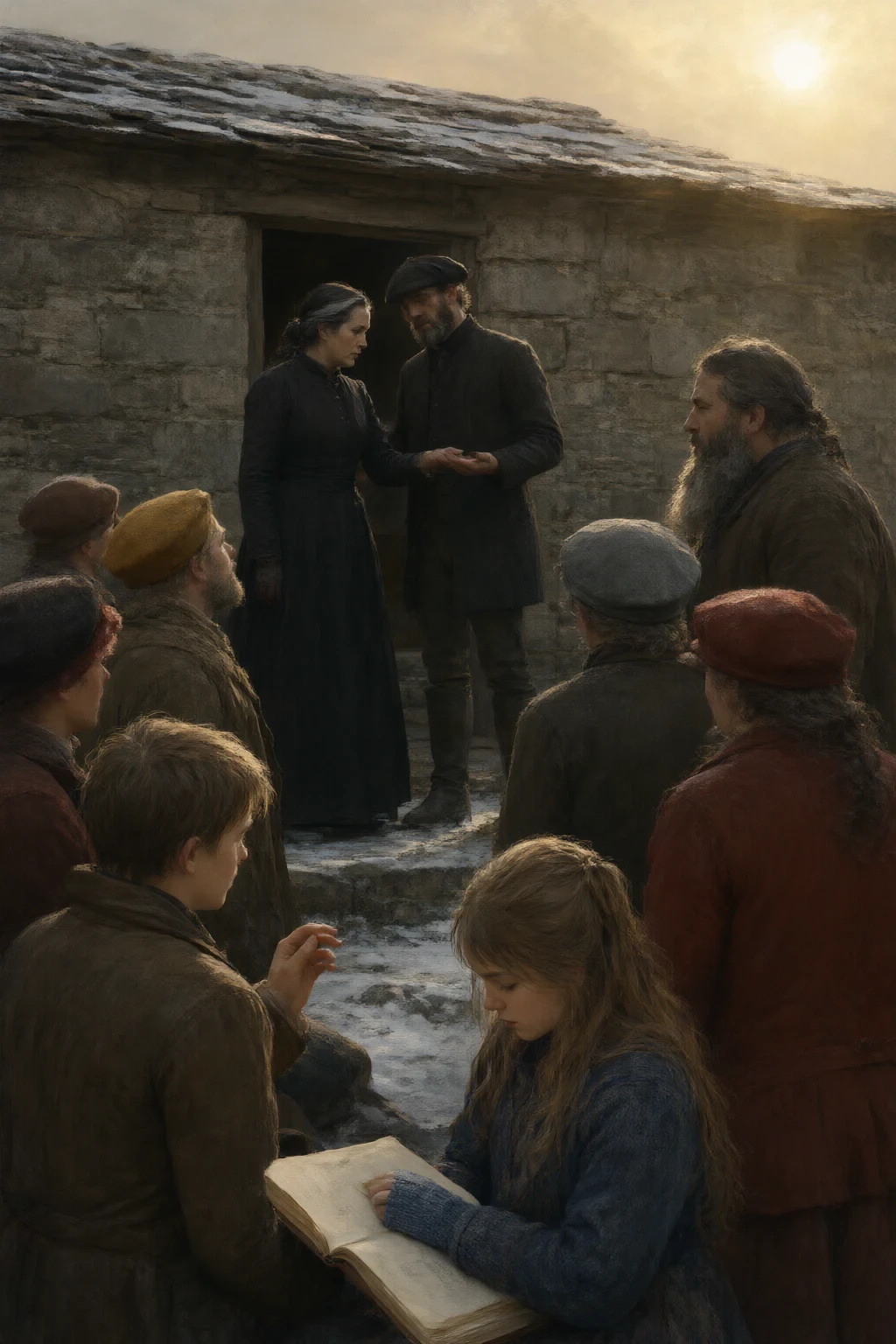
The notice was initialled in four colours and nailed to the slate of the Terrace of the Ninth Step at first light on a Tuesday in the eighth month, and by the time the sun was two hours up there were three hundred people standing on it, which is more than the Terrace had held at once since the market day in the year of the great thaw. The notice said: The Register of this pass will be read complete, in one sitting, terms and all, on four days, and all persons are invited to attend, and no person is required to attend, and no person will be asked to do anything in writing. That last clause had been argued over for two days by four keepers and it was the reason there were three hundred people instead of forty. It was also, in the end, the only part of the notice that turned out to matter. The sun on the Terrace that morning was fierce and the shade was cold, and the hailstones had been lying in the hollows of the Shutter-Stone since four o’clock, in a wide worn arc that went round the flat black square three paces across, and the arc is the shape of six hundred years of people stepping politely aside.
The notice had been four days in the making and it had nearly not happened at all, and the part of it that nearly did not happen was the part everybody obeyed. It began as an idea in the copy-desk, which is the only warm room on the pass and was built before anything else and repaired last, and by the end of the first week four keepers had written a paragraph each and Tovan Rell had written nothing at all and had sat in the corner with the magnifying glass he no longer needs in his left hand and the ledger open in front of him. The first draft asked the pass to come and be told when its vows ended. The second draft asked the pass to come and be told what its vows were. The third draft, which was Ilse Merrow’s and which nobody has seen since, was one sentence long, and Marda Osk read it once, on the stairs, and then read it again because she did not believe the first reading. The fourth draft is the one on the slate: the book will be read complete, in one sitting, terms and all, and no person will be asked to do anything in writing. The notice was initialled in four colours, ochre, undyed grey, madder red, undyed white, one by each of the four keepers who had a hand in it, in the four inks, and it was nailed to the slate at first light with a nail that came out of the Mule Yard retaining wall and had to be driven with a mason's chisel.
Ansel Dun came up the stair on the Monday, alone, with a bundle and a rolled blanket and a crook he had cut in the valley, and he was on the Mule Yard flat at four in the afternoon, which is the last flat piece of ground on the whole pass and is always in the lee of the retaining wall, and which smells of animals. The four pack-mules were in their lines and the last argument before a vow is usually had in that yard, and the argument is usually had by people who have not come up to swear anything, and Ansel Dun listened to two hours of it without saying anything, and slept badly, and got up in the small hours and went up the rest of the stair in the dark by the light of the lamps in the doorways, one lamp at a time, eleven of them, which is the only way anybody has ever seen the whole of the pass at once.
“The lamps are at the doors,” he said afterwards, to nobody, in the third person, in the manner of a person who has not yet heard of anybody else. “He is going to say it, and he is going to say it four times, because a boy who has walked up in the dark and seen the lamps is going to want to say the important thing and is going to want to say it more than once.” He reached the Terrace of the Ninth Step at first light on the Tuesday, three hundred people and a slate with a notice on it, and asked the first person he spoke to, who was a woman selling oatcakes and who was fifty years old and had sworn a vow of labour of thirty-one years, whether he could swear something that morning, and she said the reading begins today, and he said yes, right, yes, and asked whether he could swear on the second day, and she said the reading goes on four days. He asked eleven people before he found somebody who said the word shrine.
They argued about the method in the open, which nobody on this pass had done in living memory, and which took most of the first morning. There were three methods. The Bureau’s method was arithmetic: a term, added to a year, gives a date, and Marda Osk had four hundred accurate entries and a schedule in a leather case and no authority whatsoever, because the Bureau had sent her up the stair to inventory the pass and had not sent her up the stair to convene it. The mountain’s method, as the first three keepers out of the mouth of one of them put it, was to read the book. And reading the book was the whole point, and everybody wanted it, and it did not work, and the reason it did not work was written on the first page of the first volume in a hand nobody had ever explained. The Register records the term of every vow. It does not record the date the term ends. A vow was never supposed to be about the end. It was supposed to be about the thing you said you would do. “So we read the terms,” said a voice from the middle of the crowd. “And we have the terms,” said Ilse Merrow, from the front. “You can read four hundred years of terms aloud by the second afternoon. Terms. What we do not have is an end.” “Then we add.” “You cannot add. I have been a keeper for twenty-two years and I will tell you the thing nobody upstairs will tell you, which is that the year of swearing is not in this book. It is in the head of the bundle, and the heads of the bundles are not kept, and the woman who read them was nine years old and has not been to bed.” Nobody laughed. Het Kalder, who was at the back of the crowd with her left hand inside a knitted blue fingerless glove, looked at the ground.
They tried the third method at two o’clock on the first day, and it is the reason the pass knows what it knows. The third method was the only correct one and nobody had stated it, and it was got out of a keeper by brute force in about an hour, in front of three hundred people, in flat blue shadowless light. A binding can only be broken at a door a keeper opens. That is the whole of the law. There is no petition, no ceremony, no priest, no absolution, and nothing is required of the person except that they walk out. Six hundred years of the pass had been waiting for the mountain to say something, and the mountain had never once said anything, and the only thing that had ever happened to anybody was a door. So: the holder goes in, and speaks the term aloud, and the keeper opens the door, and the holder walks out, and the mountain is asked nothing. Pers Vant was sixty-one and had nineteen years of labour on him at the Fourth Shrine and eleven weeks left of it. He was chosen because he was the safest man on the pass and because he had volunteered. He went into the shrine at the Ninth Step in front of three hundred witnesses and he said, in a voice that carried, “I swore nineteen years of labour at the Fourth Shrine.”
Ilse Merrow opened the door from the inside, and Pers Vant walked out through it, and nothing happened. He stood on the flagstones in the second-light with his hand on the frame and looked at the door, and then he looked at his own arms, and then at Ilse, and everybody on the Terrace of the Ninth Step saw the exact moment when a man of sixty-one understood that he had just sworn it again. “Nineteen years,” he said. “From this afternoon. You have given me nineteen more years and I am seventy before I am sixty-two.” The Terrace was very quiet. There is no sound on this pass at two in the afternoon in the eighth month. There is a sun and a glare and a hundred and forty men and women breathing and a dog somewhere. “It was the correct term,” Ilse Merrow said. “I wrote it correctly. I have always written it correctly.” “Your turn, in a minute,” said Tovan Rell, from the back.
What the pass learned that afternoon, and could not unlearn, is that a shrine room hears everything about the vow and answers it. Not the promise. The subject. A man in a shrine room who says a number with his vow in his mouth has not made a new promise; he has made the old one current, and the body takes the current one, because the body does not read and does not distinguish and does not care whether the man meant to. They spent four hours on the wording. Ilse Merrow would not have anything to do with it for the first three of them, and then Het Kalder came to the front of the crowd and said a thing that stopped the argument dead. “She is going to say the name of the thing that is broken, and it is not a vow to say a name, and it is not in there, and it is not a number, and it will not be heard.” “What is it,” said Ilse Merrow. “She is saying that you can write the term on a slate and put the slate on the sill,” said Het Kalder, “and the mountain reads the room and not the sill, and a slate is not a room.”
By the second evening the pass had arrived at the procedure, and the procedure was one word long, and the whole of the four days was built on it. Nobody speaks inside. That was settled first, and it was settled by Pers Vant’s arms. The witness, and the word, go outside. On the Terrace, in the open air, three paces clear of the worn arc, with the Shutter-Stone between nothing and everything: the holder says their name, and then the holder says the word. Yes. Or not now. And the word is not a promise, because a promise requires a term and the word has neither, and because a terrace is not a room and the Shutter-Stone is not crossed while a vow is being read. And then the holder goes in, and says nothing at all, and the keeper opens the door from the inside, and the holder walks out. The second half of that was the easiest thing anybody on the pass had ever heard.
Ansel Dun spent the first day being refused. He came up the stair on the Monday, which was the day before the notice went on the slate, and asked Ilse Merrow whether he might swear something, and she said the reading begins tomorrow and no vow may be sworn on the Terrace during the reading, and he said yes, right, yes, and asked whether he might swear on the Wednesday, and she said Wednesday. On the Wednesday he came to the front of the Terrace with his hand already out, in the manner of a man who has been rehearsing on a wall in a valley for a month, and Marda Osk read his question back to him before she had finished turning her head, word for word, out of eleven years of habit, and he said yes, and Ilse Merrow said the word before the word was asked for, which is a thing she does. “No,” she said. “Not during.” “Why not during.” “Because on the Thursday we are going to be writing down everything anybody says in the open air, and if a fifteen-year-old boy says a promise out loud in front of three hundred witnesses, it goes in the book, and I have spent four days finding out that the book is not a place for things that are not asked for.”
Ansel Dun put his hand down. He had a burn on his hip from sleeping on the flat in sheep smoke, and his fingernails were split and dirty, and he had never been up the stairs in his life before the Monday, and he was fifteen, and he had come four days to a mountain to be taken seriously by it. “All right,” he said. “What can I do.” “You can run. You can take the word round. If a person says yes, you go to the keeper and you say the name. If a person says not now, you go to the clerk and you say the name. That is the whole of the office. It is a bad office. Take it.” “Yes, right, yes,” said Ansel Dun. They found out about Het Kalder on the second night, and she told, and the telling took nine seconds and she narrated it in the third person the whole way through, standing in the middle of the Terrace by a small flame in a deep stone doorway with a vast luminous sky behind her. “She is going to tell them now,” she said, before she had been asked, “and she is going to say it about herself, and she is not going to cry, and the reason she is not crying is that she decided about it in the cold hours and has been carrying it for four nights and has not slept.” Nobody sent her to bed. The pass does not send the reader away. Tovan Rell was the last man alive who could read the Register’s older hand, and he was sixty-eight, and he read the younger hand slowly, and by the afternoon of the second day he had begun to leave gaps of ten and fifteen seconds between the entries, and to read the same line twice. “Two hundred and forty-one,” he said, on the second afternoon, and stopped, and put his hand flat on the page. “Two hundred and forty-one what,” said Marda Osk.
“Two hundred and forty-one and there are four before it that are not in the number.” He did not look up. “I have missed four. I have been reading this book for forty-one years and I have missed four this afternoon, and they are in the older hand, and I would like somebody to read them for me.” He gave her the page. Het Kalder read them. She was nine, she read them in a whisper, and she was faster than he was. Two hundred and forty-five, said the girl, “and one of the four is written sideways, which means it is a cross-reference and not an entry, and it says look at the bundle, and she is going to have to look at the bundle, and he knows that she knows it.”
The first night the Registrar came over the ridge in one long unbroken push, and the lamps came out along the terrace, and three hundred people stayed, and a great many of them had come to be released and a great many of them had come to watch, and the two groups did not sit in different places. Marda Osk had the ledger-board on her knee and a slate and a stick of chalk, and the office she had invented on the first afternoon was this: every word spoken on the Terrace, in the open, by anybody about any vow, was written down, in the order it was said, with the time, and the position of the speaker, and the names of two witnesses who had heard it. By the lamps she had eighty-one lines. Eighty-one lines and not one release, because the word had not been settled until the second evening, and because a woman called Hessa Rufe had been the first to stand in the arc at seven o’clock and had been asked, in the plainest words anybody could find, whether she wished to be released, and had said, “I have not asked for that.” Fifty-eight years old. Twenty-two years of a vow of fasting that she had sworn at nineteen to get through a famine and had carried ever since, and it had ended four years ago, and she had not told anybody, and she had come up the stair to be asked.
She said it again at half past seven, to Marda Osk, standing at the rail with her hands in her sleeves, and she said it the way people say a thing they have said to themselves every day for four years. “You are asking me a question I have already answered. I answered it the day it ended. I did not announce it. Nobody was standing in the room. I have been free for four years and I have not said so to a living soul, because the saying of it is not the same as the being of it, and I did not want to be a woman who had been released. I wanted to be a woman who had got through it.” “Do you want to be released.” “I am released,” said Hessa Rufe. “I have not asked for that, and I am not going to be asked twice, and you can put in your book that a person came here to be asked a thing she had already finished and did not want it put in ink, and then change the ink back.”
“The term as written is twenty-two years,” Marda Osk said. “It is in the book that way. The book is wrong. You have been carrying it four years longer than the book says you were, and nobody has ever told you, and I have just told you, on a terrace, in the open, in front of nine witnesses, which is the one place on this mountain where a number is not a term.” Hessa Rufe was very still. “Say the other one,” she said. “The true one. Say how long it actually was.” “Twenty-two,” said Marda Osk, “until four years ago this spring, and the month is the third, and the day of the month I do not know and nobody is going to be able to tell me, and there is no door anywhere on this pass for a thing that has already opened, and there was never going to be one, because a term ends by itself, at its own appointed time, with nobody in the room, and that is the only mercy in this system that nobody had to think about.” “Write it down,” said Hessa Rufe. “All of it, including that I did not want it put in ink. I have not had to be a released woman for four years and now I have said so in front of nine people and I would like the record to be honest about what it cost.” Marda Osk wrote it down, word for word, in the open, on the Terrace, at half past seven in the evening of the first day, in a column with no name for itself, and then read it back to her exactly as she had said it, and Hessa Rufe listened to her own life come back out of a clerk’s mouth in the exact order she had put it in, and did not correct a word of it.
The arithmetic of the second day was this. They had read from the current volume backwards and had reached, by the second evening, the year in which the bureau first sent a clerk, and they had read two hundred and forty-five entries, and two hundred and twelve of them had living holders, and one hundred and ninety-six of those holders were on the pass, and one hundred and eighty-eight of them had come to the Terrace. Marda Osk chalked the figures on a slate that had been scrubbed white, in public, because the pass had decided that the arithmetic was going to be public. Eighty-eight said not now. Ninety-one said yes. Nine were not on the Terrace and were not heard from. Ten were in the Reliquary, in bundles, re-cut, and could not be read without a keeper. Ninety-one people wished to be released, and there were eleven keepers, and each door took about six minutes, and in four days a keeper with good hands could open a door perhaps a hundred and eighty times. “On the numbers as they stand,” Marda Osk said, “we finish on the Thursday afternoon with nine to spare, and there are four hundred miles of stair behind the Terrace, and there are two hundred and eleven living vows on this pass that are not in this room, and nobody has any way at all of getting to them.”
The failure at two o’clock on the second day, and the third day’s disaster, and the number, came in that order, and none of them could have been stopped by anybody. On the second afternoon a man of fifty-four named Oldurn Skell stood in the arc and said the word, and said yes, and Ilse Merrow opened the door, and he came out, and sat down on the sill, and would not go home. He had sworn a vow of silence at nineteen, in a temper, over a girl, and it had been thirty-five years, and he had built a life inside it. He was the only man on the pass who could write the water ledgers, because writing is the opposite of speaking and the vow had made a craftsman of him out of a boy who could not shut up, and pilgrims came up four hundred miles to buy a page in his hand, and he had forty years of that, and the door had just taken it. “Take the band off,” he said, to Ilse Merrow. “No. Leave it. Leave it and give me the other one.” The band is a thin ring of hammered iron set on the hand of anybody a keeper has let go of, and it is worn for the rest of the pilgrimage, and it is how the pass knows a thing without being told. Marda Osk wrote: released, 2 o’clock, ninth day of the eighth month, and then she wrote, underneath it, in the same hand, in smaller letters: does not want it. Nobody had a column for that either. She drew one.
Marda Osk read her own page out on the second evening, because somebody asked her to and because by that point on the second day it had become obvious that the pass was going to keep asking people for things they had not brought, and she had the only document in the world that said what a record like this does to a person, and she had written it in a room with a lamp in it and had not known until that moment that it was the most important page she had ever written. She read it standing up, without a slate, from memory, which frightened her, because she had it by heart and had not expected to. “Nothing in this inventory expresses the wishes of any holder,” she said. “It expresses only what was asked. No holder was asked whether they wished to be released, because the form does not ask it. The question is not in the form.” “And the column,” said the clerk from the low country, who had walked up with the mule and was standing at the back with his hat in his hands. “You said on page one that you had drawn one.”
“I drew one. In the margin. It says: does not want it. Underneath the release.” She put her hands flat on the ledger-board. “I have been on this mountain four days and I have watched you do the thing I could not do, which is ask a person in the open air and write down the answer, and I want it entered somewhere that it is on the record that a Bureau clerk was on this Terrace for all four days with a form in her hand that could not hold the answer, and that the answer was taken anyway, by hand, by a woman with an ink-callused finger who is not authorised to take it.” “Entered where,” said Tovan Rell. “In the margin, under the column, in the same hand as the column, with the date.” She looked at the old man. “If I have it right, and I do not, because you are the only person on this mountain who can tell me whether I have it right — and you are the only person on this mountain who will say so — then a thing entered in a margin is still in the book. That is the whole of what a margin is. I would like this to be in the book and I would like it to be the only thing I have ever put in a book that nobody sent me to put there.” He thought about it for as long as it took the lamp to gutter and come back. “It is in the book,” Tovan Rell said. “I will write the date myself, because your hand is going, and because I would like one line in that book in the next forty years to be in mine, and to be a sentence, and not a term.”
On the third day Tovan Rell could not read. It was not a collapse. He came to the Terrace at first light, as he had come for two days, and he read nine entries in the older hand and then he sat down on the step of the Shrine of the Ninth Step with his hands on his knees and said that the entries in front of him were the hands of four men and that three of them were dead, and that he could not tell which of the three it was, and that he would not read a name he could not attribute. The pass did not argue with him about it. Marda Osk asked Het Kalder to read, and the girl read for two hours and a half, in a whisper, with her whole length of plait down her back and her right hand on the page and the other one in the blue glove, and the crowd sat in the flat blue light and listened to a nine-year-old girl do the work of the last man alive who could do it. And at two o’clock they came to the bundle that was re-cut.
The entries for the years around the great thaw are in two hands and then in one, and the one is not a keeper’s hand, and the notches have been shaved and the heads replaced, and a clerk in the thaw year with a good heart and a cold hand and no more than that did it, and the notches went from the top of the stick to the side, and a notch on the side is a year of labour and a notch on the top is a year of binding, and the pass has been counting the labour notches as terms for a hundred and eighty years. “There are four hundred and six sticks in these bundles,” Tovan Rell said, “and the number of years a person has actually been carrying is not the number cut on the stick, and there is no way on earth to tell which is which, and the only way to tell is for the holder to say it out loud.” “Which they are going to do,” said Marda Osk. “Which they are going to do,” said Tovan Rell. “And that is why we are here, and I have been trying to say it since I was thirty-seven years old.”
The morning of the third day the pass found out what it had done to Oldurn Skell, and it found it out at the water. He had kept the water ledgers of the whole pass for nineteen years, in a small square hand, four hundred and sixty leaves of it, and nobody else could do it, and on the third morning the two women who carry water down from the Second Water came up to the Terrace together and stood in front of a slate shelf and asked the clerk what was to be done with the ledgers, because there was a column in them for the depth of the trough in a hard frost and there had been a hard frost, and there was nobody left who knew how to enter it. The clerk was Marda Osk. She wrote down the question exactly as it was put to her, which is her method, and then she wrote: Witnessed, holder absent, and the holder released on the second day, and there it stopped being a good entry and became the first entry in the new column that the pass would have to live with, because the new column was not for vows and it was not for releases. It was for the things that a release took with it.
“He came down at noon,” said one of the two women. “He sat on the trough wall. He has a band on and he will not take it off and he cannot write us the depth of a trough in a frost, and we are not going to ask him to, and we are not going to tell him that he cannot.” They went back down at dusk. Nobody at the Terrace suggested that the release had been a mistake and nobody said the word wrong out loud, but the phrase that went round the south half of the terrace in the next hour, quietly, between people who were not asking each other anything, was the band. Nobody had ever put a band on a man who did not want one. There was no precedent because there had never been an occasion, because the only mercy in the system is a door and the door has never in six hundred years been opened by anybody who was not a keeper, and a keeper does not open a door for a man who has not asked.
Oldurn Skell had asked. That was the difficulty. He had asked in front of three hundred people, in one word, out loud, in the open air, where the Shutter-Stone was not crossed, and the pass had heard him, and had done exactly what he had asked for, and he could not think of a single person to be angry at, and that was worse than anything else that happened in four days, because there is no cure for a thing that was your own idea. He said the number out loud at four o’clock on the third day, in the open, on the Terrace, to three hundred people, because the pass had asked him to and because nobody else on the mountain was going to. He gave it twice. He gave it once for the older hand and once for the newer, and the difference between the two was two hundred and nineteen, and the two hundred and nineteen were all in one direction, and the direction was that the pass had been holding a great many people for longer than anybody had ever believed, and that the Bureau’s schedule of dates was short by between nine months and four years depending on the term, and that there were twenty-three people standing on the Terrace that afternoon whose terms were not the terms in the Bureau’s book, and who had been counting the wrong number in their bones for a decade or more. Nobody applauded. It is not that kind of mountain.
What happened, afterwards, and Het Kalder reported it afterwards in the third person to about forty people, is that the old man stood on the step of the Ninth Step with the lamp behind him and his cuffs stained to the elbow and said that he had been right about the arithmetic in the year of the great thaw, and that he had said so at the time, and that it had been a discourtesy, and that the number had gone out of the use of the world, and that he had never said it aloud again. “You were right,” said Het Kalder, from about nine feet away, with her hands behind her back. That is the whole of the thanks. It took three seconds and nobody on the Terrace of the Ninth Step made anything of it afterwards except that it happened, and that for the rest of the four days people found that they could remember exactly where they had been standing when a nine-year-old told a man he was right.
It snowed on the third night. Not much: a skiff that came sideways out of a clear sky and lay on the terrace in the windless cold and did not melt, because the shade is cold even in the second month of sun, and by the fourth morning there was an inch of it in the arc of the Shutter-Stone and the arc had gone back to being a shape in a stone again. The lamps burned all night. People from the Second Water had walked up in the dark, which is four hours, and stood at the back of the Terrace in the snow without speaking, and Marda Osk had to put a second clerk on the board because there was more to write than one person could hold in her head and her finger had gone the colour of a bad joint four days ago and stayed that way. The eleven keepers opened doors for six hours each and stopped. Not because of the hour. Ilse Merrow’s right hand, which is the hand that has opened doors at the Ninth Step for twenty-two years, was so bad by the second night that she could not close it, and there was nothing anybody could do about that, and so on the fourth morning the Terrace divided itself without anyone ordering it: the north half went on saying words and writing them down, and the south half went quiet, and the quiet half was for the people who had said not now and wanted to stop talking about it. Nobody called the quiet half anything. That was the correct decision and it was made by four hundred people independently, in the space of about a minute, on the fourth morning, in an inch of snow.
Brother Seat came at eleven o’clock on the fourth day, and he had walked up from the Second Water in the night with the others, and he had not slept, and he had a full iron-grey beard that he had grown for the first time in his life, and his left shoulder sat an inch higher than the right, and he had been promised, by a calculation that two clerks had performed on a slate in public, that the ninth year of his labour ended in eleven weeks. He was the reason the four days had happened. Everybody on the Terrace had known it. It was not discussed. “Brother Seat,” said Marda Osk. “Term as written: nine years of labour, sworn at the Second Water, for the repair of the mule yard wall.” Brother Seat looked at the ledger for a while. “Eleven weeks,” he said. “Eleven weeks.” “Not a day out.” He said it without any expression at all, in the voice of a man who has been given the one thing he wanted and is finding out that the having of it is a different thing from the wanting. “I can live inside eleven weeks. I have been living inside eleven weeks for nine years. That is what the beard is for.”
The Terrace waited, because the pass knew what came next, and Marda Osk had the word ready, and Ilse Merrow had her hand on the door, and the whole of the fourth day turned on a man of fifty-two saying one word out loud on a terrace three paces clear of a worn arc. “I will say the word when you ask me,” said Brother Seat, “and you will not ask me until I tell you, and I am going to tell you before the day is out, and I would like it written down now that I intend to say yes and that I have not said it and that I am aware that those are two different statements.” “They are two different statements,” Marda Osk said, and wrote it down, and it was the first line in six hundred years of that book that had been put there at the request of the person it concerned. He did not step into the arc again that day. What he did, at the end, when the Registrar came up at dusk, was finish a sentence that Ilse Merrow had begun, which is what he does, and he finished it wrongly, and she let it stand.
The last entry is not a vow. Marda Osk read it to the Terrace at dusk on the fourth day, standing, because there was no room, and the sky behind her was going the colour of a wet slate and the eleven shrines were all silhouettes against the last of the light, nine going up and two coming down, every one of them with its own weather on it. “Ansel Dun, of the valley under the pass,” she read. “No shrine. No term. Nothing sworn, nothing carried, nothing owing. Recorded at his own asking. He has given his reasons and they were not good reasons and I have let them stand. Witnessed by Marda Osk, registrar’s clerk, who has no authority here, and by Het Kalder, who has no business here, and both of us were glad to.” Three hundred people on a terrace in an inch of snow, at dusk, in the eighth month, at the end of four days in which ninety-one people had been released through eleven doors and two hundred and eighty-eight had said not now or not yet or nothing at all, and in which a book which had recorded nothing but vows for six hundred years had been given, on its last page, in four hands, a column with no name for itself, in which people were entered who were not being released.
Nobody knew what to say, and there was nothing to say, and Ansel Dun stood on the flagstones with his hands at his sides and looked at the column from about four feet away, and could read, because he could always read, and did not say anything about it, which was the single most adult thing that happened in four days. Then he held out his hand. He held it out flat, palm up, the way a man does when he is waiting to be given something, and he held it there in the cold air of that terrace while Ilse Merrow looked at it and understood that there was nothing to release. There was no vow. There was no term. There had never been an entry, and there was nothing in the book against his name but a clerk’s careful line, and the band of hammered iron is only ever set on the hand of somebody the mountain has been holding, and the mountain had never held him at all. So the hand was simply out, in the cold, waiting, in front of three hundred people, and it stayed out for a long time — long enough that somebody at the back of the crowd said a single word, and it was not yes, and it was not not now — and then the lamp behind the door of the Ninth Step guttered, and Het Kalder said, out loud, in the third person, that it was getting dark, and Ansel Dun put his hand down, and went down the stair.